Creative Photo Ideas: 37 Sparks to Break the Same Old Shot

Not a beginner list, not a shooting concept — a dense idea bank of 37 creative sparks covering color, reflection, light, perspective and experimentation. For the moment when all your photos start looking the same.

Creative photo ideas — 37 sparks for color, light, perspective and experimentation
Martin Kleinheinz
Author
Martin Kleinheinz
Photographer · Content Creator · Hannover
Updated
July 19, 2026

You know your camera, the aperture is dialed in, the exposure is right — and yet your last twenty photos look suspiciously similar. That's no longer a technique problem, it's a vision problem. If you're just starting out with a camera, there's Photo Ideas for Beginners with ten detailed subjects. For a planned shoot with a moodboard and concept, there's Photoshoot Ideas. This article is neither of those.

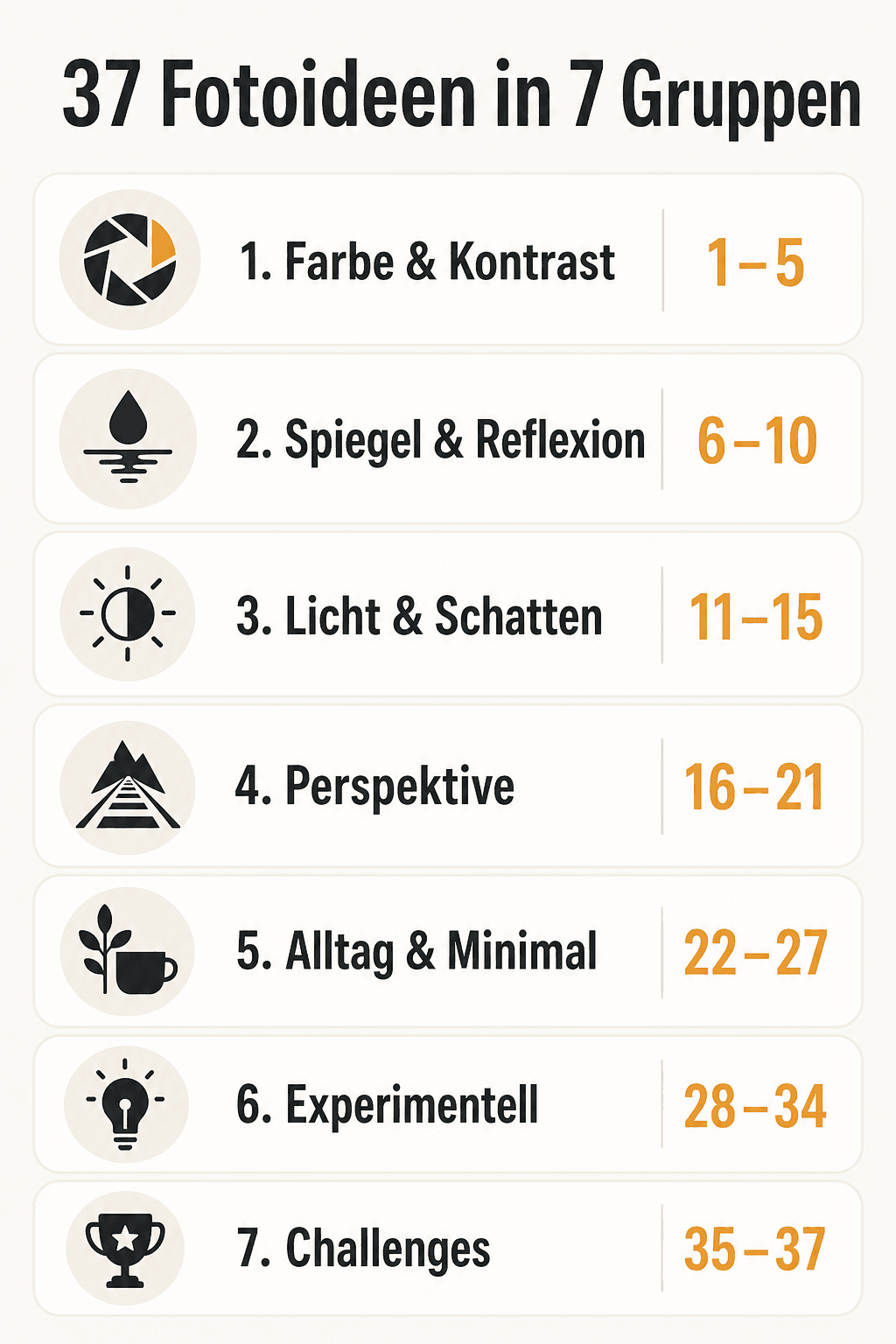
Here you get a dense idea bank: 37 compact sparks, sorted by color, reflection, light, perspective, everyday life and experimentation — each with a concrete "how-to," none longer than a few sentences. Not a subject-matter crash course, but a toolbox for the moment when nothing comes to mind, or when you notice you're always shooting from the same height, in the same light, at the same subject.

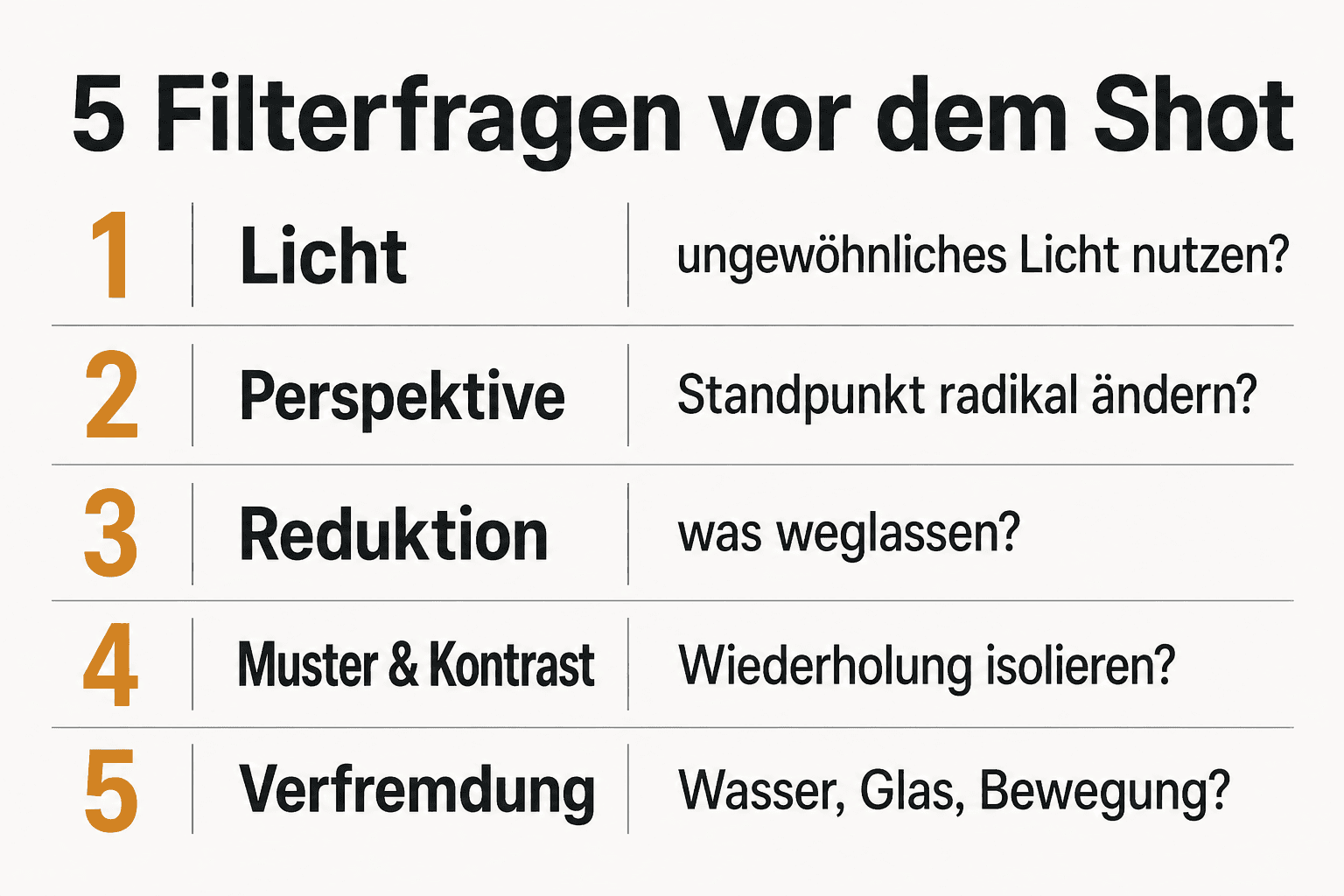
The common thread behind it is a simple creativity filter: five questions you ask yourself before pressing the shutter, instead of hoping for luck. The ideas themselves need no new gear — just a different way of looking at what's already around you. For the fundamentals of composition and light, check out Take Better Photos and Taking Professional Photos alongside this.

00
Straight Talk

What Creative Photo Ideas Really Need

Most creativity guides promise the one trick that changes everything. In workshops and my own shoots, I see something different: it's rarely a new lens that ends a creative slump — it's a small shift in how you look at things. That's exactly what the following filter is for: five questions you run through in seconds before you press the shutter.

1. Light
Is there unusual light right now — hard, colored, directional, filtered through something? If so: build on it instead of ignoring it.
2. Perspective
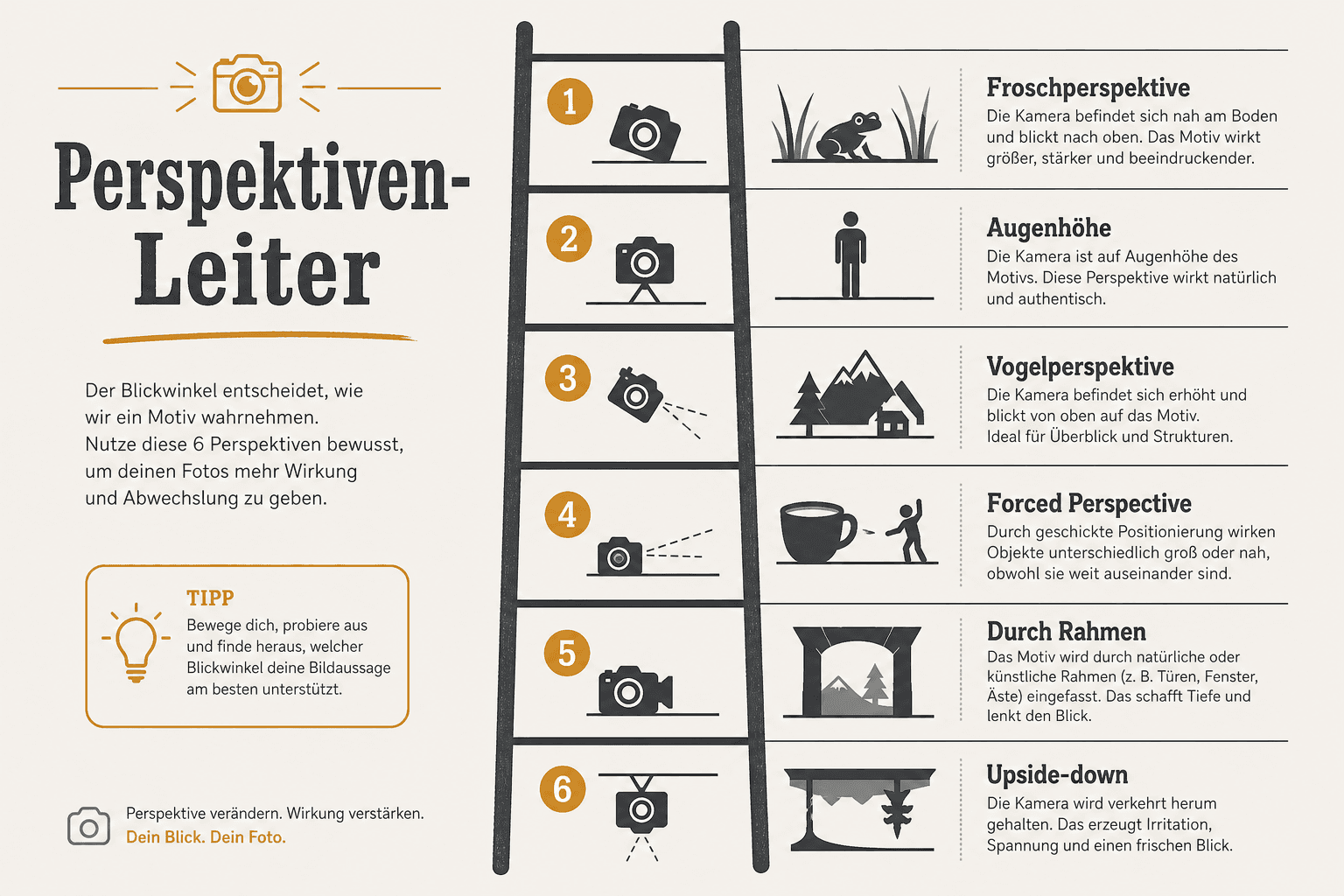
What happens if I radically change my vantage point — ground level, head height plus two meters, through an opening, upside down?
3. Reduction
What can I leave out to emphasize one thing — a color, an object, an area of empty space?
4. Pattern & Contrast
Is there repetition, symmetry or reflection I can isolate, instead of walking past it unnoticed?
5. Distortion
How does the subject change when I introduce an unusual element in between — water, glass, motion, shadow?
Five filter questions for creative photo ideas: light, perspective, reduction, pattern, distortion
The 5-question filter loop — run through it once before every shot, then press the shutter.

These five questions are why the following 37 ideas don't feel like a random list, but like variations on the same principle. Each category mainly serves one of the questions — color and reduction belong together, as do mirrors and pattern. Once you know the categories, you'll soon need the list less and less — the filter starts running automatically.

01
Overview

All 37 Ideas at a Glance

For reference, not for memorizing. Effort Low = doable right away with what you already have, Medium = needs some prep or practice, High = requires a tripod, darkness or several attempts.

IdeaCategoryEffort
1. Dominate with One Color (Negative Space)Color & ContrastLow
2. Color-Contrast FlatlayColor & ContrastLow
3. Monochrome DayColor & ContrastLow
4. Deliberate Complementary ColorsColor & ContrastMedium
5. High-Key with Colored ShadowsColor & ContrastMedium
6. Mirror Composition: Subject + ReflectionMirrors & ReflectionLow
7. Invisible Self-Portrait in the MirrorMirrors & ReflectionLow
8. Puddle Reflection (Flipped)Mirrors & ReflectionMedium
9. Abstract Reflection with BokehMirrors & ReflectionMedium
10. Silhouette Behind Frosted Glass/CurtainMirrors & ReflectionMedium
11. Isolate Hard Shadows as ShapesLight & ShadowLow
12. Silhouette Shadow from AboveLight & ShadowLow
13. Shadow + Prop IllusionLight & ShadowMedium
14. Midday Still LifeLight & ShadowLow
15. Blinds/Grid Light StripesLight & ShadowLow
16. Forced PerspectivePerspective & AngleMedium
17. Low-Angle Shot (Frog's-Eye View)Perspective & AngleLow
18. Bird's-Eye View / Looking UpPerspective & AngleLow
19. Upside-DownPerspective & AngleMedium
20. Shoot Through a Frame/OpeningPerspective & AngleLow
21. Deliberate Dutch Angle (Tilted Frame)Perspective & AngleLow
22. Just One HandEveryday & MinimalLow
23. Extreme Minimalism: One ObjectEveryday & MinimalLow
24. Everyday Object as MetaphorEveryday & MinimalMedium
25. Food Flatlay with RulesEveryday & MinimalLow
26. Arrange Fruit/Objects DeconstructedEveryday & MinimalLow
27. Make the Ordinary Extraordinary (Macro Detail)Everyday & MinimalLow
28. Double ExposureExperimentalMedium
29. Light PaintingExperimentalHigh
30. Tiny WorldsExperimentalLow
31. Portrait with Water/Droplets/MistExperimentalMedium
32. Light Projection on Face/WallExperimentalHigh
33. Prism/Glass Refraction in Front of the LensExperimentalMedium
34. Deliberate Panning ShotExperimentalMedium
35. 24-Hour One-Location ChallengeChallenge & SeriesHigh
36. Ask the 5 Filter Questions Before Every ShotChallenge & SeriesLow
37. Series: 5 Variations Instead of One FrameChallenge & SeriesMedium

37 creative photo ideas — category and effort at a glance

02
1–5

Color & Contrast

Color is the fastest lever for a photo that instantly looks different from your last one — no new location, no new lens required. These five ideas work with reduction and contrast instead of variety.

1. Dominate with One Color (Negative Space)
Find a surface in a single color — a colorful wall, a field, an awning — and place your subject small at the edge. Most of the frame stays empty and monochrome, and the eye automatically travels to the small point of contrast. Position the subject using the rule of thirds or the golden ratio, not dead center.
2. Color-Contrast Flatlay
Choose two or three objects in bold, contrasting colors — orange and turquoise, for example — and arrange them from above on a neutral surface. The contrast carries the image, so the composition can stay simple. Use f/5.6–f/8 so everything on that plane stays sharp.
3. Monochrome Day
Take an afternoon and photograph only things in a single color — today only yellow, tomorrow only red. Your usual subject filter falls away, and you look more closely than usual. By the end you'll have a series that holds together purely through its color constraint.
4. Deliberate Complementary Colors
Deliberately combine colors that sit opposite each other on the color wheel: blue/orange, red/green, violet/yellow. For portraits, a colored sweater in front of a matching background is often enough. The effect immediately looks more intentional than a random color mix.
5. High-Key with Colored Shadows
Place a translucent object — a glass bottle, a lemon slice, a colored drinking glass — in front of a white surface and light it from the side with hard light (sun, flashlight, flash). The colored shadow on the white surface becomes the actual subject. Expose for the background and overexpose it slightly so it stays truly bright white.
03
6–10

Mirrors & Reflection

Reflections give you two perspectives of the same scene in one frame — which almost automatically adds depth. Five variations, from the classic mirror to abstract bokeh reflections.

6. Mirror Composition: Subject + Reflection
Position your subject so the mirror and the original are both in frame at once — a bathroom mirror, a shop window, sunglasses. Watch the mirror's edge; it shouldn't accidentally cut off anything important.
7. Invisible Self-Portrait in the Mirror
Photograph yourself without being directly visible — just the camera in the mirror, a shadow on the floor, your hands on the shutter. The mystery comes from what's missing, not from what's shown. Works with a smartphone's self-timer too.
8. Puddle Reflection, Flipped
Unlike the classic beginner subject from Photo Ideas, this one is about post-processing: shoot with the camera just above a puddle, then rotate the image 180° so the reflection reads as reality and vice versa. A pedestrian in the original creates a break that makes people look twice.
9. Abstract Reflection with Bokeh
Find curved, shiny surfaces — a Christmas ornament, a spoon, mirrored sunglasses — and shoot them very close with a wide-open aperture. The reflection distorts the surroundings into abstract shapes while everything else blurs into bokeh. Use manual focus; autofocus struggles with strongly curved surfaces.
10. Silhouette Behind Frosted Glass/Curtain
Place a person behind a translucent but non-transparent surface — a shower curtain, frosted glass, a thin bedsheet — and light them from the other side. The outline stays visible while details disappear completely. The harder the backlight, the clearer the silhouette.
04
11–15

Light & Shadow

Hard light is usually treated as a mistake to avoid. For these five ideas, it's the prerequisite — shadow turns from a byproduct into the actual subject.

11. Isolate Hard Shadows as Shapes
With low sun or a single lamp, almost any object casts a long, sharply defined shadow. Get close enough that only the shadow's shape remains in frame — the original object can even fall outside the edge.
12. Silhouette Shadow from Above
Hold the camera directly above a person or object while low sun or a lamp comes in from the side — the shadow falls next to the subject, and the two together form a silhouette-style composition. Works especially well on light asphalt or sand.
13. Shadow + Prop Illusion
Combine a real object with a shadow that seems to belong to something else — a hand casting the shadow of a bird, a glass whose shadow looks like a different vessel. Takes a few tries with the light source's position, but it's worth it for an image people look at twice.
14. Midday Still Life
The dreaded midday sun is excellent for graphic still lifes with hard cast shadows. One object, a bright surface, f/8–f/11 — the harsh contrast becomes a deliberate stylistic tool instead of a problem.
15. Blinds/Grid Light Stripes
Let light fall through blinds, a grid or a slatted curtain, and position a person or wall directly in the stripe pattern. For deeper, controlled facial shadows, Black Background for Photos is the next step if you want to take this principle further in the studio.
05
16–21

Perspective & Angle

Most photos are taken at eye level, standing, straight ahead. These six ideas break exactly that habit — often just a few centimeters of vantage-point change is enough for a completely different image.

16. Forced Perspective
Use the size difference between near and far objects to create illusions — a hand that appears to lift a tower, a foot that seems to crush a car. Keep the camera and foreground object close together and the background object far away; tiny shifts of a few centimeters drastically change the illusion.
17. Low-Angle Shot
Camera at ground level, shooting upward or at a slight angle — people look taller, buildings more monumental, ordinary scenes more dramatic. A wide-angle lens amplifies the effect. A flip screen or self-timer saves you from kneeling with your eye glued to the viewfinder.
18. Bird's-Eye View / Looking Up
Shoot straight down from above — from a balcony, a staircase, outstretched arms — and treat the scene like a flatlay, just outdoors and bigger: groups of people, street patterns, a set table in the garden. Pattern and symmetry read more strongly from this angle than from the side.
19. Upside-Down
Shoot up through a glass pane or puddle from below, or rotate an existing image 180° afterward. Trees that appear to grow out of the sky, or people who seem to float upside down — the distortion comes purely from flipping expectation on its head.
20. Shoot Through a Frame/Opening
Use windows, archways, gaps in branches or a keyhole as a natural frame around your subject. A wide-open aperture (f/2.8–f/4) keeps the foreground frame slightly soft and inevitably draws the eye to the sharp center.
21. Deliberate Dutch Angle
Deliberately tilt the camera 10–20° to the side instead of keeping the horizon level — for motion or urban scenes, this creates a restlessness that fits the subject. Important: commit to the tilt, don't just tip it slightly by accident, or it reads as a mistake instead of a decision.
Six unusual camera perspectives compared: low-angle shot, bird's-eye view, forced perspective, framing, upside-down, Dutch angle
Six perspectives, one subject — the vantage point alone changes how the image reads.
06
22–27

Everyday, Minimal & Flatlay

No trip required. These six ideas happen at home, at the kitchen table or on your own desk — reduction and closeness instead of a new location.

22. Just One Hand
The hand alone — wrinkles, veins, edges of light, a ring, a gesture — provides enough texture for an entire image without showing a face or body. Side light emphasizes skin texture more strongly than frontal light. For hand poses in a portrait context, Portrait Posing is worth a look too.
23. Extreme Minimalism: One Object
A single object, with at least 70% of the frame left empty. The emptiness isn't missing content — it's the actual design tool, forcing the eye to the one detail that remains.
24. Everyday Object as Metaphor
Pick a mundane object and photograph it so it reminds you of something else — a slice of onion like a sunset, a tangle of cables like a brain. The appeal comes from the association in the viewer's head. Choose your crop so the original context disappears.
25. Food Flatlay with Rules
Three fixed rules deliver better results instantly than leaving it to chance: a neutral surface (wood, marble, linen), daylight from the side instead of overhead lighting, and spacing between elements instead of crowding them together. Camera straight down from above, f/5.6–f/8 for edge-to-edge sharpness.
26. Arrange Fruit/Objects Deconstructed
Cut open fruit or objects and arrange whole and sliced pieces side by side — the inner structure provides texture that stays hidden in the whole object. Works especially well with citrus fruit, pomegranate or an egg backlit.
27. Make the Ordinary Extraordinary
Get so close to everyday objects that their function becomes unrecognizable — a zipper, woven fabric, a keyboard, a bike chain. At macro distance, mundane things turn into abstract patterns of lines and light.
07
28–34

Experimental: Technique as a Creative Tool

Seven ideas that need a bit more preparation — a tripod, darkness, water, a second attempt. The effort pays off because the result isn't accidental, it's controlled.

28. Double Exposure
Two subjects layered into one image — a portrait and a texture, a face and a cityscape. Some cameras have a native multiple-exposure function in the menu; otherwise an app like Lightroom Mobile with two layers in blend mode works fine. Light on dark generally works more reliably than the other way around.
29. Light Painting
Tripod, a shutter speed of several seconds (manual mode, low ISO, f/8–f/11), complete darkness — then draw shapes in the air with a flashlight during the exposure. The light trail stays in the frame, and you can briefly light the person or surroundings behind it at the same time.
30. Tiny Worlds
Photograph everyday objects from extremely low to the ground and with very shallow depth of field, so scale becomes ambiguous — a forest of grass blades, a puddle as a lake. A wide-open aperture and a low camera position create the illusion of a miniature world.
31. Portrait with Water/Droplets/Mist
A spray bottle with a fine mist in front of the face, droplets on glass between camera and subject, or a jump into water with a fast shutter speed (1/1000s+) — water refracts light and texture in unusual ways. Burst mode significantly improves your hit rate when there's motion involved.
32. Light Projection on Face/Wall
Project a pattern or texture with a projector or phone flashlight through a stencil object (leaves, a lace curtain, perforated cardboard) onto a face or wall. Complete darkness in the room gives the projection maximum contrast; bump ISO up slightly, since the light source is usually weaker than expected.
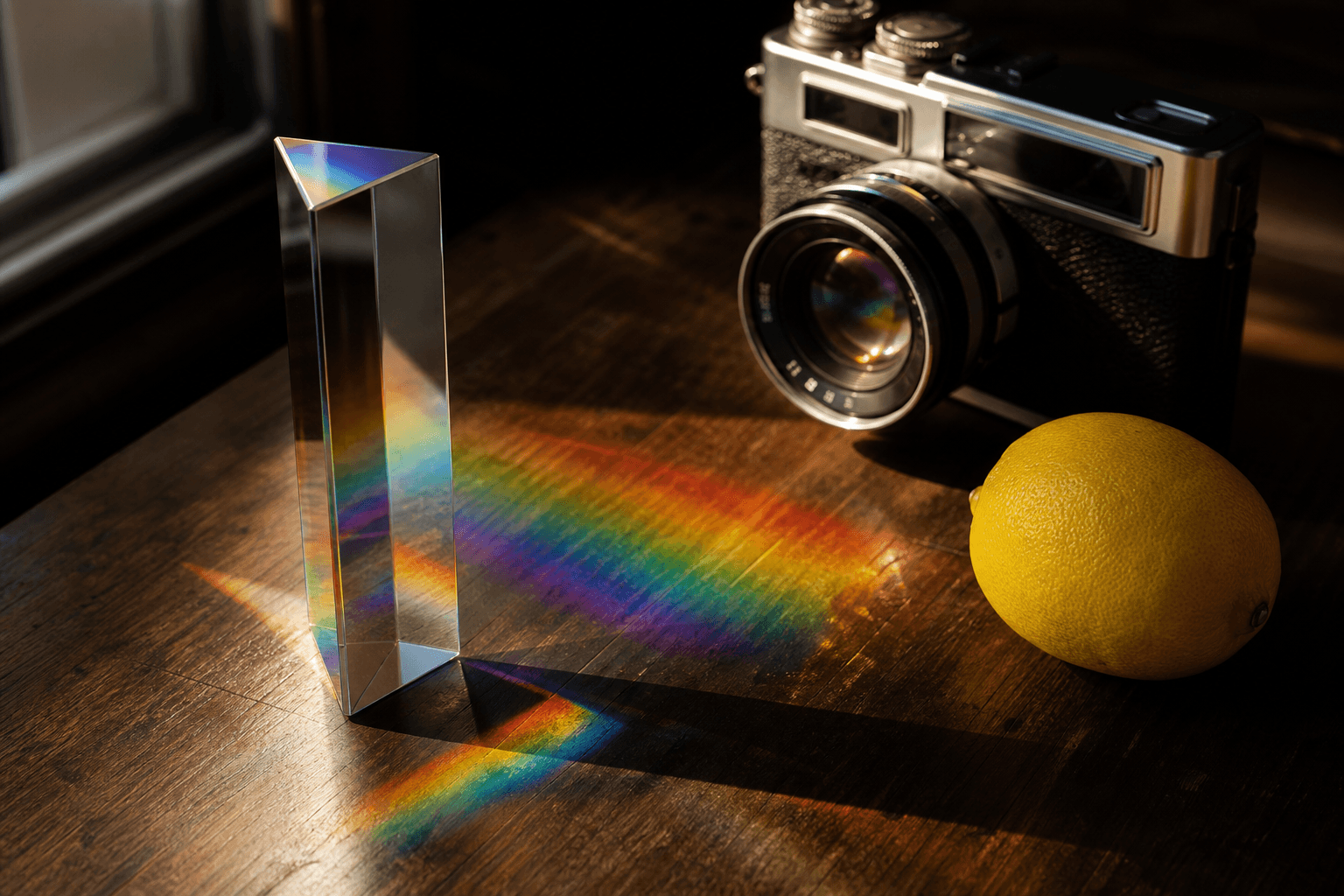
33. Prism/Glass Refraction in Front of the Lens
Hold a small glass prism or a cut drinking glass directly in front of the lens — the light refracts and creates rainbow reflections or doubled edges at the frame's border. Manual focus, wide-open aperture, and patience while trying different angles between prism and lens.
34. Deliberate Panning Shot
Extend the shutter speed to 1/15–1/60s and pan the camera exactly with a moving subject (a bicycle, car, runner) — the subject stays comparatively sharp while the background blurs into lines. Takes several attempts, but every hit looks noticeably more dynamic than a frozen still frame.
08
35–37

Challenges & Series

The last three ideas aren't single subjects, but ways of working — they change how you photograph in general, not just a single image.

35. 24-Hour One-Location Challenge
Pick a single spot — a balcony, a street corner, a kitchen — and photograph it several times across 24 hours: dawn, midday light, blue hour, night. The exercise shows how much light alone can transform a subject, with no new location or gear at all.
36. Ask the 5 Filter Questions Before Every Shot
Before you press the shutter, quickly run through the five filter questions from section 00: light, perspective, reduction, pattern, distortion. It takes less than ten seconds but stops you from taking the same shot again out of habit. Over time, the filter starts running automatically.
37. Series: 5 Variations Instead of One Frame
Instead of moving on after the first usable shot, stick with one idea and deliberately produce five different variations — a different angle, different light, a different crop. The fifth variation is almost always stronger than the first, because the obvious solution is already used up.
Category overview of the 37 creative photo ideas: color, mirrors, light, perspective, everyday, experimental, challenge
Seven categories, 37 ideas — a visual overview of the entire idea bank.
09
Practice

How to Put This Into Practice This Week

Trying to tackle all 37 ideas at once is the surest way to finish none of them. The list is meant for reference, not for working through top to bottom — and "I don't have the right gear" isn't a real excuse for most of the ideas here.

Step 1: Pick Three Ideas
One from a category that comes easily to you, one from a category that excites you, and one from a category you slightly shy away from. That third one usually delivers the biggest leap.
Step 2: Block a Fixed Time Window
30 minutes is enough for most "Low" effort ideas. Skip the spontaneous "maybe I'll have time" approach — a fixed slot in your calendar actually gets done.
Step 3: Five Variations Instead of One Frame
Apply idea 37 as a rule for all three ideas you picked. Five attempts per idea show you what works faster than three perfectly planned single shots.
Step 4: Rule Out Gear Excuses
No studio, no special lens, no flash — for more than two-thirds of the 37 ideas, whatever you're holding right now is enough. For the fundamentals behind it (light, composition, moment), Taking Professional Photos is a useful companion read.
10
FAQ

Frequently Asked Questions About Creative Photo Ideas

What's the difference between this list and "Photo Ideas for Beginners"?
"Photo Ideas for Beginners" covers ten subjects in depth with an example image and basic camera settings — for your first steps with a camera. This list is a dense idea bank of 37 sparks for photographers who already know the basics and are looking for a fresh perspective.
What's the difference between this list and "Photoshoot Ideas"?
"Photoshoot Ideas" helps you plan a specific, scheduled shoot with a concept, moodboard and location. This list is independent of any shoot date — more of a reference for everyday life or those in-between creative slumps.
Do I need special equipment for these ideas?
For most of them, no. More than two-thirds of the 37 ideas are doable with a kit lens or smartphone. Only a few — light painting, light projection, the 24-hour challenge — need a bit more preparation, but no additional gear to buy.
What exactly are the 5 filter questions?
Light, perspective, reduction, pattern & contrast, and distortion. Five questions you ask yourself before pressing the shutter to check whether an idea is more than the usual subject shot from the same height in the same light.
How many ideas should I try per week?
Three is enough. More usually means none of them get properly executed. Pick one easy one, one that excites you, and one you shy away from — the third one usually brings the biggest progress.
Do these ideas work with a smartphone too?
Yes, almost all of them. Double exposure, mirror compositions, flatlays, shadow ideas and most of the perspective tips work just as well with a smartphone as with a system camera — sometimes even easier, thanks to self-timer apps and flip screens.
What is light painting, and do I need a tripod for it?
Light painting uses a long shutter speed (several seconds) in darkness while you draw shapes in the air with a light source. A tripod is essential, otherwise the stationary part of the image blurs during the long exposure.
How do I create a double exposure without a special camera?
Through an app like Lightroom Mobile: use one photo as the base, then insert a second as a layer with a "Lighten" or "Screen" blend mode. Some cameras also offer this function directly in the shooting menu.
Which idea is easiest to start with?
Extreme Minimalism (idea 23), Just One Hand (idea 22) or Isolate Hard Shadows (idea 11) — all three need only the light you already have and a few minutes, but immediately deliver an image that looks different from your standard shot.
What do I do if I still can't think of anything?
Take the overview table, close your eyes, tap a random row, and execute exactly that idea within the next hour. The pressure to act immediately is often more effective than a long search for the "perfect" idea.
Newsletter

Stay in the loop.

Camera and photography news, honest gear tests and new articles — in your inbox. Infrequent but relevant. No spam, unsubscribe anytime.

Keep reading

From the journal.

Fotograf, Martin Fernando Mera Kleinheinz · Franz-Bork-Straße 21, 30163 Hannover · 0179 4085297