Sony RX100 VII Review: No-Nonsense Take on the Pocket Camera

The Sony RX100 VII put through a real-world test: 24–200mm zoom, autofocus, battery life and video assessed honestly — with a comparison to the Canon G7X Mark III and Sony A6700, plus a clear buying verdict.

Sony RX100 VII Review 2026 — compact camera buying guide
Martin Kleinheinz
Author
Martin Kleinheinz
Photographer · Content Creator · Hannover
Updated
July 19, 2026

A camera that fits in your jacket pocket and still zooms to 200mm without swapping lenses — that's the promise of the Sony RX100 VII. I tested it across several trips, walks and spontaneous family moments, because that's exactly the everyday setting a compact camera has to prove itself in: not in a studio, but in your pocket, when the moment arrives without warning.

The RX100 VII's reputation is clear: best autofocus in its class, absurdly versatile zoom, premium price. What often gets lost in the spec sheet is the everyday reality around it — how fast the battery drains, how fiddly the small buttons really are, and whether 200mm at f/4.5 is still sharp enough for your subject. That's exactly where this review picks up.

You won't get a pure spec-sheet rewrite here, but a buying decision: when the RX100 VII is the right call, when the cheaper Canon G7X Mark III is enough, and when upgrading to a system camera like the Sony A6700 pays off. By the end, you'll know which of the three cameras fits your use case — not a test lab's.

00
Quick

Is the Sony RX100 VII Worth It? The Quick Verdict

Short version: The Sony RX100 VII is the right camera if you want exactly one pocket camera for travel, street and family — with real telephoto reach up to 200mm, a viewfinder and an autofocus that makes system cameras from a few years ago look old. The price of around €1,049 is steep for a 1-inch sensor, and the battery is the real weak point in everyday use. Accept both, and you get one of the most versatile compact cameras out there.

Top 3

Sweet Spot · Budget · Upgrade

**#1 Sony RX100 VII** as the sweet spot for travel and street. **#2 Canon G7X Mark III**, if a brighter lens for indoor shooting matters more to you than telephoto reach. **#3 Sony A6700**, if you want to grow into an interchangeable-lens system and give up the pocket-sized form factor.

Vergleich
Sony
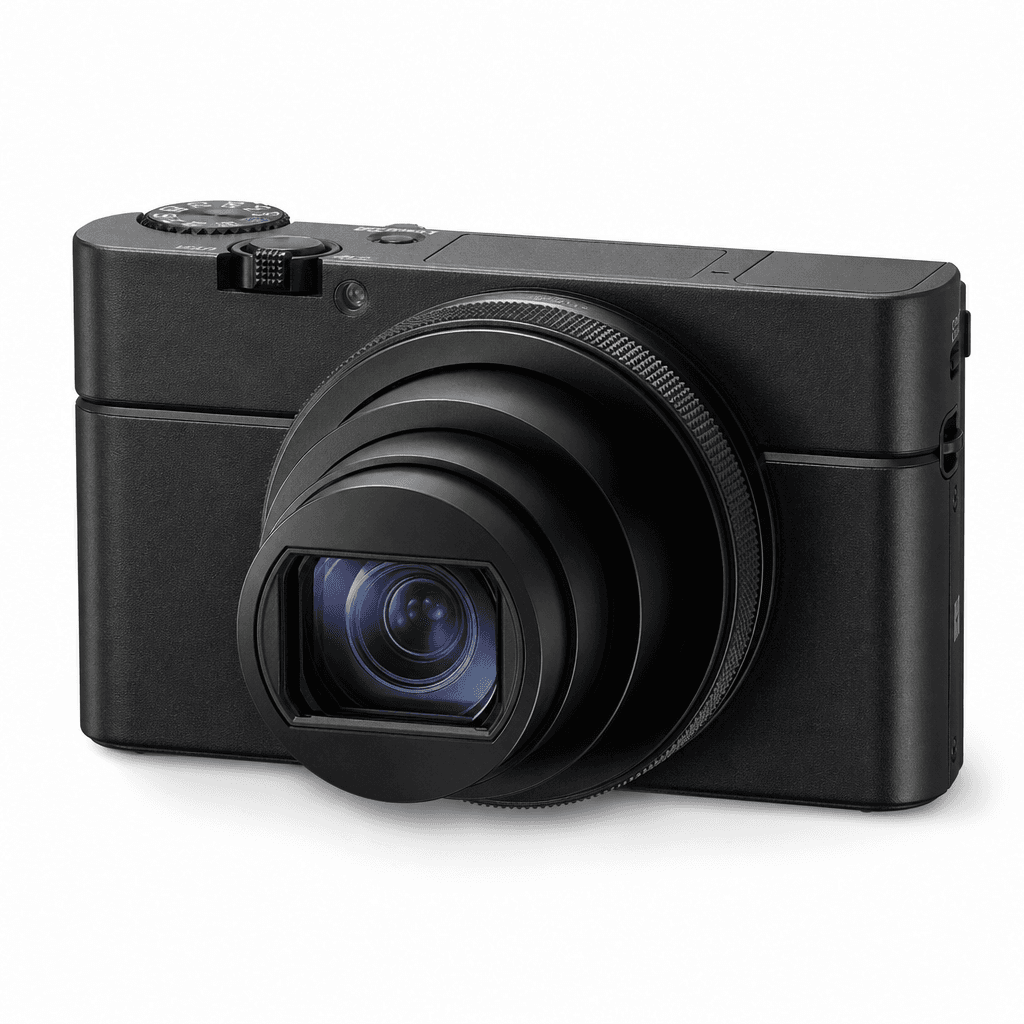
Sony Cyber-shot DSC-RX100 VII
Canon
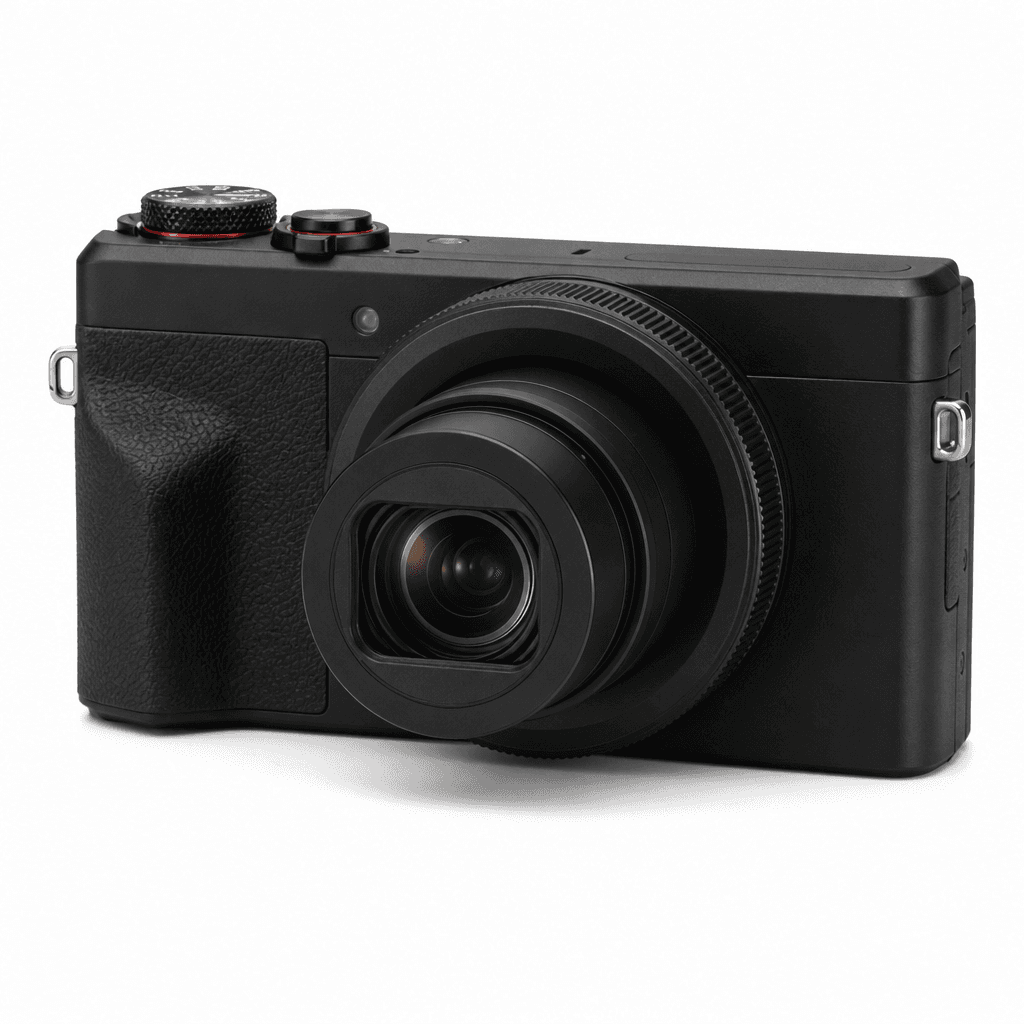
Canon PowerShot G7 X Mark III
Sony
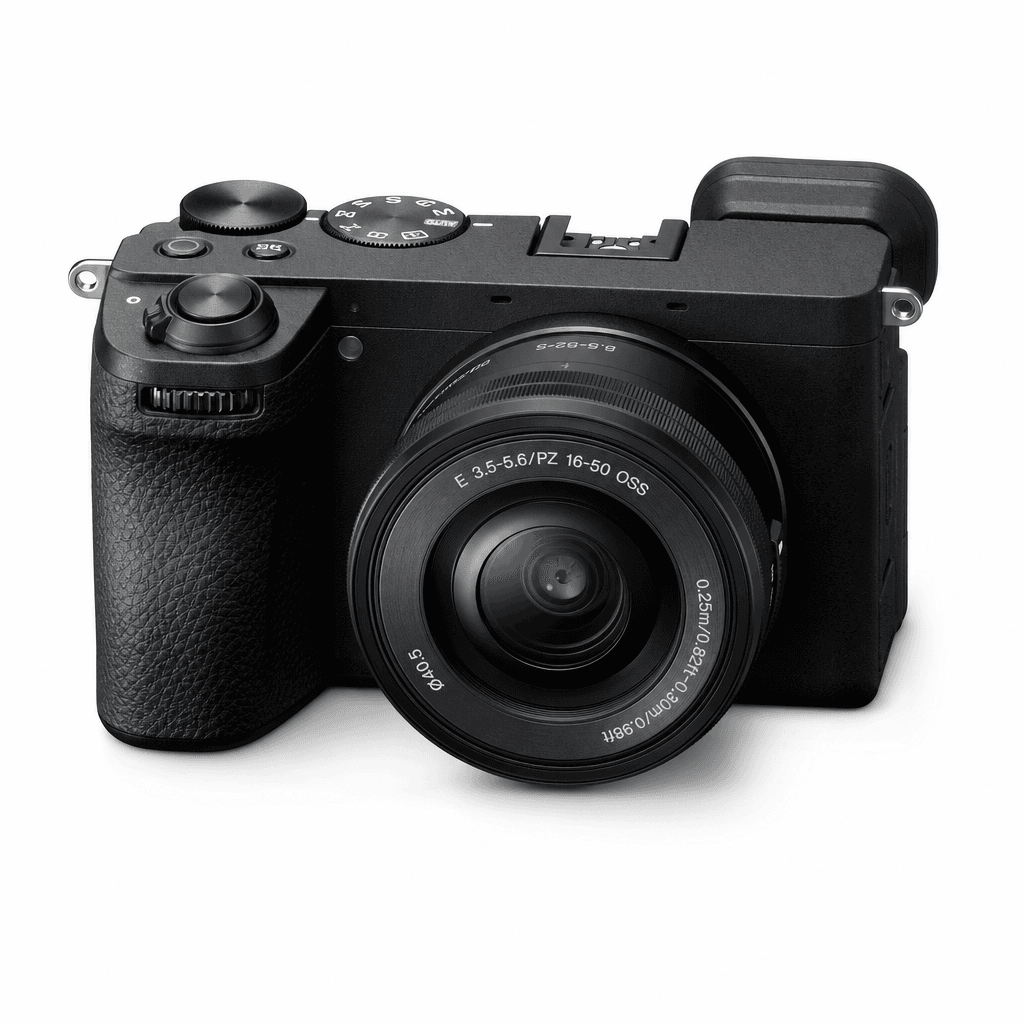
Sony Alpha 6700 (Body)
Bild
Sony Cyber-shot DSC-RX100 VII
Canon PowerShot G7 X Mark III
Sony Alpha 6700 (Body)
EmpfehlungSweet SpotBudgetUpgrade
Sensor20.1 MP 1" Stacked CMOS20.1 MP 1" Stacked CMOS26 MP APS-C BSI-CMOS
ISO-BereichZEISS 24–200mm f/2.8–4.524–100mm f/1.8–2.8Interchangeable (E-mount)
Autofokus357 phase-detection points, real-time trackingDual Pixel CMOS AF759 phase-detection points, AI tracking
Detail20 fps blackout-free, pop-up viewfinderUSB livestreaming, vertical video4K/120p (cropped), in-body stabilization
Stärken
  • +24–200mm zoom covers nearly every travel and street situation
  • +Autofocus ranks among the fastest in this camera class
  • +Pop-up viewfinder — rare at this size
  • +20 fps blackout-free, plus Single Burst up to 90 fps
  • +4K oversampled with mic input for video
  • +Consistently brighter lens — better low-light image quality
  • +About €300 cheaper than the RX100 VII
  • +USB livestreaming straight from the camera
  • +Flip touchscreen, great for vlogging
  • +Significantly better low-light image quality thanks to the APS-C sensor
  • +Battery life more than double that of compact cameras
  • +Free lens choice — from wide-angle to super-telephoto
  • +In-body stabilization and a strong video feature set (S-Log3)
Schwächen
  • Battery won't last a full day without a spare
  • No real front grip — can be added, but not standard
  • Sony menu takes time to learn
  • Lens gets dimmer at f/4.5 on the telephoto end than shorter alternatives
  • No viewfinder — screen composing only
  • Zoom tops out at 100mm instead of 200mm
  • Autofocus is solid, but not RX100 VII level
  • No weather sealing, no extra grip included
  • No longer pocket-sized — needs a bag or backpack
  • Body price alone already exceeds the RX100 VII, lenses add on top
  • More weight and bulk for travel and everyday use
  • 4K/120p only in crop mode, not full frame
Geeignet fürTravel, street and family — if you want a single camera with real telephoto reach up to 200mm.Vlogging, indoor shots and content where brightness matters more than telephoto reach.Photographers growing into an interchangeable-lens system who want better low-light image quality.
Wo kaufen

Why the RX100 VII, despite its premium price, is the smarter choice for most travel and street photographers over a smartphone upgrade or a bigger system camera — the rest of this review covers all the numbers on paper and what actually matters day to day.

01
Audience

Who the RX100 VII Really Fits

Before you dive into autofocus figures and video specs: the most important question is whether your use case even matches the RX100 VII. The table below shows the classic use cases and where the camera excels — and where another choice makes more sense.

Use CaseDoes the RX100 VII Fit?Why
TravelExcellent24–200mm covers architecture through telephoto without extra lenses in your bag
StreetExcellentSmall, discreet, autofocus reacts faster than you can
Family / KidsGoodEye AF and tracking keep moving kids sharp, telephoto keeps distance
Event as B-camConditionalA solid companion to a main camera, but no substitute in low-light indoor venues
Vlog / SelfieConditionalFlip screen is enough, but the G7X Mark III leads with a brighter wide-angle lens

Fit assessment based on hands-on testing and user consensus — as of July 2026

Travelers and street photographers get nearly everything a best travel camera should deliver: reach, compactness, robust autofocus. If you're more of a beginner looking for your first serious camera, it's worth checking our general Camera for Beginners guide first — the RX100 VII isn't a beginner price tag, but it's a very patient beginner companion if the budget works for you.

02
Specs

The RX100 VII's Technical Specs at a Glance

Before we get to everyday usability: here are the numbers behind the RX100 VII's reputation. Not a spec-sheet dump for its own sake — every line resurfaces later in this review.

CategorySpecification
Sensor20.1 MP 1" Stacked Exmor RS CMOS
LensZEISS Vario-Sonnar T* 24–200mm (full-frame equivalent), f/2.8–4.5
AutofocusHybrid AF: 357 phase-detection + 425 contrast-detection points, focus speed approx. 0.02s per Sony
AF TrackingReal-time Tracking, Real-time Eye AF (human & animal)
Burst Shooting20 fps blackout-free with AF/AE tracking
Single Burst ShootingUp to 90 fps for 7 frames (pre-buffered)
Video4K up to 30p, oversampled from 5K, HLG HDR, Active SteadyShot
Audio3.5mm microphone jack (no headphone output)
ViewfinderPop-up EVF, 2.36 million dots
Display3" flip LCD, tilts up 180°
Dimensions / Weight101.6 × 58.1 × 42.8mm, approx. 302g with battery
BatteryNP-BX1 — approx. 260 shots (LCD) / 240 (viewfinder), CIPA
Video RuntimeRealistically about 40 minutes of continuous recording per charge
Street Price (Germany)Roughly €1,000–1,150, often around €1,049 on Amazon

Sony Cyber-shot DSC-RX100 VII — core specifications, as of July 2026

On paper, this reads like a small system camera that happens to fit in a jacket pocket. Whether that holds up in everyday use is what the next section covers — including the points no spec sheet mentions.

03
Everyday Use

Handling, Battery and Menus — What the Spec Sheet Doesn't Tell You

Numbers say little about how a camera feels in your hand after four hours. Here's the honest everyday-use check — summarized from hands-on experience and the broad consensus from reviews and forums.

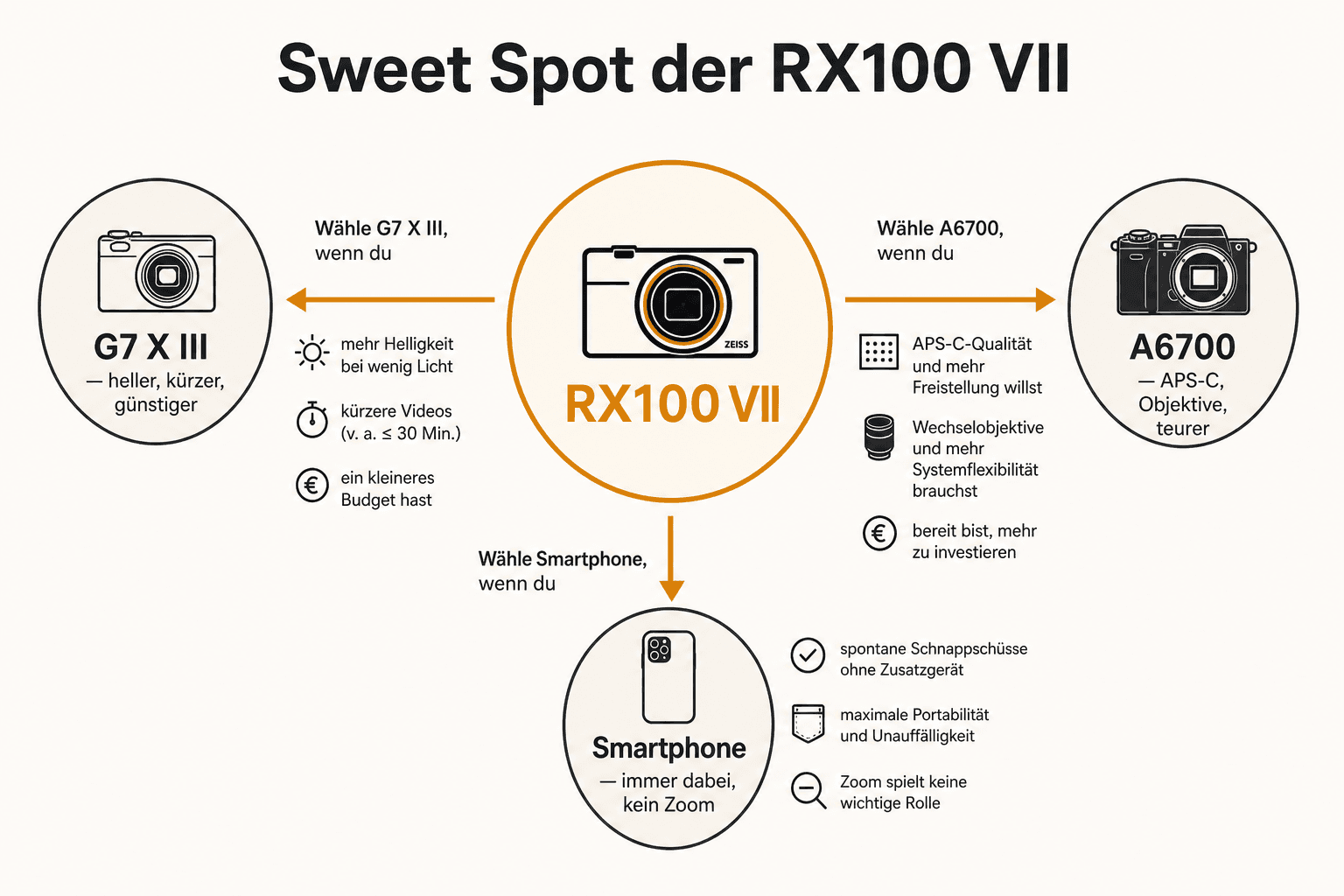
Sony RX100 VII sweet-spot graphic: when the compact camera pays off
The RX100 VII's sweet spot — reach, viewfinder and AF against premium price and battery life
Handling & Grip
The RX100 VII is so small that it lacks a real front grip. Fine for short sessions, but over a full day at the 200mm end you'll notice the lack of anything to hold onto. Many users add a cheap stick-on grip — a sensible €10 investment right after purchase.
Battery — Complaint No. 1
In reviews and forums, one point comes up first almost every time: the battery. About 260 shots per CIPA sounds thin in theory — in practice it's even less once you use the viewfinder, shoot a lot of burst sequences, or zoom frequently. For a full travel day, you need at least one, realistically two spare batteries.
Menu — Sony's Familiar Learning Curve
Sony menus are deeply nested, and the RX100 VII is no exception. Coming from Canon or Fujifilm, expect one or two sessions before the key functions (AF mode, burst shooting, Fn menu) click. After that, the menu stops being an obstacle — the first impression is worse than the reality.
Buttons & Controls
The buttons are tiny, the lens control ring feels precise, and the touchscreen only allows limited input (no full touch menu). For glasses wearers with thicker fingers, that takes some getting used to, but it's not a dealbreaker after a short adjustment period.

German Amazon reviews average around 4.2 out of 5 stars. Consistently praised: image quality for the sensor size and the fact that the camera truly fits in any pocket. Criticisms repeat as well: price, menu navigation and battery life. That matches exactly what I found in my own testing — no surprises, just confirmation.

04
Image

Image Quality: What a 1-Inch Sensor Really Delivers

A 1-inch sensor is neither full-frame nor APS-C — accept that with every compact camera purchase decision. In daylight, the RX100 VII delivers crisp, contrast-rich images with pleasant color rendering, exactly what you'd expect from Sony's Exmor RS sensors. At low ISO up to around ISO 800, you're on safe ground.

  • Up to ISO 800–1,600: clean images, low noise, a good base for post-processing
  • ISO 3,200–6,400: noticeable noise, still usable for web and smaller prints
  • Above that: a fallback option — the small sensor area clearly shows its physical limits here

The real trade-off lies in the zoom itself: the ZEISS lens starts at f/2.8 in wide-angle but drops to f/4.5 by 200mm. That means less light at the telephoto end — exactly where you'd need the most light at dusk or indoors. The Canon G7X Mark III is more honestly designed here: its shorter 24–100mm lens stays consistently brighter at f/1.8–2.8 and delivers noticeably less noisy results in low light — if you can live without the reach from 100mm to 200mm.

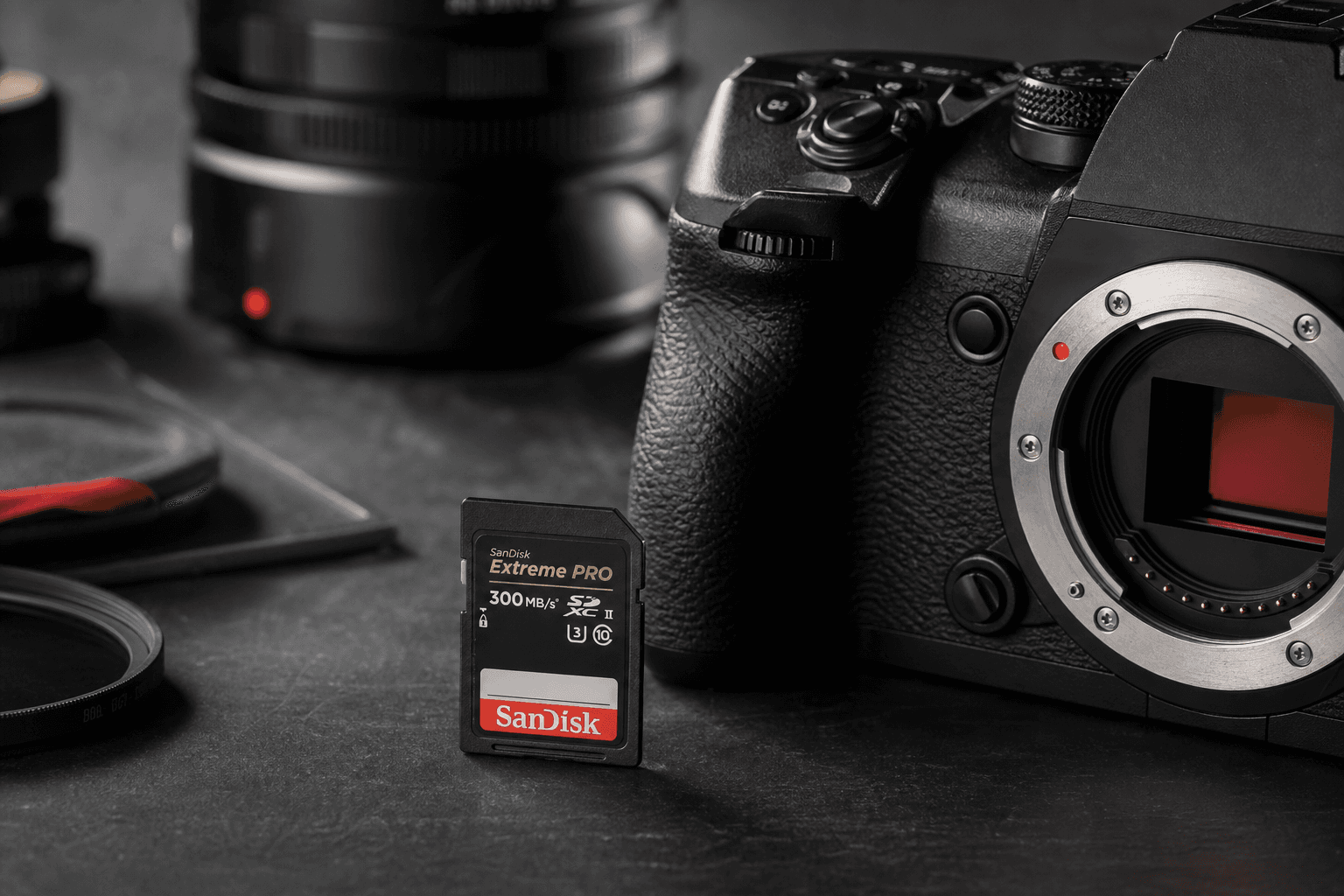
In short: the RX100 VII wins on reach and versatility, the G7X Mark III wins on brightness and thus low-light image quality within its usable focal range. If you shoot a lot of RAW and fill up cards quickly on the road, our guide to the right SD card covers the matching storage solution.

05
AF & Speed

Autofocus and Burst Shooting: the Real Strength

If one feature justifies the RX100 VII's premium price, it's the autofocus. 357 phase-detection points plus 425 contrast-detection points form a hybrid system that Sony says focuses in about 0.02 seconds — and in testing, that matched my subjective experience: focus often locks before you've consciously registered the subject.

Real-time Tracking
Tap a subject once, and the camera holds onto it — even if it moves quickly through the frame or briefly disappears. For kids, pets and street moments, that's a noticeable difference from older compact cameras.
Real-time Eye AF (Human & Animal)
Detects eyes reliably, even in profile shots and partial occlusion. Animal mode works surprisingly well on dogs and cats — not just on subjects sitting still.
20 fps Blackout-Free
Full 20 frames per second with AF/AE tracking, without the viewfinder flickering or cutting out. You see exactly what's happening throughout, instead of guessing after the burst whether you nailed the moment.
Single Burst Shooting (up to 90 fps)
A special mode that buffers before the shutter fully releases, delivering up to 90 frames per second for short 7-frame sequences. Ideal for the exact instant of a droplet, a jump, or a rally point — not a mode for long continuous bursts.

In practice, that means: with fidgety kids at family shoots, photographing pets, or in a hectic street environment, you'll nail noticeably more sharp shots with the RX100 VII than with comparable compact cameras — including the G7X Mark III, whose dual-pixel AF is solid but not on this level.

06
Video

Video: Strong for the Format, But Not Limitless

For a camera this size, video quality is impressive: 4K up to 30p, oversampled from a 5K resolution for maximum detail, HLG HDR for extended dynamic range straight on your TV, plus Active SteadyShot for steadier handheld footage. The 3.5mm microphone jack isn't a given in this camera category and makes the RX100 VII a serious option for interviews and vlogs with an external mic.

  • 4K oversampled: noticeably more detail than pure pixel-binning on competing models
  • HLG HDR: direct HDR playback with no post-processing, provided your screen supports it
  • Active SteadyShot: a noticeably steadier image while walking, at the cost of some field of view
  • No headphone jack: live audio monitoring isn't possible

The practical limit lies less in an official time cap than in the compact body itself: during long 4K takes in warm conditions, the camera can shut down from heat buildup — a known issue with compact cameras at this processing level, not an RX100 VII-specific flaw. For vlog clips, travel B-roll and short interviews, that's a non-issue in practice; for continuous recording sessions of 30 minutes or more, plan around it.

07
Comparison

Three Cameras in Direct Comparison

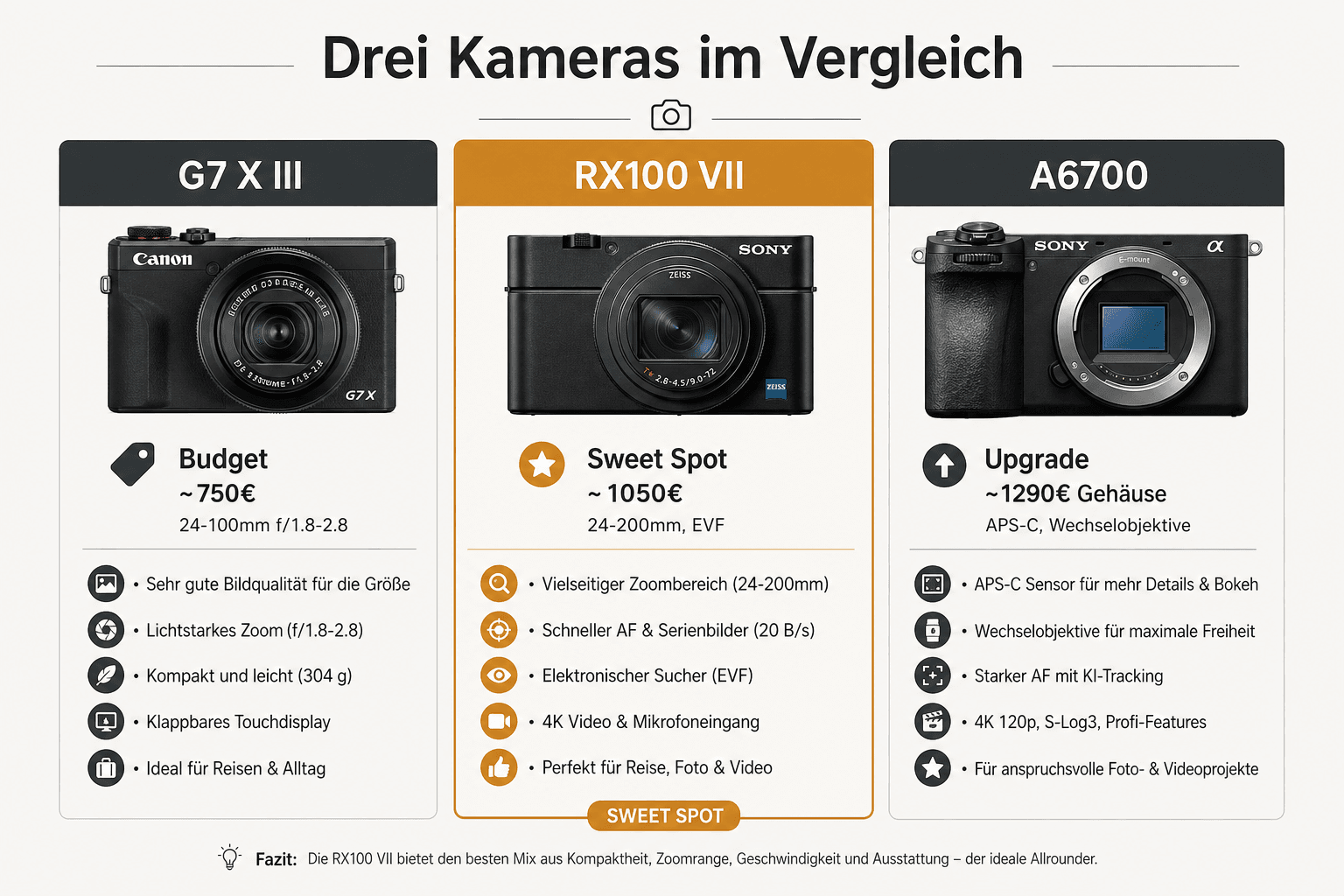
Rather than isolated spec sheets, a direct comparison makes the decision tangible. The graphic sums up the three candidates, the table delivers the details behind it.

Comparison graphic: Sony RX100 VII, Canon G7X Mark III and Sony A6700
Sony RX100 VII vs. Canon G7X Mark III vs. Sony A6700 — the three candidates at a glance
CriteriaSony RX100 VIICanon G7X Mark IIISony A6700
Sensor20.1 MP 1"20.1 MP 1"26 MP APS-C
Lens24–200mm f/2.8–4.5 (fixed)24–100mm f/1.8–2.8 (fixed)Interchangeable (E-mount)
Autofocus357 phase-detection points, real-time trackingDual Pixel CMOS AF759 phase-detection points, AI tracking
Burst Shooting20 fps blackout-free, 90 fps single burst20 fps (mech./electronic shutter)11 fps with AF/AE
Video4K/30p oversampled, HLG HDR4K/30p, USB livestreaming4K/120p (cropped), S-Log3
ViewfinderPop-up EVF, 2.36M dotsNo viewfinderEVF, 2.36M dots
Weightapprox. 302gapprox. 304gapprox. 493g (body only)
Battery (CIPA)approx. 260 shotsapprox. 235 shotsapprox. 570 shots
Price approx.€1,049€749€1,289 (body)

As of July 2026 — check exact prices and availability with the retailer

The trade-off is clear: the RX100 VII wins on reach, autofocus speed and viewfinder over the G7X Mark III — but loses on brightness and price. Against the A6700, it wins on size and everyday usability as an always-with-you camera — but loses on image quality, battery life and expandability. None of the three cameras is objectively the best — each is the right answer to a different question.

08
Decision

The Decision Tree: Which Camera Fits You

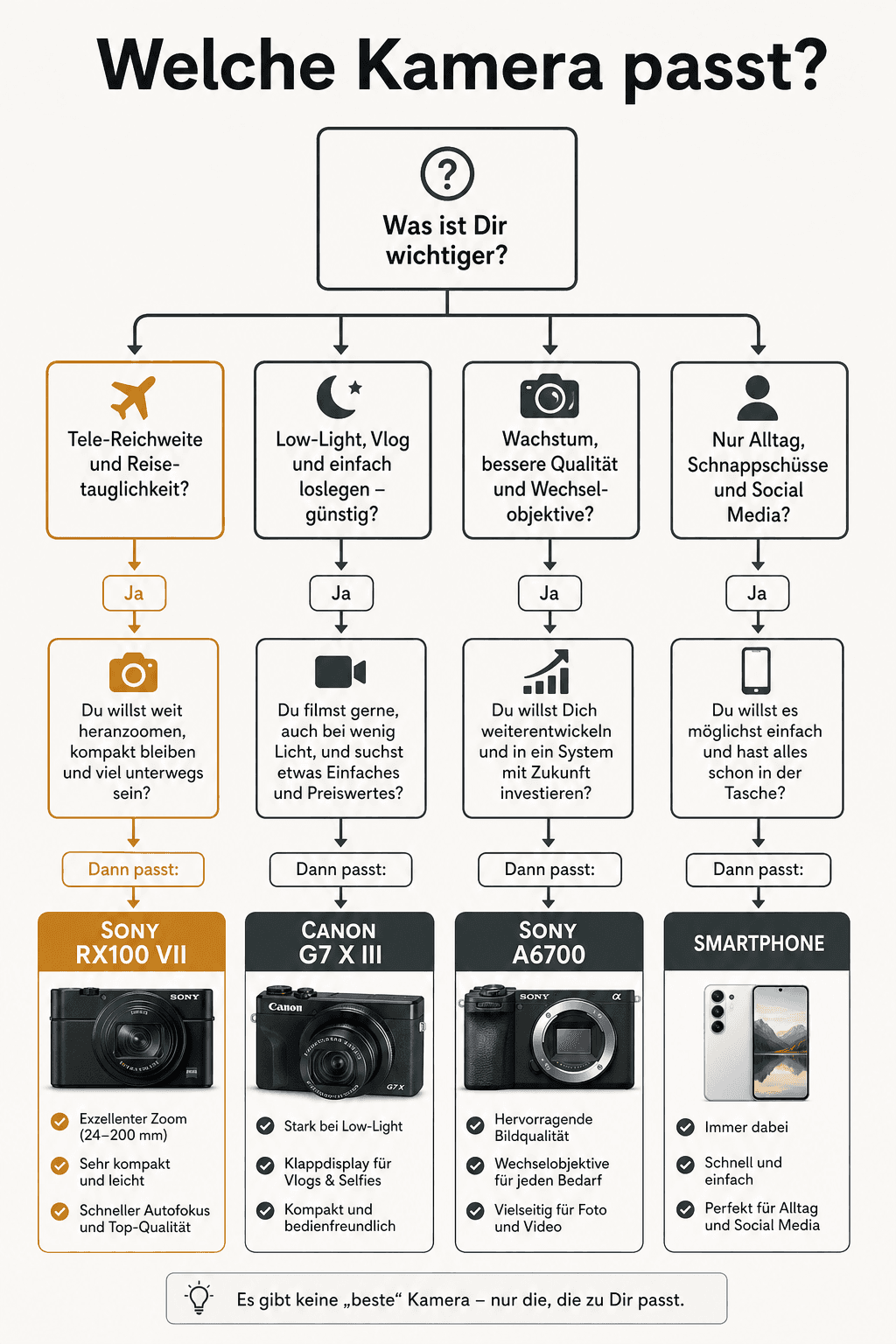
Instead of comparing more specs, work through the tree from top to bottom. The first question decides more about your purchase than any single figure from the tables above.

Decision tree: Sony RX100 VII, Canon G7X Mark III or Sony A6700
Decision tree — from use case to the right camera
  • Want one camera for travel, street and family with real telephoto reach up to 200mm → Sony RX100 VII
  • Mostly filming indoors, vlogging or selfies and need more light than reach → Canon G7X Mark III
  • Want to grow into an interchangeable-lens system and get more image quality in low light → Sony A6700
  • Don't mind the size, but care about video with S-Log3 and higher frame rates → Sony A6700
  • Your smartphone is honestly already enough → don't buy any of the three, see the FAQ

For most readers who've made it this far, the path leads to the RX100 VII — exactly why it's the sweet spot in this review, not just a formality. If you're unsure whether a system camera overall would be the better choice, our comparison of compact mirrorless cameras offers a broader take beyond the A6700.

09
Detail

Sony RX100 VII in Detail: Strengths and Compromises

After all the tables and comparisons, one simple question remains: does what convinces about the RX100 VII outweigh what annoys? Here's the short, honest balance before the full verdict card.

The Everyday Strengths
The 24–200mm zoom makes it the only camera you need for an entire travel day. The autofocus barely misses a moment. The pop-up viewfinder allows precise composing even in bright sunlight — a feature many competitors this size don't even offer.
The Compromises
The price is steep for a 1-inch sensor, the battery won't last a full day without a spare, and without an extra grip the camera gets slightly unwieldy at the telephoto end during long sessions. Accept these three points upfront, and the camera itself won't surprise you further.
Sweet Spot
Sony Cyber-shot DSC-RX100 VII
Bewertung
4.6
/ 5,0
★★★★
Basierend auf 0 verifizierten Bewertungen
Sony

Sony Cyber-shot DSC-RX100 VII

Sweet Spot — the pocket camera with real telephoto reach

20.1 MP 1" sensor, ZEISS zoom 24–200mm f/2.8–4.5, hybrid autofocus with 357 phase-detection points and real-time Eye AF for humans and animals. 20 fps blackout-free, pop-up viewfinder, 4K video with mic input. Typically around €1,049 — the premium price for the most versatile compact camera for travel, street and family. Battery is the real weakness: spare NP-BX1 packs belong in your bag.

Was überzeugt
  • +24–200mm zoom covers nearly every travel and street situation
  • +Autofocus ranks among the fastest in this camera class
  • +Pop-up viewfinder — rare at this size
  • +20 fps blackout-free, plus Single Burst up to 90 fps
  • +4K oversampled with mic input for video
Was Du wissen solltest
  • Battery won't last a full day without a spare
  • No real front grip — can be added, but not standard
  • Sony menu takes time to learn
  • Lens gets dimmer at f/4.5 on the telephoto end than shorter alternatives
Editor's Statement

One camera for travel, street and family — accept the price and the battery

Verfügbar bei
10
Alternative

Cheaper: When the Canon G7X Mark III Is the Better Choice

The Canon G7X Mark III costs about €300 less and scores exactly where the RX100 VII compromises: brightness. With a consistent f/1.8–2.8 across its shorter 24–100mm range, it delivers noticeably cleaner images indoors, in restaurants and in evening light. For vloggers, USB livestreaming is also a real plus the RX100 VII doesn't offer.

The trade-off: no viewfinder, less telephoto reach, and an autofocus that's solid but not on RX100 VII level. If you mostly film indoors, use it as a vlog camera at events, or shoot content at close range, you get more camera for less money here. If you regularly want to zoom to 150mm or 200mm, you'll quickly hit the lens's limit. Our guide to the best camera under €1,000 offers a good starting point for whether a sub-€1,000 compact is even the right category for you.

Budget
Canon PowerShot G7 X Mark III
Bewertung
4.4
/ 5,0
★★★★
Basierend auf 0 verifizierten Bewertungen
Canon

Canon PowerShot G7 X Mark III

Cheaper — brighter indoors, shorter zoom

20.1 MP 1" sensor with a consistently bright 24–100mm f/1.8–2.8 lens and Dual Pixel CMOS AF. Livestreaming straight via USB, flip touchscreen for vlog and selfies. Typically around €749 — about €300 cheaper than the RX100 VII, but without a viewfinder and with noticeably less telephoto reach. The right choice if light matters more to you than zoom.

Was überzeugt
  • +Consistently brighter lens — better low-light image quality
  • +About €300 cheaper than the RX100 VII
  • +USB livestreaming straight from the camera
  • +Flip touchscreen, great for vlogging
Was Du wissen solltest
  • No viewfinder — screen composing only
  • Zoom tops out at 100mm instead of 200mm
  • Autofocus is solid, but not RX100 VII level
  • No weather sealing, no extra grip included
Editor's Statement

For indoors and vlog, the brighter lens often matters more than 200mm

Verfügbar bei
11
Alternative

Upgrade: When the Sony A6700 Pays Off

The Sony A6700 isn't a direct competitor to the RX100 VII, but the logical next step once compact-camera limits start holding you back: a larger APS-C sensor at 26 MP, significantly more battery life (about 570 vs. 260 shots), in-body image stabilization, and the freedom to swap lenses as needed — from a bright portrait lens to a super-telephoto.

The cost: the A6700 is already more expensive as a body alone than the RX100 VII, and every additional lens adds on top. Your pocket camera becomes a camera bag. For travel and spontaneous everyday use, that's a real step back in convenience — for anyone diving deeper into photography as a hobby or side gig, it's the right step forward. If you're generally weighing whether a compact system camera fits your next step, our overview of compact mirrorless cameras helps place it beyond the A6700.

Upgrade
Sony Alpha 6700 (Body)
Bewertung
4.7
/ 5,0
★★★★
Basierend auf 0 verifizierten Bewertungen
Sony

Sony Alpha 6700 (Body)

Pricier upgrade — interchangeable lenses and APS-C growth

26 MP APS-C sensor with 759 phase-detection points and AI-based subject tracking, in-body image stabilization, 4K up to 120p in crop mode with S-Log3 for serious video projects. The NP-FZ100 battery lasts significantly longer at approx. 570 shots than any compact camera. Typically around €1,289 for the body alone — every lens adds to that. No longer pocket-sized, but the step into a full system.

Was überzeugt
  • +Significantly better low-light image quality thanks to the APS-C sensor
  • +Battery life more than double that of compact cameras
  • +Free lens choice — from wide-angle to super-telephoto
  • +In-body stabilization and a strong video feature set (S-Log3)
Was Du wissen solltest
  • No longer pocket-sized — needs a bag or backpack
  • Body price alone already exceeds the RX100 VII, lenses add on top
  • More weight and bulk for travel and everyday use
  • 4K/120p only in crop mode, not full frame
Editor's Statement

The right step once photography becomes more than a travel companion

Verfügbar bei
12
Accessories

Accessories: What You Actually Need for the RX100 VII

The shopping list for the RX100 VII is short, but not optional. Two points make the difference between frustration and relaxed everyday use.

Spare Battery NP-BX1
Given the roughly 260 shots per charge, a second — better, a third — NP-BX1 battery isn't a luxury; it's basic gear for any day away from home. Original batteries are more reliable; cheaper third-party alternatives usually work but with somewhat lower real-world capacity.
Extra Grip
A stick-on L-shaped grip for around €10–15 noticeably improves handling, especially at the telephoto end and with wet or cold hands. Not a must for occasional snapshots, but worthwhile for anyone using the camera as their main travel camera.
The Right Memory Card
For 4K video and 20 fps bursts, a fast SDXC card with sufficient write speed pays off. Our guide to the right SD card explains which speed class you actually need in detail — for the RX100 VII, a solid V30 card is enough in almost all cases.
13
Verdict

The Clear Buying Decision

The Sony RX100 VII isn't a camera for everyone — but for the right audience, it's one of the best compact cameras you can buy right now. If you want a single camera for travel, street and family that truly fits in your pocket, offers real telephoto reach up to 200mm, and captures moments before you can consciously react, the premium price is justified.

If instead you shoot mostly indoors, need more light than reach, or want livestreaming straight from the camera: the Canon G7X Mark III saves you about €300 and delivers exactly that. If you want to grow into a system with interchangeable lenses, better low-light image quality and significantly more battery life: the Sony A6700 is the more consistent, but also bulkier, step.

14
FAQ

Frequently Asked Questions About the Sony RX100 VII

Is the Sony RX100 VII still worth it in 2026 compared to a smartphone?
Yes, if you need real optical zoom up to 200mm, a viewfinder and autofocus that stays reliable even with fast-moving subjects. For simple snapshots in good light, today's top smartphones deliver very good results — the difference shows up with telephoto shots, burst shooting and difficult light.
Is the RX100 VII better than my current smartphone?
In wide-angle and good light, the difference is small. As soon as you zoom, need burst shooting or shoot at dusk, the RX100 VII pulls clearly ahead thanks to its physically larger sensor and real optical zoom. Still, it's not a smartphone replacement — more a smart complement for everything your phone is too limited for.
How long does the RX100 VII's battery really last?
CIPA rates it at about 260 shots with the LCD and about 240 with the viewfinder. In practice, especially with heavy viewfinder use, burst shooting or video, that's more of a ceiling than an average. For a full day away from home, plan on one or two spare batteries.
Should I buy a used RX100 VI instead of the RX100 VII?
Only if the price difference is significant and you can live without real-time Eye AF for animals and the VII's slightly faster burst shooting. The VI shares most of its sensor and zoom range with the VII but has an older, noticeably slower autofocus system. At a similar price, the VII is the more sensible choice.
Why is the RX100 VII so expensive for a compact camera?
The price reflects the elaborate hybrid autofocus system, the bright ZEISS zoom lens reaching 200mm, the built-in viewfinder and the stacked sensor technology for fast burst shooting. For the sensor alone, the price would be steep — in the context of the full feature set, it's understandable, if not cheap.
Does the RX100 VII charge via USB, and what's the deal with the version without USB charging?
Most RX100 VII units charge via USB cable inside the camera body. Due to component shortages, Sony removed this feature on some later production batches and includes an external charger instead. Check the current product listing before buying if USB charging matters to you.
Do I need an extra grip for the RX100 VII?
Not strictly, but it's worth it. Without a real front grip, the camera gets fiddly to hold during long sessions, especially at the telephoto end. A stick-on grip for around €10–15 noticeably improves handling and barely takes up space.
Is the Canon G7X Mark III the better choice for me?
If you shoot mostly indoors, vlog, or need livestreaming straight from the camera and can do without reach beyond 100mm, yes. For travel, street and pet/kid photos with more zoom and a stronger autofocus system, the RX100 VII remains the more capable compact.
When does upgrading to the Sony A6700 make sense?
When low-light image quality, battery life and the ability to swap lenses matter more to you than pure compactness. The A6700 is no longer a pocket camera — but it grows with you once photography becomes more than just a travel companion.
Which SD card fits the Sony RX100 VII?
For 4K video and fast burst shooting, a solid UHS-I card with a V30 rating is enough in the vast majority of cases. Details on the right capacity and speed class are in the SD card guide.
Affiliate links marked with * — Amazon product links use partner ID martinkleinheinz-21. I earn a small commission if you buy through these links; there's no extra cost to you. The assessments are based on hands-on testing, manufacturer specs and the consensus from reviews and user reports — no brand sponsored this article.
Newsletter

Stay in the loop.

Camera and photography news, honest gear tests and new articles — in your inbox. Infrequent but relevant. No spam, unsubscribe anytime.

Keep reading

From the journal.

Fotograf, Martin Fernando Mera Kleinheinz · Franz-Bork-Straße 21, 30163 Hannover · 0179 4085297