Camera Perspectives: The guide to angles & shot sizes
Every camera angle from photo and film — with AI illustrations (setup + result), focal lengths and equipment. From eye level through Dutch angle to dolly-in.
Author
Martin Kleinheinz
Photographer · Content Creator · Hannover
Updated
August 22, 2026
"Try an interesting perspective." — that's how it starts and often ends with a half-tilted phone photo and a soft subject. Perspective isn't a random filter. It's the decision of where your camera stands, how it looks at the subject and how much you leave in the frame.
This guide separates two things beginners mix up: camera perspective (angle, height, position) and shot size (distance / frame). In film that's shot size — wide, medium, close-up. You always combine both: a low-angle close-up tells a different story than the same low angle in a wide shot.
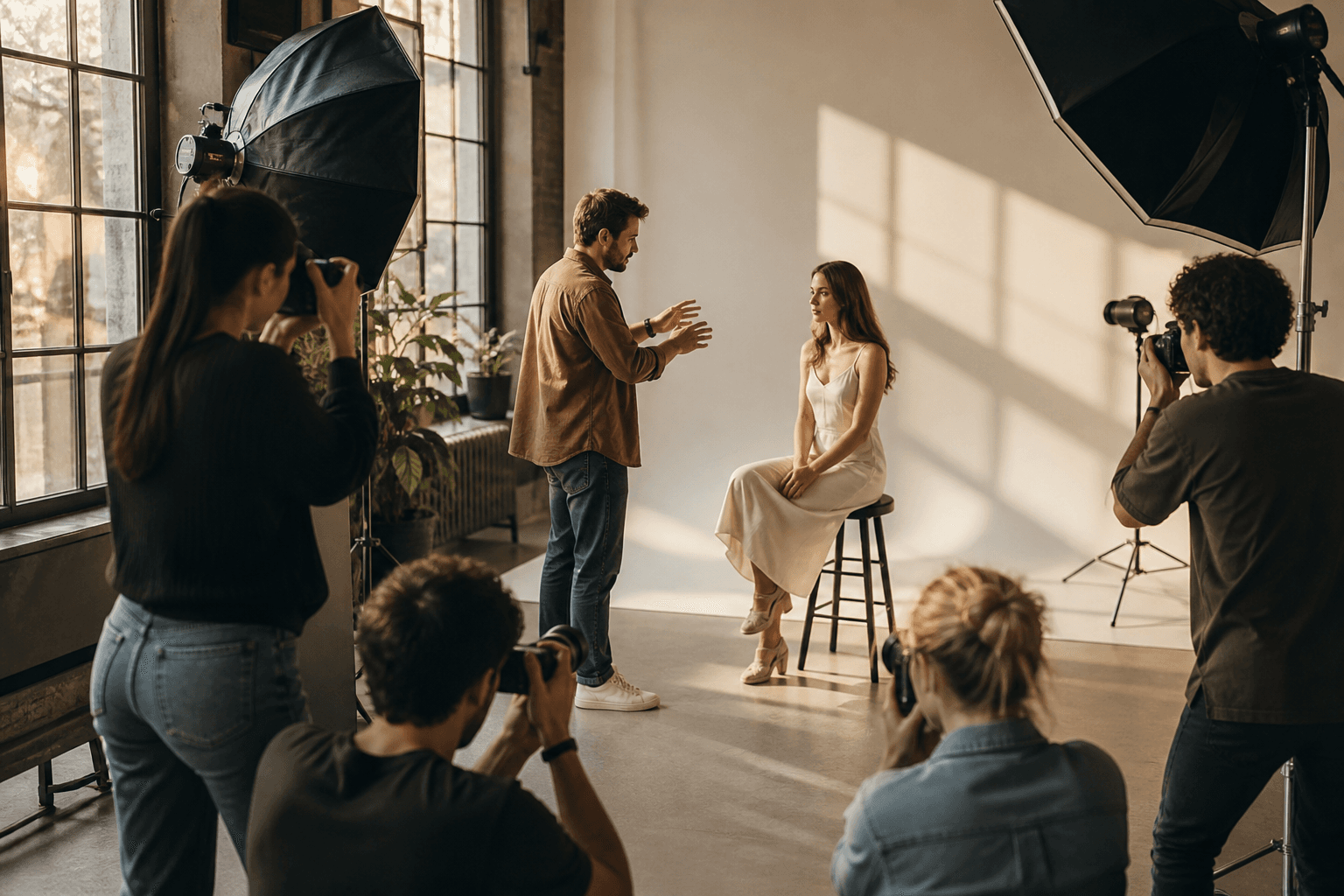
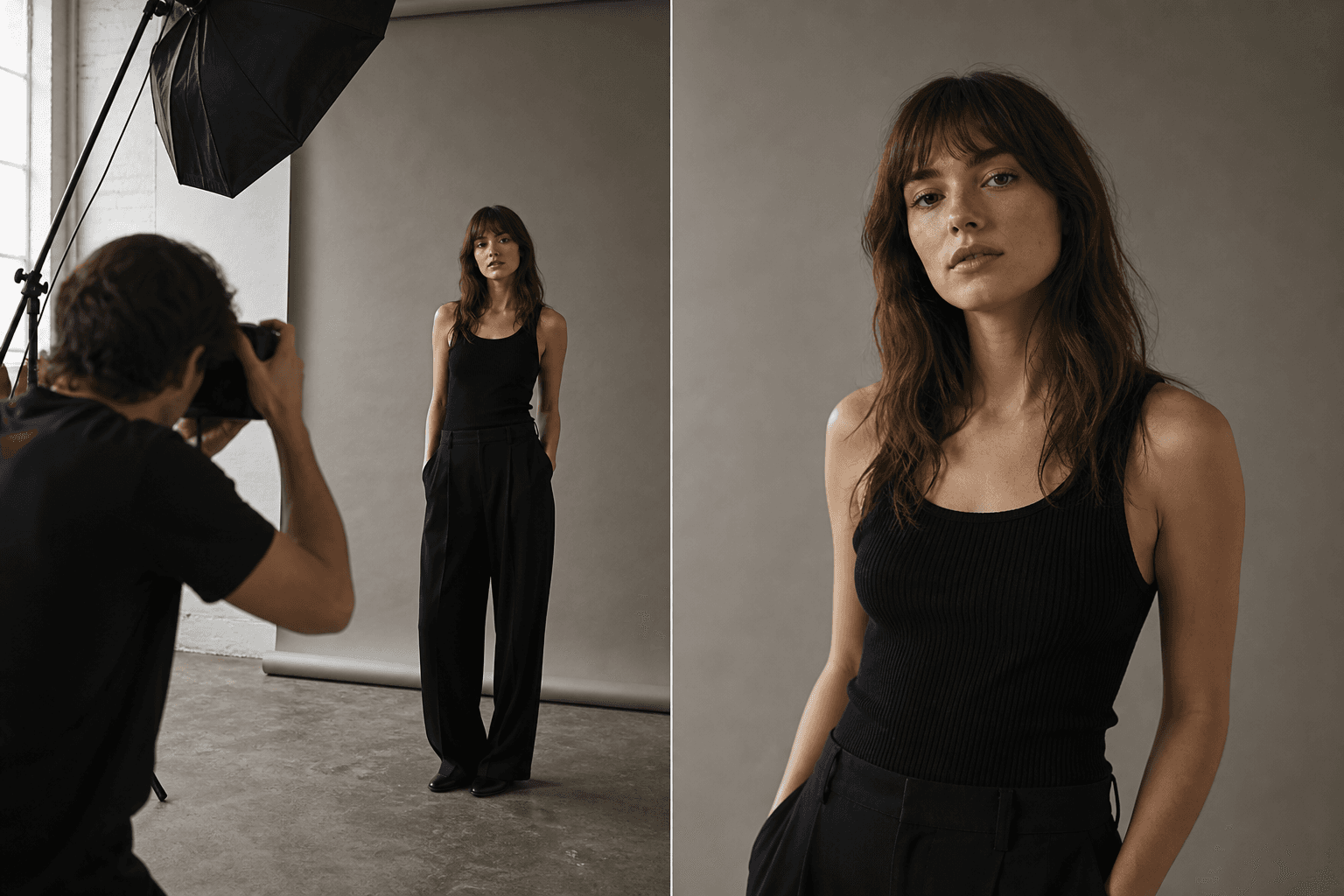
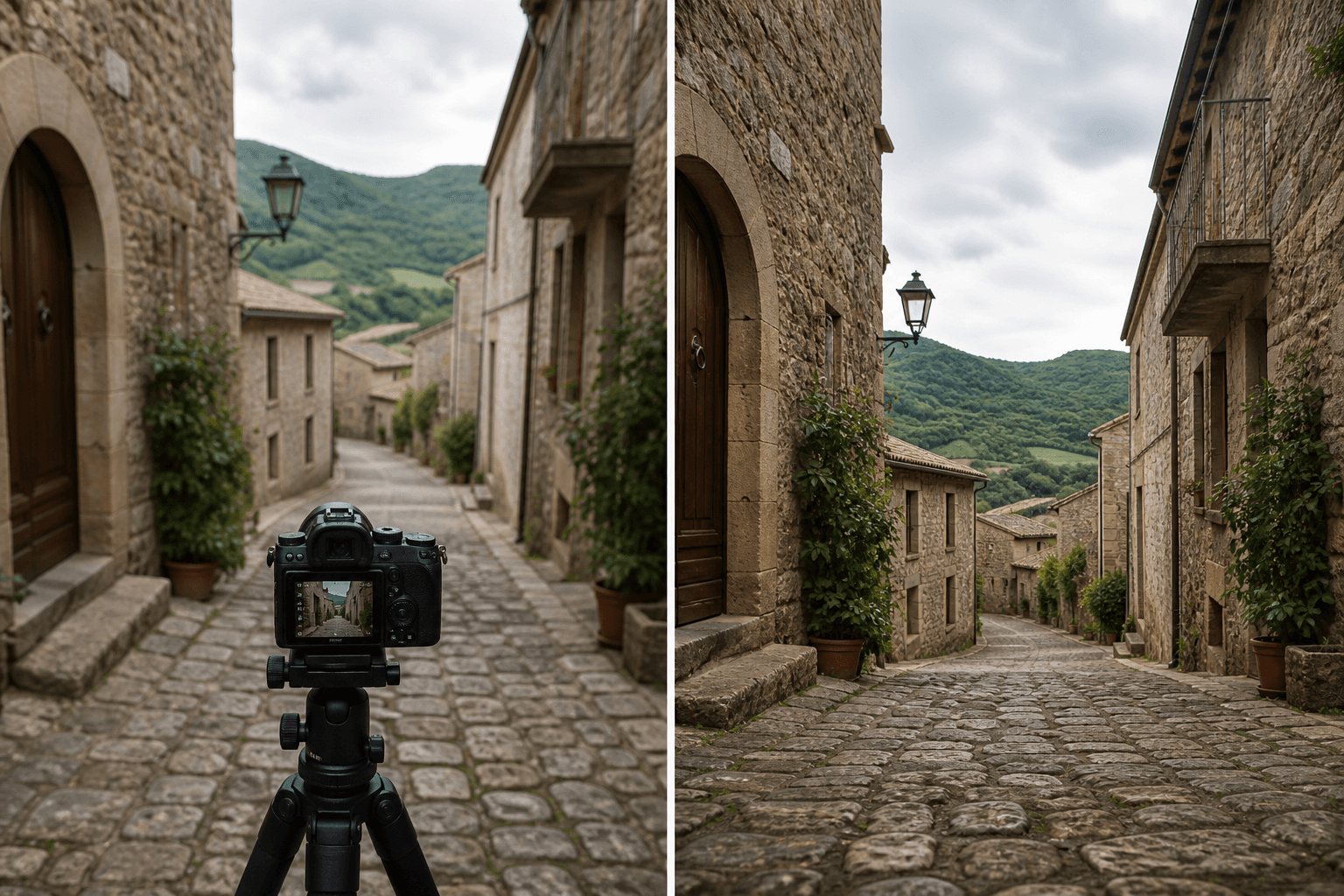
For each perspective: term, film terminology, effect, focal length, equipment — plus one AI illustration as a diptych (left typical setup, right typical result). The images illustrate the perspective; they don't replace a real shoot on set.
00
Basics
Perspective vs. shot size
Camera perspective = camera position and viewing angle relative to the subject. Eye level, on the ground or on a ladder? Frontal, profile or over the shoulder?
Shot size = how large the subject is in the frame — wide (full body + environment) to detail (eye or ring only). You control this with distance and focal length, not just height.
German
English
What changes
Eye / high / low angle
Eye / High / Low Angle
Camera height & tilt
Frontal / profile / three-quarter
Frontal / Profile / 3/4
Position around subject
Wide / medium / close-up
Wide / Medium / Close-Up
Distance & frame
Dutch angle
Dutch Angle
Tilted horizon (roll axis)
Two axes — angle and frame — plus special cases
Focal lengths are guidelines for full frame. On APS-C or MFT the same mm numbers act "longer" — what matters is field of view. The Field of view calculator and Which focal length for what help with conversion.
01
Map
All perspectives at a glance
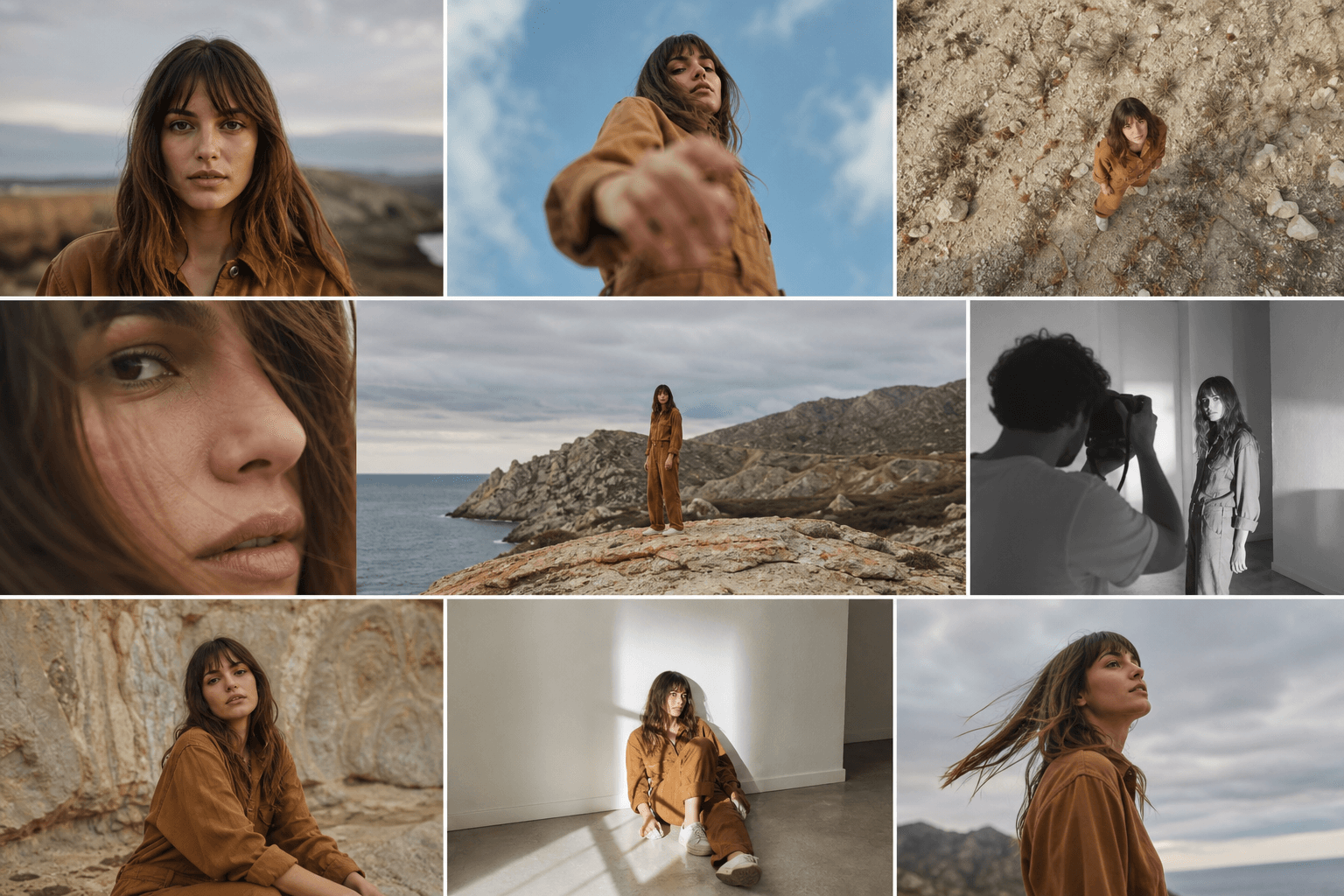
The overview below is an AI illustration — it orients you visually before you dive into individual perspectives.
For each perspective a diptych follows: left a typical setup situation (camera, position, light), right the corresponding result — both as illustrative examples, not frames from the same real shoot.
◆ Lightroom PresetsBundle
Photos with film character
9 Lightroom presets inspired by Portra, Kodak, Fuji & Ilford — for street, portrait and landscape. One-time €29, no subscription.
Vertical perspectives determine whether your subject looks powerful, vulnerable or on equal footing. What matters is not only where the camera stands, but how steep the viewing angle is — and whether you use wide angle to amplify the effect.
Perspective
German
Effect
Focal length
Eye Level
Normalsicht / Augenhöhe
Neutral, natural, equal — baseline for all other angles
Power, dominance, heroism — subject looks larger than the viewer
24–35 mm
Worm's Eye View
Froschperspektive / Wurmaufsicht
Extreme threat from above, awe, surrealism
14–24 mm
Top Shot / Overhead
Top-Shot / Draufsicht (90°)
Alienation, pattern, collectivity — people become shapes
24–50 mm
Vertical — overview of all perspectives in this category
Eye Level (*Normalsicht / Augenhöhe*)
Eye level is the invisible norm: the viewer feels on equal footing with the subject. In portraits it looks honest and understated — that's why I use it for business headshots when trust matters more than drama. In film EL is standard coverage for dialogue because nobody "dominates".
Film term
Effect
Focal length (FF)
Equipment
Camera height
Eye-Level Shot (EL)
Neutral, natural, equal — baseline for all other angles
35–50 mm
Handheld, tripod, shoulder rig
At subject eye level (approx. 1.50–1.70 m for adults)
Eye Level — technical quick reference
AI illustration — left: setup · right: result — Eye Level (35–50 mm). Film reference: Dialog in *Before Sunrise* (1995)
Practice: Kneel down for children or small subjects — otherwise you look down even though you're shooting "normally". For Portrait poses (30–45° body angle): EL + three-quarter view is the sweet spot.
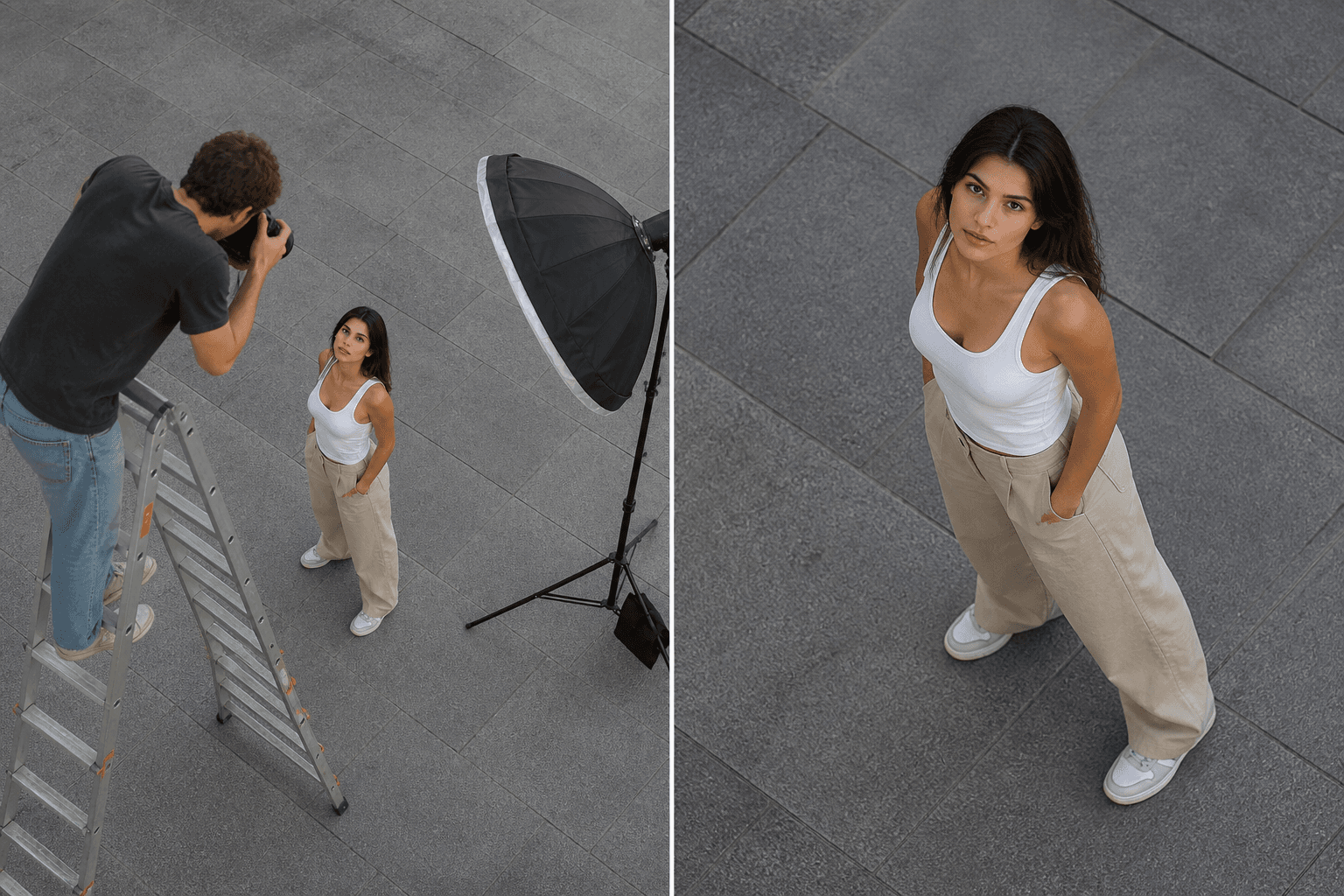
High Angle / Bird's Eye (*Aufsicht / Vogelperspektive*)
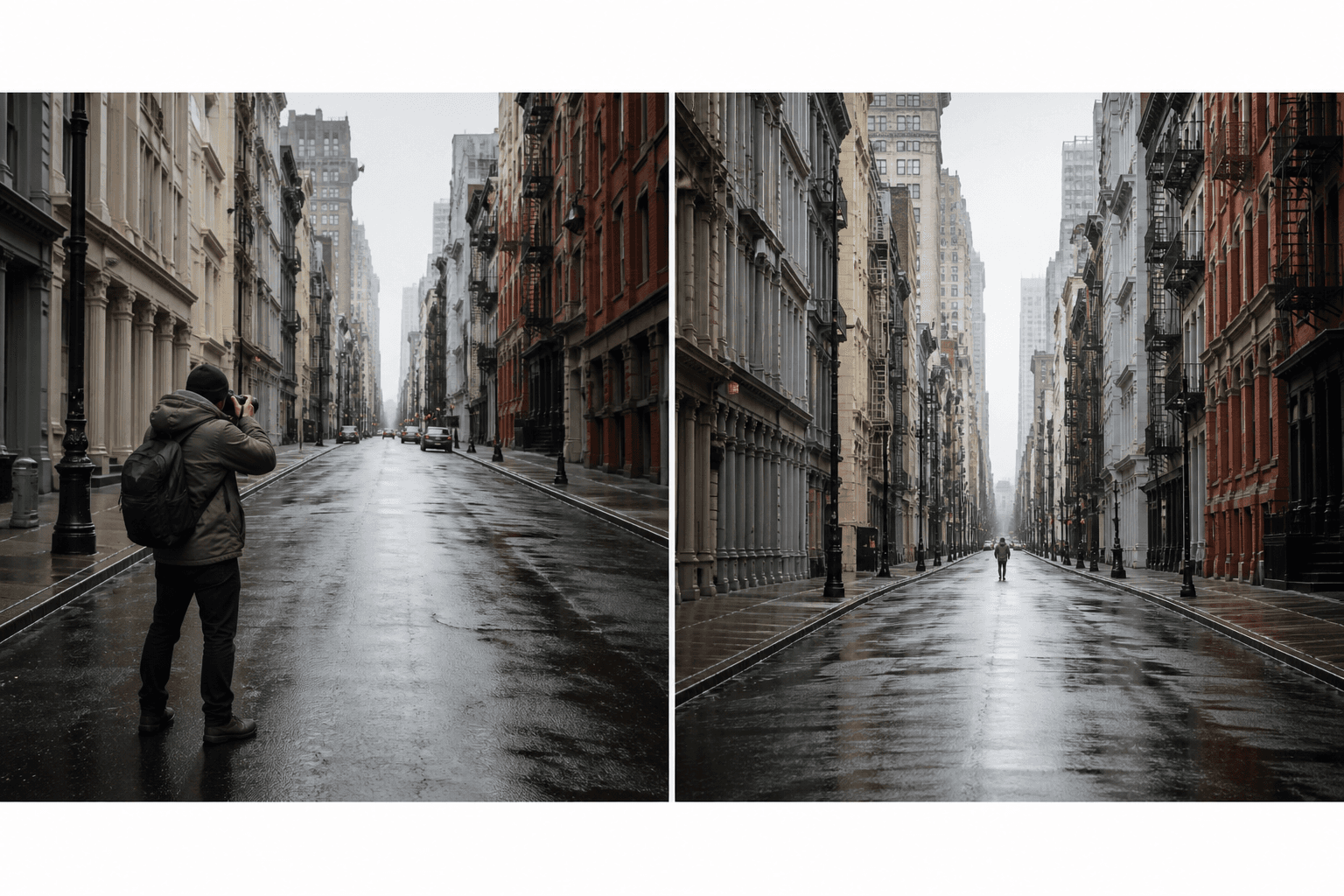
High angle turns heroes into figures in a larger world. The higher and steeper, the stronger the distance. Bird's eye means diagonal from very far above — not exactly vertical (that would be top shot).
Ladder, tripod, crane, drone (diagonal from above)
Above the subject, looking down (approx. 5–45°)
High Angle / Bird's Eye — technical quick reference
AI illustration — left: setup · right: result — High Angle / Bird's Eye (24–50 mm). Film reference: Dusch-Szene *Psycho* (1960); Crop-Duster *North by Northwest*
Practice: Ladder or balcony instead of expensive drone. Wide angle shows more context; tele from above isolates the subject on the ground. High angle + wide shot = loneliness in space.
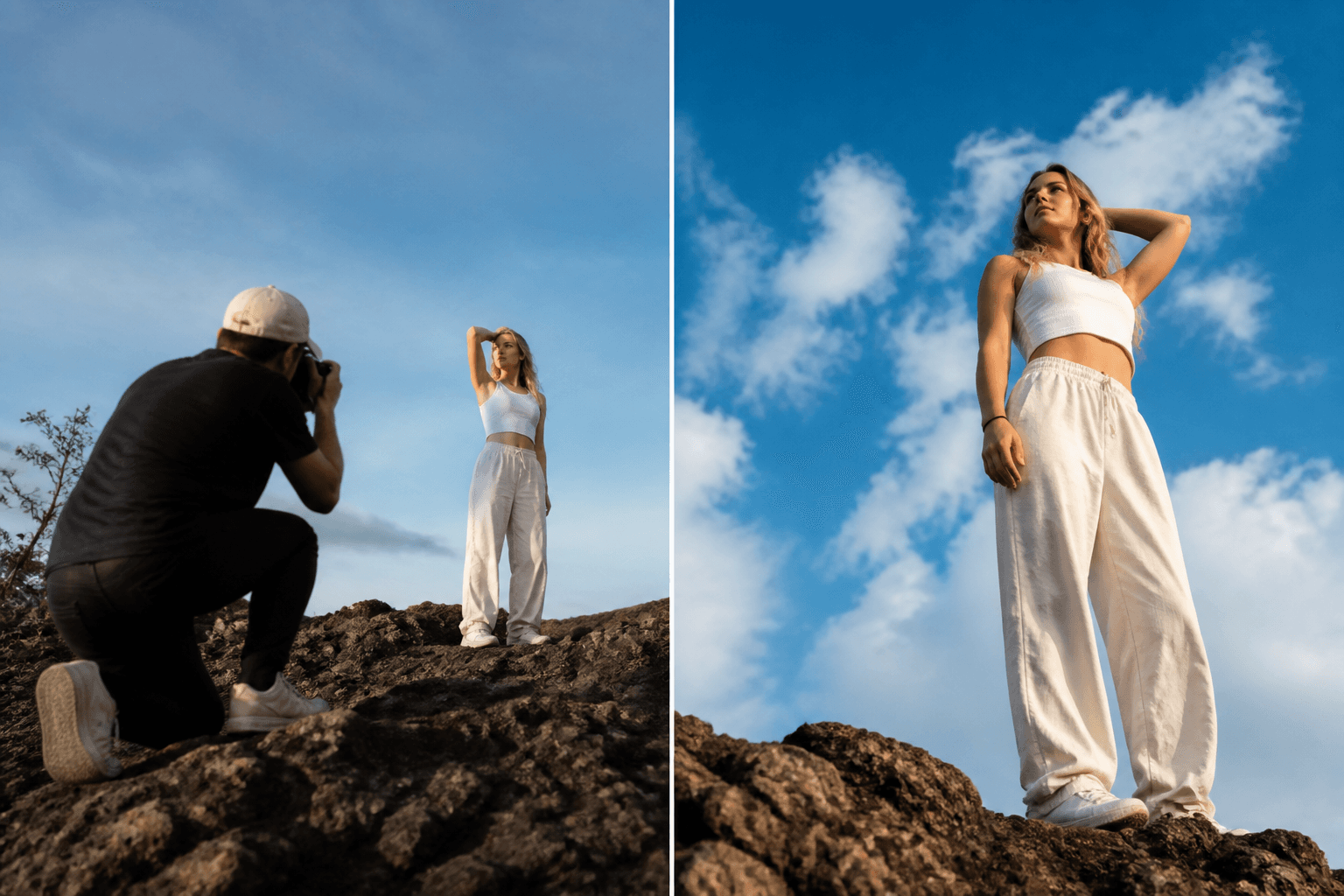
Low Angle (*Untersicht / Low Angle*)
Low angle is the classic for "important" people: CEO portraits, architecture, sneaker ads. Sky or ceiling becomes the area behind the subject — they rise into the frame.
Film term
Effect
Focal length (FF)
Equipment
Camera height
Low-Angle Shot (LA)
Power, dominance, heroism — subject looks larger than the viewer
24–35 mm
Handheld, ground-level tripod, kneeling
Below eye level, looking up (knee to hip height)
Low Angle — technical quick reference
AI illustration — left: setup · right: result — Low Angle (24–35 mm). Film reference: Eröffnung *Der Pate* (1972)
Practice: Camera at navel height, tilt slightly upward. Wide angle lengthens legs and enlarges the body — careful with portraits or nose and chin dominate.
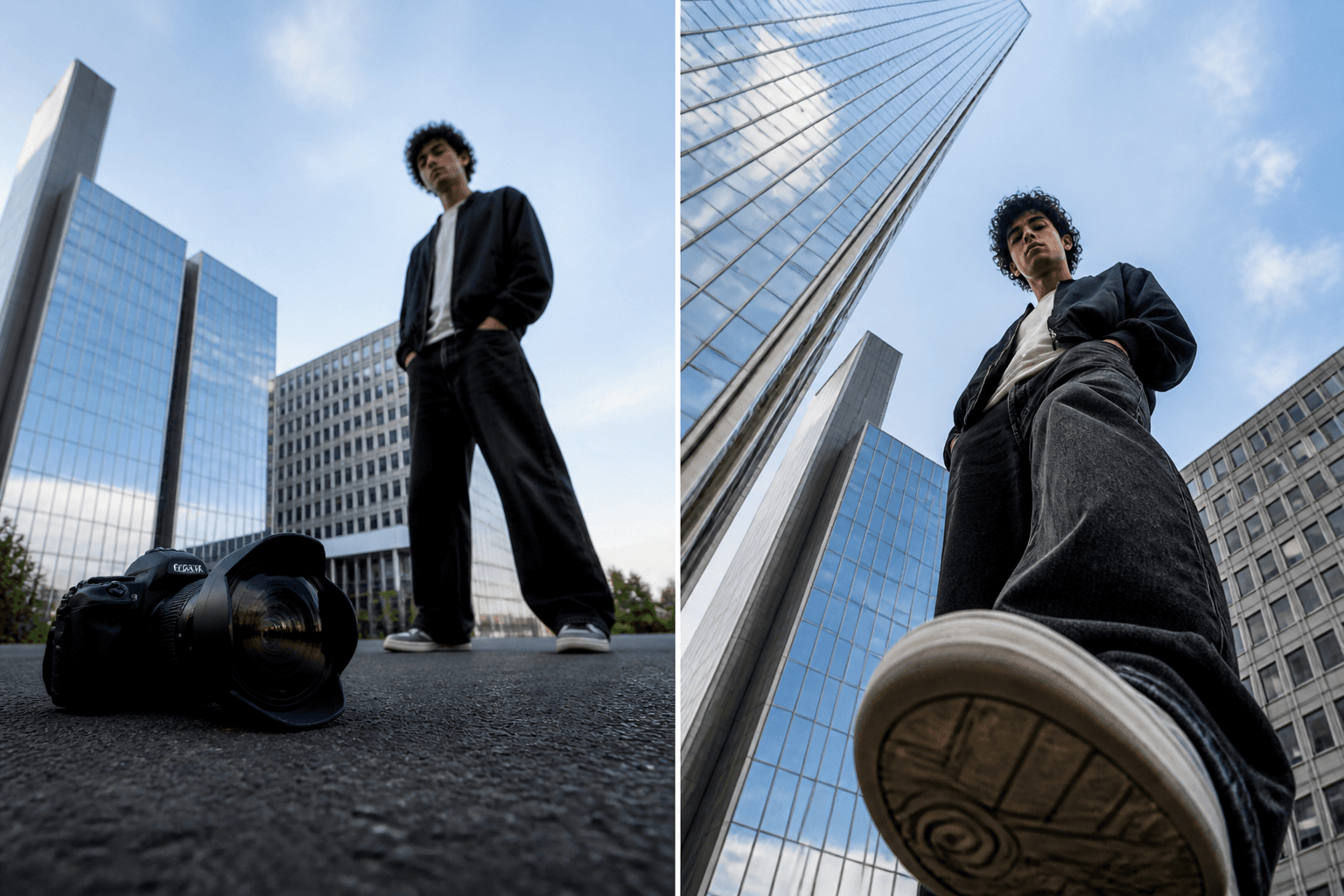
The extreme variant of low angle: you're practically on the asphalt. Skyscrapers, trees or standing people become monoliths. The effect is deliberately unnatural — perfect for drama, sport, street.
Film term
Effect
Focal length (FF)
Equipment
Camera height
Extreme Low Angle
Extreme threat from above, awe, surrealism
14–24 mm
Camera on ground, mirror rig, ultra-wide angle
Near or on ground, steep upward look (up to ~80°)
Worm's Eye View — technical quick reference
AI illustration — left: setup · right: result — Worm's Eye View (14–24 mm). Film reference: Untersichten in *Citizen Kane* (1941); Architektur-Klassiker
Practice: LCD or remote app, otherwise you're guessing composition. Vignetting and wide-angle distortion are part of the look — don't "fix" them.
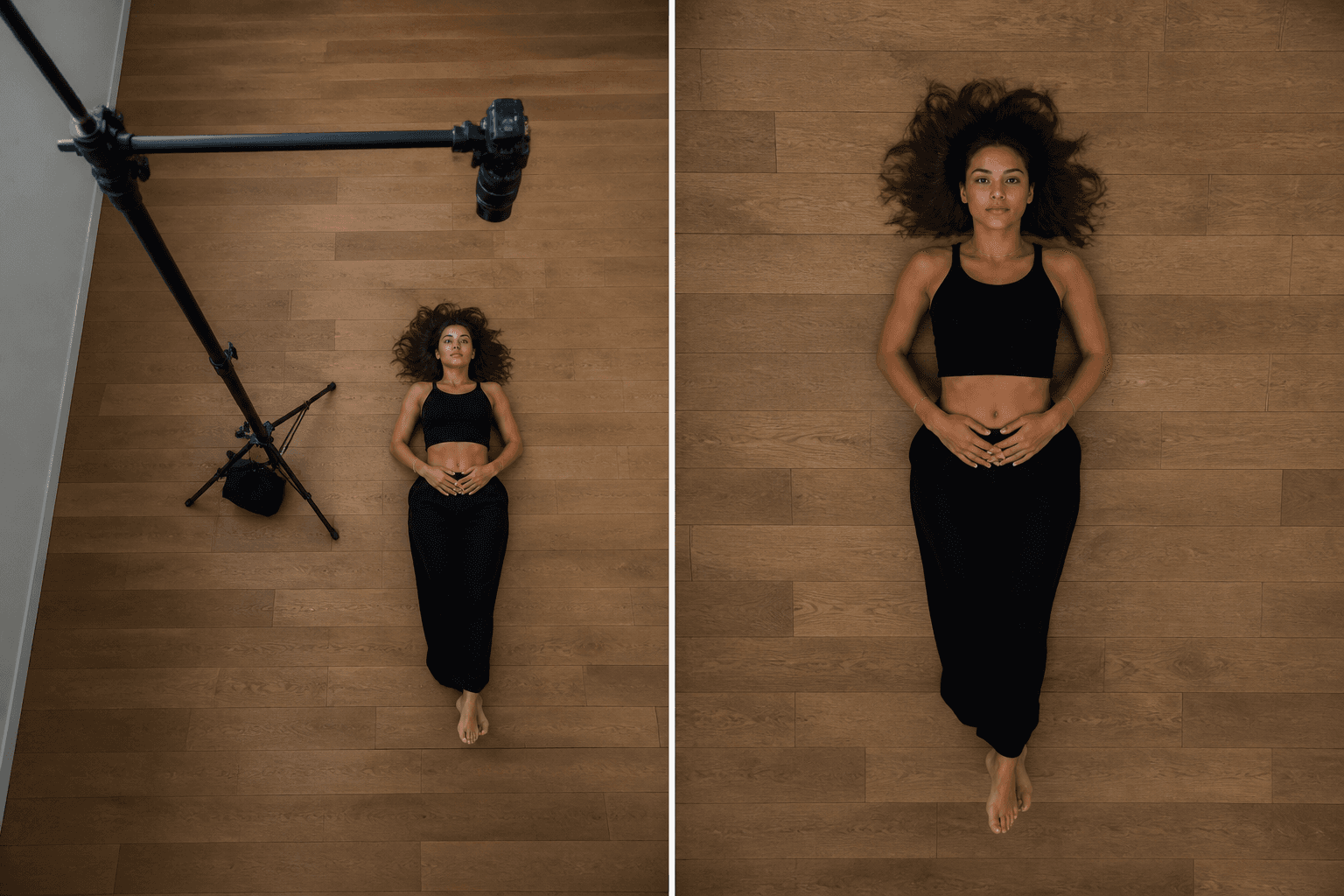
Top Shot / Overhead (*Top-Shot / Draufsicht (90°)*)
Top shot is not "bird's eye": the camera looks exactly from above — no diagonal view. The scene looks graphic, almost like a plan.
Film term
Effect
Focal length (FF)
Equipment
Camera height
Top Shot (90° Overhead)
Alienation, pattern, collectivity — people become shapes
24–50 mm
Crane, drone, overhead rig, ladder with vertical arm
Vertically above subject (~90°)
Top Shot / Overhead — technical quick reference
AI illustration — left: setup · right: result — Top Shot / Overhead (24–50 mm). Film reference: Busby-Berkeley-Tänze; Straße in *Taxi Driver* (1976)
Practice: Check parallel alignment (spirit level or grid). Shadows fall radially — side light models, top light flattens.
03
Horizontal
Position around the subject: frontal, profile, POV
Horizontally you move around your subject — or let the viewer see through their eyes. This is the domain of portrait, dialogue and storytelling: the same person can look confrontational head-on and distant in profile.
Perspective
German
Effect
Focal length
Frontal View / Full Face
Frontalansicht
Directness, confrontation, intensity
50–85 mm
Profile View
Profilansicht
Elegance, distance, contour — less accessible than frontal
50–135 mm
Three-Quarter View
Dreiviertelansicht
Most natural portrait perspective — depth + readability
Mystery, departure, loneliness — viewer follows the figure
35–85 mm
Horizontal — overview of all perspectives in this category
Frontal View / Full Face (*Frontalansicht*)
Frontal looks at you — or through you. Symmetry looks graphic and sometimes distant. For LinkedIn headshots often too "passport photo" — better three-quarter.
Film term
Effect
Focal length (FF)
Equipment
Camera height
On-Axis
Directness, confrontation, intensity
50–85 mm
Tripod, handheld
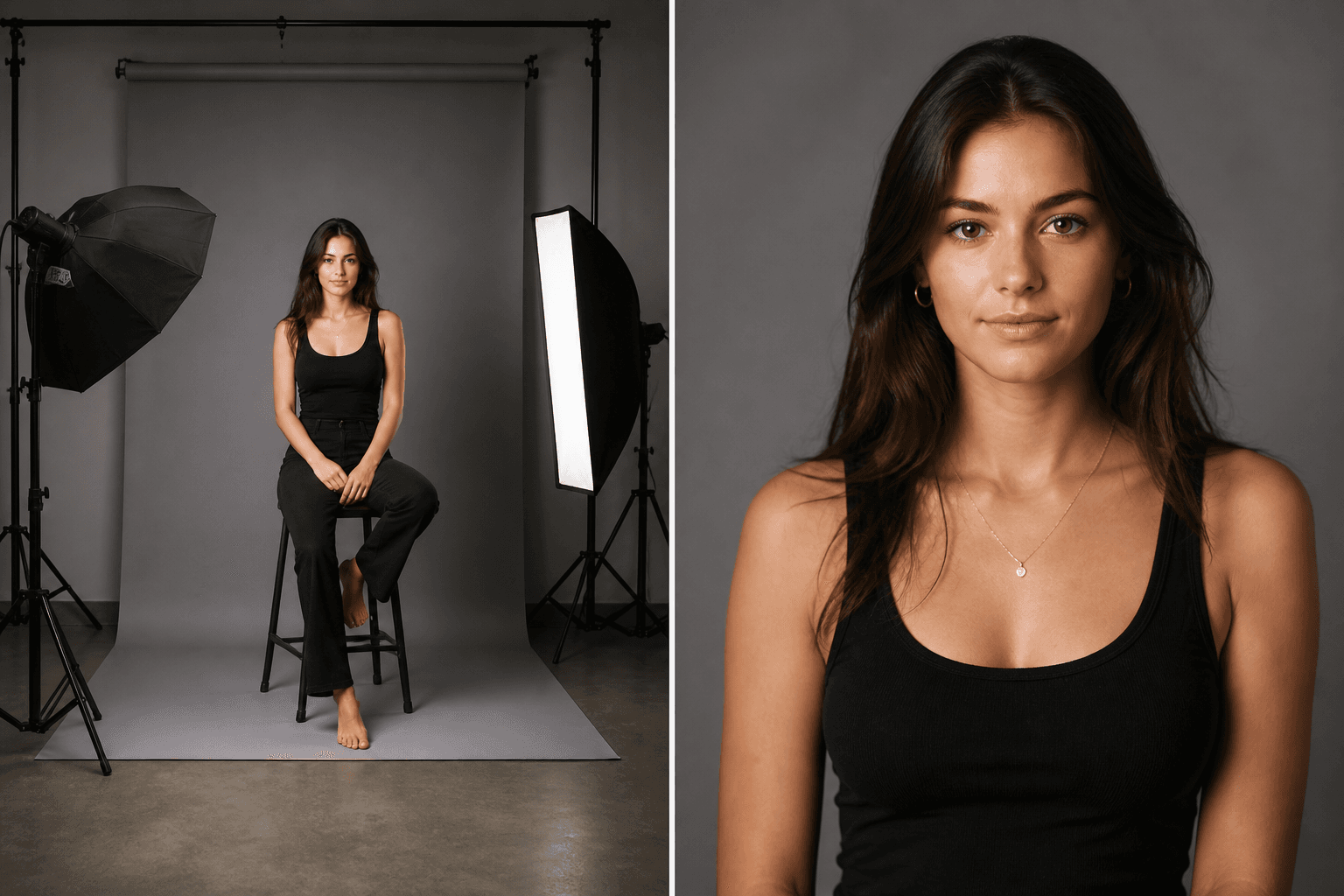
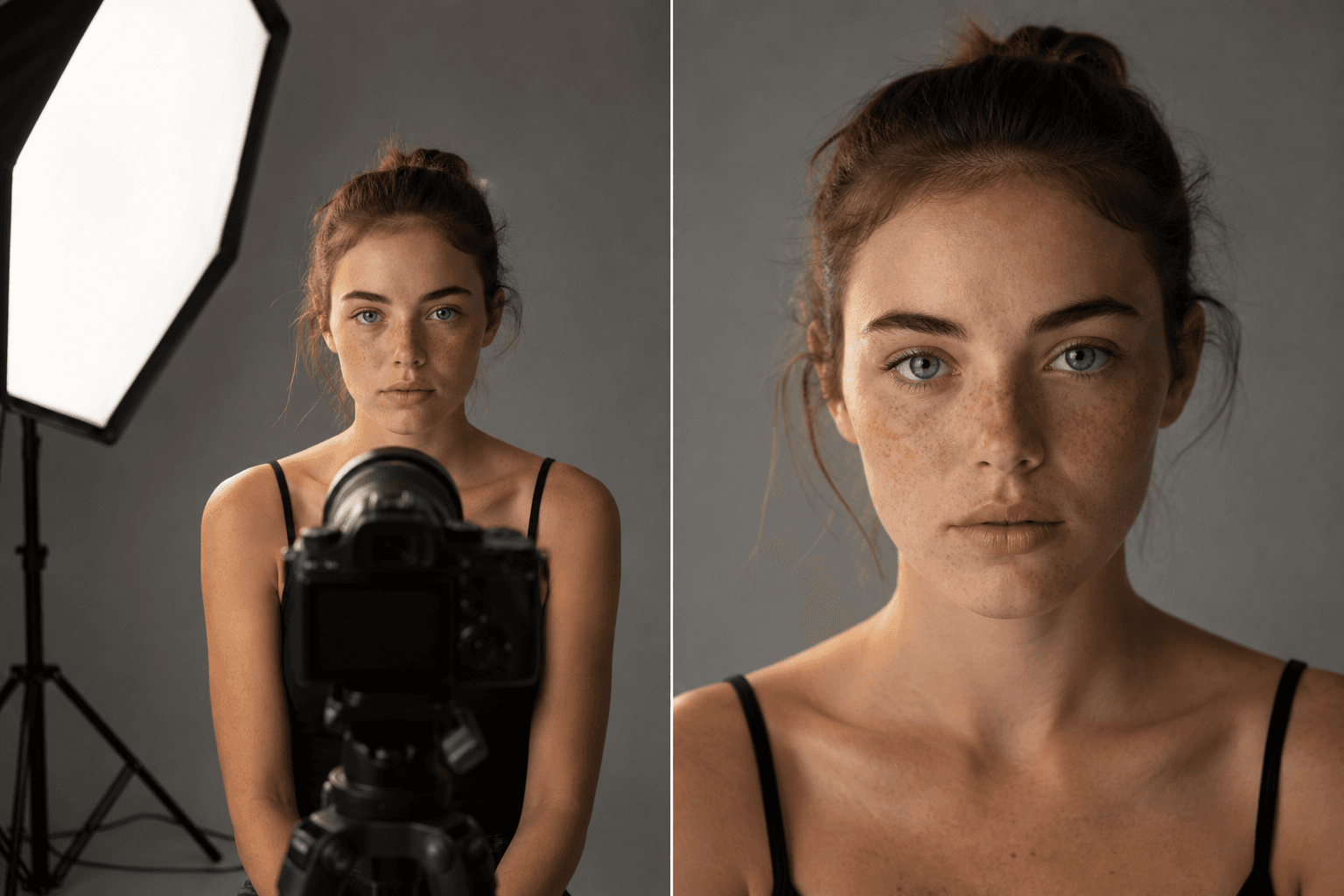
Eye level, camera frontal on subject
Frontal View / Full Face — technical quick reference
AI illustration — left: setup · right: result — Frontal View / Full Face (50–85 mm). Film reference: Dolly-Zoom *Vertigo* (1958); Pass-/Headshot-Frontal
Practice: Eyes at same height as lens. At 85 mm keep distance or the face looks flat or distorted.
Profile View (*Profilansicht*)
Profile reduces the face to line and silhouette. Strong with hats, headwear, smoke, dramatic light from front-back.
Film term
Effect
Focal length (FF)
Equipment
Camera height
Profile Shot
Elegance, distance, contour — less accessible than frontal
50–135 mm
Tripod, handheld
Eye level, camera 90° to the side
Profile View — technical quick reference
AI illustration — left: setup · right: result — Profile View (50–135 mm). Film reference: Holbein-Porträts; *The Great Escape* (1963)
Practice: Watch the "nose line" — too far in front of camera and the nose dominates. Stand slightly behind the subject's shoulder line.
Three-Quarter View (*Dreiviertelansicht*)
Three-quarter is my default for portraits and business: face readable, body modelled, less confrontational than frontal. Fits Portrait poses (30–45° body angle).
Film term
Effect
Focal length (FF)
Equipment
Camera height
Three-Quarter Angle
Most natural portrait perspective — depth + readability
50–85 mm
Tripod, reflector, handheld
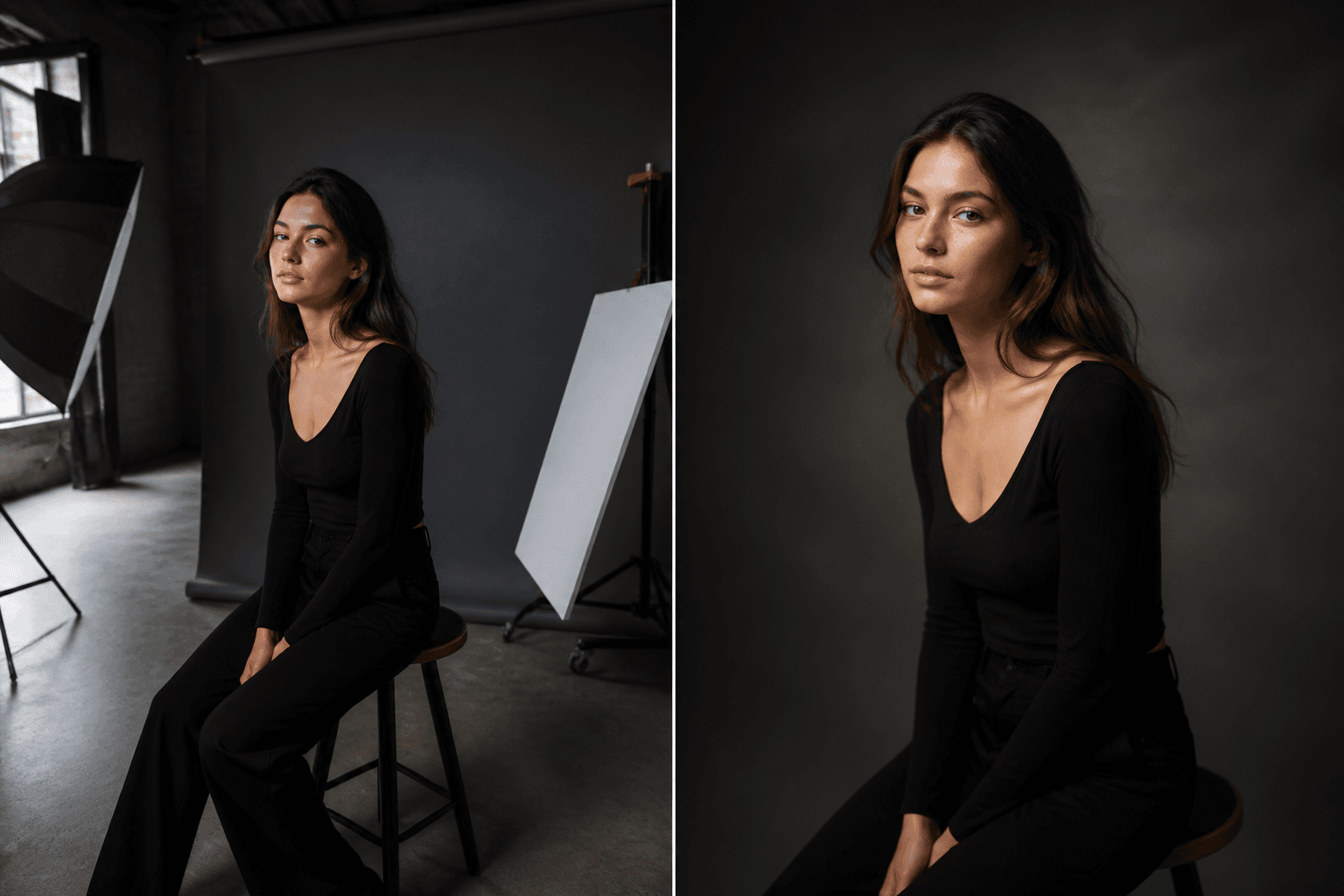
Eye level, subject ~30–45° to camera
Three-Quarter View — technical quick reference
AI illustration — left: setup · right: result — Three-Quarter View (50–85 mm). Film reference: Rembrandt-Porträts; Standard-Interview-Framing
Practice: Turn subject until both eyes visible — but far cheek still shows a line. 85 mm at f/2–2.8 separates from background.
Over-the-Shoulder (*Über-die-Schulter*)
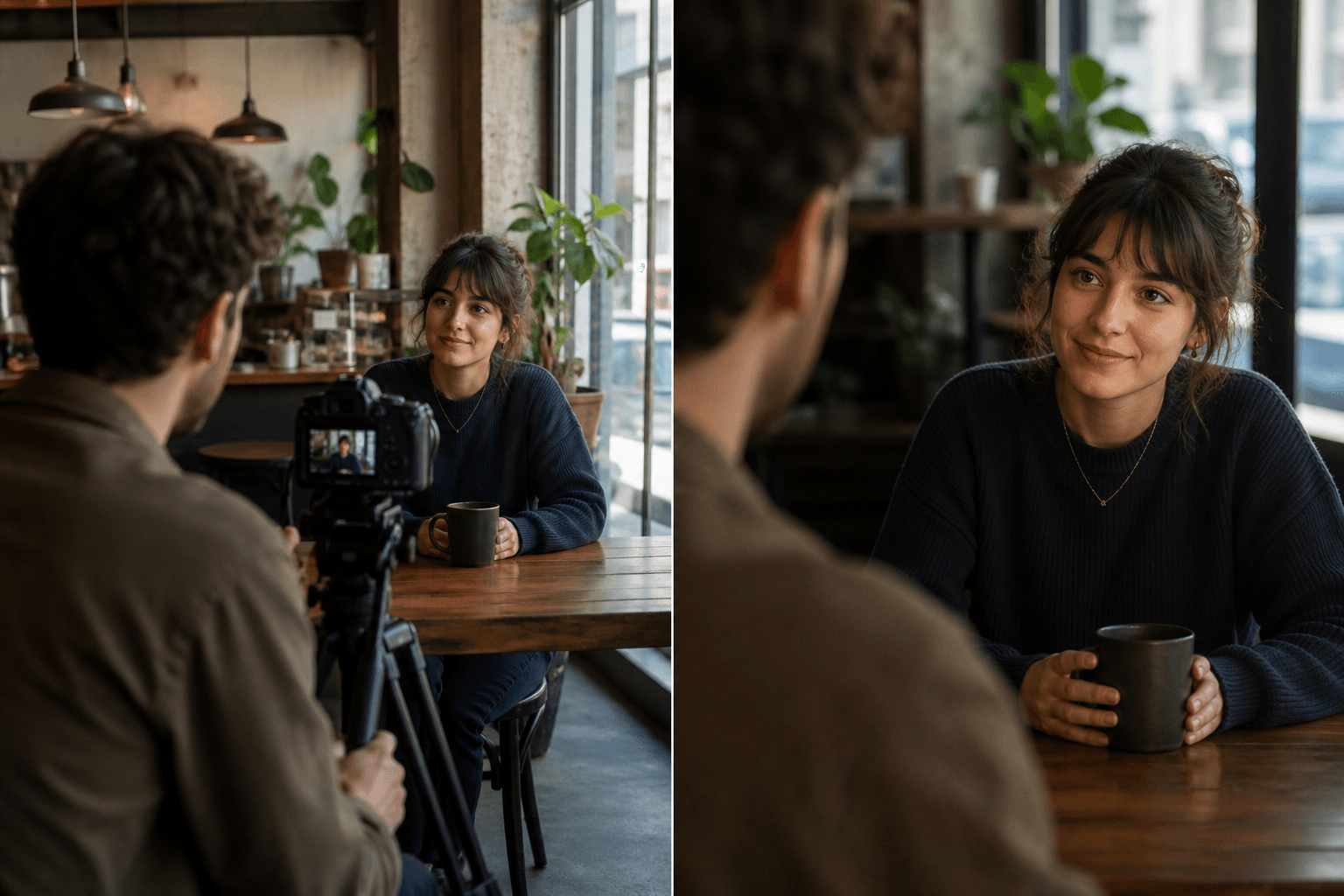
OTS connects viewer with one figure and shows the other. Shoulder or head in foreground (often blurred) frames the shot.
AI illustration — left: setup · right: result — Over-the-Shoulder (50–85 mm). Film reference: Dialog-Szenen *Der Pate* (1972)
Practice: Foreground not too large — max. 1/3 of frame. Focus on face in background. Also usable in couple and coaching photos.
Point of View (*Subjektive Kamera / POV*)
POV makes the viewer an actor. Hands in lower frame reinforce the effect (first person).
Film term
Effect
Focal length (FF)
Equipment
Camera height
POV Shot
Immersion — viewer sees through character's eyes
35–50 mm
Handheld, gimbal, chest rig if needed
Exactly character eye level and viewing direction
Point of View — technical quick reference
AI illustration — left: setup · right: result — Point of View (35–50 mm). Film reference: Eröffnung *Halloween* (1978); *Das Fenster zum Hof* (1954)
Practice: 35–50 mm roughly matches human vision. For travel and event stories: hold camera where you'd stand — not "pretty" from outside.
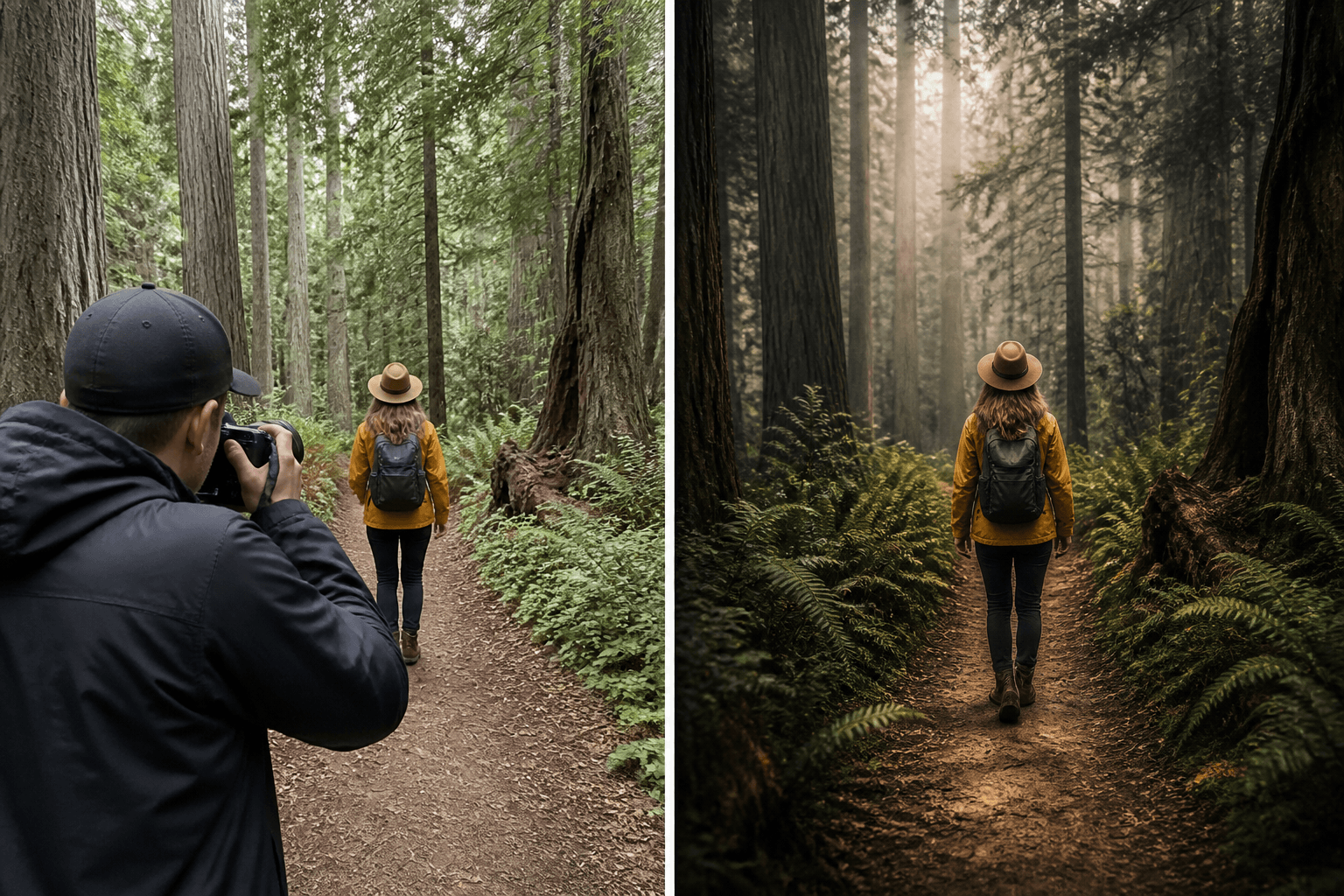
Back View / From Behind (*Rückenansicht / Von hinten*)
From behind you show where someone goes — not exactly who. Hidden face = projection surface.
Film term
Effect
Focal length (FF)
Equipment
Camera height
Back to Camera
Mystery, departure, loneliness — viewer follows the figure
35–85 mm
Handheld, tripod
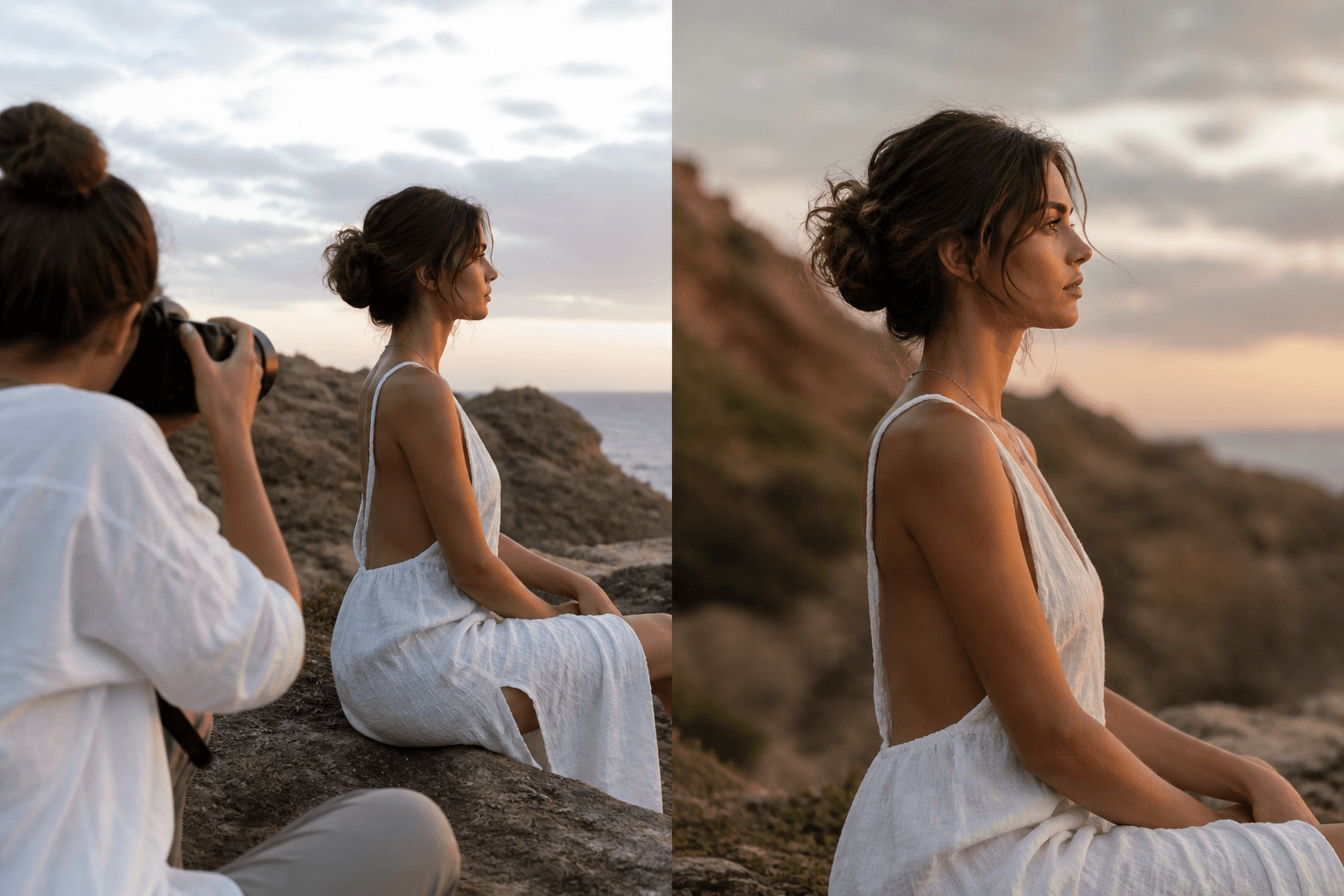
Eye level behind subject
Back View / From Behind — technical quick reference
AI illustration — left: setup · right: result — Back View / From Behind (35–85 mm). Film reference: Wanderer über dem Nebelmeer (Friedrich); viele Trail-Reels
Practice: Silhouette or bright backlight strengthens the story. POV proximity: slightly over shoulder.
04
Shot size
Frame & distance: wide shot to detail
Shot size is not the same as camera angle — but you always combine both. A wide shot from low angle tells a different story than a close-up at eye level. Film terminology (MS, CU, ECU) is your vocabulary for clear briefings.
Perspective
German
Effect
Focal length
Establishing Shot
Etablierungsaufnahme
Orientation — where? when? what context?
16–35 mm
Extreme Wide Shot
Supertotale / Extreme Weite
Epic scale — human small in the world
14–24 mm
Wide Shot / Long Shot
Totale / Weite Einstellung
Body + environment — action in space
24–35 mm
Medium Shot
Halbnah / Halbtotal
Balance person/context — body language readable
40–60 mm
Cowboy Shot
Amerikanische Einstellung
Confident, action-ready — Western classic
35–50 mm
Medium Close-Up
Naheinstellung / Halbnah (Brust)
More personal — face dominant, shoulders visible
60–85 mm
Close-Up
Großaufnahme / Close-Up
Intimacy, expression, reaction
75–105 mm
Extreme Close-Up
Detailaufnahme / Extreme Close-Up
Intensity, focus on one detail — can feel oppressive
90–135 mm oder Macro
Two-Shot
Zweier-Einstellung
Relationship between two people — closeness or tension
35–50 mm
Shot size — overview of all perspectives in this category
Establishing Shot (*Etablierungsaufnahme*)
Establishing is functional: a scene needs anchors. Skyline, facade, landscape — then the camera can move closer.
Film term
Effect
Focal length (FF)
Equipment
Camera height
Establishing Shot (ES)
Orientation — where? when? what context?
16–35 mm
Tripod, drone, crane
Variable; often elevated or far away
Establishing Shot — technical quick reference
AI illustration — left: setup · right: result — Establishing Shot (16–35 mm). Film reference: Auenlandschaft *Der Herr der Ringe* (2001)
Practice: For photo stories: wide of location first, then details. Instagram carousel: image 1 = ES.
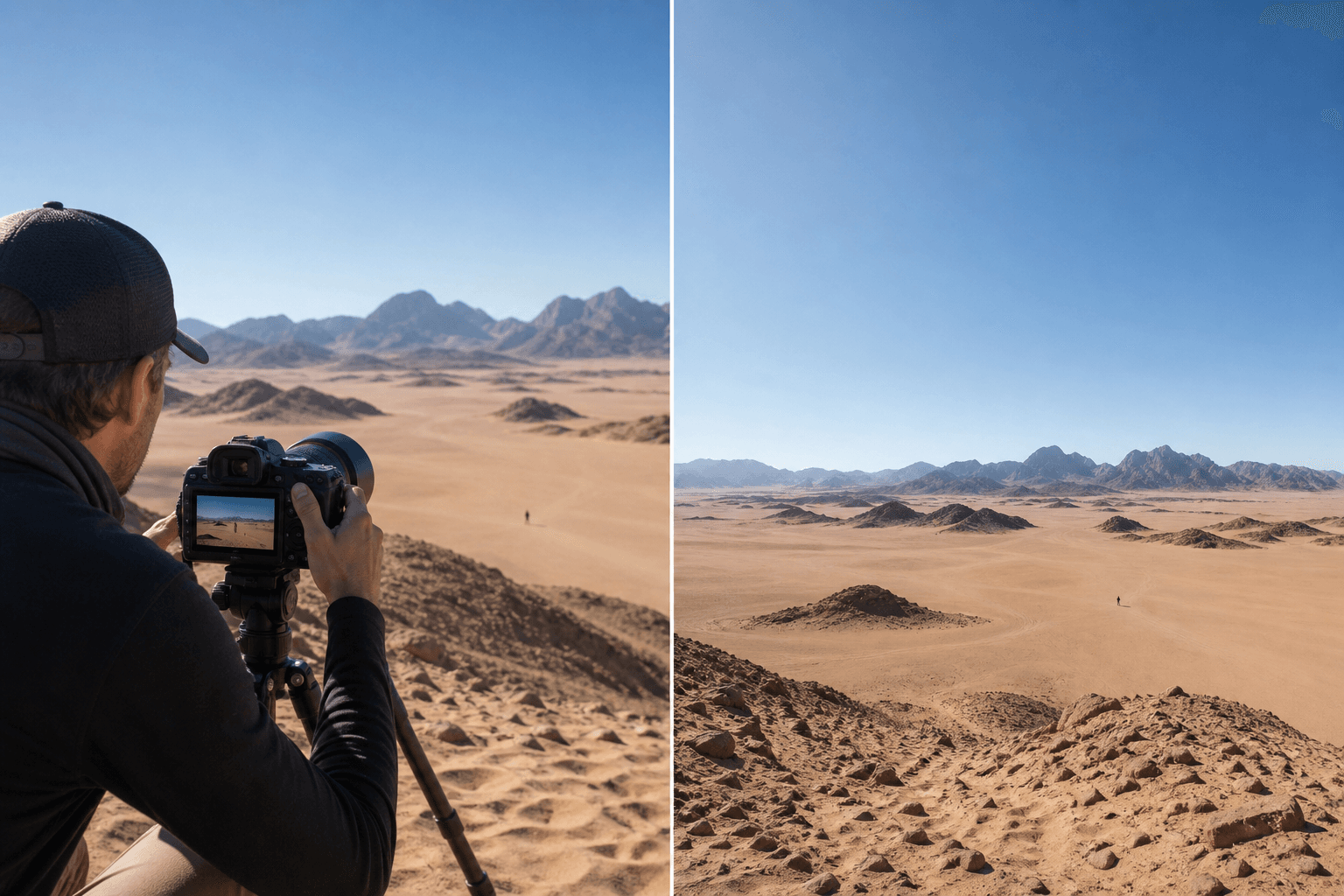
Extreme Wide Shot (*Supertotale / Extreme Weite*)
Extreme wide is more landscape than person. Figure optional — often just a dot in frame.
Film term
Effect
Focal length (FF)
Equipment
Camera height
ELS / EWS
Epic scale — human small in the world
14–24 mm
Tripod, drone
Often very far or high
Extreme Wide Shot — technical quick reference
AI illustration — left: setup · right: result — Extreme Wide Shot (14–24 mm). Film reference: Wüste *Lawrence von Arabien* (1962)
Practice: Ultra-wide or drone. Place horizon low (lower third) for scale.
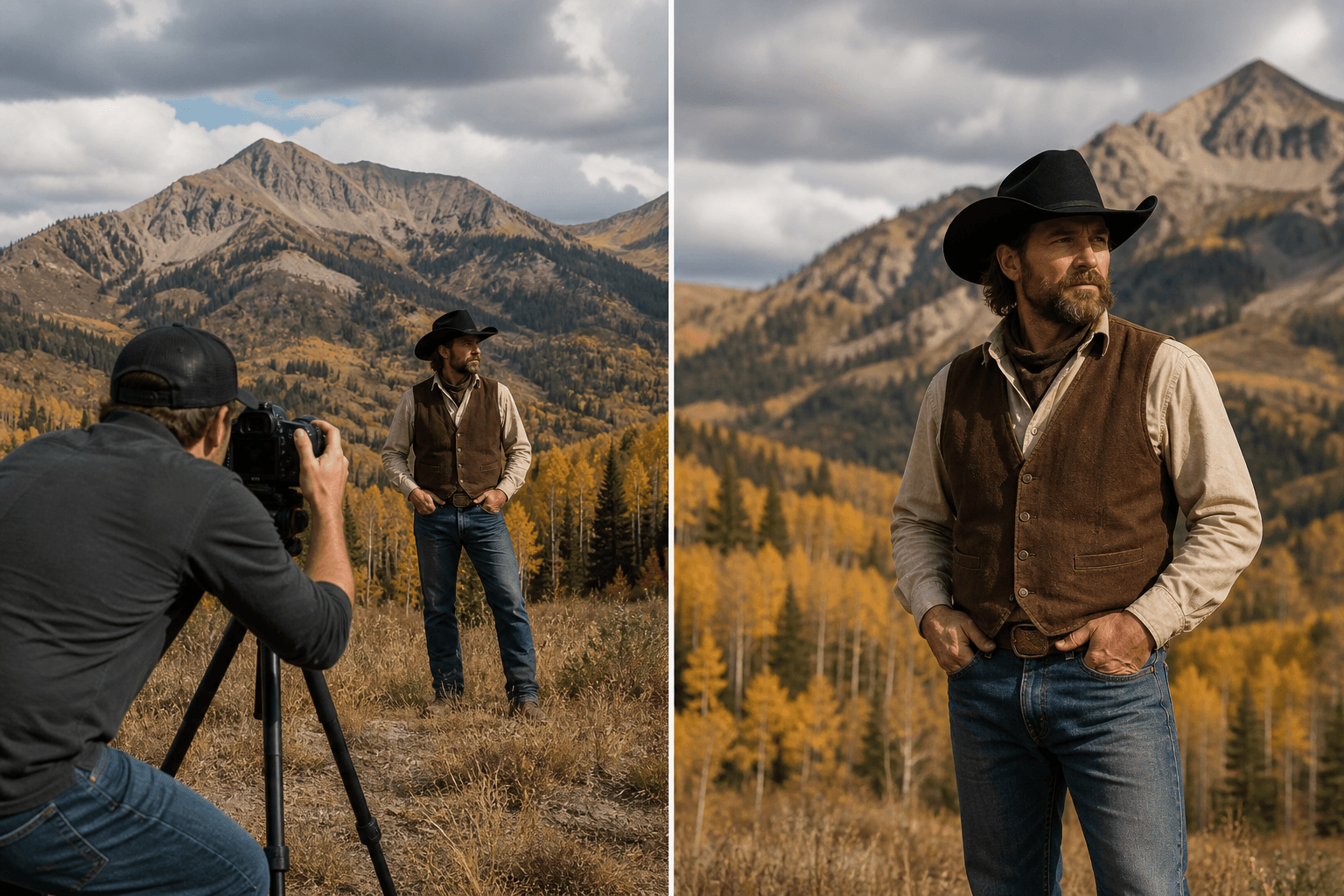
Wide Shot / Long Shot (*Totale / Weite Einstellung*)
Wide shot shows the full figure with context. You tell where and how someone stands — not just who.
Film term
Effect
Focal length (FF)
Equipment
Camera height
Wide Shot (WS)
Body + environment — action in space
24–35 mm
Tripod, handheld
Usually eye level
Wide Shot / Long Shot — technical quick reference
AI illustration — left: setup · right: result — Wide Shot / Long Shot (24–35 mm). Film reference: Western *Once Upon a Time in the West* (1968)
Practice: Horizon straight (unless Dutch deliberate). For groups: wide first, then zoom in — classic film coverage that structures reportage too.
Medium Shot (*Halbnah / Halbtotal*)
Medium shot is the workhorse: gesture, posture, jacket, hands — all visible. Ideal for workshops and speakers.
Film term
Effect
Focal length (FF)
Equipment
Camera height
Medium Shot (MS)
Balance person/context — body language readable
40–60 mm
Tripod, handheld
From waist up
Medium Shot — technical quick reference
AI illustration — left: setup · right: result — Medium Shot (40–60 mm). Film reference: TV-Dialog-Standard; *The Substance* (2024)
Practice: Cut at chest or waist. Don't accidentally land on "American" or "CU" — boundaries are team agreement.
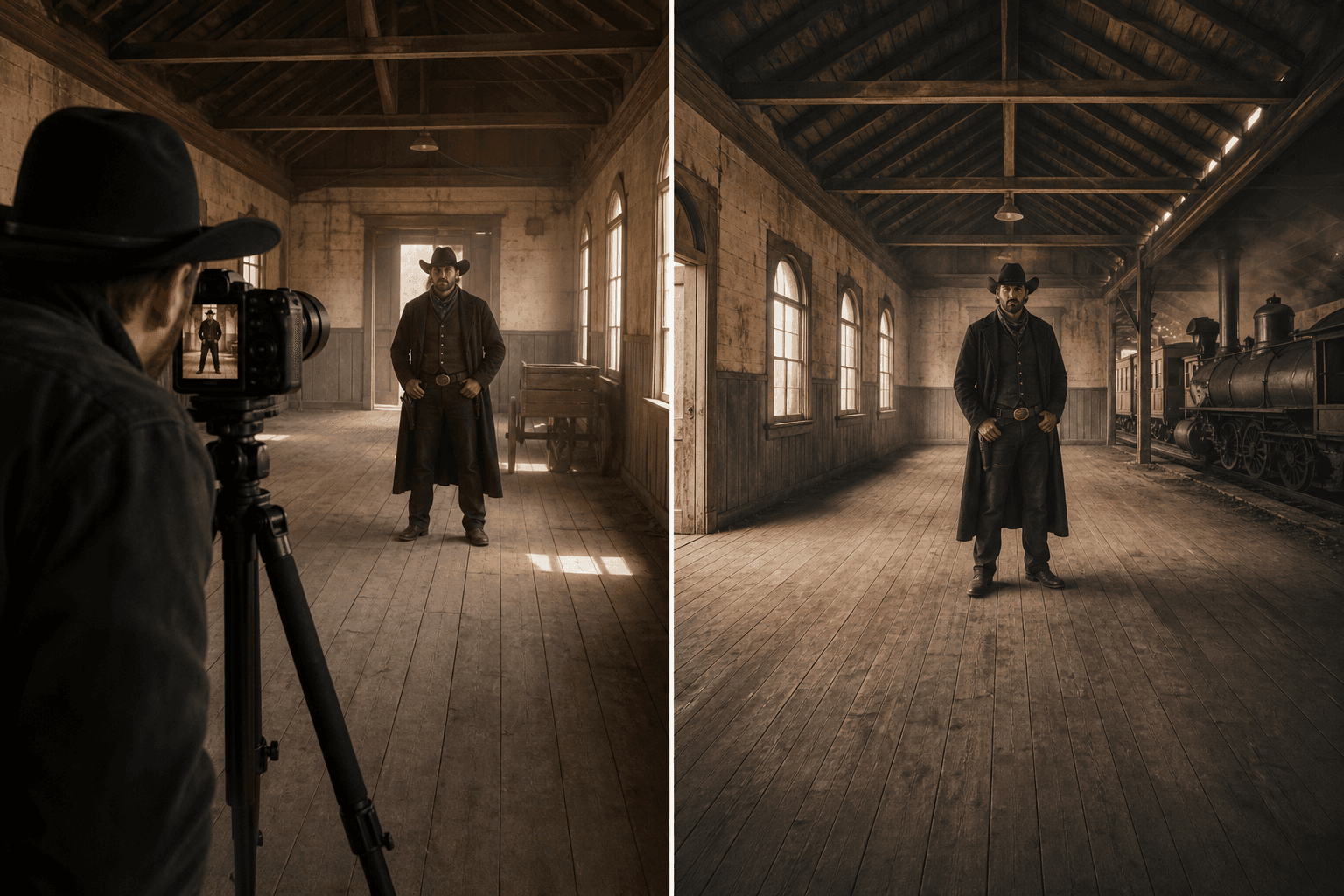
Cowboy Shot (*Amerikanische Einstellung*)
The "American" cuts roughly at mid-thigh — so you see hands, belt, holster (historically). Today: fashion, street, confidence portraits.
Film term
Effect
Focal length (FF)
Equipment
Camera height
Cowboy / American Shot
Confident, action-ready — Western classic
35–50 mm
Tripod, handheld
From mid-thigh upward
Cowboy Shot — technical quick reference
AI illustration — left: setup · right: result — Cowboy Shot (35–50 mm). Film reference: *Für eine Handvoll Dollar* (1964)
Practice: When cropping don't cut too tight at knees — lower third or mid-thigh.
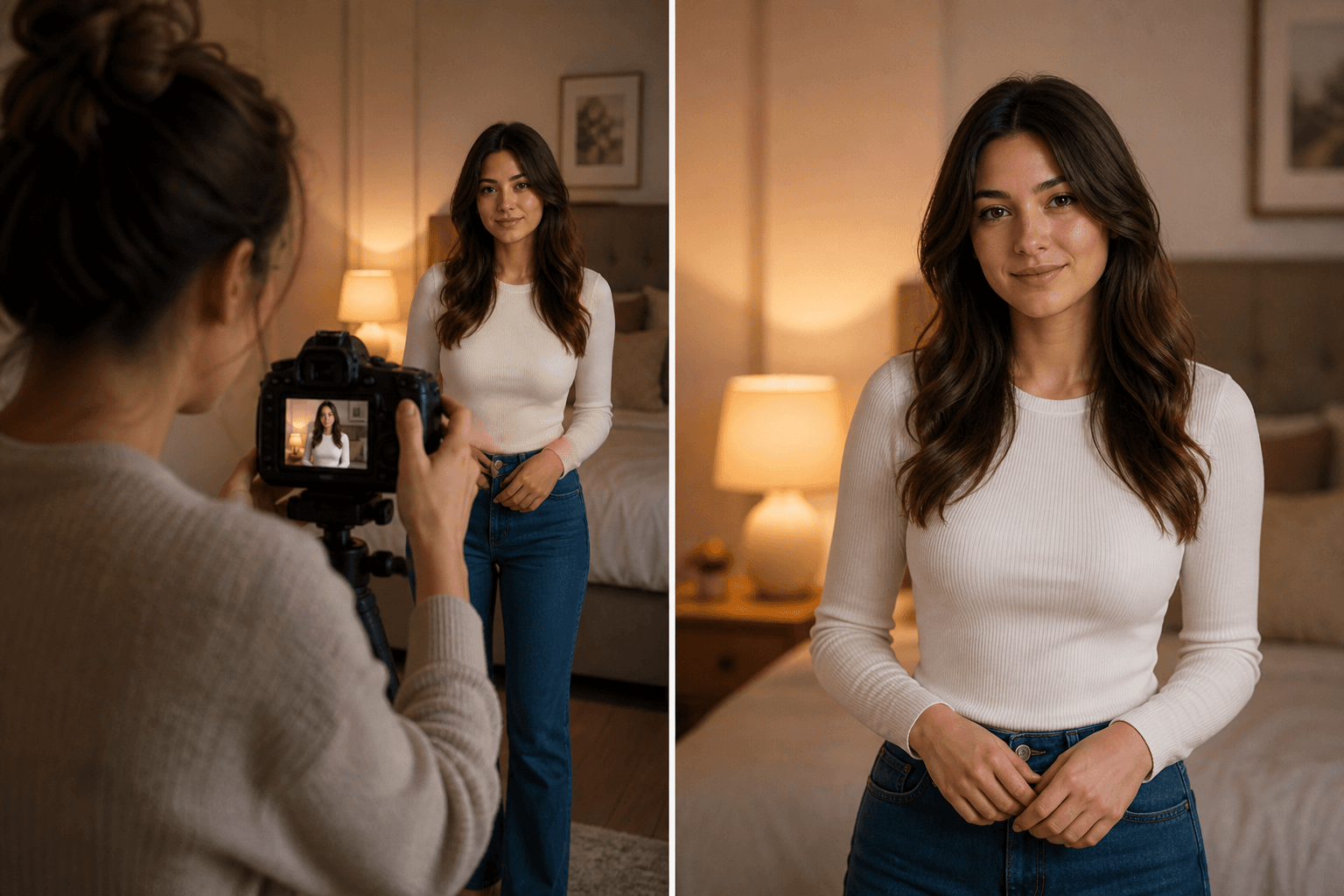
Medium Close-Up (*Naheinstellung / Halbnah (Brust)*)
MCU bridges medium shot and close-up. Emotion comes closer, context remains a hint.
Film term
Effect
Focal length (FF)
Equipment
Camera height
Medium Close-Up (MCU)
More personal — face dominant, shoulders visible
60–85 mm
Tripod, handheld
From chest/shoulders up
Medium Close-Up — technical quick reference
AI illustration — left: setup · right: result — Medium Close-Up (60–85 mm). Film reference: Interview-Nähe in Dokumentationen
Practice: Standard for talking-head video and many business portraits with environment in bokeh.
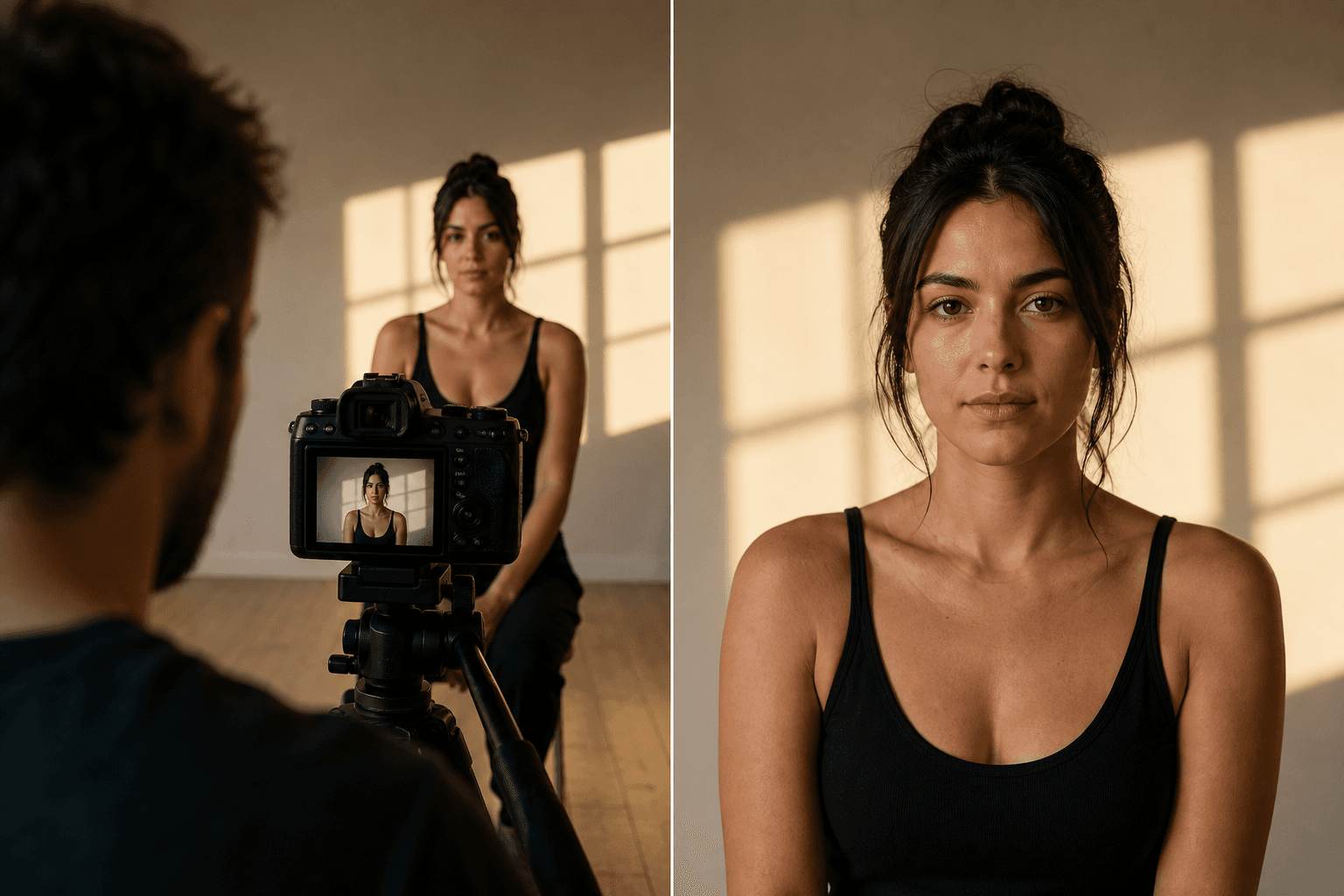
Close-Up (*Großaufnahme / Close-Up*)
CU is pure emotion. Skin, eyes, micro-expression — everything counts. So: soft light, focus on nearer eye.
Film term
Effect
Focal length (FF)
Equipment
Camera height
Close-Up (CU)
Intimacy, expression, reaction
75–105 mm
Tripod, handheld
Head + shoulders fill the frame
Close-Up — technical quick reference
AI illustration — left: setup · right: result — Close-Up (75–105 mm). Film reference: Brody sieht den Hai — *Jaws* (1975)
ECU isolates: eye, ring, watch, drop. In film often insert between larger shots.
Film term
Effect
Focal length (FF)
Equipment
Camera height
ECU / Insert
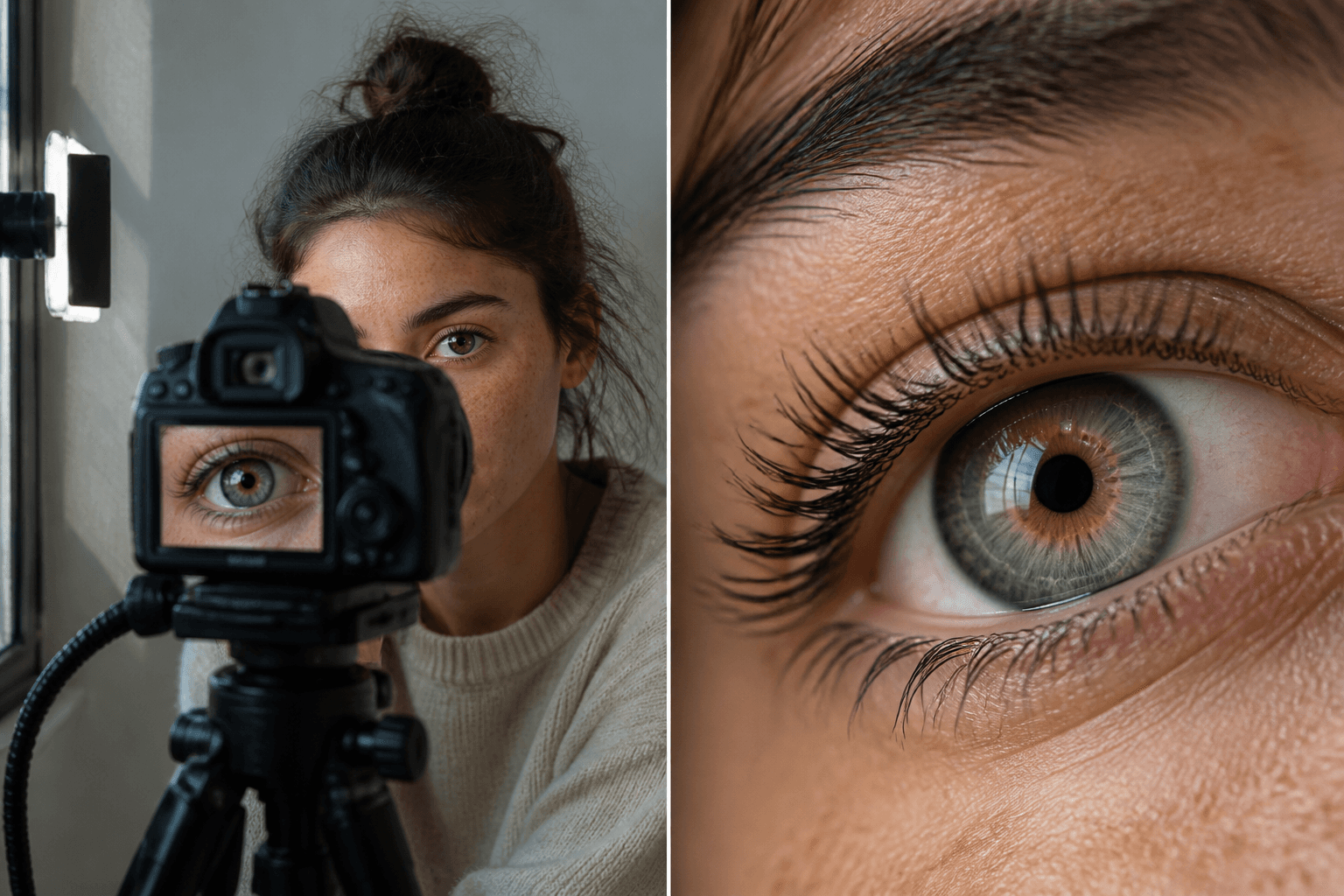
Intensity, focus on one detail — can feel oppressive
90–135 mm oder Macro
Tripod, macro lens
Aimed at detail
Extreme Close-Up — technical quick reference
AI illustration — left: setup · right: result — Extreme Close-Up (90–135 mm oder Macro). Film reference: Braut-Augen *Kill Bill Vol. 1* (2003)
Practice: Tripod mandatory. Macro or tele with close focus. Depth of field millimetre-precise — Depth of field calculator helps.
Two-Shot (*Zweier-Einstellung*)
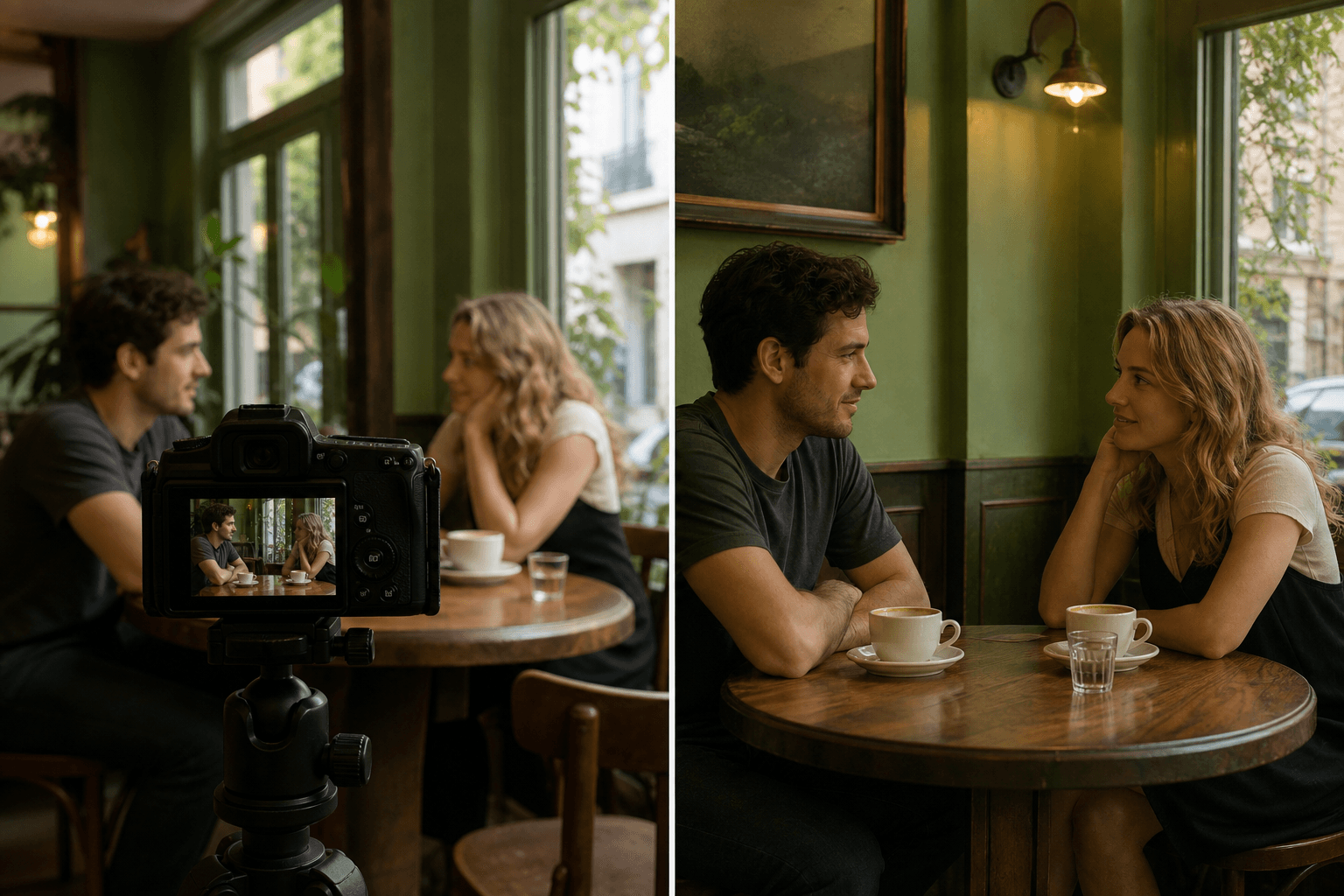
Two-shot holds two heads in one composition — couples, interviews, duel.
Film term
Effect
Focal length (FF)
Equipment
Camera height
Two-Shot / 2-Shot
Relationship between two people — closeness or tension
35–50 mm
Tripod, slider
Both in frame, usually medium shot
Two-Shot — technical quick reference
AI illustration — left: setup · right: result — Two-Shot (35–50 mm). Film reference: Café *Before Sunset* (2004)
Practice: Same eye height, same distance to camera if symmetry wanted. Otherwise: deliberately offset for hierarchy.
05
Special
Dutch angle, silhouette, drone & flat lay
Special perspectives deliberately break the norm: tilted horizon, backlit silhouette, aerial view or exactly parallel top-down look. This is where most beginner mistakes happen — and the strongest images.
Perspective
German
Effect
Focal length
Dutch Angle
Schrägsicht / Dutch Angle
Instability, paranoia, psychological unease
35–50 mm
Silhouette
Silhouette / Gegenlicht
Mystery, melancholy, graphic form
50–200 mm
Aerial / Drone Shot
Luft- / Drohnenaufnahme
Epic overview, freedom, fate
12–24 mm (Drohnen-Weitwinkel)
Flat Lay
Flat Lay / Top-Down (Produkt)
Order, aesthetics, product focus
50 mm ideal (35–85 mm)
Special — overview of all perspectives in this category
Dutch Angle (*Schrägsicht / Dutch Angle*)
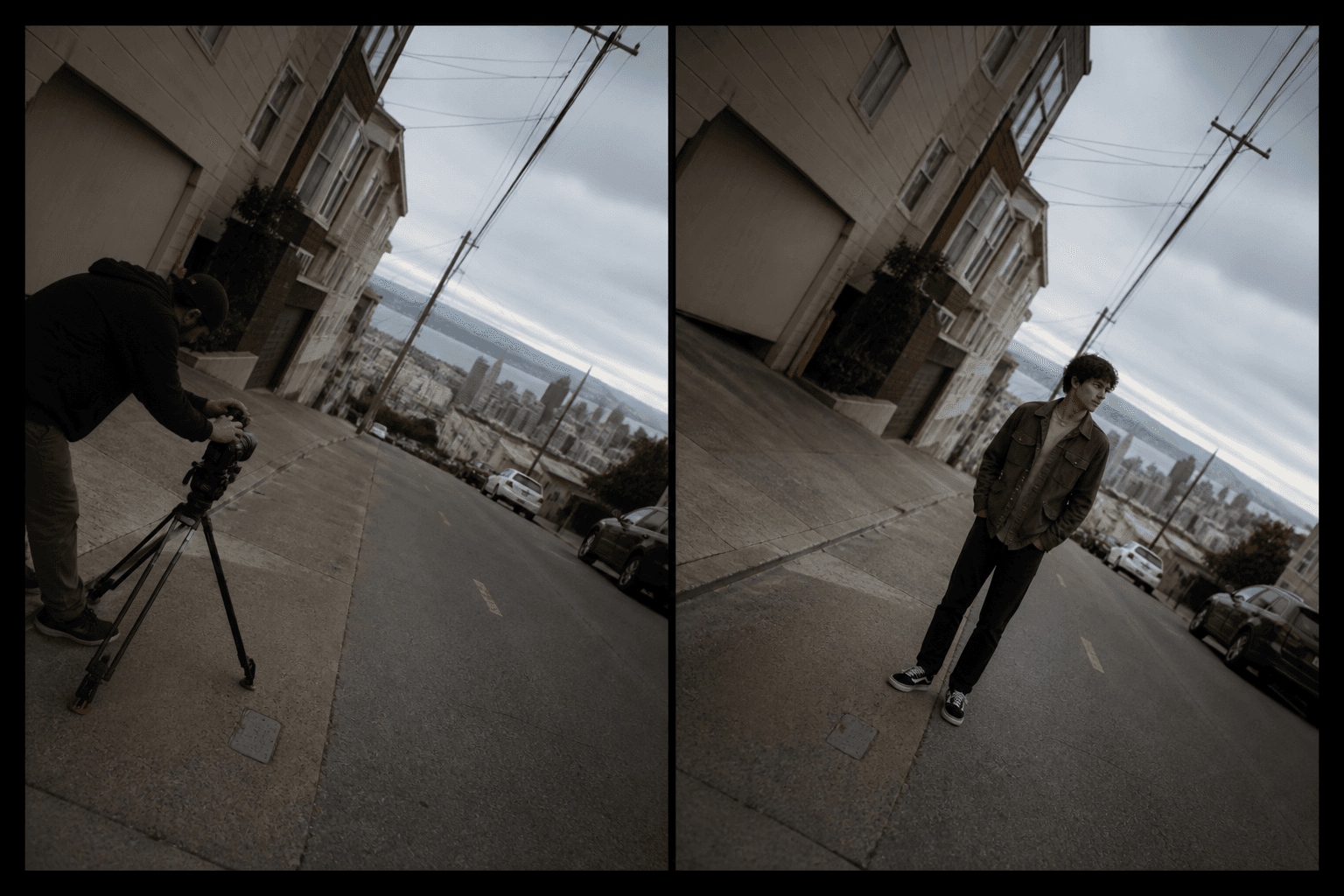
Dutch tilts the horizon — not the height. The space feels "wrong". Use sparingly; constant Dutch looks like a gimmick.
Film term
Effect
Focal length (FF)
Equipment
Camera height
Dutch Tilt / Canted Angle
Instability, paranoia, psychological unease
35–50 mm
Tilted camera (10–45° roll)
Any — horizon diagonal in frame
Dutch Angle — technical quick reference
AI illustration — left: setup · right: result — Dutch Angle (35–50 mm). Film reference: *Citizen Kane* (1941); *The Third Man* (1949)
Practice: 10–20° often enough. Combined with low angle = maximum threat.
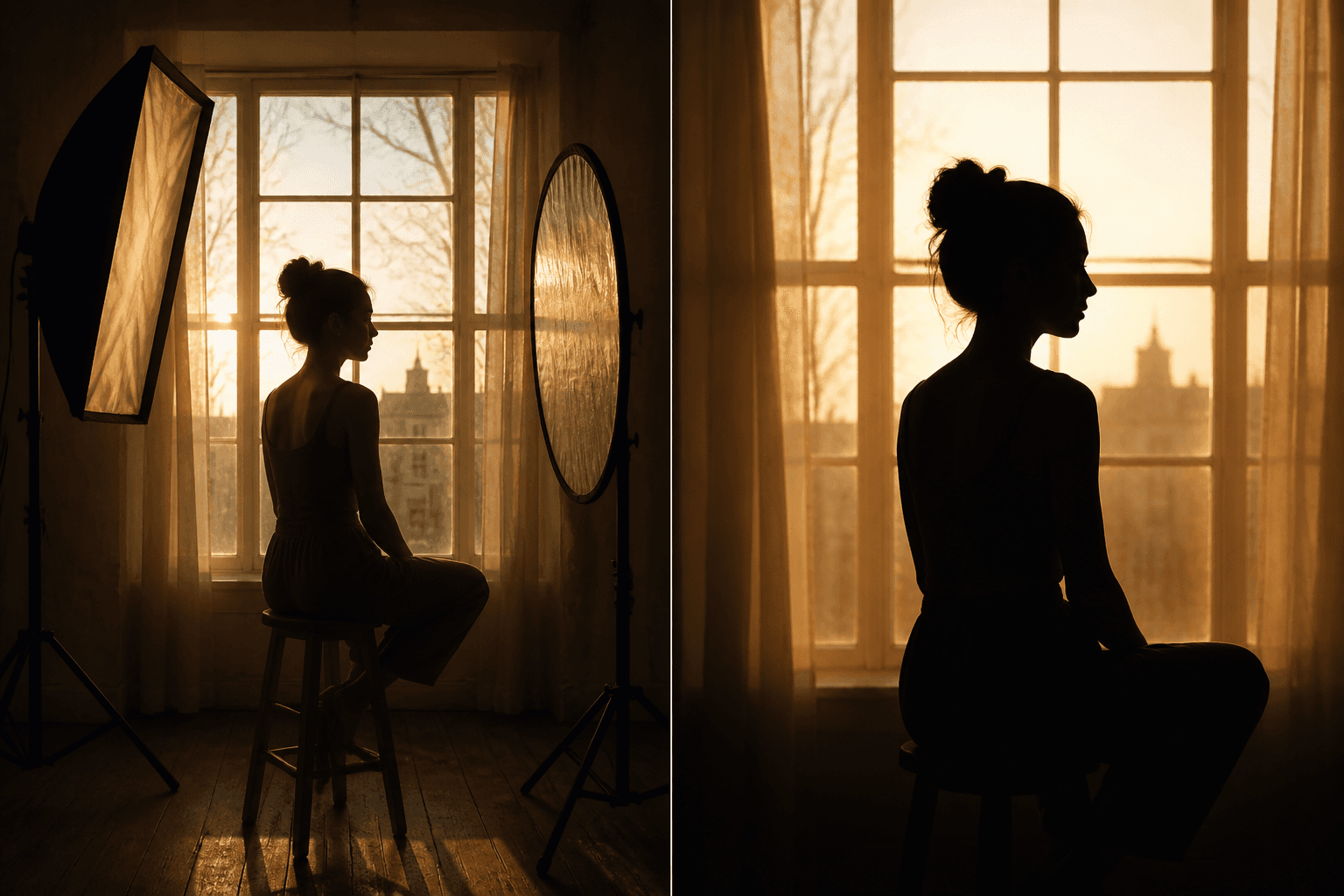
Silhouette (*Silhouette / Gegenlicht*)
Silhouette = form not detail. You need bright background light and dark subject — meter exposure on background.
Film term
Effect
Focal length (FF)
Equipment
Camera height
Silhouette Shot
Mystery, melancholy, graphic form
50–200 mm
Tripod, backlight (window, sun, rim)
Usually eye level, subject before bright area
Silhouette — technical quick reference
AI illustration — left: setup · right: result — Silhouette (50–200 mm). Film reference: Flughafen *Casablanca* (1942)
Practice: Underexpose manually or spot meter on sky. Rim light separates from BG — see Black background photos for light logic.
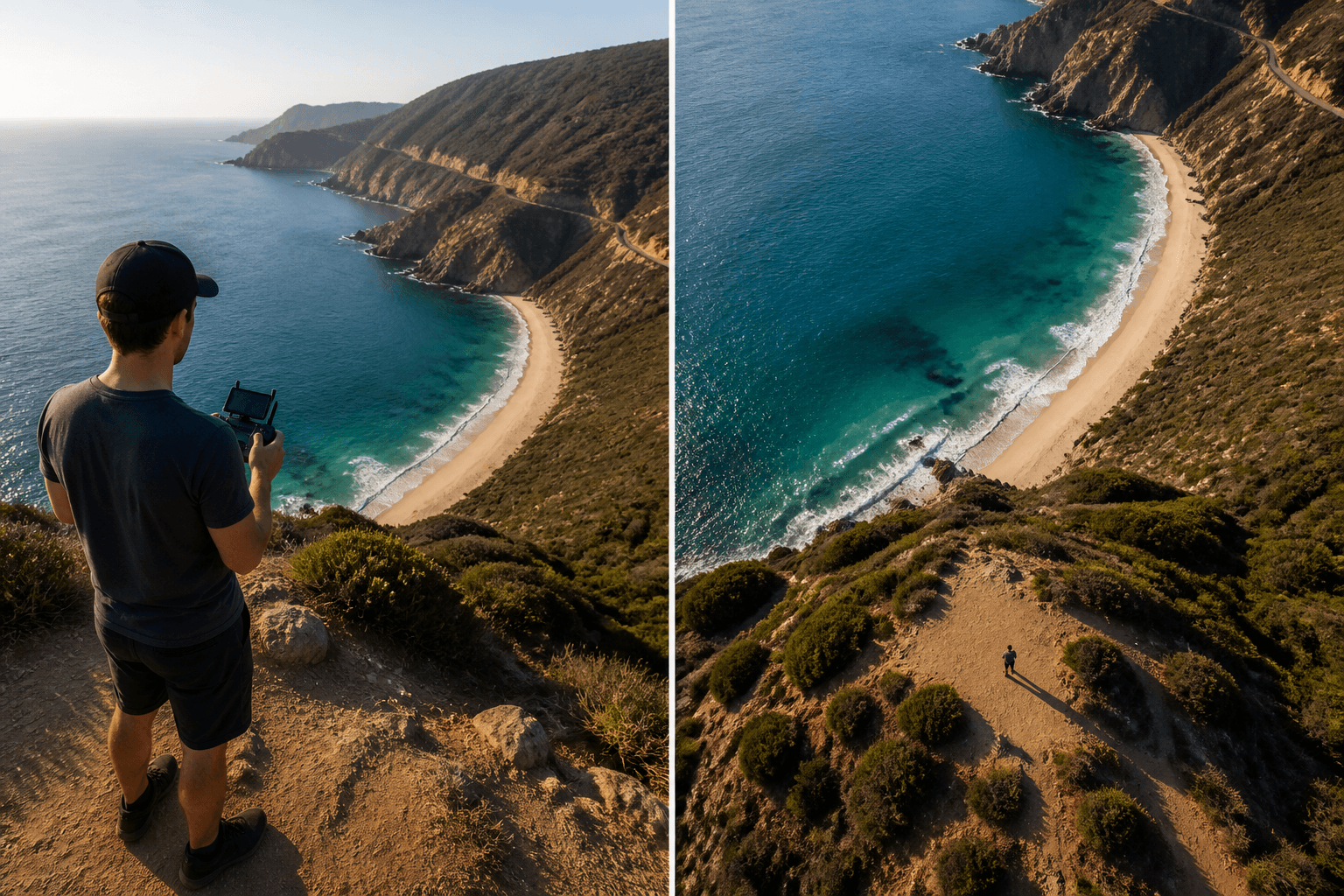
Aerial / Drone Shot (*Luft- / Drohnenaufnahme*)
Drone = establishing on steroids. Legally in Germany: drone license, airport proximity, privacy.
Film term
Effect
Focal length (FF)
Equipment
Camera height
Aerial Establishing
Epic overview, freedom, fate
12–24 mm (Drohnen-Weitwinkel)
Drone (license/airspace rules apply)
Metres to kilometres above terrain
Aerial / Drone Shot — technical quick reference
AI illustration — left: setup · right: result — Aerial / Drone Shot (12–24 mm (Drohnen-Weitwinkel)). Film reference: Eröffnung *Skyfall* (2012)
Practice: Not just high — movement (reveal, orbit) makes the shot. Golden hour for shadows.
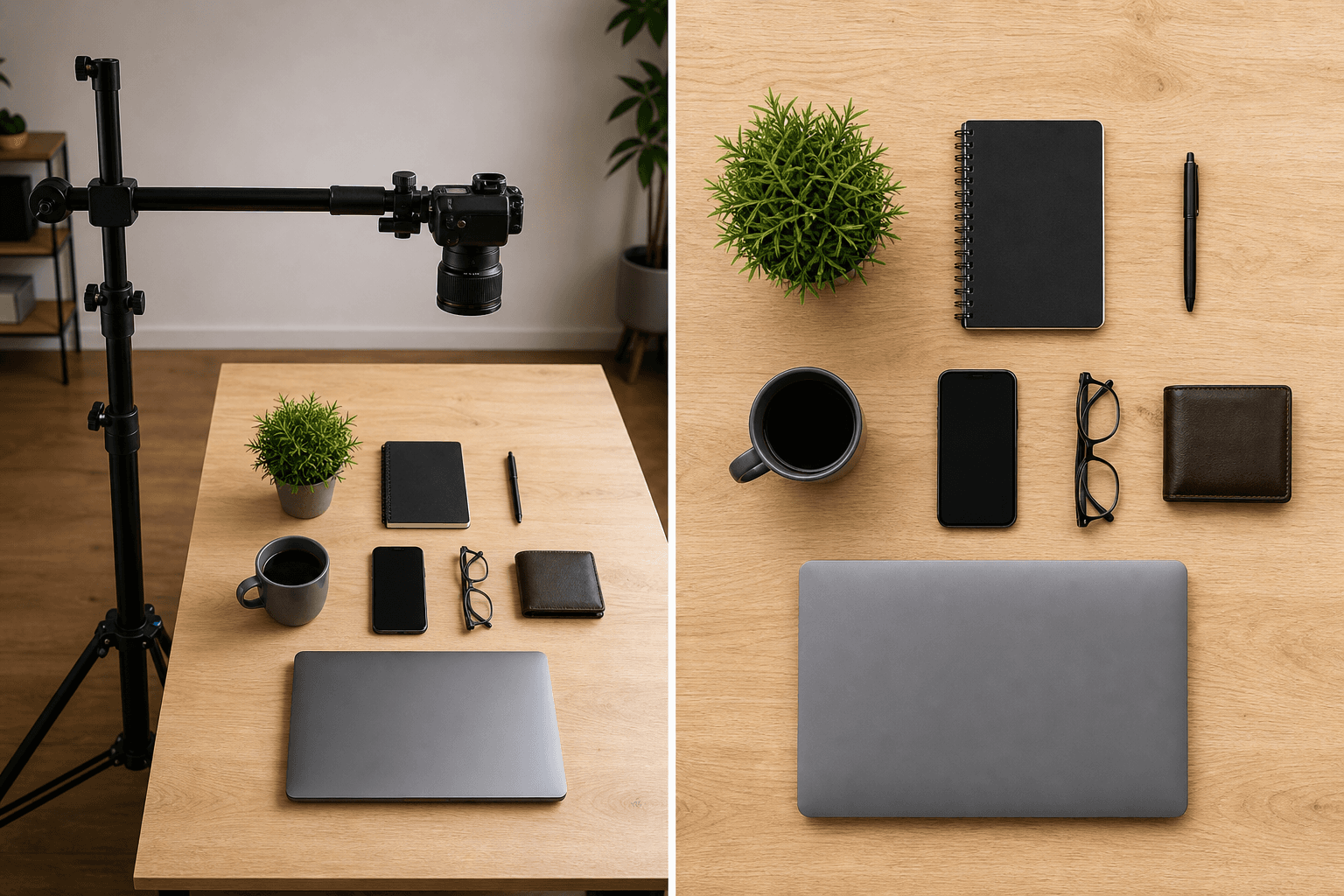
Flat Lay (*Flat Lay / Top-Down (Produkt)*)
Flat lay lives on exact 90° — one degree off and symmetry tips. 50 mm minimises edge distortion.
Film term
Effect
Focal length (FF)
Equipment
Camera height
Overhead Product Shot
Order, aesthetics, product focus
50 mm ideal (35–85 mm)
Tripod boom arm, spirit level, softbox
90° parallel, 30 cm–2 m above surface
Flat Lay — technical quick reference
AI illustration — left: setup · right: result — Flat Lay (50 mm ideal (35–85 mm)). Film reference: Produktfotografie; Inserts *Amélie* (2001)
Practice: Even light from both sides or large softbox above. Props on one plane — depth only subtle.
Lightroom Presets9 film looks inspired by Portra, Kodak & Fuji —View pack →
06
Movement
Camera movement: dolly, tracking, crane — in stills too
In film the perspective changes during the shot. As a photographer you can recreate the same effect in series, focal length changes or in-between frames — or deliberately simulate movement by positioning the camera as if it were gliding.
Perspective
German
Effect
Focal length
Dolly In
Dolly-In / Push-In
Increasing intimacy or tension
35–50 mm
Tracking Shot
Tracking / Verfolgungsfahrt
Dynamism — viewer "runs along"
24–50 mm
Crane Shot
Kranfahrt / Jib
Grandeur, reveal, perspective change in height
24–50 mm
Handheld
Handheld / Handkamera
Documentary, urgent, chaotic — immediacy
24–35 mm
Movement — overview of all perspectives in this category
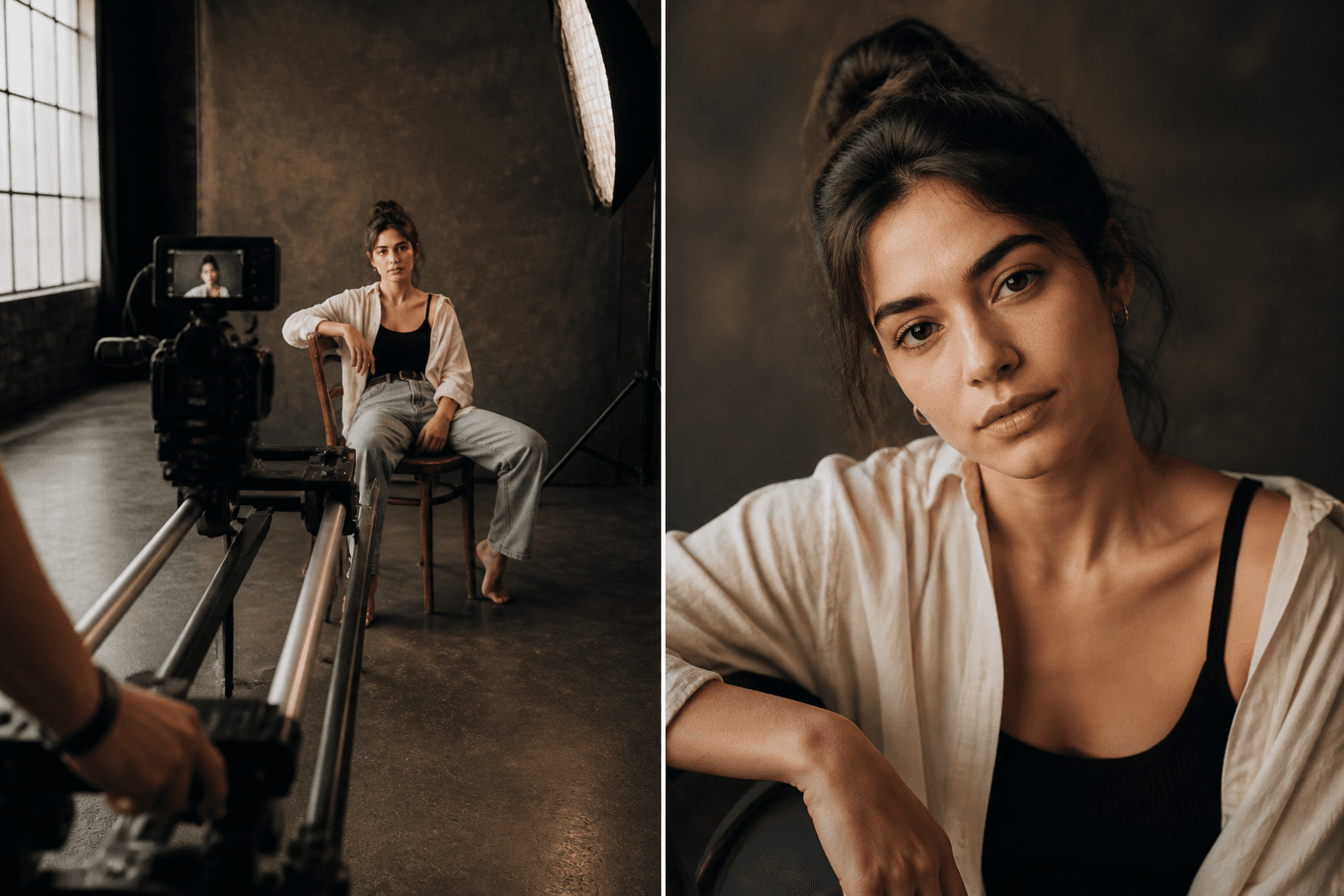
Dolly In (*Dolly-In / Push-In*)
Push-in = camera moves closer without a cut. In stills: series of three distances (wide → MCU → CU) simulates the same effect.
Film term
Effect
Focal length (FF)
Equipment
Camera height
Forward Dolly
Increasing intimacy or tension
35–50 mm
Slider, dolly, slow walk forward
Constant during move
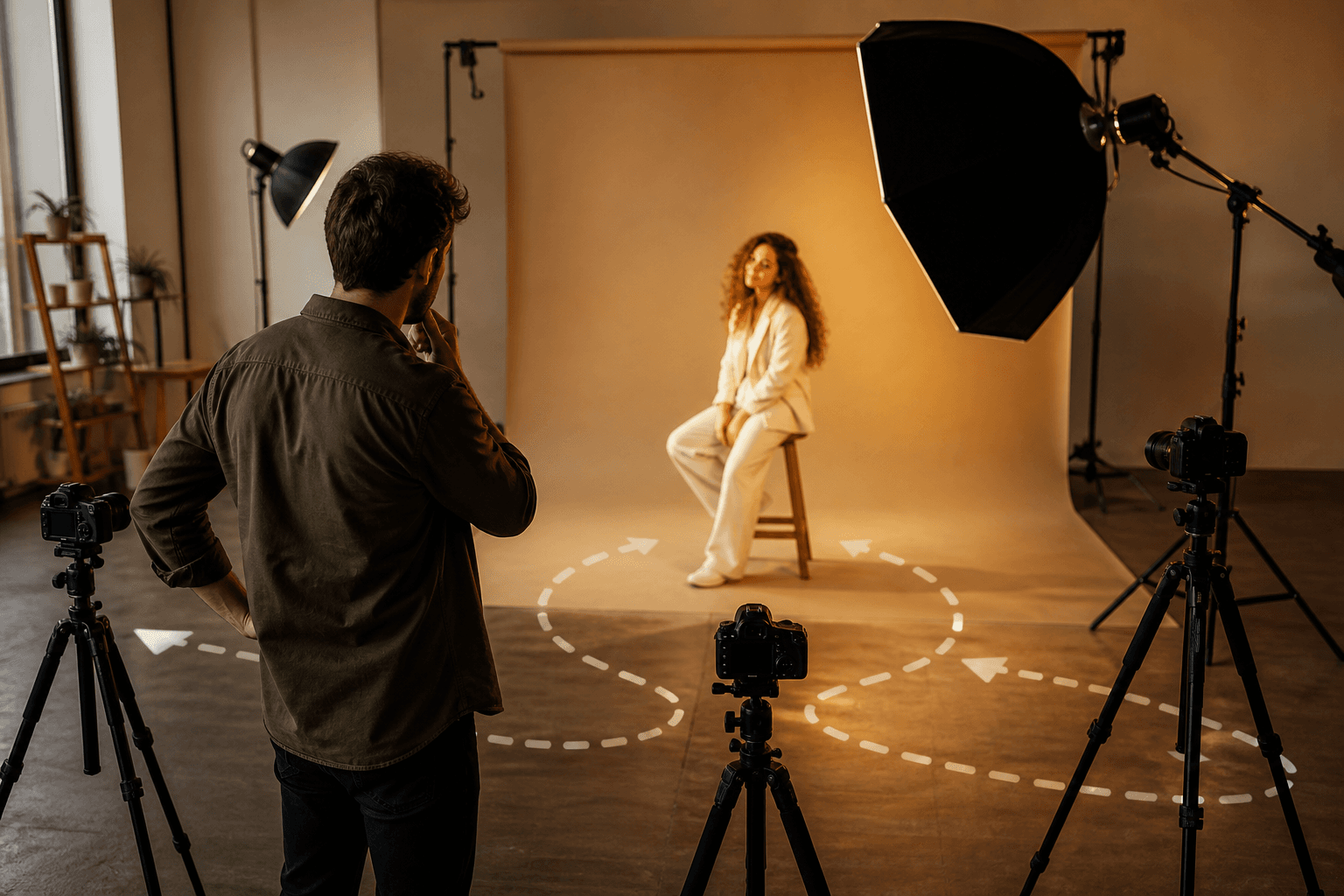
Dolly In — technical quick reference
AI illustration — left: setup · right: result — Dolly In (35–50 mm). Film reference: Copacabana *Goodfellas* (1990); Glockenturm *Vertigo*
Practice: 40–80 cm slider enough for product video. Pull focus or small aperture.
Tracking Shot (*Tracking / Verfolgungsfahrt*)
Tracking keeps pace: run beside subject, parallax in background. Photographically: pan with long shutter or sharp follow series.
Film term
Effect
Focal length (FF)
Equipment
Camera height
Follow / Lateral Dolly
Dynamism — viewer "runs along"
24–50 mm
Gimbal, Steadicam, parallel dolly
Parallel to movement, eye level
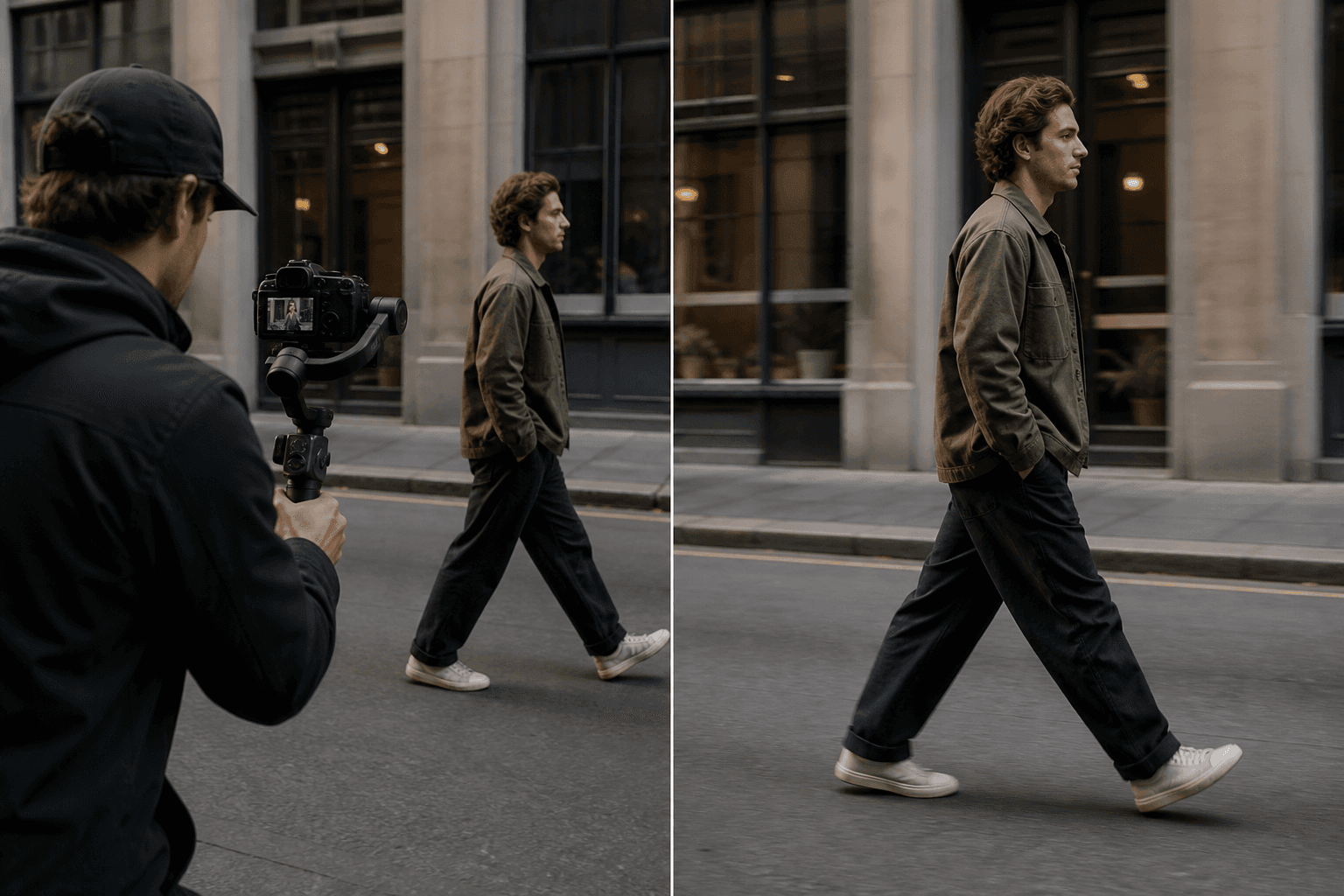
Tracking Shot — technical quick reference
AI illustration — left: setup · right: result — Tracking Shot (24–50 mm). Film reference: *Children of Men* (2006) — lange Steadicam-Takes
Practice: Wide angle + close distance = speed. AF-C and burst for peak moment.
Crane Shot (*Kranfahrt / Jib*)
Crane starts low and reveals above — or vice versa. Emotional "lift".
Film term
Effect
Focal length (FF)
Equipment
Camera height
Crane / Jib
Grandeur, reveal, perspective change in height
24–50 mm
Crane, jib, vertical drone
Rising or falling vertically
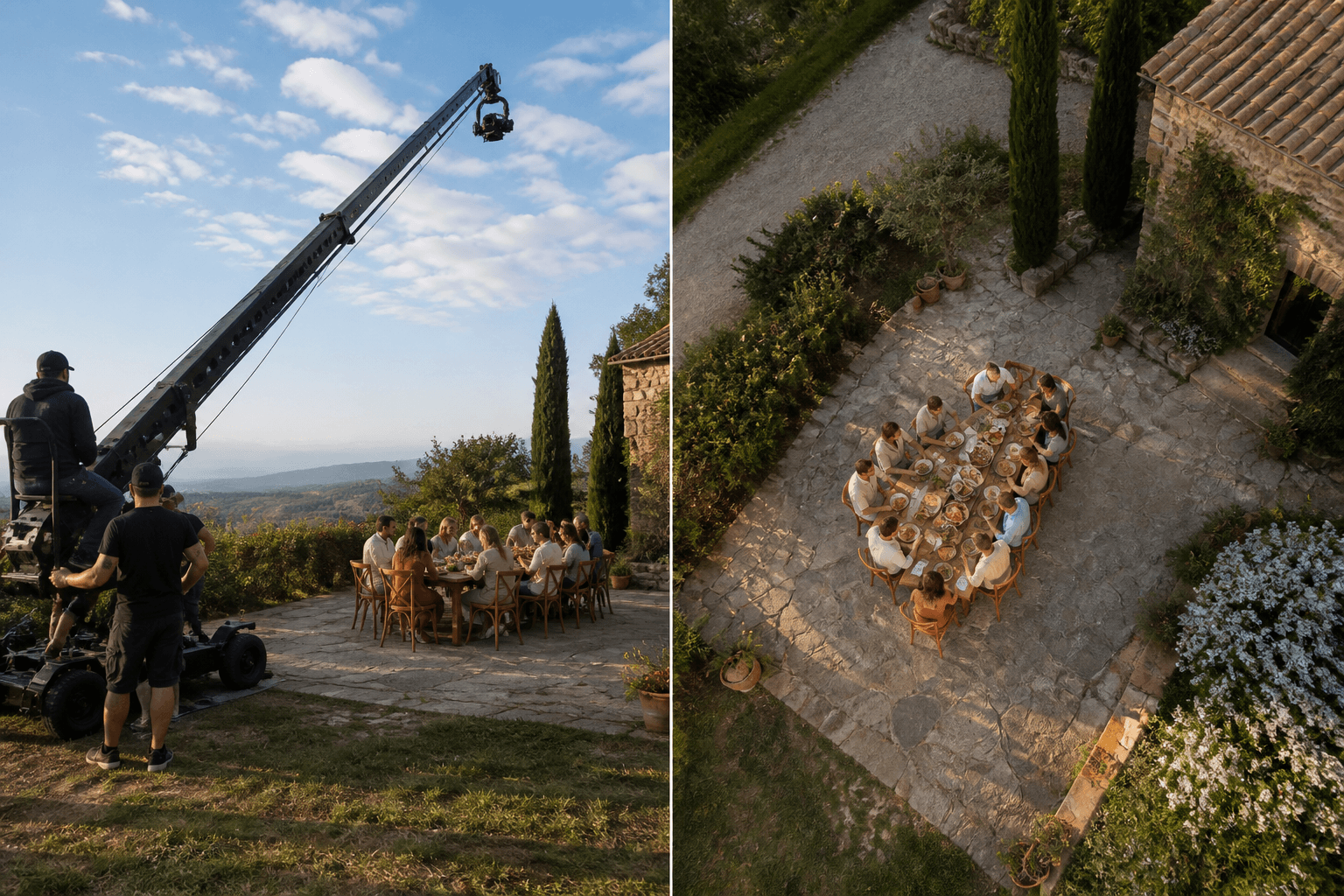
Crane Shot — technical quick reference
AI illustration — left: setup · right: result — Crane Shot (24–50 mm). Film reference: Brennendes Atlanta *Vom Winde verweht* (1939)
Practice: Drone rising vertically = cheap crane substitute. Photo: two frames (ground vs. elevated) as diptych.
Handheld (*Handheld / Handkamera*)
Handheld = visible shake. In film associated with chaos and authenticity; gimbal/Steadicam = immersion without wobble.
Film term
Effect
Focal length (FF)
Equipment
Camera height
Handheld Shot
Documentary, urgent, chaotic — immediacy
24–35 mm
Freehand, shoulder rig (vs. gimbal = smoothed)
Variable, often slightly unsteady around eye level
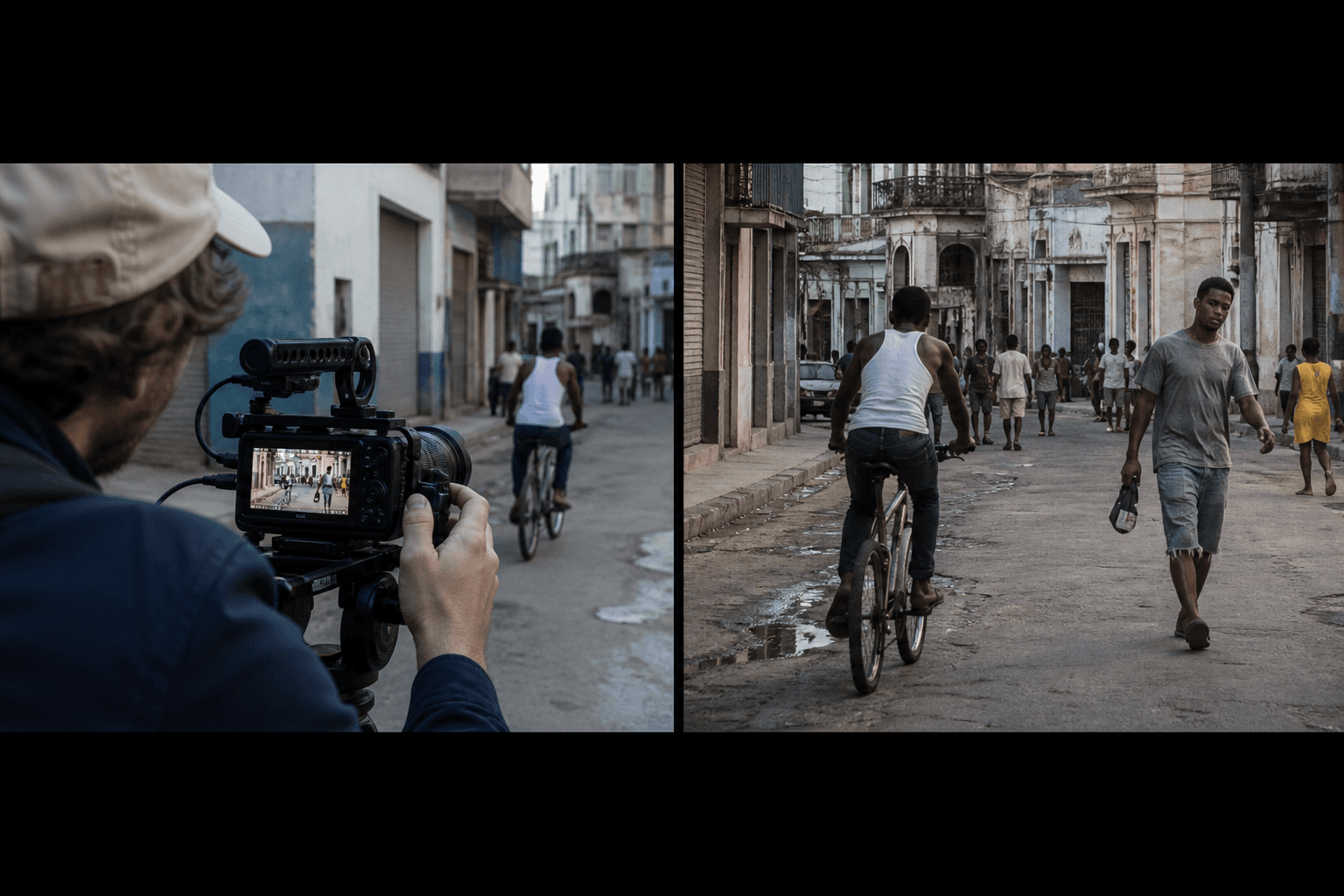
Handheld — technical quick reference
AI illustration — left: setup · right: result — Handheld (24–35 mm). Film reference: Omaha Beach *Saving Private Ryan* (1998)
Practice: 24–35 mm, 1/60 s or slightly longer for motion blur. For events: deliberately handheld instead of tripod for "being there" feeling.
07
Combo
Angle + shot size: combinations & common mistakes
Perspectives really come alive in the mix. Three combinations I see again and again — that work deliberately:
Low angle + close-up
Power + intimacy at once — threateningly close. CEO portraits, athletes, architecture details.
High angle + wide shot
Loneliness, feeling lost. Street, travel, "figure in the city".
Dutch + medium close-up
Psychological tension without horror cliché — sparingly, 10–15° is enough.
Typical *beginner mistakes*
◆Dutch angle in every second image — quickly looks cheap
◆Flat lay not exactly 90° — product looks "hanging"
◆Bird's eye with tele instead of wide angle — loses spatial context
◆Low angle with 85 mm close to face — distorted nose, double chin
◆POV without clear viewing direction — viewer doesn't know whose eyes they're seeing through
◆Confusion: high angle ≠ top shot (diagonal vs. vertical)
08
Decision
Decision tree: What do I want to convey?
Instead of memorising all 28 perspectives: start with effect. The decision tree leads you to angle and shot size.
Decision tree (AI illustration) — from desired effect to angle and shot size
◆Neutral / documentary → eye level + medium + three-quarter
You don't need to memorise 28 terms. You need to understand that every camera shift makes a statement — about power, closeness, calm or chaos. Start with eye level as baseline, experiment with one low angle and one high angle per shoot — and use the diptychs to compare setup and result directly.
If you like, combine strong perspectives with film presets for the look — but first: stand where it makes sense.
11
FAQ
Frequently asked questions
Are the setup/result images real photos from a shoot?+
No — the diptychs in this article are AI-generated illustrations. They show typical setup ideas and result looks per perspective so you understand angles and effects faster. For real reference, photograph yourself: once setup (phone photo from camera position) and once the result.
What's the difference between bird's eye and top shot?+
Bird's eye = diagonal from very far above (typically 30–60° tilt). Top shot = camera vertical (90°) above subject — graphic, alienating, like flat lay or Busby Berkeley dancers.
Which focal length for which shot size?+
Full-frame guidelines: extreme wide 14–24 mm, wide 24–35 mm, medium 40–60 mm, close-up 75–105 mm, detail 90–135 mm or macro. Distance also matters — see Which focal length for what.
What is a Dutch angle?+
The camera is tilted on the roll axis (horizon diagonal in frame). Effect: instability, paranoia. Don't confuse with low angle — Dutch tilts sideways, low angle tilts upward.
Do I need a special tripod for flat lay?+
A tripod with centre arm extension or overhead rig helps. More important than expensive gear: exactly 90°, even light, 50 mm (little distortion). Spirit level or grid in live view.
Eye level — for children too?+
No — if you shoot standing, that's high angle for children. Kneel to the child's eye level. Otherwise it looks down from above and unnatural.
How many perspectives should I use per shoot?+
Quality over quantity. 3–5 deliberate angles are enough: e.g. establishing, medium EL, close-up three-quarter, detail, optionally one extreme (low or high angle). Film coverage: wide → medium → close.
From my workflow
35mm & 120mm film presets
Portra, Kodak Gold, Velvia, HP5 & more — ready-made XMP presets for Lightroom Classic and mobile.
**Image transparency:** The diptychs, overview and decision tree in this article are **AI-generated** — deliberately as clear illustration, not photo documentation of a real set. Setup and result show the **idea** of the perspective; in practice you photograph both yourself, and then person, light and angle match for sure.
◆ Newsletter
Stay in the loop.
Camera and photography news, honest gear tests and new articles — in your inbox. Infrequent but relevant. No spam, unsubscribe anytime.