Lenses for Business Portraits: Job Glass Over Spec Sheets
85 mm as the default, 50 mm for environmental, 70–200 for teams — and why f/1.2 is often the wrong flex for corporate headshots.
Author
Martin Kleinheinz
Business Photographer · Hannover
Updated
July 30, 2026
Looking for strong company imagery, not a lens buying guide? You're in the wrong place — and exactly right at Business Photography: portraits, team, and corporate in Hannover. This post is for photographers who bill corporate headshots and team photo days.
On a team day, what matters is whether both eyes are sharp, whether the glass handles meeting-room distance, and whether you can switch from singles to groups — not an MTF curve. This is Post 9 in the Business Photography cluster and the middle of the technical trilogy: Camera for Business Photographers → lenses (this post) → Lighting for Business Portraits.
Documented line in short: Canon R5 / R6 Mark II, 85 mm f/1.8 for ~12 years, 85 mm f/1.2L sold; captions often approx. 85 mm, f/2.8. What is not here: focal-length map → Which Focal Length for What. Lens types → Which Lens for What. Here: job logic 2026 — matrix, aperture, mount, tiers without product cards and without MTF scores.
00
Start
Who this guide is for
This post is for photographers who bill employee portraits and corporate photos, LinkedIn headshots, and team photo days — or are preparing that seriously. The question isn't "Which glass has the best MTF?" but: "Which glass lets you deliver the job calmly and repeatably — with two sharp eyes and a consistent series?"
In practice — how it runs for me with R5/R6 II: tight meeting room, 18 people, LinkedIn crop and website half-body from the same take, next executive already in the doorway. If you're soft on the rear eye at f/1.4 or distorting with 35 mm close to the face, the client notices — even without knowing the specs.
“My rule of thumb since the 85/1.8 workhorse: 85 mm as the default, stop down enough that both eyes hold — often toward f/2.8 — and a zoom in the case when teams and rooms change. Spec flex sells well. Job glass delivers.”
— Martin Kleinheinz, Business Photographer Hannover
Business starters
Sections 01–04, then Budget/Mid tiers (06). A solid 85 before buying f/1.2.
Workhorse upgrade
Matrix (02), depth of field as a calculation model (03), RF mount honesty (05), Mid/Pro tiers (06).
The line is drawn in the intro. Previous body post: Camera for Business Photographers. Here: paid corporate everyday — job glass that carries the assignment.
01
Requirements
What corporate glass must do
Business means: tight time windows, changing faces, cramped rooms, matching crops for web and LinkedIn. Corporate glass is a production tool, not a bokeh showcase: same distance, same focal length, same working aperture — person after person. Four traits decide more than marketing curves; plus AF that holds, and a kit you swap in your sleep.
Think in risks, not brochures: soft rear eye on the CEO, distorted nose at 35 mm too close, zoom not in the case while the group waits — that costs more than the gap between f/1.8 and f/1.2. Retouching saves skin and color; skewed proportions and a soft rear eye only cost money.
1. Focal length with intent
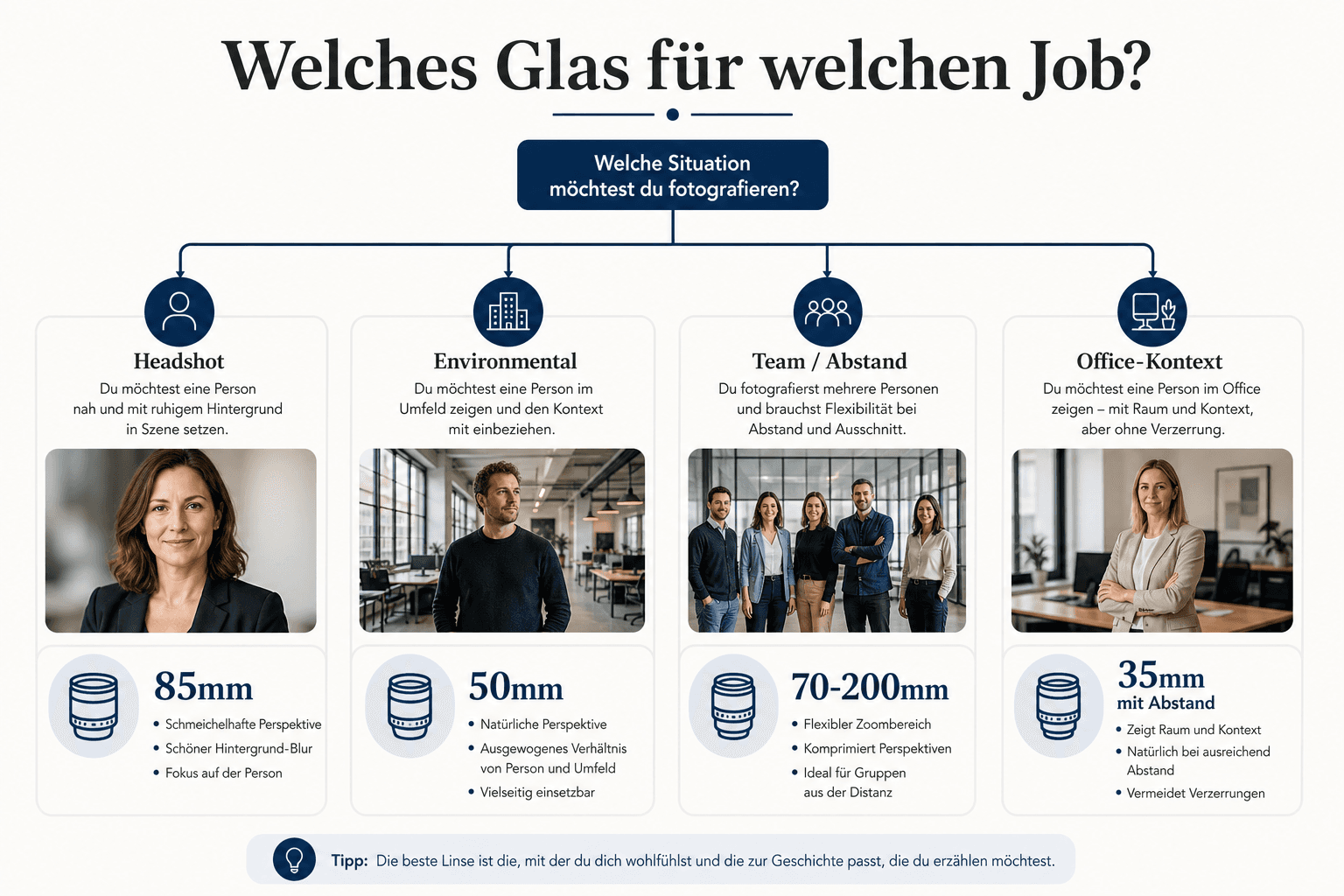
85 mm as the headshot default on full frame. 50 mm for environmental and half-body with space. 70–200 for teams, distance, and fast crops. 35 mm sparingly for context — not as the default face lens up close.
2. Aperture as a sharpness tool
Corporate default often f/2.8–5.6: both eyes sharp, series consistent. Wider apertures are fine — with intent and distance, not as permanent flex. Details in section 03.
3. AF that holds on the job
Eye AF on the body only helps if the glass acquires and tracks fast and reliably. For series, repeatability beats peak lab sharpness.
4. Kit logic over a single piece
One prime covers headshots. Teams, environmental, and tight rooms need a complement — zoom or second prime. Plan the kit, not just the "best" 85.
From use case (headshot / environmental / team / context) to focal-length class — no spec theater
Requirement
Why in business
Priority
85 mm default
Proportions, distance, calm background
Must (headshots)
Both eyes sharp
Series looks professional and fair
Must
f/2.8–5.6 working aperture
Room for tilt / glasses (calculation-model orientation)
Strongly recommended
70–200 or zoom alternative
Teams, distance, fast crops
Strongly recommended
50 mm environmental
Person + room / brand in frame
Depends on offering
35 mm context
Show office/location — not default face
Optional
f/1.2 peak bokeh
Editorial look — rarely corporate default
Nice-to-have
Priorities for corporate headshots and team days — as of 2026; no MTF scores
Light and pose decide the image more than maximum aperture — soft: Studio Portrait Lighting. The glass must not sabotage the rest. Next: the focal-length matrix for corporate everyday.
02
Matrix
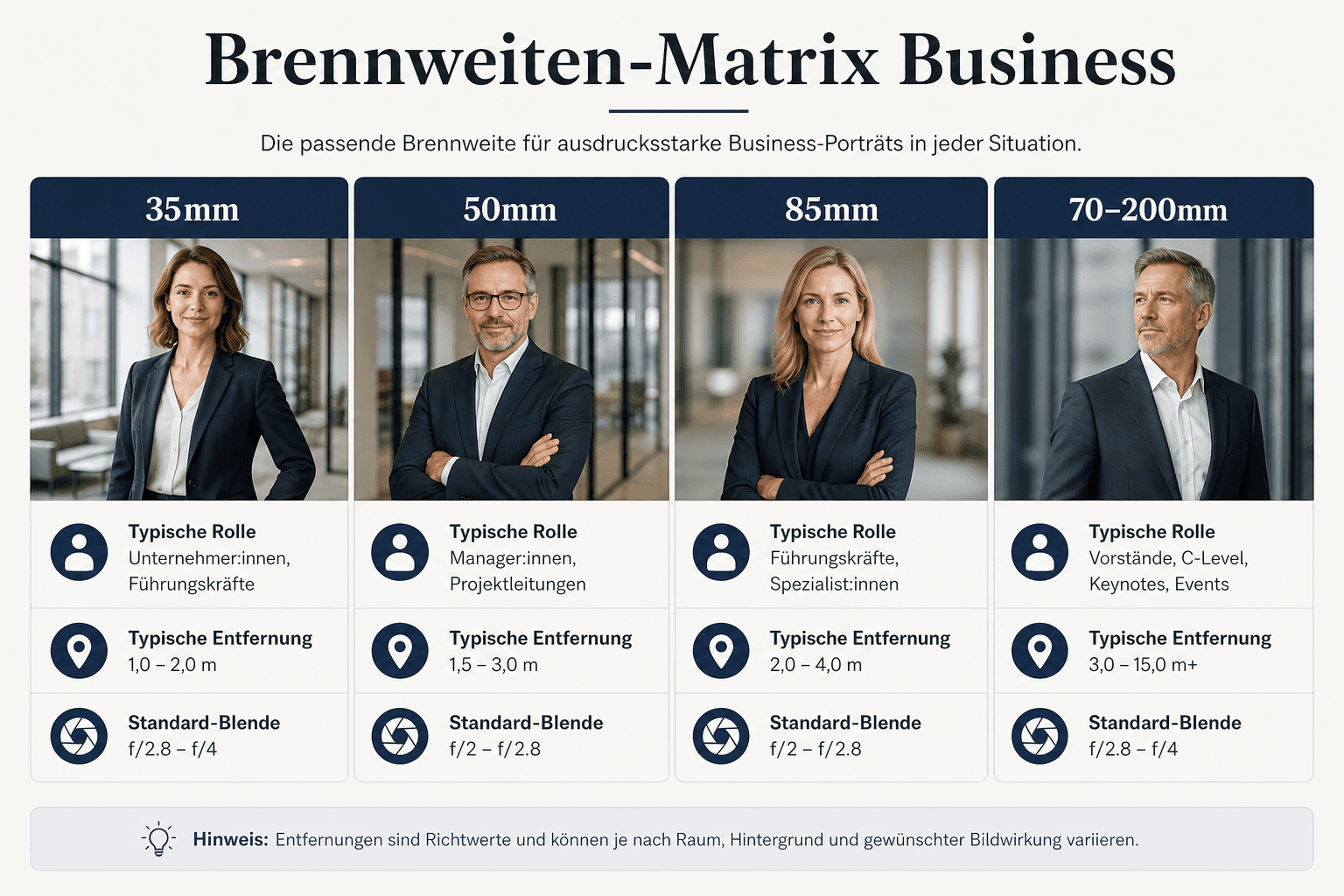
Focal-length matrix — 85 / 50 / 70–200 / 35
Four focal lengths cover corporate everyday. Not because "more glass = better," but because each answers a different job question. APS-C: factor in the crop (50 mm ≈ 75–80 mm equivalent) — the logic stays, the numbers shift.
You don't need all four on day one. You need to know which role is missing when the job stalls. Missing headshot calm → 85. Missing group/distance → zoom. Missing "person + office" → 50. Missing location story → 35. That's how you prioritize budget instead of a wish list.
Classic headshot distance, flattering facial proportions, calmer background without extreme wide-open shooting. For LinkedIn circle crop and website portrait, the sweet spot on full frame. If you can buy only one prime: start here. On APS-C a native 85 mm often already feels very "tele" — then a 56–60 mm equivalent (e.g. 50 mm on crop) can take the practical headshot role. The job question stays: calm face, enough distance, repeatable framing.
50 mm — environmental & half-body
Person plus space: office, reception, brand color in the background. Closer than 85 mm — but with distance from the face still proportioned. Good for story frames beside the tight headshot. Too close to the face gets restless; then step back or switch to 85.
70–200 mm — teams, distance, pace
Groups without wide-angle chaos, individuals from the second row, fast crops without lens swaps. In a tight room often the rescue: you stand farther back, faces stay natural. On a team day, zoom saves lens changes in front of the group. f/2.8 helps in weak office light — f/4 can be enough with flash. Take stabilization and weight seriously: glass you won't hold after hour two is practically dead.
35 mm — context, not default face
Location, team in the room, "we're here" frames. For tight headshots up close: watch distortion (section 04). 35 mm is a tool for surroundings — not a substitute for an 85 on the face.
Focal length (FF)
Typical job
Distance (orientation)
Caveat
85 mm
Headshot, LinkedIn, website portrait
approx. 2.5–4 m
Needs some room
50 mm
Environmental, half-body + brand
approx. 1.5–3 m
Not too close to the face
70–200 mm
Teams, distance, crop flex
variable / farther away
Weight; stability
35 mm
Context, location, group in room
depends on scene
Close to face = distortion
Full-frame orientation — distances are practice guidelines, not lab measurements
Next: why aperture is often more important than the speed on the nameplate.
03
DOF
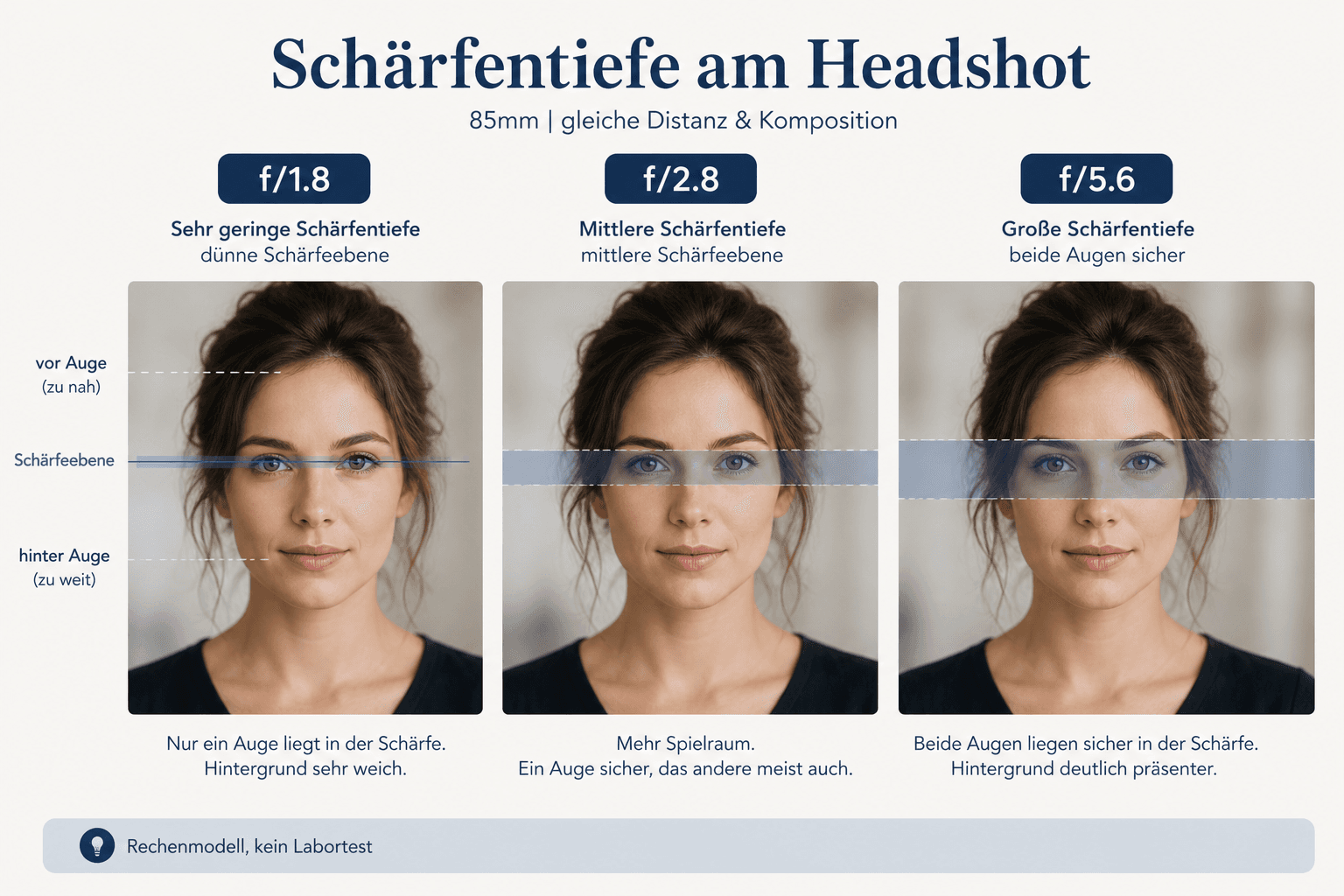
Aperture & depth of field — f/1.2 is often the wrong flex
Wide apertures sell bokeh. Corporate sells trust: two sharp eyes, glasses without a soft zone, a series that doesn't feel "random." That's why the corporate default is often f/2.8 to f/5.6 — not because f/1.2 is bad, but because the job demands repeatability.
Important: depth of field here only as a calculation model for orientation — no lab certificate, no measured millimeter zones from my studio. Distance, focal length, sensor, and acceptable circle of confusion move the numbers. What matters in practice: at 85 mm headshot distance, the zone at f/1.4–f/1.2 often gets so thin that a slight head turn or eyes at different distances to the camera softens the rear eye. You see that on the display faster than in any formula.
So don't fear "stopping down too much." A cleanly separated portrait at f/4 with controlled light beats a risky f/1.2 with hope. Background calm comes from distance, focal length, and modifiers — not only from the nameplate. Soft deep-dive on light: Studio Portrait Lighting.
Calculation model/orientation: wide open = thin zone; corporate often f/2.8–5.6 for both eyes — no lab diagram, no MTF
Working aperture
Typical effect (85 mm headshot)
When it makes sense
f/1.2–f/1.4
Very thin zone; rear eye risky
Editorial, intent, calm subject, control
f/1.8–f/2.0
Soft, but tight margin
Experienced hands, good light, little tilt
f/2.8–f/4
Often sweet spot: separation + reserve
Many corporate single portraits
f/4–f/5.6
Both eyes + light pose reserve
Series, glasses, uncertain posture
f/8+
More DOF, less separation
Groups, strong sharpness priority
Corporate working apertures — calculation model/orientation, no measured values, no MTF/lab scores
Both eyes first
Check on display/zoom: front and rear eye. Soft in back = stop down or fix the pose.
Glasses & side glance
Lenses and a slight turn increase the distance of the eyes to the focus plane. Better one stop down than a soft series.
Series before hero shot
Corporate delivers consistency across 10–40 people. An aperture that holds at person 1 and person 37 beats peak bokeh at person 3.
Light instead of wide open
A dark office is solved with flash/continuous — soft: Studio Portrait Lighting. Not with permanent f/1.2 and hope.
Calculation help (also a model, not a set measurement): Depth of Field Calculator. Here the job rule is enough: corporate default stopped down enough for two eyes — wide open only with intent. Next: why distance and focal length shape the face more than many think.
04
Perspective
Compression, distance, distortion
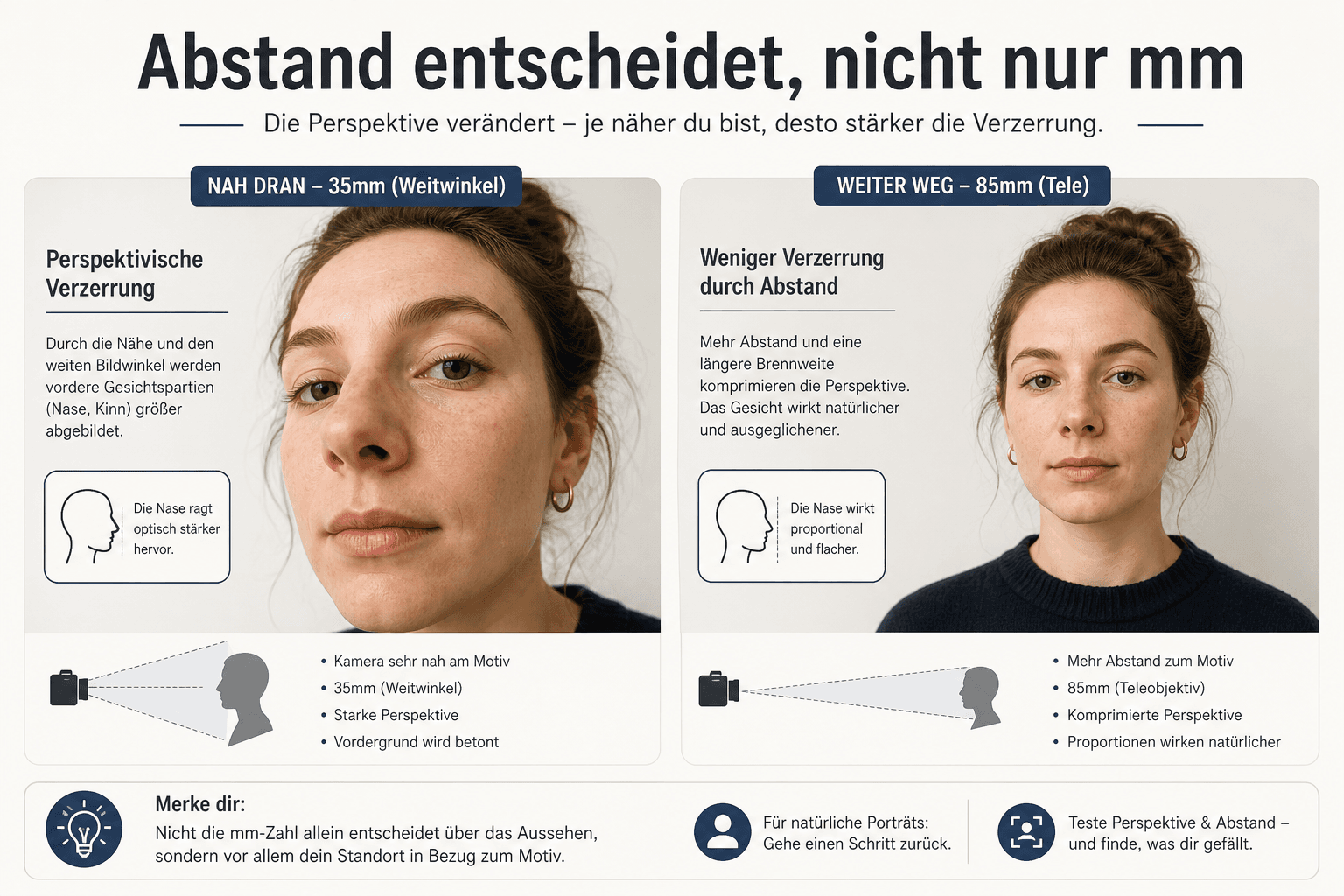
"85 mm flatters" is half right. What often decides is the distance to the face — focal length dictates how far you stand to fill the same crop. Short and close: nose larger, ears back, proportions restless. Longer and farther: calmer face, tighter background.
That also explains why the same 50 mm look can feel "natural" once and "weirdly close" once: same millimeter value, different distance. For CI series you lock focal length and camera position — not just white balance. If you secretly switch between people from 35 to 85, faces change differently even with the same retouch.
Same framing, different distance: near wide/normal angles distort; 85 mm with distance stays proportioned
Headshot rule
Prefer 85 mm (or 70–105 mm zoom) with distance over 35–50 mm at arm's length. Exception: intentional environmental look with space in the frame.
Compression
Longer focal lengths make the background feel "closer" — helpful against open-office chaos. Not magic: distance + focal length + crop.
Tight rooms
No space for 85 mm? Zoom toward the long end, person slightly back, tighter crop — or accept 50 mm with more distance from the face. Not 35 mm at arm's length as a LinkedIn emergency.
Groups
Too wide and too close = edge people warped. Prefer farther away with 70–135 mm or stagger the row.
Once you understand perspective, buying gets simpler: you buy distance management, not just millimeters. Next: which mount keeps you honest on the glass budget.
05
System
Mount logic — RF, E, and Z honestly
You keep lenses longer than bodies. So the ecosystem counts: native selection, third-party, adapters, used market. No brand religion here — job budget and availability.
Anyone who only compares bodies and plans glass as "it'll come" underestimates the expensive part. A workhorse kit of 85 + zoom often costs more than the body jump from mid to mid. So: choosing a mount means choosing a kit — including an honest third-party picture.
Mount
Third-party FF (as of 2026)
Practice note
Business fit
Sony E
Strong (Sigma, Tamron, etc.)
Many alternatives to GM prices
High — kit often cheaper to scale
Nikon Z
Strong / growing
Good third-party coverage for many focal lengths
High — depending on local availability
Canon RF (FF)
Native third-party thin
Often: EF glass + adapter or RF original
High with EF park / adapter strategy
Mount honesty July 2026 — RF third-party thin; no MTF comparisons, availability logic
My documented line stays Canon R5/R6 II — so RF bodies. Honesty on glass: native third-party for full-frame RF is thinner than on Sony E or Nikon Z. So: RF natives where it pays off — and EF + adapter where the used market and proven optics are strong. The 85 mm f/1.8 over ~12 years and selling the 85 mm f/1.2L show the same logic: ecosystem and resale count, not just the newest RF SKU.
An adapter isn't second-class for me when AF and sharpness hold on the job. It's a budget and continuity strategy: you keep proven glass across body generations. Anyone jumping into RF without an EF park should budget natives honestly — otherwise you get a body with too thin a kit. That's mount honesty, not brand justification.
Sony / Nikon: use third-party
f/1.8 and f/2.8 classes often cheaper at comparable job fitness. Test AF on your body with a person and real distance — not via charts or forum rankings.
Canon RF: plan the adapter strategy honestly
EF-L and good EF primes remain workhorses (my 85/1.8). Plan adapter quality and AF behavior in; a dual-slot body saves files, not focus feel. Buy native RF where you truly need native — not on principle.
Deeper system context: Camera Brands. Next: tiers 2026 — as copy classes, without product cards.
06
Tiers
Recommendations 2026 — classes, no product cards
No affiliate matrix, no editor verdicts on single SKUs. First the default buying path, then the tier table — you map both onto your mount (RF/EF, E, Z). As of July 2026. Classes outlast SKUs: model numbers turn faster than job logic.
Default buying path
◆1. 85 mm f/1.8 class — deliver headshots immediately
◆2. 70–200 (f/4 new or f/2.8 used) — teams and space
◆3. 50 mm — if you sell environmental
◆4. 35 mm — if location story is part of the package
◆5. f/1.2 / f/1.4 ultra — only once working aperture and kit are settled
Tier
Glass class
What for
Be honest about
Budget start
85 mm f/1.8 class
Headshot default, light, affordable
Not the brightest marketing — often the better job buy
Budget zoom
70–200 f/4 class (or used f/2.8)
Teams, distance, crops
f/4 + flash often beats an empty case
Mid workhorse
85 f/1.8 or f/1.4 + 70–200 f/2.8
Series + groups + weaker light
Weight and price — for pace
Mid environmental
50 mm f/1.8 or f/1.4 added
Person + room / brand
Not as the only glass for tight headshots
Pro / documented
85 workhorse + zoom + maybe 35/50
Full corporate offering
f/1.2 optional — not required (see sold 1.2L)
Orientation July 2026 — classes instead of shop links; no MTF scores
Canon note (documented practice)
With R5/R6 II (RF): EF 85 mm f/1.8 for ~12 years stays job-ready; RF natives or EF+adapter depending on budget. The sold 85 mm f/1.2L was optically impressive — in the corporate default I still often worked at working aperture toward f/2.8 (like the site caption). So don't buy speed for an aperture you'll stop down on the job.
Sony E / Nikon Z
Use third-party strength: 85 f/1.8 and 70–200 classes often scale cheaper. Same job order: 85 → zoom → 50 → 35. Check AF and weight on your own body.
General lens types and entry-level stay in Which Lens for What. Here the recommendation ends at job classes — deliberately without product photos and without a shop matrix.
07
Anti-list
What you don't need for business
Spec sheets sell speed and curves that are rarely the bottleneck on a team day. Money for a second reliable lens, flash, or backup body otherwise lands in flex. The anti-list protects timing: series and working aperture first, then optionally open up. Kit for teams first, then ultra-prime. Mount strategy first, then collecting.
f/1.2 as a corporate must
Per the calculation model often too thin a zone for series — and confirmed on the display in practice. f/1.8 class + working aperture f/2.8–5.6 delivers more often.
MTF rankings as a buying reason
No MTF scores here — and no buying decision on charts alone. Test eyes, distance, series on your body.
Only a 24–70 and "that's enough"
Works in a pinch. For headshot quality and background calm you often miss the longer end — add 85 or 70–200.
35 mm as LinkedIn default
Context yes, tight face up close no. Distortion isn't a style when the CI says "trustworthy."
System switch for one prime
A single dream lens rarely justifies rebuilding the kit. Stay if body and service fit.
Three ultra-primes before the first zoom
Teams and rooms punish prime purism. A zoom in the case is insurance.
Which lens do I need for corporate headshots in 2026?+
Default on full frame: 85 mm class (often f/1.8). Working aperture frequently f/2.8–5.6 for two sharp eyes. Add: 70–200 for teams and distance, 50 mm for environmental. Not f/1.2 as a must.
Why not simply always shoot f/1.2 or f/1.4?+
Because depth of field at headshot distance gets very thin — rear eye, glasses, slight tilt. That's foreseeable as a calculation model and tangible on the display on the job, not a lab certificate. Corporate lives on consistent series. Wide open is intent, not default. I sold an 85 mm f/1.2L and often worked toward f/2.8 on the job anyway.
Is 50 mm enough for business portraits?+
For environmental and half-body with space: yes. For tight LinkedIn headshots, 85 mm or the long zoom end is often better — otherwise restless proportions if you get too close.
Do I need a 70–200 for team photo days?+
Strongly recommended. Groups, distance, and fast crops without lens swaps. f/4 with flash can be enough; f/2.8 helps in tighter light. Used is often smart.
Which aperture for LinkedIn series with glasses?+
Start toward f/4–f/5.6 — more room for both eyes and lenses (orientation/calculation model, decide on the display). Then carefully open if light and pose allow.
Canon RF — are third-party lenses worth it?+
Honesty: native third-party for full-frame RF is thinner than on Sony E or Nikon Z. My practice with R5/R6 II: RF original or EF glass + adapter (incl. long-term 85/1.8). Sony/Z scale kit budgets via third-party more easily — not RF-bashing, availability logic.
How does this guide differ from Which Focal Length / Which Lens?+
Which Focal Length for What = genre map (incl. caption approx. 85 mm, f/2.8). Which Lens for What = types and entry. This post = job glass for paid corporate headshots and team days (matrix, DOF as calculation model, RF mount honesty, tiers 2026).
Are there affiliate product cards for lenses here?+
No — deliberately not. Recommendations as copy tiers/classes. No MTF scores, no shop matrix. I earn from Business Photography bookings, not from lens links in this article.
I don't want to buy lenses — can I book business photos in Hannover?+
Yes. I'm a business photographer in Hannover: portraits, team, corporate. Inquire via Business Photography. Open: I earn from bookings; the technique guide stays usable for photographers without a booking.
**Transparency:** This article has **no product cards and no affiliate verdicts** on specific lens models — on purpose. Recommendations stay as copy tiers and classes (e.g. "85 mm f/1.8 class"), not a shop matrix. No brand sponsored this article. I am a business photographer in Hannover and offer [Business Photography](/en/business-photography/) myself — openly labeled; I earn from bookings, but you don't need one to use the guide. Documented practice: Canon R5 and R6 Mark II; Canon 85 mm f/1.2L sold; oldest 85 mm f/1.8 for ~12 years; captions often approx. 85 mm, f/2.8. No invented MTF scores. Depth-of-field figures only as a calculation model / orientation. As of: July 2026.
◆ Two paths
Glass sorted — secure the job or book production?
Photographers: 85 mm default, f/2.8–5.6 for two eyes, zoom for teams — tiers above without product cards and without MTF. Clients: if you need portraits or a team day in Hannover, don't shop lenses — request production. Open: I earn from booking; the guide stays the job checklist.