
Camera for Business Photographers: What Won't Sabotage the Job

Eye AF, dual-slot, silent shutter and the right resolution — buying guide for corporate headshots and team days 2026. Not for clients — for photographers.

Camera for business photographers — setup for corporate headshots and business portraits
Martin Kleinheinz
Author
Martin Kleinheinz
Business photographer · Hannover
Updated
July 30, 2026

You're not looking for a body buying guide — you want a strong company image? Then you're in the wrong place — and exactly right at Business Photography: portraits, team and corporate in Hannover. This text is for photographers who bill corporate headshots and team days.

On team day what counts is whether eye AF holds, whether the second card is writing, and whether silent shutter under LED office light doesn't produce stripes — not the spec sheet. This is Post 8 in the Business Photography cluster and the start of the tech trilogy: camera (this text) → Lenses for Business PortraitsLighting for Business Portraits. After brand system and prep (posts 1–7) comes the tool layer.

What is not in here: brand comparison → Camera Brands. Form factor → Mirrorless vs. DSLR. First camera → Camera for Beginners. Here: job logic 2026 — eye AF, dual-slot, silent incl. banding, resolution and honest tiers.
00
Start

Who this guide is for

This text is for photographers who bill business portraits, LinkedIn headshots and team days — or are preparing that seriously. The question isn't "Which camera is the best in the world?" but: "Which camera lets you deliver the job calmly and repeatably?"

In practice: reception at 9:15, first person at 9:30, location change from meeting room to lounge, LED ceiling, reflections in glass, someone arrives late and the next executive is already waiting. If AF flakes, the buffer hangs or you're hunting for the second slot, the client notices — even without knowing the specs.

My rule of thumb: save, focus, don't annoy. Dual-slot and eye AF save more jobs than a megapixel jump.

Martin Kleinheinz, business photographer Hannover
Business career starters
Sections 01–04, then budget/mid recommendations (05). Dual-slot and eye AF before "premium sensor".
Workhorse upgrade
Resolution, silent/banding (03), dual-slot workflow (04), mid/pro verdicts (05).
Clients / commissioners
Not this text — Business Photography. Cluster context e.g. What Does Business Photography Cost.

Quick boundary: Camera Brands = systems and service. Mirrorless vs. DSLR = form factor. Camera for Beginners = entry. Here: paid business day-to-day.

01
Requirements

What a business camera must do

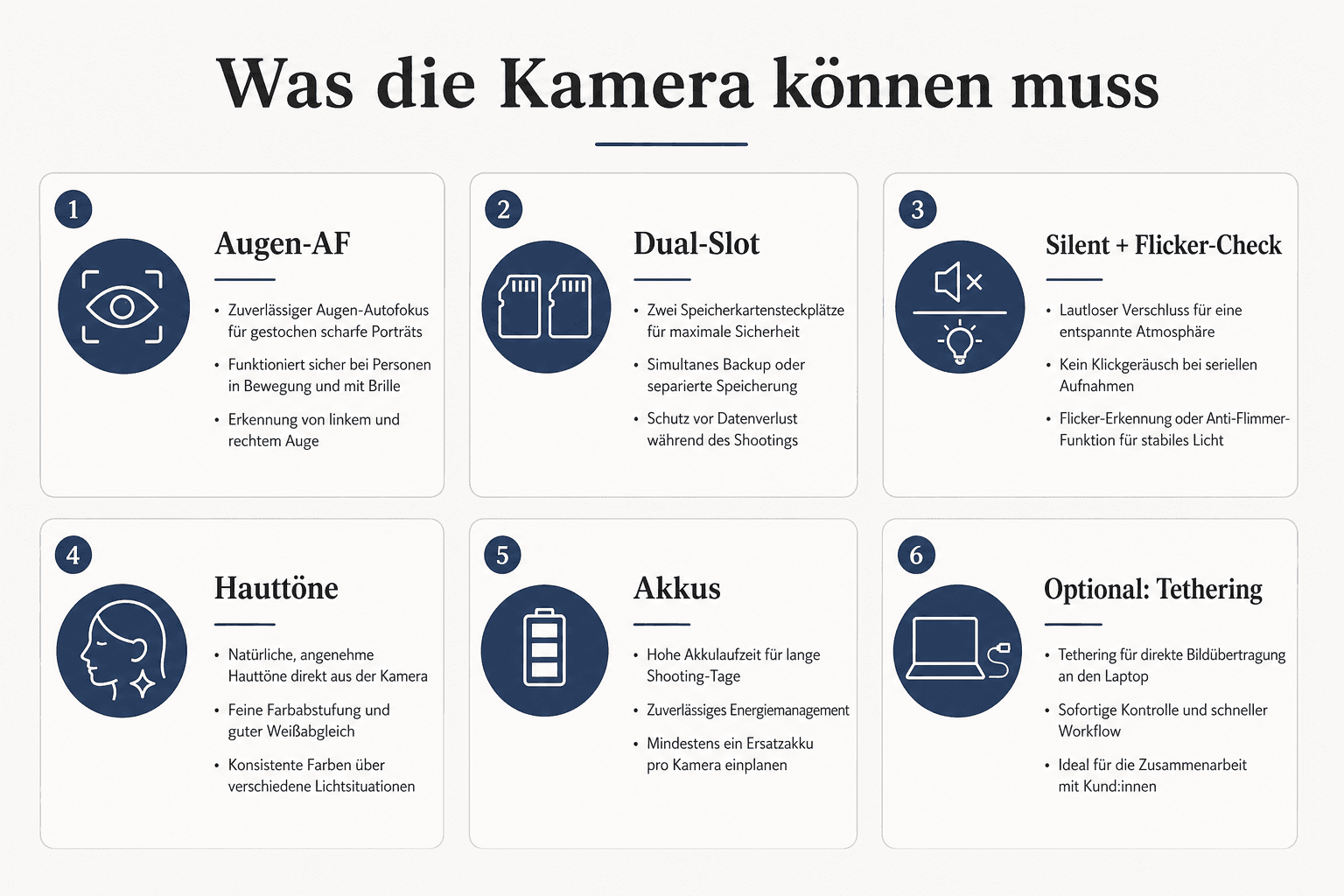
Business means: tight time windows, changing faces, often office light, often the same crops for web and LinkedIn. The camera has to map that repeatably — not spectacularly, but reliably. Four features decide more than marketing ISO. Plus: battery life, operation under stress and a system you run in your sleep.

Think in risks, not brochures: What does a lost slot cost? Soft focus on the left eye of the leadership? A permanent "click-click" in a quiet boardroom? The answers are more expensive than the gap between two body generations.

1. Eye / face detection
On headshots and series, AF keeps sharpness on the eyes — even if someone tilts slightly. Without solid eye AF you lose minutes; at 20 people that multiplies. Test with glasses, side glance and restless sitting — not only with the ideal subject.
2. Dual-slot (backup)
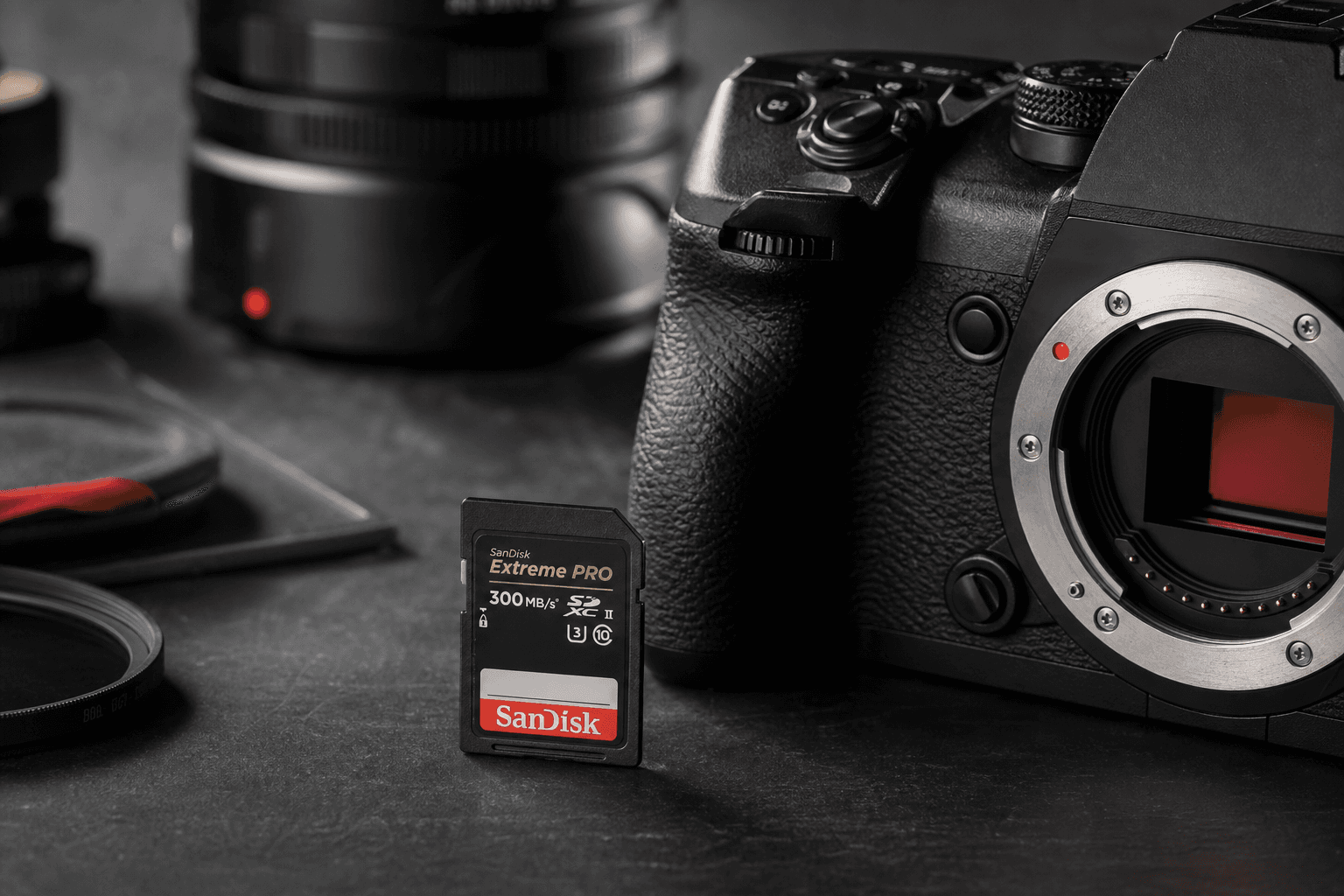
Two cards writing in parallel. If one fails, you still have the job. On paid shoots that's insurance, not luxury. Card choice: Best SD Card for Camera.
3. Quiet / silent shutter
In open office, discretion counts. Electronic shutter helps — with the LED banding caveat (section 03). Mechanically quiet is good; "totally silent" only when the light cooperates.
4. Resolution with intent
24 MP is enough for web, LinkedIn and most website crops. 32–45 MP pays off with heavy crop, print plans or multi-format from one take. More megapixels are flexibility and file size — not automatic quality gain.
Business camera checklist — eye AF, dual-slot, silent shutter, resolution, batteries
Job checklist: what must sit on the body before buying and before team day
FeatureWhy in businessPriority
Eye AFFast, consistent sharpness across many peopleMust
Dual-slot backupInsurance against card/write failureMust (paid jobs)
Silent / quietDiscretion in the office — plus banding checkStrongly recommended
24 MPWeb, LinkedIn, standard cropsOften enough
32–45 MPCrop reserve, print, multi-format from one takeDepends on workflow
IBISHelpful on location; secondary in flash studioNice-to-have
8K / ProRes internalRarely the business bottleneckUsually overkill

Priorities for corporate headshots and team days — as of 2026

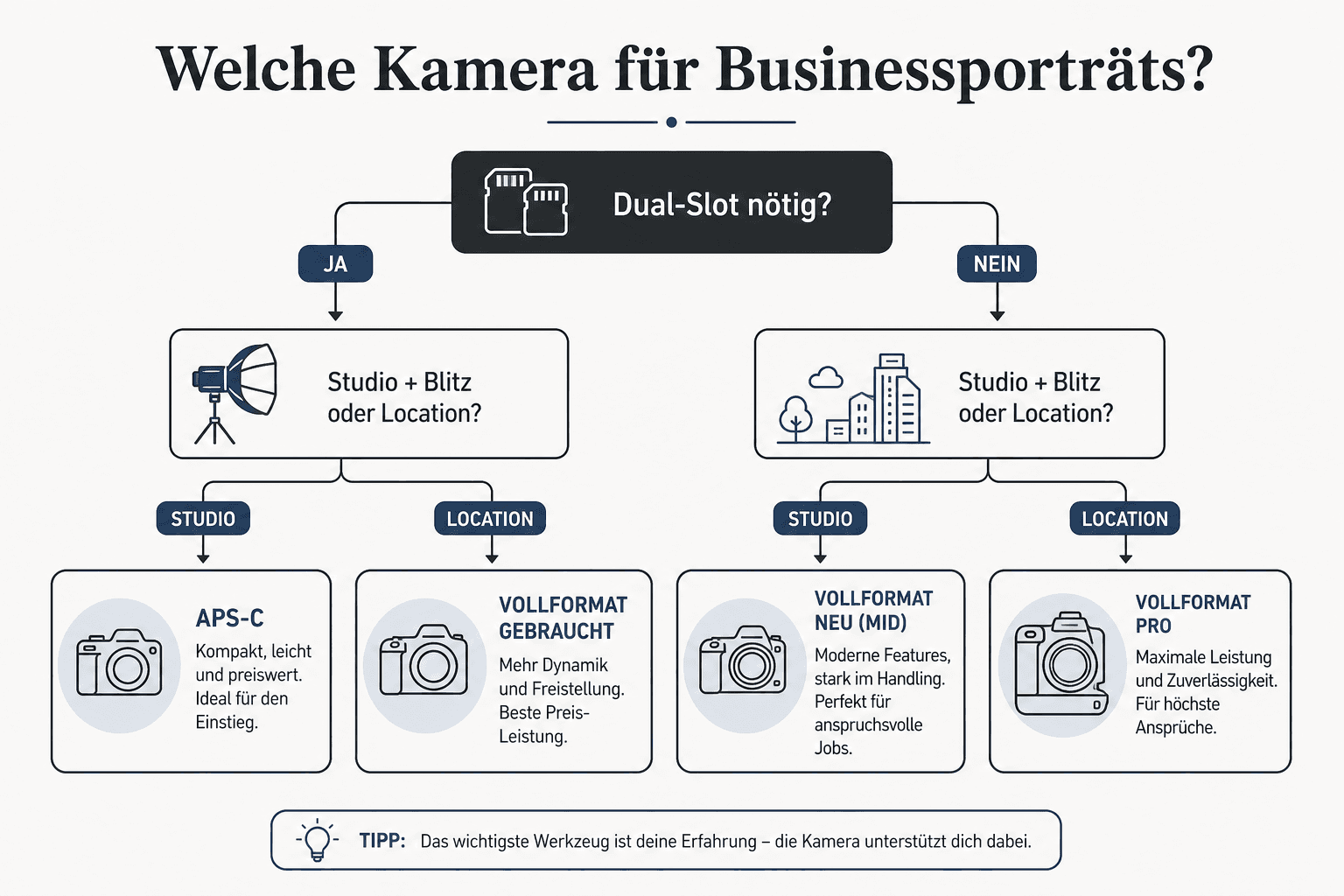
Decision tree camera for business photographers — studio vs. location, APS-C vs. full-frame, budget to pro
From use (studio/flash vs. location) through sensor and budget to body class — without spec theatre

Light and pose decide the image more than the sensor — soft: Studio Portrait Lighting. The camera must not sabotage the rest. Next: sensor format by use logic.

02
Sensor

APS-C vs. full-frame — and when medium format

Sensor format is use logic, not a status symbol. In the studio with flash, APS-C often plays strongly: enough sharpness, handy bodies, good value. On location in dark corridors, without setup time and on available light, full-frame often pulls the better ISO reserve and flatter bokeh at the same aperture and focal-length equivalent.

On set what looks professional is: even light, calm pose, consistent retouch and files that arrive — not the format label. An APS-C body with flash and clear distance beats an expensive full-frame without a plan at ISO 6400. Conversely: often without setup in real offices? Then full-frame saves frustration — because the reserve is missing, not because APS-C is "bad".

APS-C
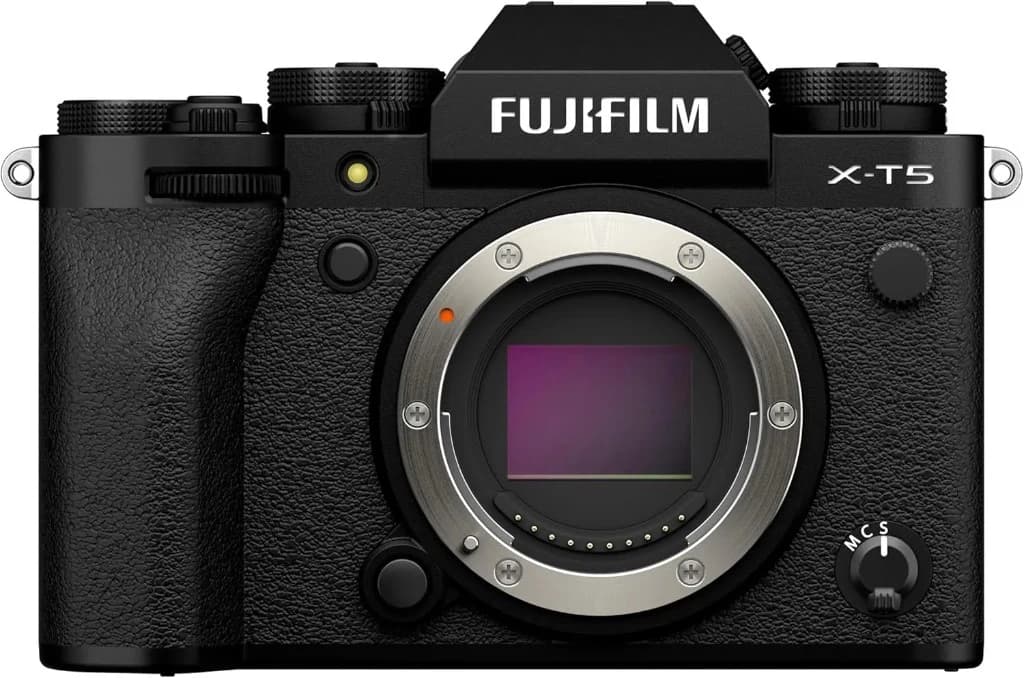
Makes sense for studio + flash, compact kits and budget. Example class: Fujifilm X-T5. Factor crop into focal-length choice (85 mm equivalent vs. true 85 mm on FF).
Full-frame
Often the better choice for location jobs, tight light and flexible look. Workhorse examples: Canon R6 Mark II (24 MP), Sony A7 IV (33 MP hybrid), Canon R5 (high resolution in the documented pro combo).
Digital medium format
Premium niche: maximum detail, different tempo and budget. Not the default for a typical team day. Orientation: Digital Medium Format Cameras.

Short: studio with light → APS-C can suffice. Lots of location, little light → full-frame often calmer. Medium format → deliberate premium project, not default for LinkedIn series.

03
Office reality

Silent shutter in the office — and LED banding

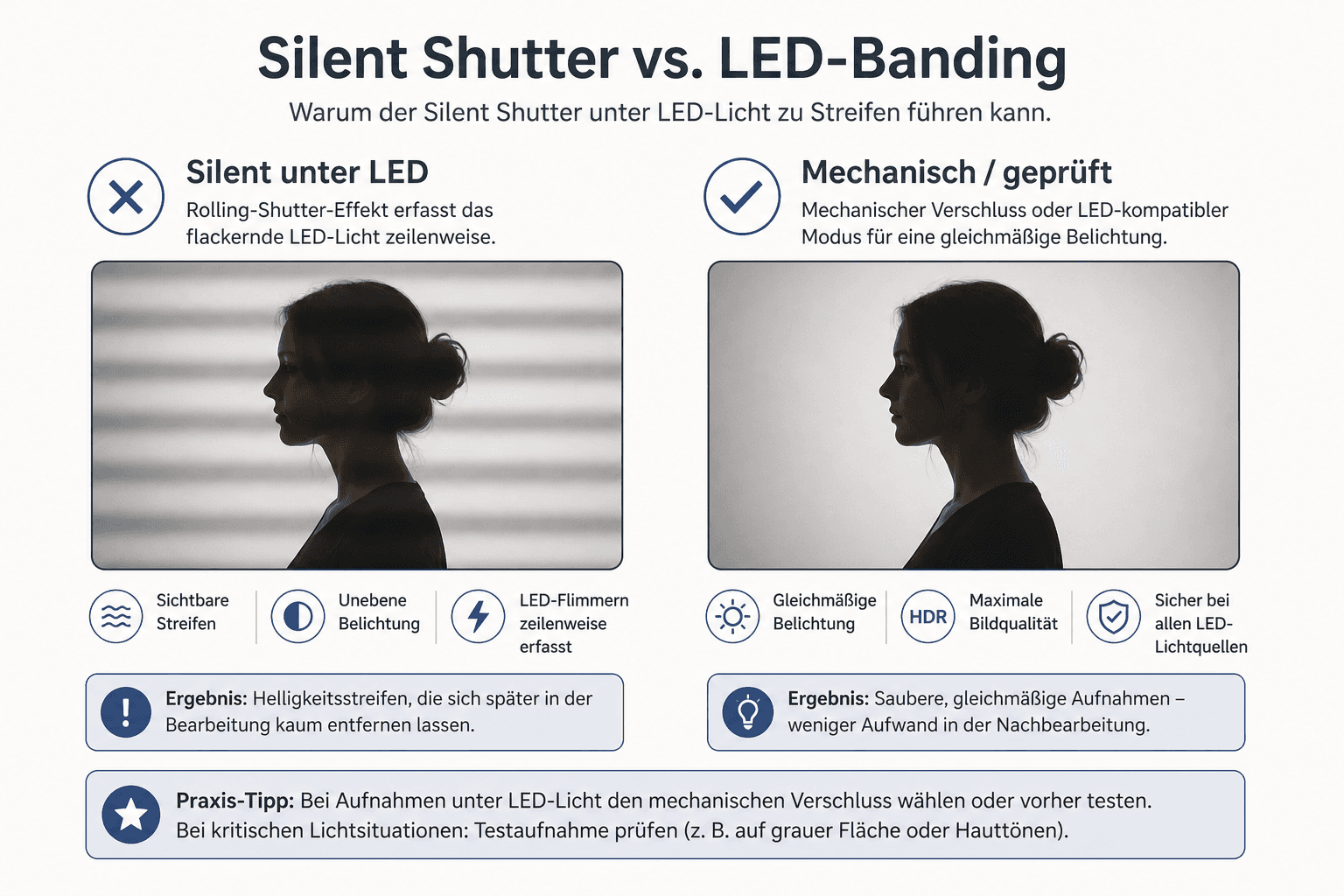
Silent shutter is gold in business: no click cascade in open plan, less disruption in meetings. Electronic shutter scans the sensor line by line though. When that and flickering LED/ceiling lights meet badly, stripes appear — banding. Often harmless on the small display; in retouch or a big crop it hits hard.

Modern offices are LED landscapes: panels, spots, ambient strips, sometimes PWM dimming. What looks "even" to the eye can pulse for the sensor. Silent isn't a habit — it's a decision after a test frame.

Silent shutter vs. mechanical shutter — LED banding risk in the office schematically
Quiet isn't always error-free: test silent under LED office light — otherwise mechanical or flash
Test before the job
One test frame with the planned shutter mode under the real ceiling light. Stripes? → mechanical / EFCS, different shutter speed, or flash. Zoom into skin and background — banding often sits subtly.
Times & sync
Sometimes a different shutter speed helps (near mains frequency, e.g. around 1/50 or 1/60). Don't trust "silent = always ok". Know and use anti-flicker aids.
Flash stays your friend
Controlled light reduces dependency on ceiling LEDs. Office/team day: Lighting for Business Portraits. Pattern physics: Studio Portrait Lighting.

Practice: silent as default in a quiet room after a test. With a critical LED mix prefer mechanical and discreet — or set light so you're independent of the ceiling. Factor rolling shutter on fast movement in electronic mode: rarer on classic headshots, yes on reportage portions.

04
Insurance

Dual slot, batteries, files — tethering optional

Paid jobs rarely fail on "too few megapixels". They fail on missing files, empty batteries and chaotic folders. Dual-slot in backup mode is the cheapest professional liability you can build into the body.

Plan the day backwards: When do you copy? Where to? How many people at how many takes? With RAW and 30+ MP the stack grows fast. Dual-slot protects against loss; capacity and transfer time protect against "cards full" mid C-level series.

Dual-slot backup
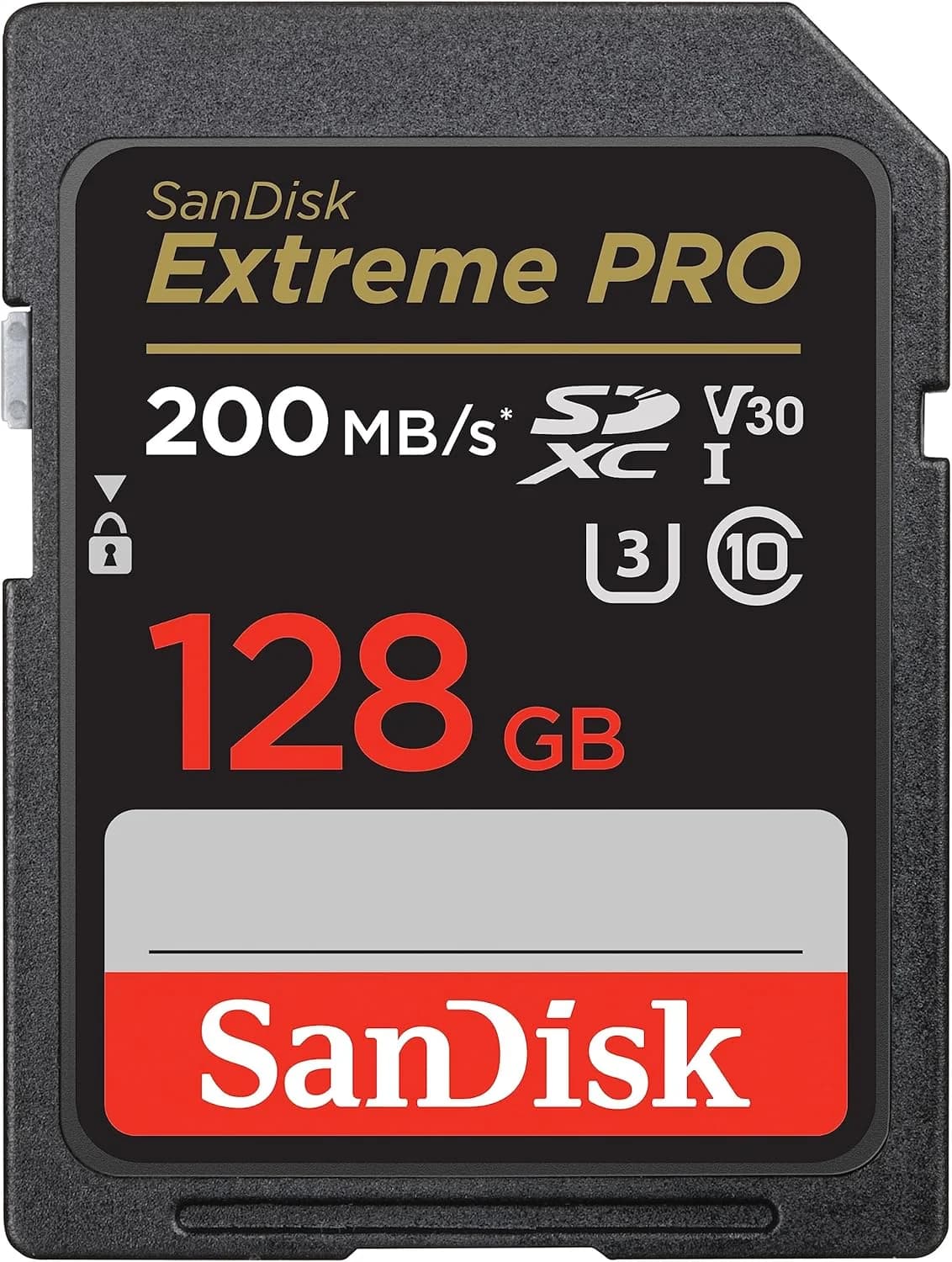
Two identical cards, mode: parallel / backup — not "overflow when full". Default often SanDisk Extreme PRO 128GB V30. Details: Best SD Card for Camera.
Batteries
Team day = several batteries + charger in the case. IBIS, AF and display eat power. A spare battery isn't nice-to-have when leadership at 16:40 still wants "three quick portraits".
Files & workflow
RAW (or RAW+JPEG per client request), clear folder logic, quick backup after the day. More resolution = more storage and longer transfers. Naming by company/date/person saves hours at delivery.

Single-slot bodies can make images. For recurring paid business jobs, prioritise dual-slot anyway — before you pay for another spec feature. Only one slot? At least clone immediately after the job (two targets) and lock in the upgrade path.

Tethering — nice, rarely mandatory

Tethering (camera → computer/iPad live) helps with art direction, CI check or stakeholders on set. For headshot streets and efficient team days often overkill: more cables, more setup time. Value rises when someone approves crops — not when you run 25 people through fixed light in 90 minutes.

  • Useful: CI-critical hero shoots, agency on set, exact crop approval live
  • Often unnecessary: 15–40 LinkedIn portraits in series with fixed light
  • Alternative: good camera preview + look agreed in advance (guidelines)
  • Stability before show: reliable saving beats impressing live with dropouts

If you tether: tested cable/interface, charged computer, backup on card anyway. Tethering doesn't replace dual-slot.

05
Buy

Recommendations 2026 — budget, mid, pro

Three body paths plus the card that makes dual-slot actually useful. No universal winner — job and system budget decide. My documented pro combo remains Canon R5 + R6 Mark II; below that the alternatives that honestly make sense for business jobs in 2026. Always cross-check prices and specs in the shop and manual.

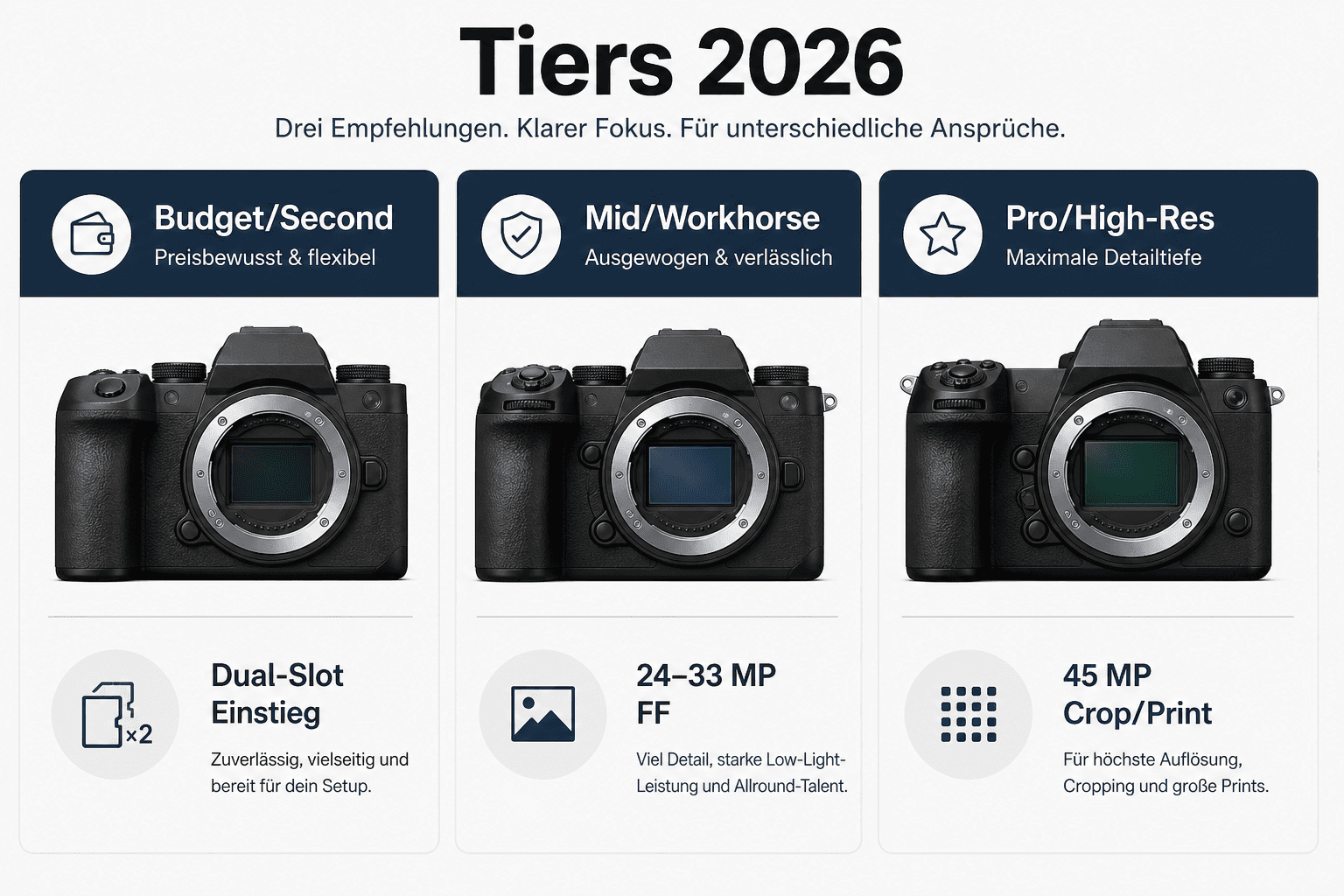
Budget doesn't mean "bad" — it means "studio+flash and system cost small". Mid = paid day-to-day without drama. Pro = resolution + second body + reserve. Already in an ecosystem? Don't switch for one spec — switch when AF, slots or service regularly sabotage you.

Camera tiers for business photographers 2026 — budget APS-C, mid full-frame, pro dual-body
Budget · Mid · Pro — ranked by job risk, not marketing megapixels
Top 4

Mid workhorse · hybrid · APS-C · dual-slot card

**#1 Canon EOS R6 Mark II*** — mid/pro workhorse, dual-slot, strong eye AF, 24 MP for everyday web. **#2 Sony A7 IV*** — 33 MP hybrid when photo+video and E-mount ecosystem matter. **#3 Fujifilm X-T5*** — APS-C with high resolution for studio/flash-heavy setups. **#4 SanDisk Extreme PRO 128GB V30*** — default card; two for backup. Check prices and availability in the shop.

Vergleich
Canon
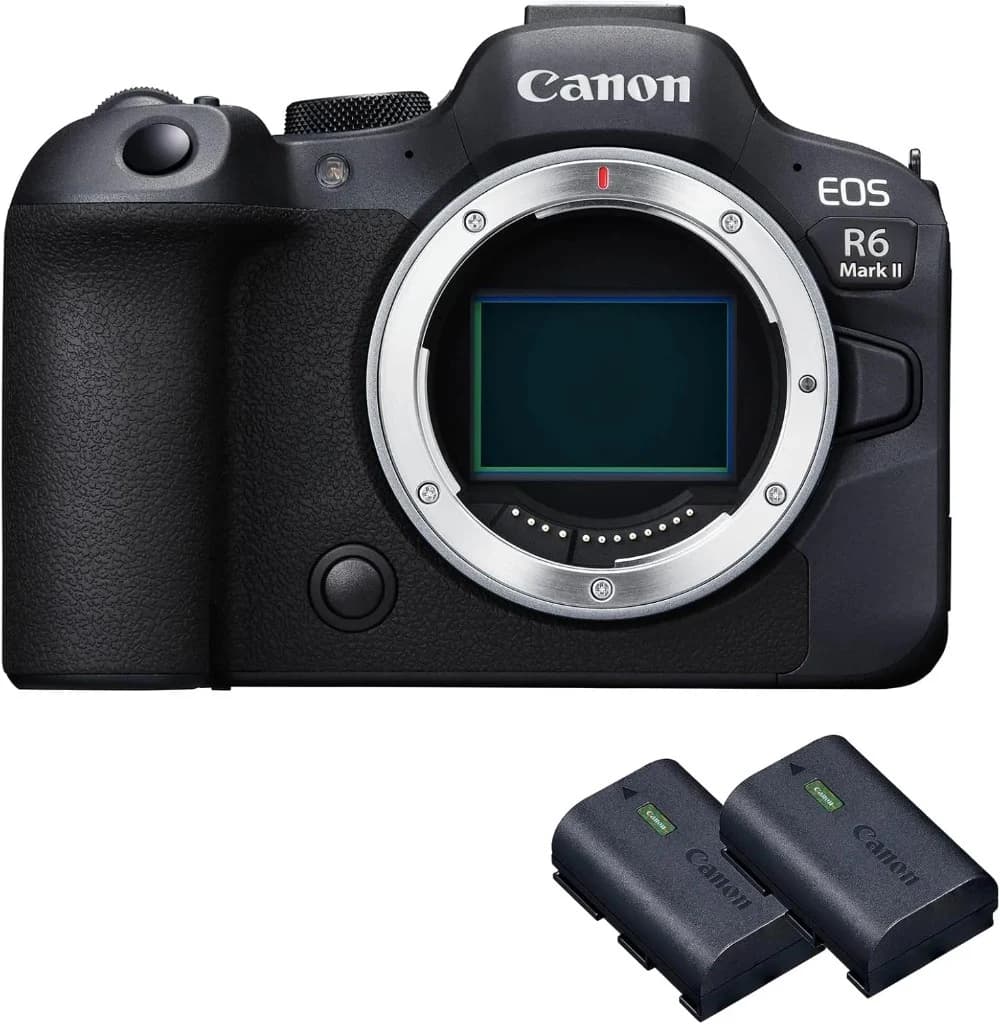
Canon EOS R6 Mark II
Sony
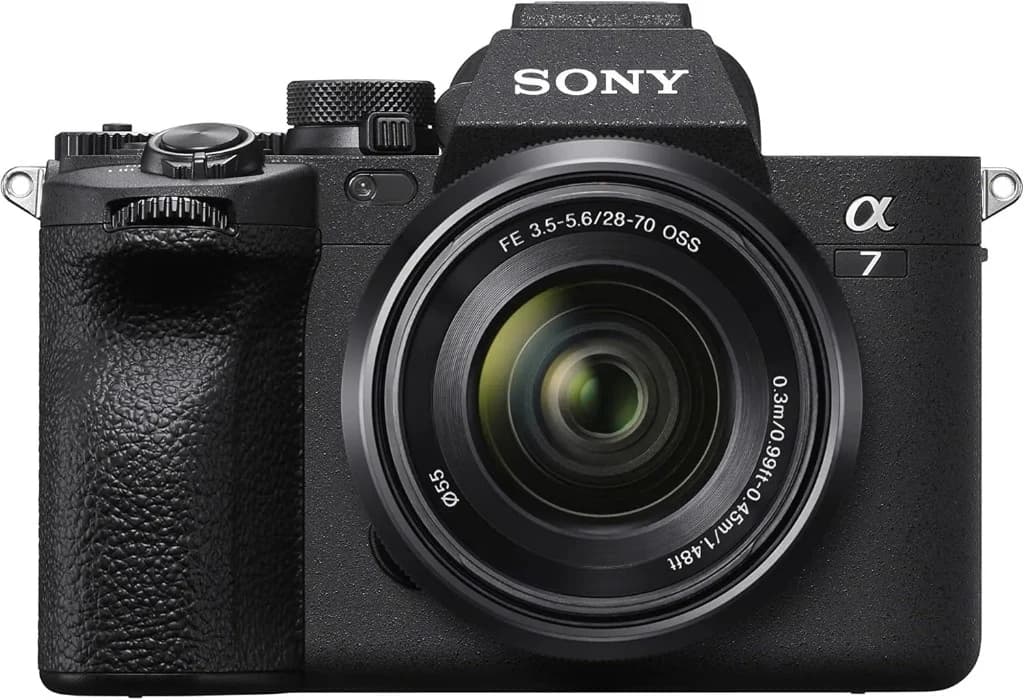
Sony A7 IV
Fujifilm
Fujifilm X-T5
SanDisk
SanDisk Extreme PRO 128GB V30
Bild
Canon EOS R6 Mark II
Sony A7 IV
Fujifilm X-T5
SanDisk Extreme PRO 128GB V30
EmpfehlungEditor's ChoiceCrop ReserveStudio APS-CDual-Slot
Sensor24.2 MP · full-frame BSI33 MP · full-frame BSI40 MP · APS-C X-Trans 5128 GB (SDXC)
ISO-BereichDual SD (UHS-II)CFe Type A / SD + SDDual SD (UHS-II)UHS-I
AutofokusDual Pixel II · Eye/SubjectReal-Time Tracking · Eye AFSubject DetectionV30
DetailIBIS · 4K60 · check Silent (LED)IBIS · 4K60 · test electronic for bandingIBIS · Film Sims · Crop 1.5×Everyday RAW · normal 4K
Stärken
  • +Dual-slot = backup for paid jobs
  • +Skin tones and Canon service in DE
  • +Strong value new and used
  • +33 MP for multi-crop delivery
  • +Dual-slot and strong AF
  • +Large E-mount ecosystem
  • +Dual-slot without a full-frame budget
  • +High resolution for crops
  • +Compact and tactile
  • +Sensible as a pair on price
  • +Enough for typical headshot days
  • +Works in almost every SD slot
Schwächen
  • 24 MP: less crop reserve than 32–45 MP
  • RF portrait glass costs extra
  • Menu takes getting used to
  • Electronic shutter + LED still needs testing
  • APS-C: DOF and available light differ from FF
  • AF tracking behind top FF on tough cases
  • No UHS-II — may need V60/V90 for extreme bitrates
  • CFe slots may need other media
Geeignet fürCorporate headshots, team days, second body, business & event.Business portraits with a hybrid brief and more crop reserve.Studio headshots with flash, second body, compact dual-slot kit.Backup slot and everyday RAW for business portraits.
Wo kaufen
TierDirectionWhyCaveat
Budget / APS-CX-T5 class*Studio+flash, high MP, compactISO reserve & AF behind top FF
Mid workhorseR6 Mark II*AF, dual-slot, tempo, skin tones24 MP = less crop reserve
Mid hybridA7 IV*33 MP, video, trackingMenu/workflow; rolling shutter in silent
Pro (documented)R5 + R6 IIResolution + speed/backup bodyInvestment + RF glass budget

Orientation July 2026 — no DXO scores, job logic

Mid / default workhorse: Canon EOS R6 Mark II*

For many business jobs the sweet spot: dual-slot, strong eye AF, calm handling, 24 MP enough for web and LinkedIn. Less crop reserve than 33–45 MP — more speed and reliability. Fits the documented R5 + R6 II line from Camera Brands. Buying one new body and Canon? Start here.

Editor's Choice
Canon EOS R6 Mark II
Bewertung
4.8
/ 5,0
★★★★
Basierend auf 0 verifizierten Bewertungen
Canon

Canon EOS R6 Mark II

Workhorse for paid business portraits

24 MP full-frame, dual SD, strong eye AF and skin tones that often need little retouch. For corporate headshots and team days, the documented mid/value pick alongside the R5 — dual-slot and reliability over megapixel theatre.

Was überzeugt
  • +Dual-slot = backup for paid jobs
  • +Skin tones and Canon service in DE
  • +Strong value new and used
Was Du wissen solltest
  • 24 MP: less crop reserve than 32–45 MP
  • RF portrait glass costs extra
Editor's Statement

My business workhorse next to the R5

Hybrid alternative: Sony A7 IV*

Beside headshots also reels/interview snippets — or already on E-mount? 33 MP give more crop flexibility. Test silent/electronic deliberately under LED office light. Not a must for pure photo headshot streets; for hybrid offers often the more logical mid pick.

Crop Reserve
Sony A7 IV
Bewertung
4.7
/ 5,0
★★★★
Basierend auf 0 verifizierten Bewertungen
Sony

Sony A7 IV

33 MP hybrid with crop reserve

33 MP full-frame and dual-slot — more room for LinkedIn circle, website and print from one RAW. Strong eye AF; menu and grip are taste. Solid mid alternative when crop flexibility matters.

Was überzeugt
  • +33 MP for multi-crop delivery
  • +Dual-slot and strong AF
  • +Large E-mount ecosystem
Was Du wissen solltest
  • Menu takes getting used to
  • Electronic shutter + LED still needs testing
Editor's Statement

When you want more megapixels and hybrid

Budget/studio path: Fujifilm X-T5*

APS-C with high resolution — makes sense when flash/studio is your default and you want to keep system cost small. On location in tight light windows, plan light more aggressively. AF and ISO stay behind top full-frame workhorses — place honestly. For strictly colour-controlled CI jobs: RAW and consistent retouch.

Studio APS-C
Fujifilm X-T5
Bewertung
4.7
/ 5,0
★★★★
Basierend auf 0 verifizierten Bewertungen
Fujifilm

Fujifilm X-T5

APS-C with dual SD for studio + flash

40 MP APS-C, dual SD and strong JPEGs — makes sense when you mostly shoot studio with flash and need dual-slot. Crop factor and DOF differ from full-frame; on-location available light is often calmer with FF.

Was überzeugt
  • +Dual-slot without a full-frame budget
  • +High resolution for crops
  • +Compact and tactile
Was Du wissen solltest
  • APS-C: DOF and available light differ from FF
  • AF tracking behind top FF on tough cases
Editor's Statement

APS-C path with backup slot

Dual-slot card: SanDisk Extreme PRO 128GB V30*

The card that makes backup affordable: 128 GB V30 as a pair in both slots. For everyday photo and normal 4K usually enough — details and when V60/V90: Best SD Card for Camera. Better two good V30s than one expensive V90 and an empty second slot.

Dual-Slot
SanDisk Extreme PRO 128GB V30
Bewertung
4.8
/ 5,0
★★★★
Basierend auf 0 verifizierten Bewertungen
SanDisk

SanDisk Extreme PRO 128GB V30

Happy path for dual-slot backup

UHS-I V30, 128 GB — the sweet spot for business and event days. Buy once, insert twice: dual-slot as data insurance. Details and alternatives: SD card guide.

Was überzeugt
  • +Sensible as a pair on price
  • +Enough for typical headshot days
  • +Works in almost every SD slot
Was Du wissen solltest
  • No UHS-II — may need V60/V90 for extreme bitrates
  • CFe slots may need other media
Editor's Statement

Two cards for dual-slot

Verfügbar bei
06
Second hand

Buying used — without nasty surprises

Used is often smarter in business than "newest model, one slot". A checked previous-gen dual-slot body beats a new marketing bargain without backup. You buy risk down — if you check.

Dealers with warranty often cost a bit more and save the worst case. Weigh the premium against a failure on a paid job. Factor brand service — one reason Canon stays strong in the documented business recommendation (Camera Brands).

  • ☐ Dual-slot present and both slots tested (write + read)
  • ☐ Shutter count in range for the price
  • ☐ Check sensor for dust/scratches (even surface, stopped down)
  • ☐ Test eye AF with a person — not only on the datasheet
  • ☐ Check silent mode under LED light for banding
  • ☐ Batteries: capacity / original batteries, charger included
  • ☐ Firmware updatable? Know known AF bugs of the generation
  • ☐ Receipt / dealer warranty vs. private-sale risk

A body without matching lenses and flashes isn't a setup — plan glass and light into the budget before you "cheaply" catch the last generation.

07
Anti-list

What you don't need for business

Spec sheets sell features that are rarely the bottleneck on team day. Money that could go into dual-slot, second body, light or lenses otherwise lands in marketing lines. Before every upgrade: which risk am I eliminating — and which do I still owe if light and glass are weak?

Maximum megapixels "for safety"
Without a crop/print plan, 60+ MP mostly create storage, heat and longer exports. 24 MP web-ok; 32–45 MP with intent.
Internal 8K / ProRes as a buying reason
Business headshots are photo jobs. Only buy video extras if you actually bill them.
Medium format as default
Premium and deliberate — not needed for LinkedIn series. See Digital Medium Format Cameras.
Single-slot despite paid jobs
"I'll just be careful" isn't backup. Cards die without warning.
Silent shutter without a light test
Banding across the whole series costs more than two mechanical test frames.
New system only for one spec
Lenses, flashes, batteries, workflow: switching systems costs more than the body. Stay if AF + slots + service fit.

Budget free? Prefer light and a second reliable lens over a body feature you don't touch on team day. Trilogy continues: Lenses for Business Portraits and Lighting for Business Portraits.

08
Trilogy & service

Next steps — tech trilogy and booking

Post 8 closes the entry to the tech trilogy: the body that won't sabotage the job. Next: Lenses for Business Portraits (Post 9) and Lighting for Business Portraits (Post 10). Soft entry pattern physics: Studio Portrait Lighting.

Path A — you shoot professionally
Checklist 01–04 → pick tier in 05 → V30* card pair → used check (06) → anti-list (07). Parallel: Best SD Card for Camera, system context Camera Brands.
Path B — you want to be photographed
Don't shop the body — book production: Business Photography in Hannover. Orientation on effort and ranges: What Does Business Photography Cost.
  • ☐ Eye AF tested at your typical distance
  • ☐ Dual-slot backup active with two identical cards
  • ☐ Silent checked under real office LED (banding?)
  • ☐ Resolution to workflow: 24 vs. 32–45 MP decided
  • ☐ Spare batteries for team day in the case
  • Lenses and lighting of the trilogy read

Cluster context sparingly: prep and brand in posts 1–7 — e.g. Prepare Employee Photos and Corporate Branding Photography. Here the focus stays body. Once the body sits, glass — then light. In that order you save expensive wrong buys.

09
FAQ

FAQ on the business camera

Which camera do I need for corporate headshots 2026?
Priority: eye AF, dual-slot backup, controllable (silent) shutter and enough resolution for your crops. For many: Canon EOS R6 Mark II (24 MP workhorse) or Sony A7 IV (33 MP hybrid). Documented pro combo: Canon R5 + R6 Mark II. APS-C (e.g. Fujifilm X-T5*) can suffice in studio with flash.
Are 24 megapixels enough for LinkedIn and website?
Yes — for web and LinkedIn, 24 MP is usually fully sufficient. 32–45 MP mainly pays off for heavy crops, print and multi-format from one take. More pixels are flexibility, not an automatic "better portrait".
APS-C or full-frame for business?
APS-C is often fine in studio with flash and budget-friendly. On location with tight light and flexible look, full-frame is often calmer. Decide by use, not status.
Why is dual-slot so important on paid jobs?
Because a defective or corrupt card can kill the job. Backup mode with two identical cards is the simplest insurance. Default card often SanDisk Extreme PRO 128GB V30* — details in the SD card guide.
Can I use silent shutter in the office without worry?
No — not blindly. LED and ceiling light can create banding. Always test under the real light; if stripes appear, prioritise mechanical/EFCS or flash.
Do I need medium format for business portraits?
No as a default. Digital medium format is a premium niche — orientation: Digital Medium Format Cameras. For typical team and LinkedIn series, modern full-frame/APS-C bodies are enough.
How does this guide differ from camera brands / beginners / DSLR vs. mirrorless?
Camera Brands = systems, market, service. Mirrorless vs. DSLR = form factor. Camera for Beginners = entry. This post = job requirements for paid business shoots (AF, slots, silent, resolution, tiers 2026).
Should I buy used?
Often yes — if dual-slot, sensor, shutter count and AF check out. Checklist in section 06. A solid previous-gen dual-slot body often beats a new single-slot bargain.
What comes after the camera in the trilogy?
Next: Lenses for Business Portraits (Post 9) and Lighting for Business Portraits (Post 10). Soft entry pattern physics: Studio Portrait Lighting.
I don't want to buy a camera — can I book business photos in Hannover?
Yes. I'm a business photographer in Hannover: portraits, team, corporate. Enquire via Business Photography. Open: I earn from bookings; the tech guide stays usable for photographers without a booking.
**Disclosure:** Affiliate links marked with * — Amazon and partner product links. I earn a small commission if you buy through these links; there's no extra cost to you. No brand sponsored this article. I'm a business photographer in Hannover and offer [business photography](/en/business-photography/) myself — openly disclosed; you don't need a booking to use the guide. Documented practice from [Camera Brands](/en/camera-brands/): Canon R5 and R6 Mark II for business & wedding. No invented DXO scores. As of: July 2026.
Two paths

Body settled — secure the job or book yourself?

Photographers: dual-slot, eye AF and the matching tier recommendation above (* affiliate) — plus card pair from the SD guide. Clients: if you need portraits or a team day in Hannover, don't shop the body — enquire about production. Open: I earn from booking and affiliate; the guide stays the job checklist.

Keep reading

From the journal.

Fotograf, Martin Fernando Mera Kleinheinz · Franz-Bork-Straße 21, 30163 Hannover · 0179 4085297