Lighting for Business Portraits: Freeze the Team Photo Day
Loop + softbox as the default, clamshell for pace, glasses without glare — and why window light often sabotages the corporate grid. Office workflow 2026.
Author
Martin Kleinheinz
Business Photographer · Hannover
Updated
July 30, 2026
Looking for strong company imagery, not a lighting buying guide? You're in the wrong place — and exactly right at Business Photography: portraits, team, and corporate in Hannover. This post is for photographers who bill corporate headshots and team photo days.
On a team day, what matters is whether person 1 and person 18 have the same light quality — not whether Rembrandt looks "more interesting." This is Post 10 in the Business Photography cluster and the finale of the technical trilogy: Camera for Business Photographers → Lenses for Business Portraits → lighting (this post).
Documented line in short: Canon R5 / R6 Mark II, softbox key in loop as the grid default, clamshell only when pace or glasses need it, kit core softbox-80 + reflector + AD200 class — no lux table. What is not here: pattern physics, softbox-vs.-umbrella, and home-studio recipe catalog → Studio Portrait Lighting. Flash fundamentals → Flash Photography Guide. Here: office workflow — freeze loop, clamshell for pace, glasses, window light, kit for the meeting room.
00
Start
Who this guide is for
This post is for photographers who bill business portraits, LinkedIn headshots, and team photo days — or are preparing that seriously. The question isn't "Which light pattern looks most dramatic?" but: "Which setup lets you deliver 20 faces consistently in two hours — with glasses, LED ceilings, and changing outfits?" From my own team days in Hannover: softbox is up, tape on the floor, first person at 9:30, CFO at 10:05 with rimless glasses, window light drifts, someone turns the ceiling LED up. If you rebuild every time, the client sees it in the grid.
“My rule of thumb from paid team days: freeze loop, don't touch the softbox, power manual. Rembrandt only when the brief wants character — not because it looks cooler on Instagram.”
— Martin Kleinheinz, Business Photographer Hannover
Business starters
Requirements (01) → decision tree (02) → one-light (03) → glasses (06) → freeze (07). One loop setup before buying clamshell.
Workhorse upgrade
Clamshell (04), window-light limit (05), kit matrix (08), silent/LED in the team-day section (07).
Business means: tight time windows, changing faces, cramped rooms, matching crops for web and LinkedIn. Corporate light is a production tool, not a mood board — same key angle, same softbox height, same power, person after person. Drift costs more retouching and trust than softbox 60 vs. 80: person 3 brighter than person 12, glare on the CFO's glasses, window side blows out skin. Pose and Clothing for Business Photos help; inconsistent light doesn't save a series.
1. Repeatability
Tape marks, manual flash power, fixed white balance. TTL and "by feel" drift the grid. Details in section 07.
2. Soft key with intent
Softbox (often ~80 cm class) close enough to the face, far enough for working room. Loop as default — Rembrandt only intentional.
3. Fill without drama
Reflector or second light as fill — not as a second key. Shadow side readable, series calm, thumbnails clear.
4. Pace under stress
Clamshell or a frozen one-light beats "relight every face." Glasses and short slots need a setup you don't constantly touch.
Requirement
Why in business
Priority
Loop as default
Friendly, readable, CI-ready
Must (series)
Softbox key
Soft, controllable, portable
Must
Manual power + fixed WB
Grid stays consistent
Must
Tape marks / fixed positions
Hold distance and angle
Strongly recommended
Clamshell option
Pace, glasses, beauty-adjacent
Depends on job
Window light alone
Fast — often uncontrolled
One-offs only
Rembrandt as permanent default
Character — rarely corporate grid
Nice-to-have / intent
Priorities for corporate headshots and team days — as of 2026; no lux readings
Think crop: a LinkedIn circle forgives less glare and harder shadows than a website half-body — soft: LinkedIn Profile Photo. Next: which setup path fits the job.
02
Decision
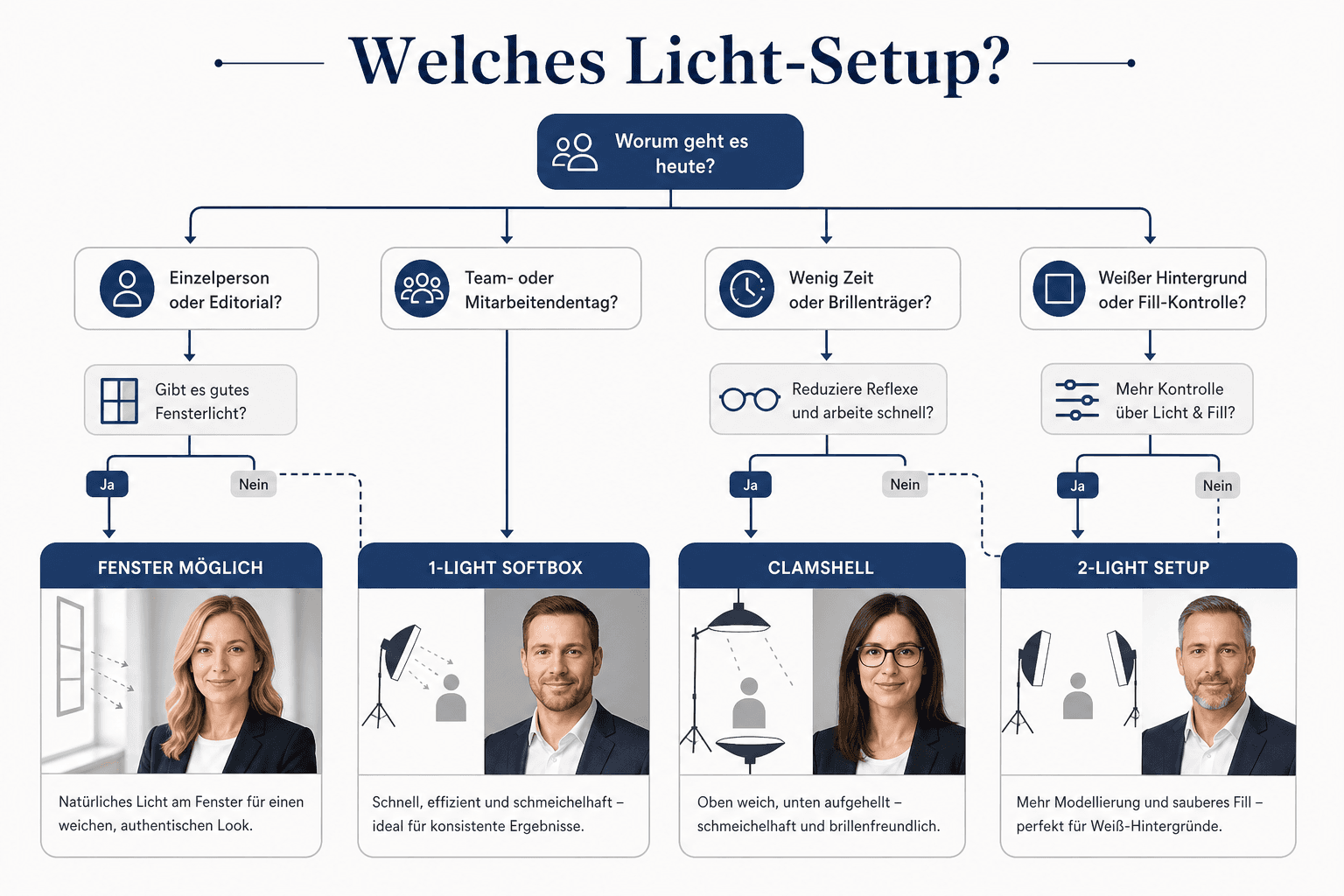
Decision tree — which setup when
Not every corporate image needs the same light. The mistake is jumping between Rembrandt, window, and clamshell on a team day "for variety." The grid needs a default — and clear exception paths.
From brief (series / pace / glasses / character) to setup — no mood-board theater
→ Clamshell or loop with careful fill from front-below. Angle of incidence (06) stays mandatory.
Single photo, strong window, time pressure
→ Window only if position and contrast sit — and you know the next slot won't have the same light.
Character / editorial intent
→ Rembrandt or split on purpose — don't mix mid LinkedIn series.
Default chosen? Then build it once correctly — section 03.
03
Default
One-light + softbox — freeze loop
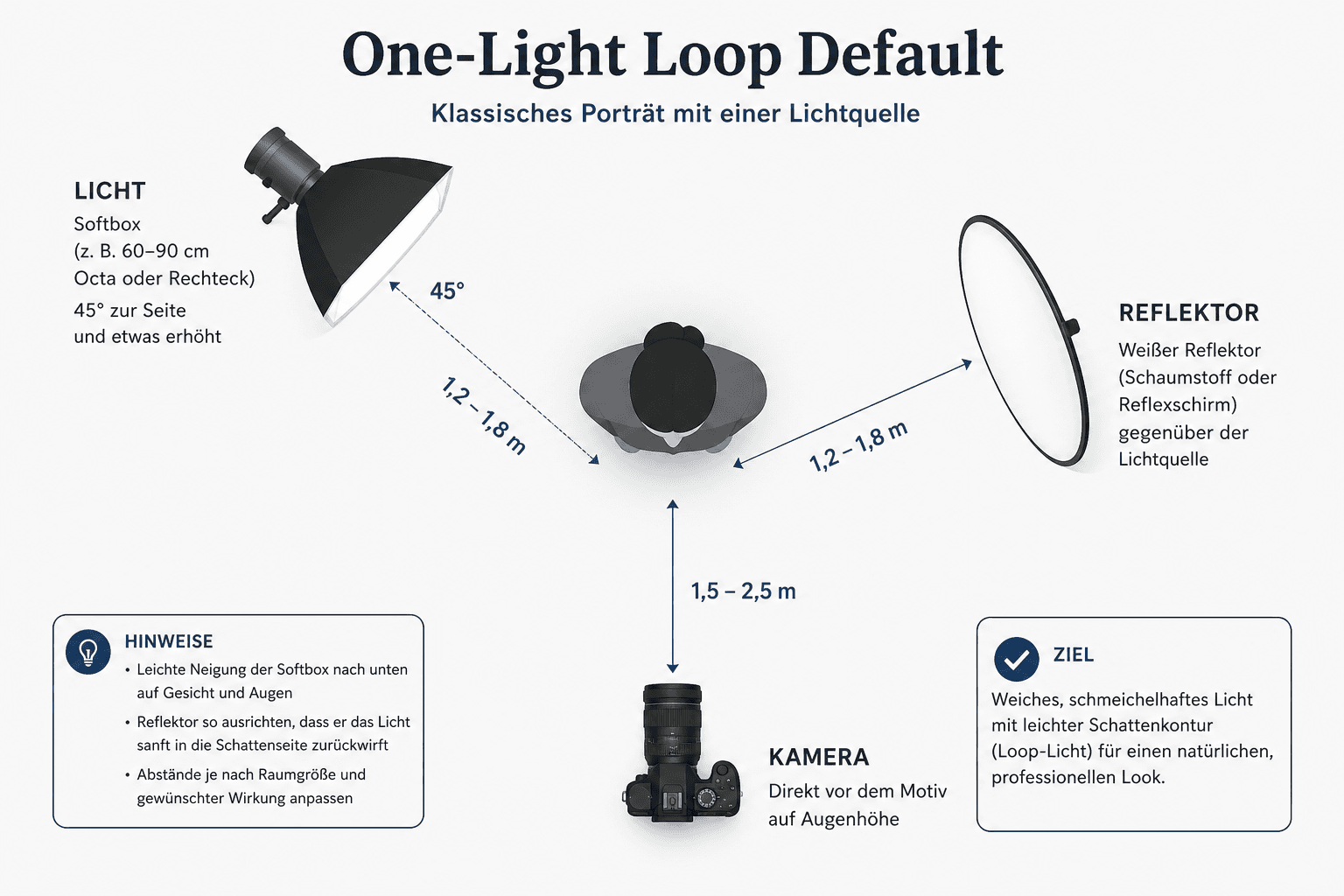
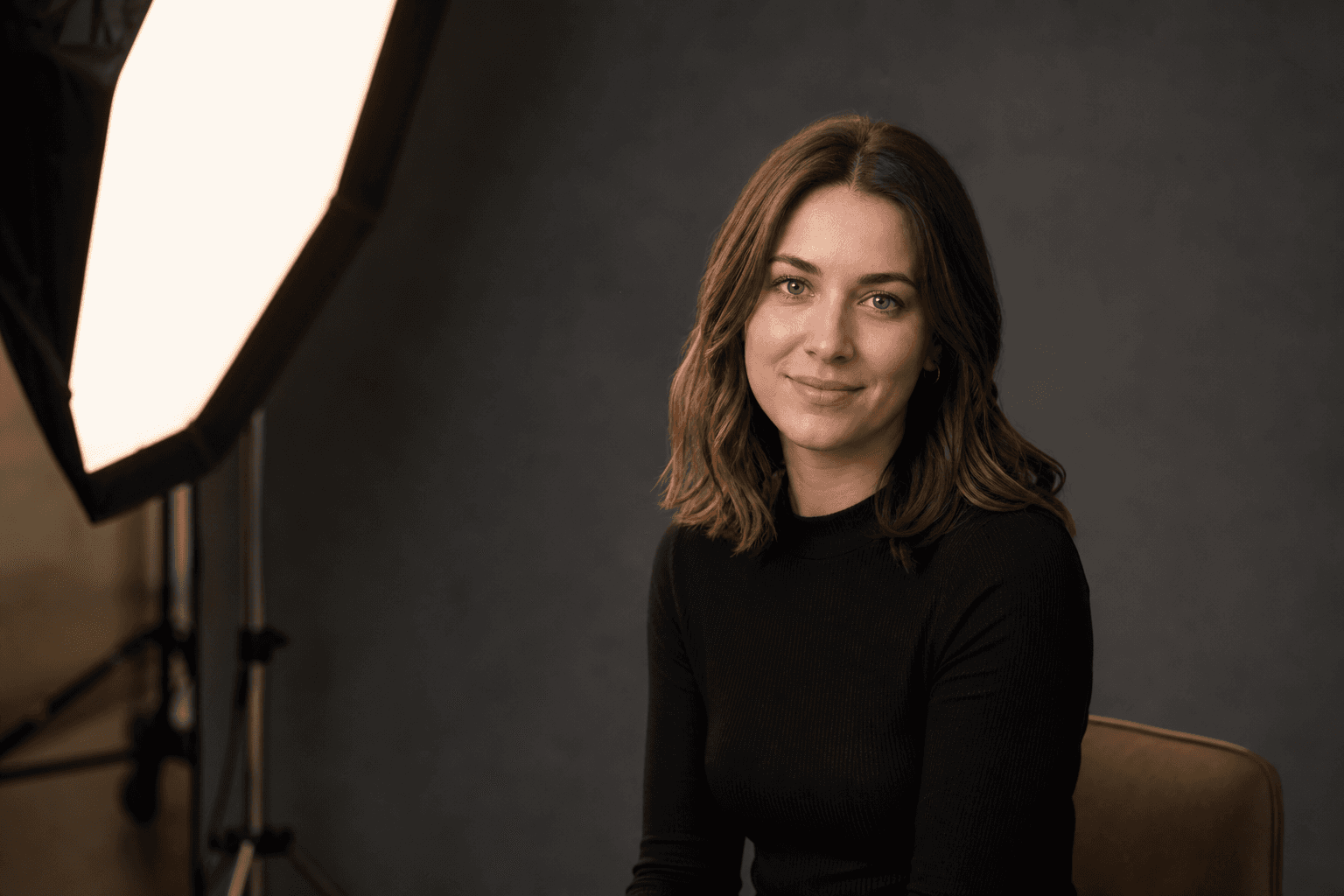
If you take away just one thing: one softbox key, slightly above eye level, about 30–45° off the camera axis (loop), and on the shadow side a white reflector as fill. This isn't a workaround — it's the setup I typically freeze for corporate grids in Hannover so person 1 and person 18 still match afterward.
Loop default: softbox key front-side elevated, reflector as fill — tape-mark positions
Key (main light)
Softbox (often 80×80 class) with flash (AD200 class or strong speedlight). Elevated, slightly off to the side. Draws catchlights and a small nose shadow toward the corner of the mouth — loop, not Rembrandt triangle.
Fill (brightening)
White reflector opposite. Opens shadows under eye and chin without a second hard key. Set distance and angle once — then leave them.
Background & room
Pull the subject off the background as far as the meeting room allows. Less shadow on the wall, calmer crop for website and LinkedIn.
Camera / exposure
Flash manual, ambient down (fast shutter, low ISO, stop down if needed) so the flash carries the image. TTL as a start is fine — hold the job series manual.
Softbox close = softer and often "fuller" on the face; softbox far = harder and more spill in the room. For corporate, prefer a bit closer and power down over far away and "louder" flash. Flash fundamentals: Flash Photography Guide.
When pace and glasses break the default: two-light and clamshell — next section.
04
Pace
Two-light & clamshell — when the clock is ticking
Two lights don't automatically mean "more professional." They mean: more variables. In corporate the second light pays when you control fill without constantly holding the reflector — or when you run clamshell: key from above, fill from below, both relatively frontal.
Clamshell is the pace path: flatter, friendlier, catchlights often double-ring or large. Good for short slots, beauty-adjacent CI, and lots of glasses — because you can often hold the angle more stably than with strongly side loop. Caveat: some brands want "more edge" — then the visual language from the Corporate Branding Photography brief counts. Stay on loop and save clamshell for the glasses-heavy minutes.
Key above
Softbox or beauty-adjacent source above the camera line, tilted slightly forward. Not so high that the eye sockets go black.
Fill below
Second light or large reflector from below — weaker than the key. Goal: open shadows under chin and nose, not create a second hard face.
Ratio on purpose
Keep fill clearly under key. Too flat reads "beauty ads"; too hard reads tired and restless in the grid. Check on the display — no lux table needed.
When not
When CI wants "editorial / strong" and you have time for loop. Clamshell is a tool, not a status symbol.
Two-light needs discipline: both sources manual, both positions marked. Otherwise you multiply drift. Next the temptation that often breaks everything: "We'll just use window light."
05
Ambient
Window light — when yes, when no
Window light is beautiful, fast, and dangerous for series. It drifts. Clouds change. Person 8 stands a meter farther left and suddenly gets a different ratio. For a single editorial portrait on the right morning: often magic. For a corporate grid with 18 people over two hours I've seen it enough: person 1 and person 12 no longer match — and the client notices in the grid.
Yes — one-off / time window
One person, controlled position, reflector as fill, you accept that the look won't transfer 1:1 to the afternoon. Or intentional "daylight story" for environmental, not for the LinkedIn grid.
No — team-day default
When consistency is mandatory: softbox key dominates, ambient down. Close or flag the window if it blows contrast.
Hybrid with caution
Window as weak fill, flash as key — only if you truly keep the ambient share low. Otherwise the window wins at the next cloud break.
Client side: good prep (room, timing, outfit) saves more than a "nice north window." Soft: Prepare Employee Photos; outfit depth: Clothing for Business Photos. Next the classic that eats retouch budgets: glasses.
06
Optics
Glasses without glare — angle of incidence, one variable
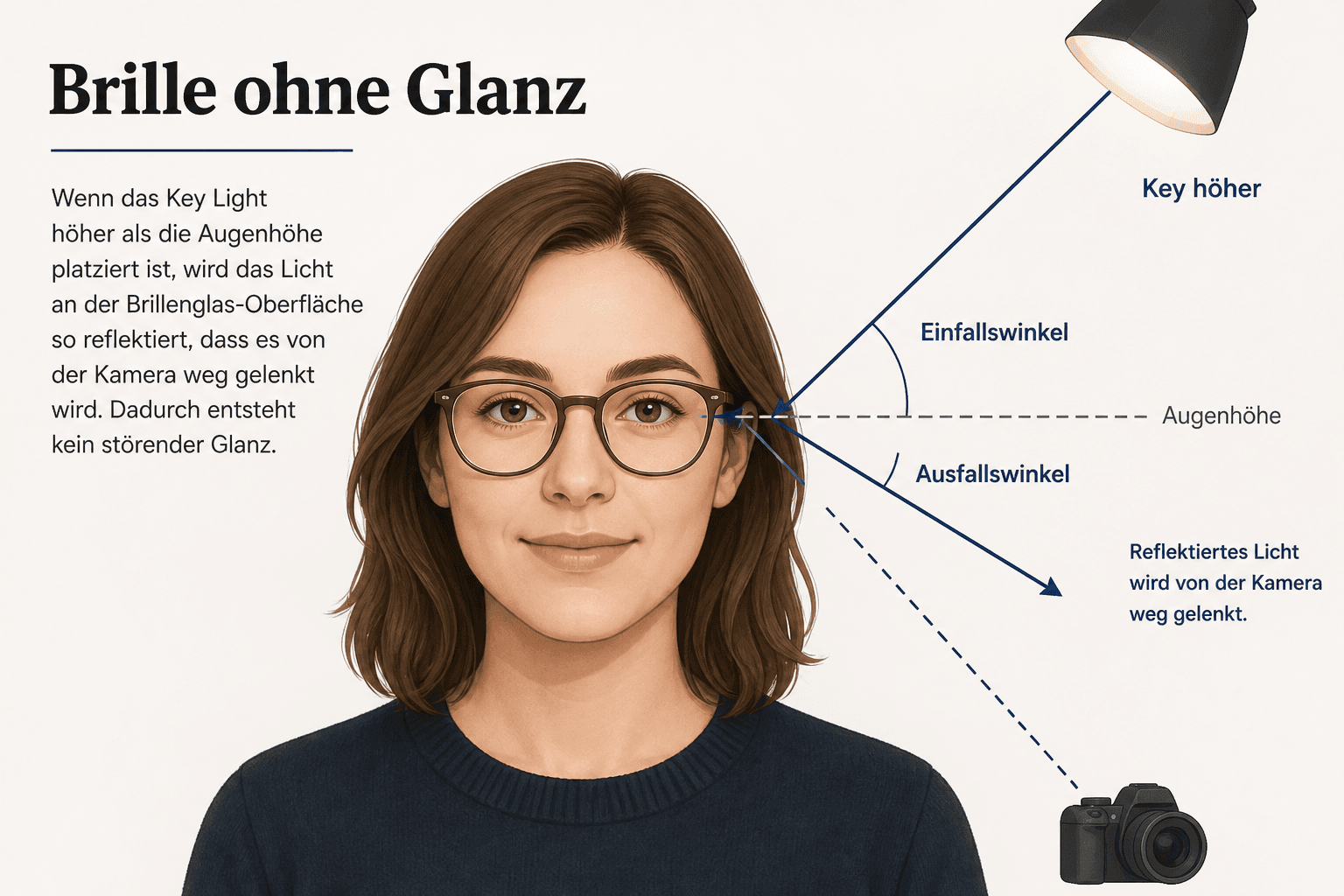
Glare on glasses is physics, not bad luck. Light source, glass surface, and camera form a mirror angle. If you see the softbox reflection in the lens, you (or the light) are at the wrong angle. On set I skip panic retouching: change one variable, two test frames — rarely five things at once.
Change one variable: key higher/more side or tip the head slightly — not everything at once
Rule: one variable
Either key slightly higher/more side, or subject tips chin/glasses minimally, or camera height changes. Not softbox, power, fill, and pose at once — otherwise you don't know what helped.
Softbox vs. hard spotlight
A large soft surface reflects as a soft veil — often less distracting than a hard point. Still: angle beats diffuser magic.
Clamshell help
More frontal sources and a controlled angle can reduce glare — test. Don't blindly rebuild mid loop series.
Anti-reflective coatings
Help, but don't replace the angle of incidence. Rimless and strongly curved lenses stay demanding.
Think crop: in the LinkedIn circle, glare often sits mid-face — soft: LinkedIn Profile Photo. Next: how you freeze the whole setup for hours.
07
Production
Team photo day — freeze the light
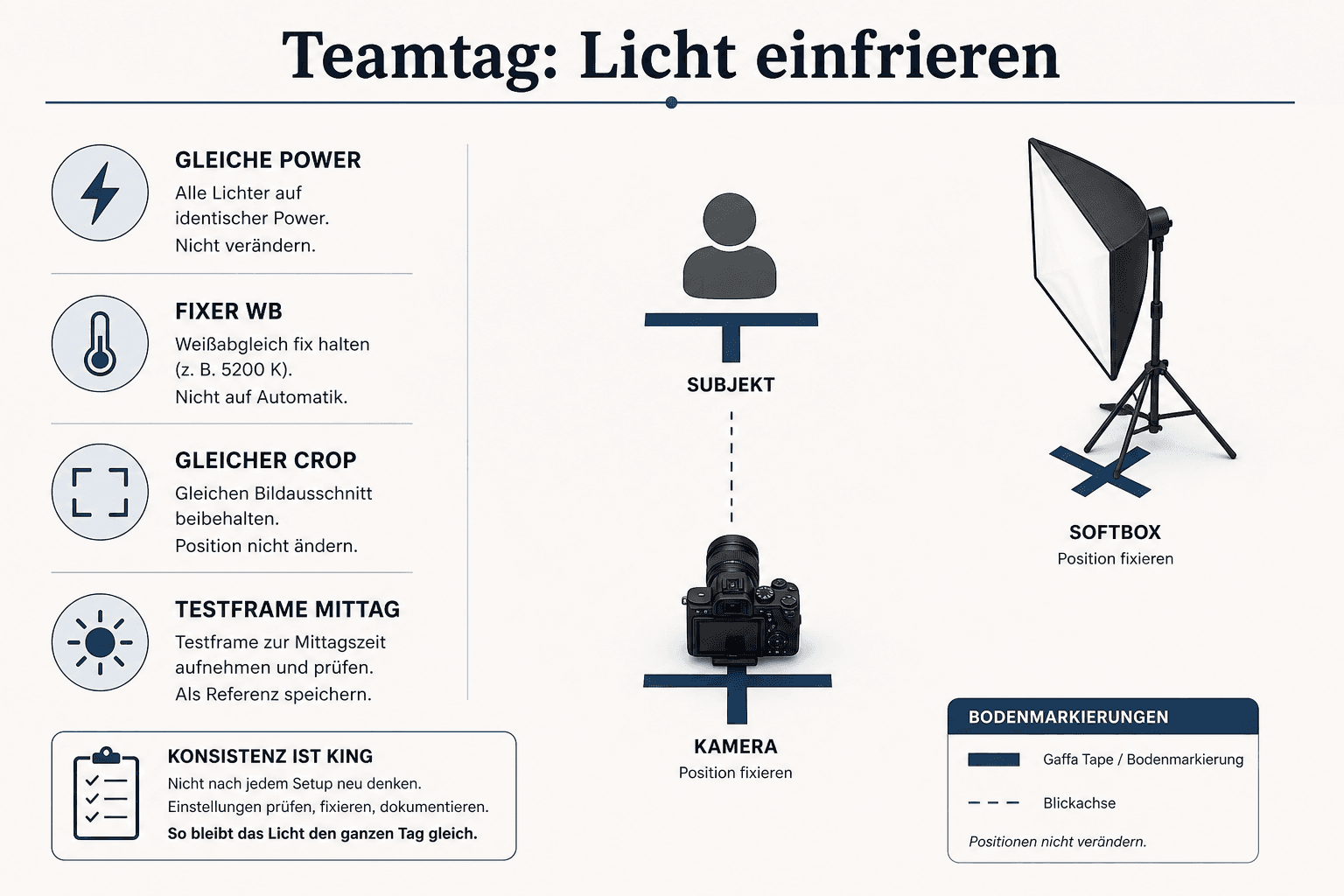
The paid job rarely fails from "not enough creativity." It fails from drift: softbox shifts, power "just" goes up, WB is on auto, someone opens the blinds. Freezing for me means: lock physical and exposure variables — and only free pose/expression. What drifts shows up in the grid — and by then the queue is gone.
Tape on the floor, softbox height marked, power manual, WB fixed — the same for every person
◆☐ Mark softbox stand and subject position with tape
◆☐ Flash power manual — don't "chase" after test frames
◆☐ White balance fixed (Kelvin or custom) — not auto across 20 faces
◆☐ Ambient down / control windows before the queue starts
◆☐ Check silent under real office LED (banding?) — otherwise mechanical/EFCS
◆☐ One reference JPEG or histogram check person 1 vs. middle vs. end
◆☐ Assistant holds reflector at the same mark — or reflector on a stand
◆☐ Rebuild only between blocks (e.g. after a break), never wild mid-series
Silent & LED — body interface on set
Continuous light and ceiling LED feel pleasant — you see the light live. For corporate series ambient mixes in, and silent shutter can produce banding under LED. Deep dive: Camera for Business Photographers. Short: test under real light; if stripes appear, go mechanical/EFCS or prioritize flash key and drop ambient. Two mechanical test frames before silent all day save the job.
Only if color and intensity hold across the slot — and silent is consciously checked. LED + flash: either flash clearly dominates, or both are locked — otherwise the grid drifts.
Setup frozen? Next the kit that fits trunk and meeting room.
08
Buy
Portable office kit — softbox, reflector, AD200
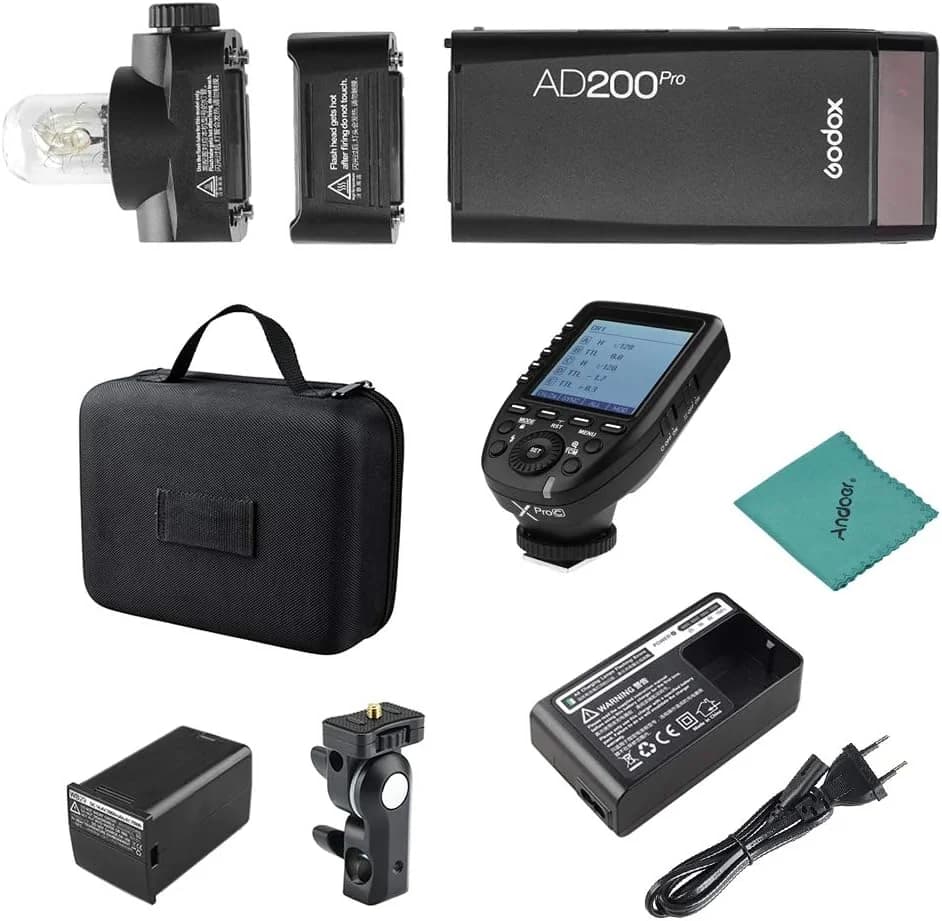
For office jobs you don't need a studio on wheels. You need three things that carry loop together: soft surface, controlled fill, enough power. Softbox ~80, 5-in-1 reflector, AD200 class — that's the core I recommend for location headshots and run myself. Stands, trigger, and a background plan come on top; without the core everything stays ambient lottery.
Budget left? Prefer this trio reliable over three more modifiers "for options." You rebuild options once the default sits. Check prices and bundles in the shop — cross-check specs and compatibility (mount/trigger) against manufacturer data and current listings; shop prices change.
Office trio
Modifier · Fill · Key flash
**#1 Godox Softbox 80 Kit*** — soft key for loop in the meeting room. **#2 Neewer 5-in-1 Reflector 110*** — fill without a second light. **#3 Godox AD200 Pro*** — power for softbox and distance, portable enough for location. Check prices and availability in the shop.
Vergleich
Godox
Godox Softbox 80×80 with S2 Mount & Grid
Neewer
Neewer 5-in-1 Reflector 110 cm
Godox
Godox AD200 Pro
Bild
Empfehlung
Team Day Key
Fill
Key Flash
Sensor
Softbox 80×80 cm
5-in-1 folding reflector
approx. 200 Ws (manufacturer)
ISO-Bereich
S2 / speedlight + Bowens-compatible
approx. 110 cm dia. (manufacturer)
Battery · TTL/HSS (system)
Autofokus
Grid / honeycomb included
Diffuser · Silver · Gold · White · Black
Key · softbox · location office
Detail
Corporate headshots · office
One-light fill · clamshell · window
Stärken
+Soft key sized for a meeting room
+Grid = calmer background across many people
+S2 included — speedlight or AD200
+Fill without second-flash ratio chaos
+Clamshell underside for glasses/pace
+Compact for location
+Enough power for softbox headshots on location
+Compact for team photo days
+Fast recycling in a portrait workflow
Schwächen
−Needs a stable stand and some space
−Often too small for large groups
−Needs support (person/clamp/stand)
−Gold goes warm fast for corporate
−Trigger and softbox sold separately
−Not hall/group-level power
Geeignet für
One-light loop default on team photo days and solo headshots on location.
Office kit: open up a softbox key and run clamshell without a second light.
Anyone who takes a softbox in the office seriously and is stepping up from a speedlight to stable key power.
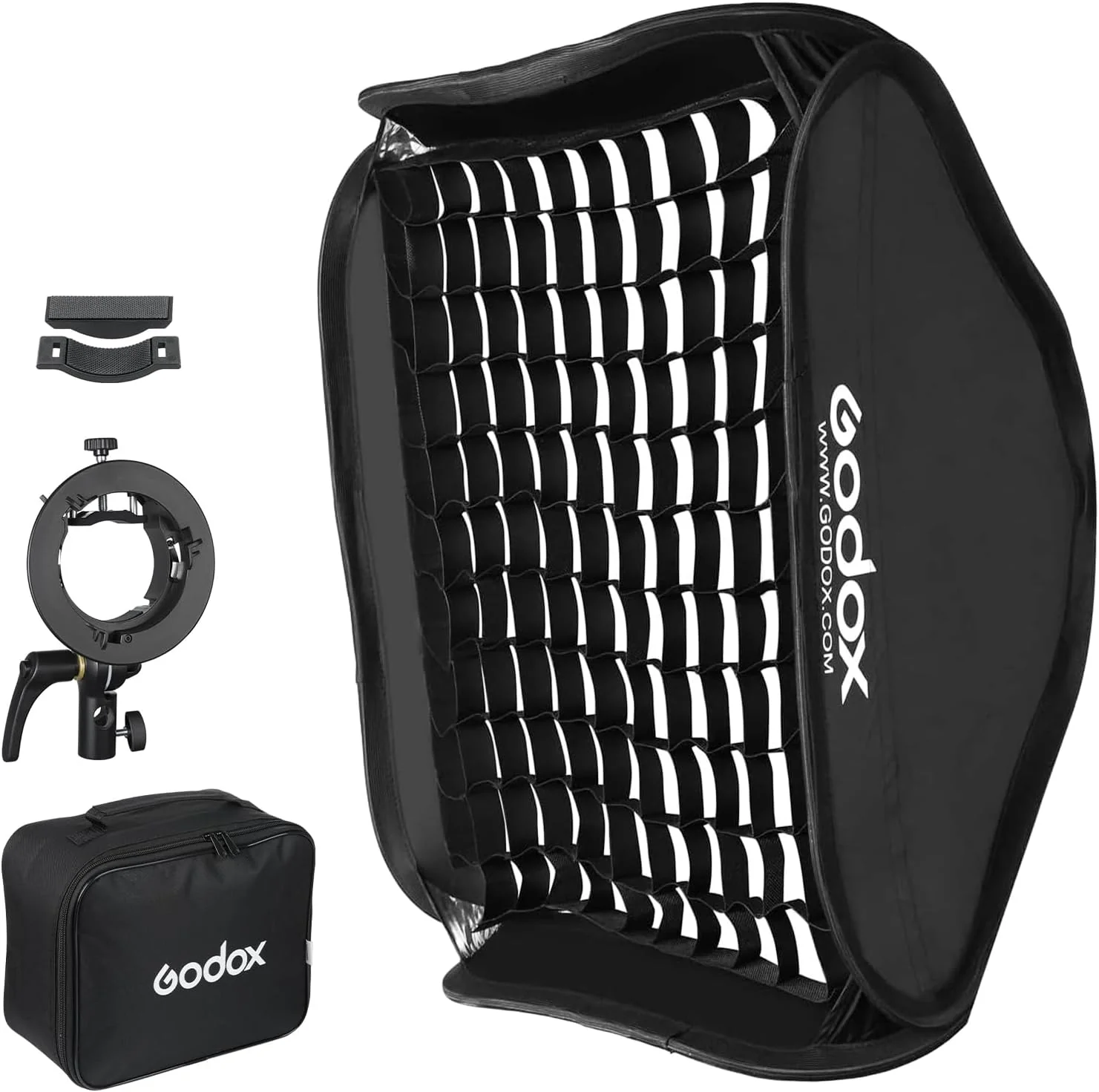
The surface that makes loop soft in the office — in my location practice the default modifier. 80-class is the sweet spot between portability and softness for headshots. Grid optional when spill paints the wall too bright. Without a solid softbox even a strong flash often stays too hard for corporate series.
Team Day Key
Godox
Godox Softbox 80×80 with S2 Mount & Grid
Key modifier for loop on team photo days
Square softbox 80×80 cm including S2 mount and grid. For corporate headshots in a meeting room: soft key, grid keeps spill off the background — important for consistent series. Fits speedlights and AD200-class strobes. Chosen from office/team-day practice, not commission.
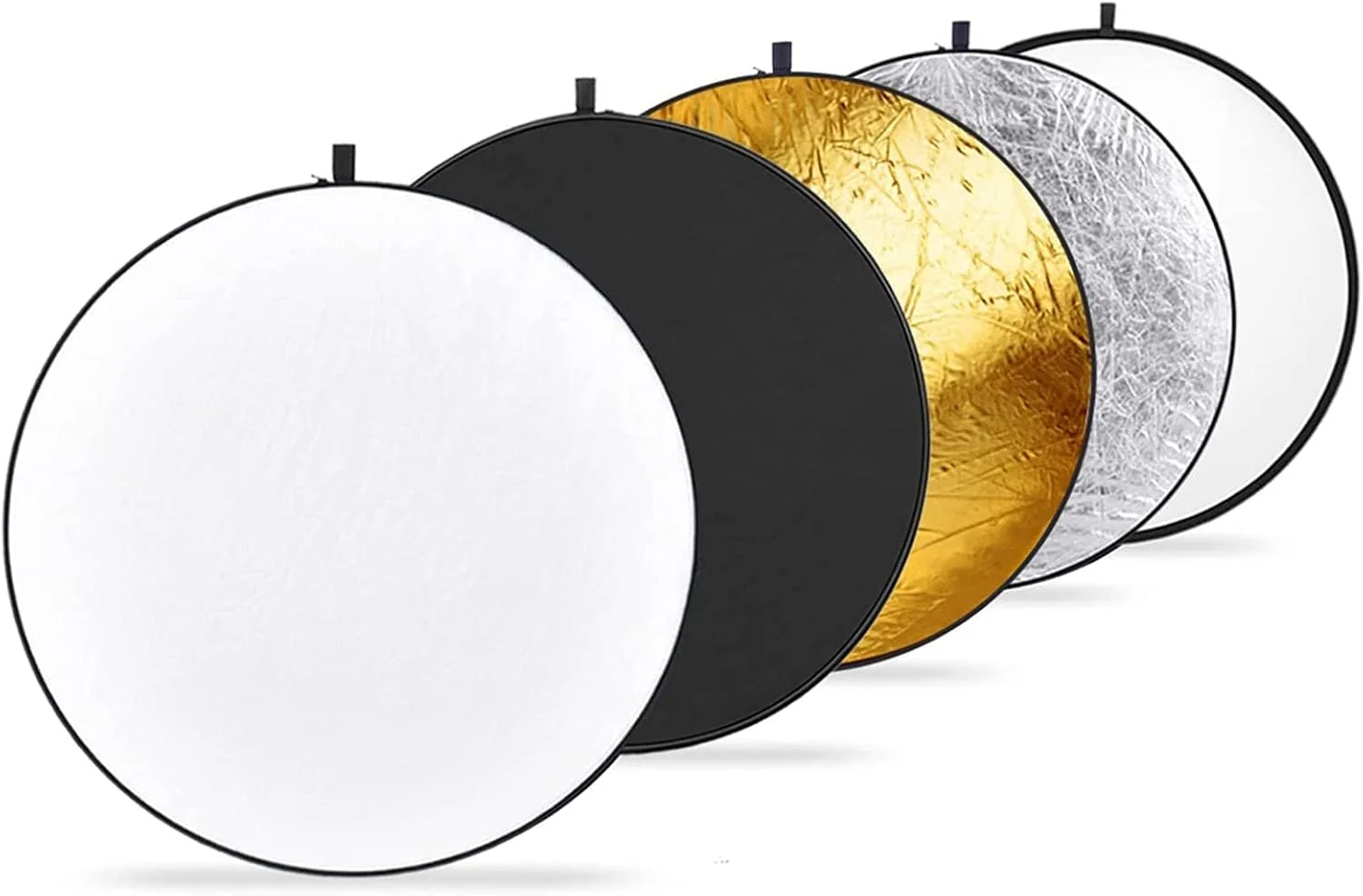
White as the fill default (how I run it on the team day), silver only when you intentionally fill harder, gold sparingly (skin cast). 110 cm class gives enough area for chest portraits. On the team day: holder or assistant at the tape mark — otherwise fill drifts with every arm.
Fill
Neewer
Neewer 5-in-1 Reflector 110 cm
Fill and clamshell from below — without a second flash
Foldable 5-in-1 reflector approx. 110 cm. White side = gentle fill opposite the softbox key; from below = clamshell fill for pace and often less glasses glare. Use gold sparingly on business skin. Size ≈ manufacturer claim — check listings.
Between speedlight and big studio strobe: enough reserve for softbox and some distance, compact for the trunk — my typical key for office headshots. Learning manual pays for series. Plan trigger (X system) and spare battery. Power approx. 200 Ws per manufacturer; for huge halls/groups often too weak vs. larger heads — for office headshots usually the sweet spot.
Key Flash
Godox
Godox AD200 Pro
Portable key — softbox in the office with reserve
Compact battery flash approx. 200 Ws (manufacturer) — enough reserve for an 80×80 softbox and some distance in the office. Portable for team days; plan a trigger (X system) and a stable stand. Pro II is a successor class worth noting — buy by availability and current listing, not a fixed price here.
What lighting do I need for business portraits in 2026?+
Default for corporate headshots: softbox key in loop (slightly off to the side, a bit elevated) plus a white reflector as fill. Flash manual, WB fixed, positions marked. Clamshell as pace/glasses path. Rembrandt only with intent — not as series default.
Why not simply always use window light?+
Because it drifts and often makes the corporate grid inconsistent — I've seen that enough on team days: person 1 and person 12 no longer match. For one-offs window light can be strong; for series over hours, flash key with ambient down is the more robust default. No lux table needed — histogram and grid comparison are enough.
Loop or Rembrandt for business?+
Loop as default: friendly, readable, CI-ready. Rembrandt for character and editorial — intentional, not mixed mid LinkedIn series. Pattern physics: Studio Portrait Lighting.
When is clamshell worth it?+
For short slots, lots of glasses, and CI that wants flat-friendly. Key above, weaker fill below. Caveat: can look beauty-ish — check the brand. Don't blindly rebuild the loop grid.
How do I avoid glare on glasses?+
Angle of incidence: change one variable (key higher/more side, tip head/glasses slightly, or camera height). A soft large surface often helps vs. a hard spot — but doesn't replace angle. Retouching is plan B.
What belongs in a portable office kit?+
Core from my own location practice: softbox ~80, 5-in-1 reflector, AD200 class plus stands and trigger. More modifiers only once the default sits. Ws and sizes = manufacturer claims; check prices in the shop. Verdicts and matrix in section 08 ( = affiliate).
Can I use silent shutter with continuous light/LED?+
Only after testing. LED can cause banding. Short version in the team-day section (07); details: Camera for Business Photographers. If stripes appear, go mechanical/EFCS or prioritize flash and drop ambient.
How does this guide differ from the studio lighting article?+
Studio Portrait Lighting = patterns, modifiers, physics, home studio. This post = office/team-day workflow for paid corporate series (freeze, glasses, window-light limit, kit trio, trilogy finale).
I don't want to buy lights — can I book business photos in Hannover?+
Yes. I'm a business photographer in Hannover: portraits, team, corporate. Inquire via Business Photography. Open: I earn from bookings; the technique guide stays usable for photographers without a booking.
**Transparency:** Affiliate links marked with * — Amazon product links use partner ID martinkleinhe-20. I earn a small commission if you buy through these links; there's no extra cost to you. No brand sponsored this article; recommendations are based on my own office/team-day practice, not commission. I am a business photographer in Hannover and offer [Business Photography](/en/business-photography/) myself — openly labeled; I earn from bookings, but you don't need one to use the guide. Documented practice from [Camera Brands](/en/camera-brands/): Canon R5 and R6 Mark II. No invented lux numbers, no fake ROI claims. Pattern physics stays in the studio guide; here job logic for team days. As of: July 2026.
◆ Two paths
Light frozen — secure the job or book production?
Photographers: loop + softbox default, clamshell for pace, team day with tape and manual power — kit and verdicts above. Clients: portraits or team day in Hannover? Don't shop softboxes — request production. Open: I earn from booking; the guide stays the job checklist. Trilogy complete: camera → lenses → lighting.