Colors, patterns, industry dress codes and the checklist — so you don't stand in front of the camera in the wrong outfit on shoot day.
Author
Martin Kleinheinz
Photographer · Business & Team Photography · Hannover
Updated
July 30, 2026
On shoot day, the most expensive brand doesn't count — whether your outfit looks calm, fitting and credible in front of the camera does. In Hannover and the surrounding area I see the same pattern: good faces, but a poorly chosen top costs more time and retouching than you'd think. If you want to book the team day, that starts at Business Photography.
This article is the outfit deep-dive in the business photography cluster: colors, fabrics, moiré, industry dress codes, team style direction and checklists. The 90-second short version for the briefing email stays in Prepare Employee Photos. On-set workflow, posing and short outfit notes: Employee Portraits & Corporate Photos.
A business photo is not a fashion editorial. It's a work tool: website, LinkedIn, recruiting, pitch deck. The outfit has to fit the role and the brand — and it has to be camera-ready. What looks "fine" in the mirror can reflect under flash, blow out, or break the series.
“My rule of thumb: one level above everyday — as if you were going to an important client meeting. Not costume party, not the home-office hoodie.”
— Martin Kleinheinz, photographer Hannover
Prep for HR (timeline, slots, briefing) stays in Prepare Employee Photos — outfit there only as a 90-second paragraph. The dual guide Employee Portraits & Corporate Photos connects a short dress code with posing and setup. Here, clothing is the topic.
For employees
You want to know in the morning what to wear — and what to leave at home. Sections 01–04 and 06, plus the checklist in 08.
For HR & marketing
You need a clear style direction for the series — not "everyone as they like". Sections 04, 05 and 08.
For leadership
Consistent faces sell trust. An outfit briefing is cheaper than reshoots. Booking: Business Photography.
01
Basics
The 5 camera rules
Before color and industry: five rules I keep needing on set. They apply to solo headshots and team days alike — and they often decide faster than the brand on the label.
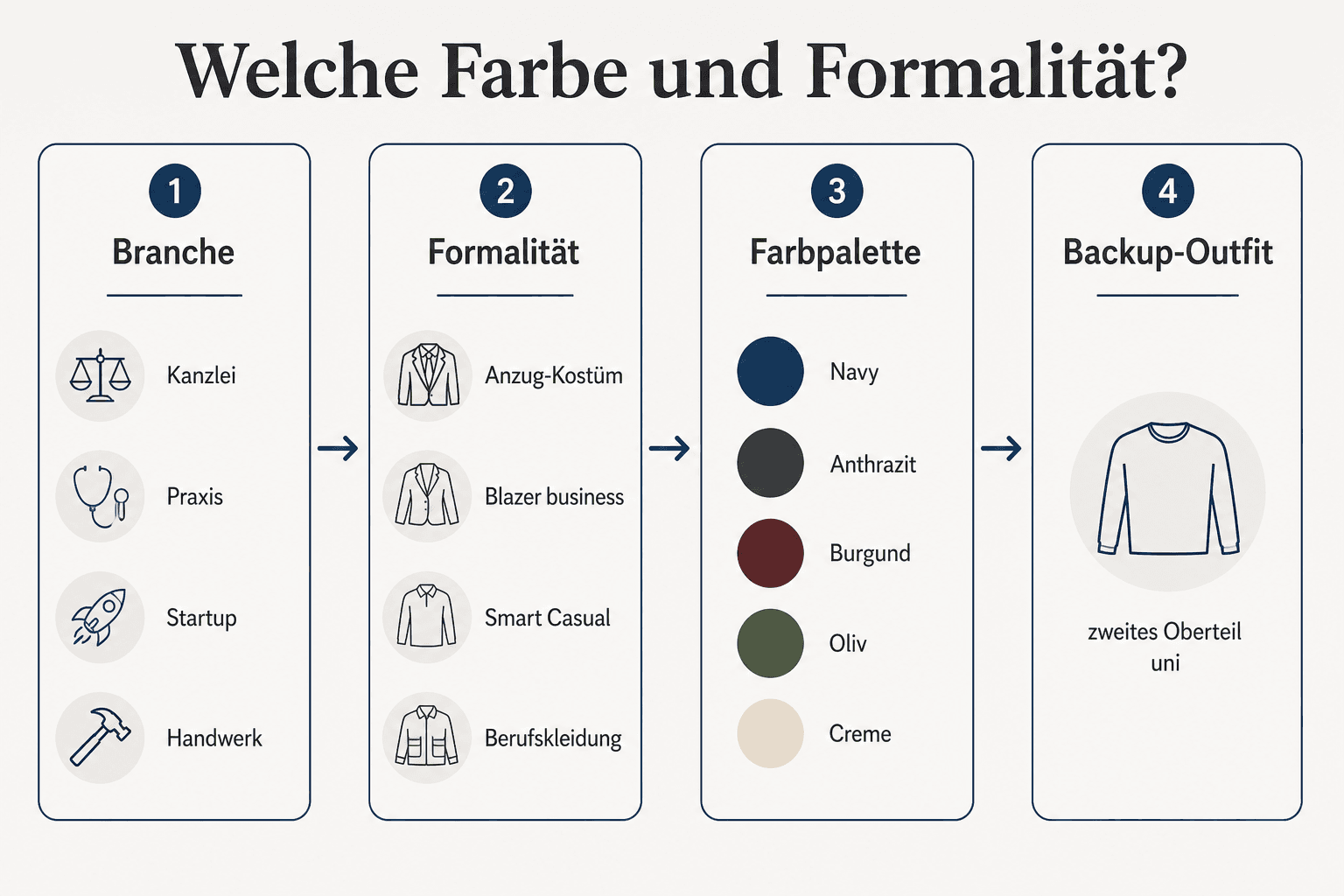
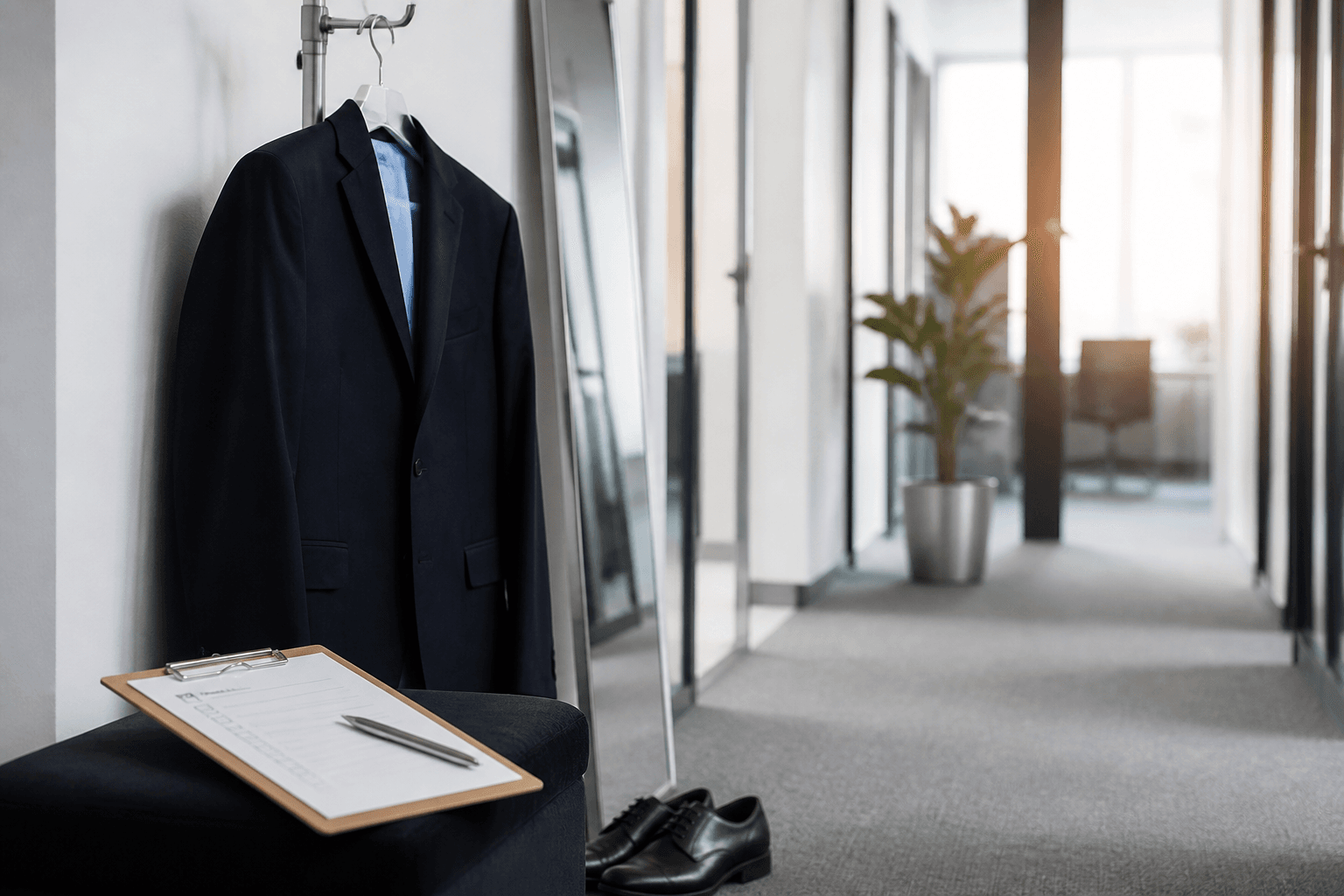
From fit and color through pattern check to the backup outfit — the short path to a camera-ready decision
1. One level above everyday
Think important client meeting or pitch — not Friday in the home office. Too stiff looks fake; too casual looks unfinished. The middle hits it.
2. Fit beats brand
A well-fitting mid-range top beats the expensive blazer that pulls or hangs. Shoulders, sleeves, collar: if it pinches, you see it in the portrait.
3. Matte before shine
Satin, high-gloss fabric and oily leather looks reflect under light. Matte cotton, wool, jersey and light weaves stay calm. Light stretch is fine — reflection isn't.
4. Quiet before loud
Solid color or a very subtle pattern. Large prints, neon and XXL logos pull the eye away from the face — and destroy team consistency.
5. Authentic to the role
Trades and PPE may look genuine. Law firms and consulting often need more classic. Startups can be looser — but not random. More in section 04.
Once the five rules are in place, color choice gets easier: you're not looking for "something nice", but something calm, matte and fitting — and that's exactly where the next section starts.
02
Palette
Colors that work
Navy is my default for most business series: calm, trustworthy, works on light and dark backgrounds. Around it, solid mid-tones work — and that's exactly the sweet spot for the camera.
Color
Effect on camera
Recommendation
Navy / dark blue
Calm, professional, face stays in focus
Default for most industries
Anthracite / charcoal
Modern, clear, a bit cooler than navy
Very good — alternate default
Burgundy / wine red
Warm, present, without being loud
Strong for leadership & consulting
Olive / muted green
Natural, modern, industry-flexible
Good — not neon green
Cream / off-white / beige
Light, soft, often friendlier than pure white
Good against a dark background
Mid gray / taupe
Neutral, team-friendly
Solid all-rounders
Pure white
Can blow out / look overexposed
Risk — not a ban; caution with strong light
Pure black
Swallows detail in shadows and fabrics
Risk — not a ban; matte & well-fitting is better
Neon / signal / loud color
Pulls the eye, disrupts the series
Avoid for corporate portraits
Orientation from portrait practice — not fashion dogma. Skin tone, background and brand color also decide.
White and black I don't ban. I mark them as a risk: pure white can "flare" under flash and lose detail. Pure black eats texture in shadows and fabrics — the portrait looks flat. Cream, off-white and anthracite are often the safer siblings.
Skin tone and hair color play along: very fair skin often looks softer in cream than in pure white. Dark hair carries navy and burgundy especially clearly. That's observation on set — not a color-scheme certificate. In doubt: navy or anthracite, matte, well fitting. Next: what patterns and logos do to the sensor.
03
Fabrics & details
Patterns, logos & fabrics — understanding moiré
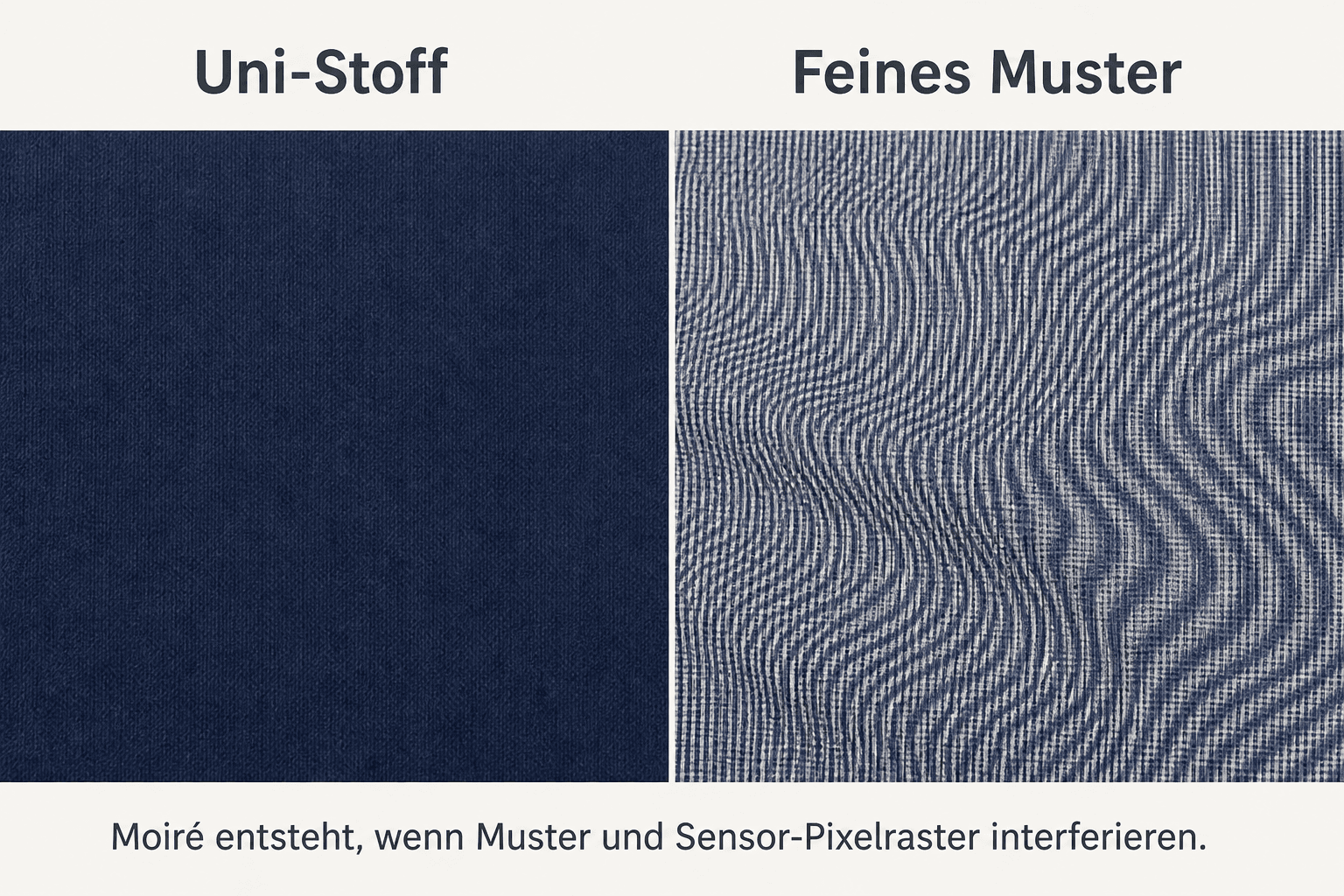
Moiré is the enemy of many "almost perfect" outfits. Fine checks, tight stripes and dense houndstooth create a flickering wave pattern on the sensor. It often already looks wrong on the camera display — and in retouching it's tough to impossible to clean up properly.
Left calm and camera-ready — right fine pattern with typical moiré flicker
Fine patterns
Micro-check, tight pinstripe, fine houndstooth: high moiré risk. Prefer solid or a very coarse, calm pattern from a distance.
Large logos & prints
Company logo chest-size, band shirt, loud graphic: pulls the eye and makes team photos inconsistent. Small embroidered logo often okay — XXL rarely.
Fabrics
Matte and lightly textured works. High gloss, wet-looking satin, wrinkling thin fabric: stress for light and retouching.
Ties & scarves
Solid or coarsely patterned. The classic fine silk tie with micro-pattern is a classic — and a classic for moiré.
Practice check the day before: hold the top at arm's length. Does the pattern already look restless from a distance or "flicker" optically? Then prefer the solid alternative. Coarse stripes or a large check that stays clearly readable are often less problematic than micro-texture. And then: what fits the industry and role.
04
Context
Industry by industry
"Business" doesn't mean a suit everywhere. Credibility comes when clothing and role fit together. First the matrix for scanning — below it the practice nuances that don't fit in the table.
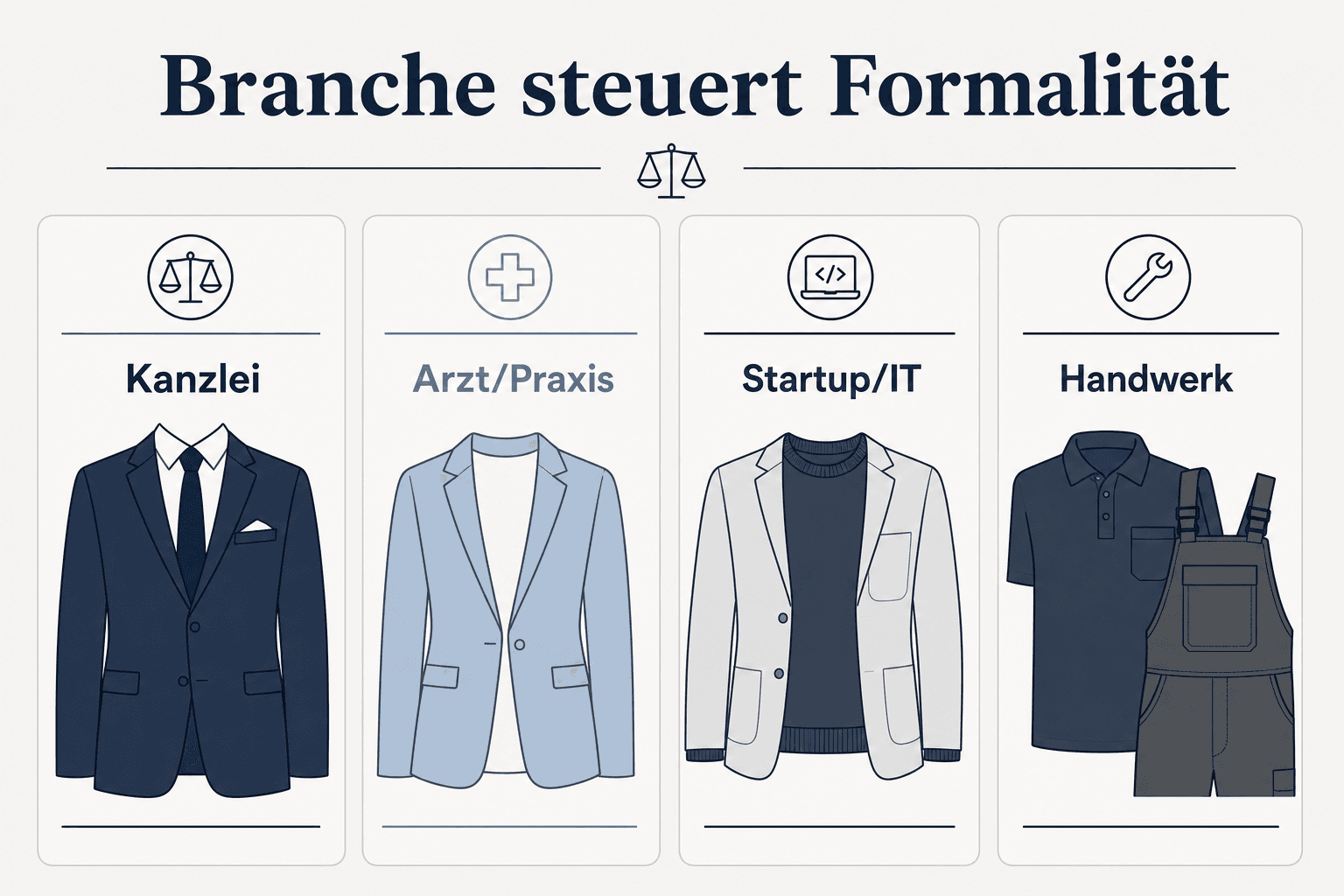
Dress code by context: classic, trust-near, modern-casual or authentically trade-like
Industry
Direction
Typically camera-ready
Rather avoid
Law / consulting / finance
Classic, calm
Navy/anthracite blazer or shirt/blouse, subtle solid tie
Hoodie, neon, large prints, shiny fabrics
Doctor / practice / health
Clean, trust-near
Solid blouse/shirt, optional scrub if authentic to daily work
Too loud patterns, strong shine, unkempt look
Startup / tech / agency
Modern, deliberately casual
Good polo or shirt, fine knit, dark jeans + blazer possible
Random home-office hoodie, wrinkled, XXL logo
Trades / commercial
Authentic
Clean workwear or simple business-casual variant — depending on message
Dirty PPE "for the photo", or conversely: a suit nobody knows
Real estate / sales
Approachable-professional
Blazer or shirt/blouse in navy/cream, clear neckline
Too stiff tuxedo feeling, too sporty
Creative / design
Character with calm
Solid base color + one deliberate detail (cut, texture)
Everything loud at once — pattern + neon + statement jewelry
Orientation for briefings — adapt internally to brand and audience.
Law firm, consulting, finance
Clients expect clarity. Tie only if it fits everyday life — and then preferably solid or coarsely patterned. Fine silk micro-patterns remain moiré risk number one in this industry. Visual language, crops and discretion on set: Photographer for Law Firms.
Medical practice & health
Some practices deliberately shoot in scrubs — that looks real when it's daily work. Otherwise: classic portrait outfit for the website. Make-up matte; hands and nails groomed if they're in frame. Visual language, coat/business in one session and privacy on set: Photographer for Doctors.
Startup & tech
Casual yes — sloppy no. Polo, fine merino or shirt without tie looks modern; dark, clean trousers. The blazer is optional. What I avoid: the same gray hoodie from the Teams call.
Trades & commercial
Authenticity beats costume. Clean workwear or a clear business-casual variant — depending on whether the website says "we're craftspeople" or "we're entrepreneurs too". Dirty PPE "for realism" looks unprofessional; a suit nobody in the company knows looks wrong.
Real estate & sales
Approachable-professional: navy or cream, clear eye contact, no tuxedo overkill. The outfit should open trust — not create distance.
Creative & design
One deliberate detail is enough (cut, texture, color). When pattern, neon and statement jewelry are loud at the same time, the outfit wins against the face.
05
Series
Team series: style direction instead of uniform
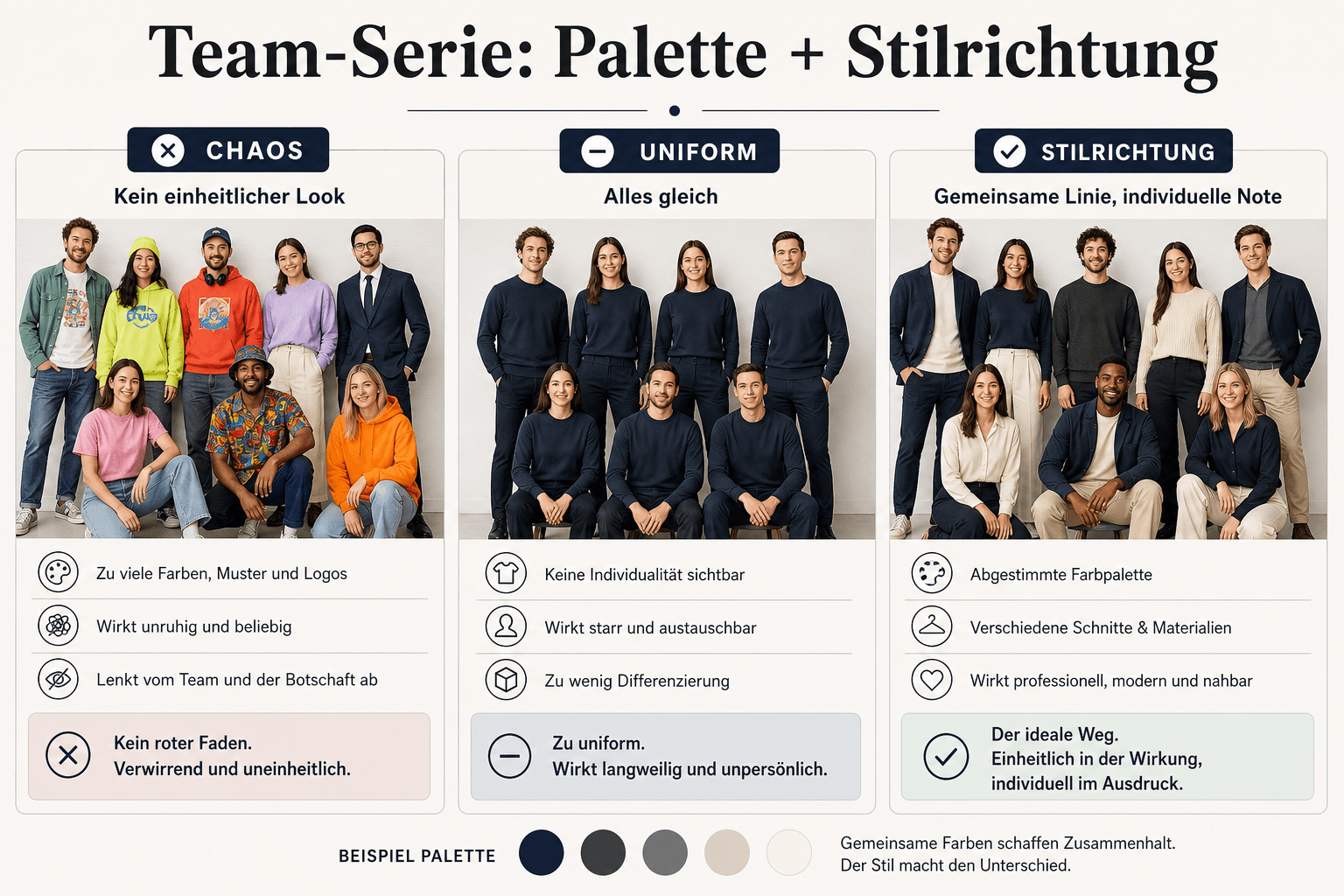
Once the industry direction is set, the most common HR mistake arrives: "Everyone please wear a white shirt." The result looks like a school choir — or like forced costume. Better: a style direction. Same level, similar color family, individual fit.
Color family + matteness + fit = series. Not: identical shirt for everyone
Define a color family
e.g. navy / anthracite / cream — or "dark calm tones". Not: everyone in a different neon color.
Set the formality level
"Business with blazer" or "business casual without hoodie". One sentence is enough — if it's clear.
Rule on logos
None / small / company polo allowed — decide once and write it into the briefing email.
Align leadership & team
C-level may be a bit more formal — but should stay in the same style direction, otherwise the website looks like two companies.
“Consistency comes from direction, not from a uniform. The series should look like a team — not like a costume.”
— Martin Kleinheinz
If individual teams (e.g. sales vs. workshop) should deliberately look different: define two style directions, not chaos. Cluster clearly on the website later — then difference looks intentional, not accidental. Next the details that often save or ruin portraits: glasses, jewelry, make-up.
06
Details
Accessories, glasses & make-up
Color and style direction are set — now the details. Less is usually more in front of the camera — except for things that belong to you and that you wear every day.
Glasses
If you wear them in everyday life: put them on. Without glasses you often look "not like you". Clean the lenses — fingerprints and scratches show immediately. Light anti-reflective coating helps; strong mirror lenses can throw flash reflections.
Jewelry
Reduced. One necklace or earrings okay if they don't flash and don't rattle. Large statement pieces pull the eye. Watches: subtle; strongly reflective cases maybe turn or leave off.
Make-up
Matte before shine. Strong highlighter and oily creams reflect. Powder or blotting paper help on set — prep at home helps more. Lips natural to clearly defined, not extremely glossy.
Hair & beard
A haircut you know — ideally barber/salon 3–7 days beforehand, not the morning of. Beard groomed or deliberately left. Wild experiments on shoot morning often end in "this feels wrong".
Bags & layers
Jacket off if it wrinkles or pulls. Under the blazer a calm top. Scarves only if they belong to the look and don't cover the chin.
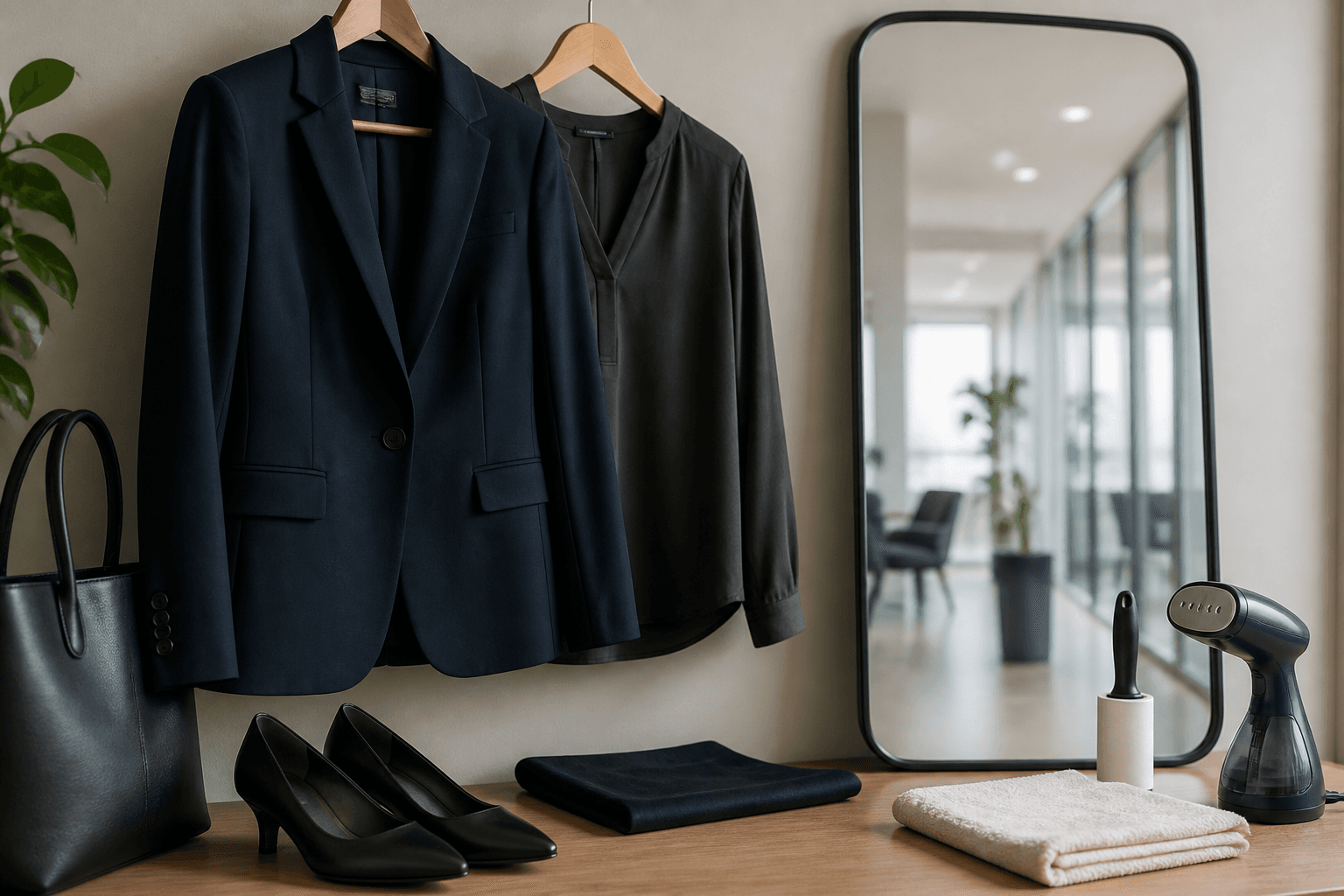
Small prep helpers that save the morning: lint roller, garment steamer or iron, microfiber cloth for glasses. Not a must-buy — but if you're tidying anyway, exactly these three things prevent stains, wrinkles and fingerprints before the camera turns on.
07
Practice
Season, transport & backup
The best outfit helps little if it arrives wrinkled or you realize on set: wrong choice. Transport and plan B belong to prep — just like color and style direction.
Season
In summer light, matte fabrics — no sweaty polyester satin. In winter layers: outerwear off before the portrait, camera-ready top underneath. Turtlenecks can look strong — don't crush the neckline and face.
Transport
Blazer on a hanger or fold-light in a suitcase. Don't crumple it in a backpack for three hours. On set: two minutes of smoothing — better than twenty minutes of retouching.
Backup outfit
Bring a second top. Stains, "feels wrong", moiré surprise, collar too tight: everyday. The backup saves the slot.
Shoes & trousers
Even if it's only a chest crop: posture comes from below. Clean, fitting trousers and shoes you stand securely in. Wobbly heels or jeans that are too tight change the body — and the portrait.
For team days: HR can put a small "emergency basket" on site — lint roller, safety pins, matte powder, microfiber cloth. That doesn't replace a backup outfit, but it catches half the disasters. After that: check off.
08
Check off
Checklists HR & employees
Two lists — one for organization, one for each person in front of the camera. Checking off beats "we said that". Everything above condenses here.
HR / marketing — style direction & briefing
◆☐ Style direction defined (color family + formality level + logo rule)
◆☐ Industry fit checked (not "suit for everyone" if it doesn't fit)
◆☐ Outfit paragraph in briefing email 5–7 business days ahead
◆☐ Reminder day before: backup outfit + clean glasses
◆☐ Photographer briefed (background color → factor in outfit contrast)
Employees — outfit & morning
◆☐ Outfit chosen: matte, well fitting, calm color (navy/anthracite often default)
◆☐ Pattern check: no fine flicker / moiré risk
◆☐ No large logos / no neon (unless briefing allows it)
◆☐ Backup top packed
◆☐ Glasses cleaned (if everyday) — or lens variant tested
◆☐ Make-up rather matte; hair/beard as planned (salon 3–7 days beforehand)
◆☐ Transport: blazer not wrinkled
◆☐ 5 min earlier at meeting point — mirror check
09
Close
Takeaway: navy, fit, style direction
Clothing for business photos is not a fashion guide — it's camera-readiness plus credibility. Navy and anthracite as default, mid calm tones as room to play, white and black with caution. Matte before shine. Fit before brand. Avoid fine patterns because of moiré. In the team: style direction instead of uniform. Bring a backup.
Once that's in place, the slot gets shorter, the series more consistent — and retouching stays on skin and light, not fabric problems. That's the experience behind this guide.
10
FAQ
FAQ on clothing
Which color is safest for business photos?+
Navy is my default — calm, professional, camera-ready. Anthracite and burgundy are strong alternatives. Cream/off-white often safer than pure white.
May I wear white or black?+
Yes — with risk, not as a ban. Pure white can blow out; pure black loses detail. Matte, well fitting and matching the background makes both usable. In doubt navy or cream.
What is moiré — and why is it bad?+
A flicker/wave pattern that appears when fine fabrics "fight" the camera sensor. Hard to retouch. That's why: avoid fine checks, tight pinstripes and micro-patterns.
Only if it fits industry and everyday life. Startup and trades often look more credible without. One level above everyday is enough — see the industry matrix in this article.
Should the whole team dress the same?+
No. Better a style direction (color family + formality level) than a uniform shirt. That way the series looks like a team, not like a costume.
Glasses on or off?+
On, if you wear them daily — otherwise you often don't look like you. Clean the lenses. Strong reflections can be fixed with angle adjustments; we sort that on set.
What should I bring as backup?+
At least a second top in a calm color, matte, without a critical pattern. Ideal: one navy and one lighter option.
What does a business or team shoot cost?+
Orientation ranges under What Does Business Photography Cost. A good outfit doesn't change the list price — it decides whether the images are usable immediately.
Do you offer business photography in Hannover yourself?+
Yes. I'm a photographer in Hannover for business and team photography. Bring the outfit checklist — details and inquiry under Business Photography. Openly: I earn from bookings; the guide is still the practice I need before the shoot.
I offer [business photography in Hannover](/en/business-photography/) myself — openly disclosed, not hidden. The recommendations are based on my practice as a photographer; no brand sponsored this article. As of: July 2026.
◆ Next step
Outfit sorted — and shot professionally?
I'm a photographer in Hannover for business and team photography: calm setup, clear style direction, series for website and LinkedIn. Tell me headcount, industry and preferred date — I'll brief you on dress code too. Openly: I earn from the booking; the outfit guide above stays the same one I need before the day.