Photographer for Doctors: Warm Competence Over Clinic Sterility
Portraits, team and practice rooms for doctors, dentists and practice teams — authentic, patient-near and channel-ready for website, Jameda, Doctolib and LinkedIn.
Author
Martin Kleinheinz
Business photographer · Hannover
Updated
July 30, 2026
When someone googles your practice, they rarely start with publications — they check faces and rooms. Whether GP, dentist or specialist: the portrait on website, Jameda, Doctolib and LinkedIn is the first trust check. As a business photographer in Hannover I shoot doctors and practice teams on site — and I see the same mistake again and again: too cold, too clinic-like, too uneven between lead physician and medical assistants — or a phone snapshot next to a magazine portrait. If you're planning a professional practice shoot, that starts under Business Photography.
This article is post 6 in the business photography cluster — the practice deep dive: why practice images are different, what patients check, warm competence, package, crops, coat vs. business, team day, hygiene & privacy on set, dentists/specialists/MVZ, budget and checklist. No medicinal advertising or professional-rules advice, no compliance review — only photographic practice from briefings and shoots. Distinction: at law firms understatement and client discretion matter; here warm competence, patient proximity, plus privacy and hygiene on set.
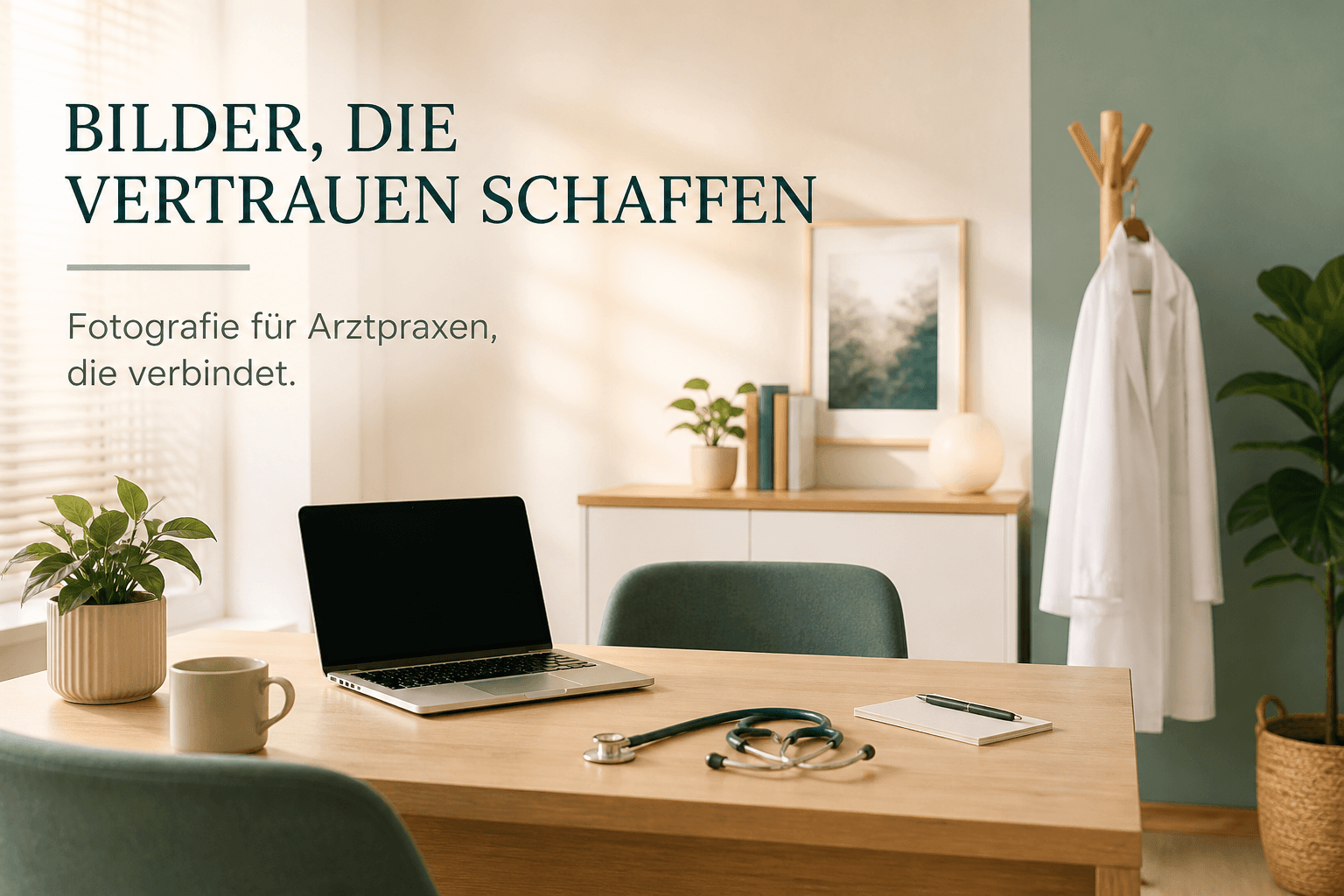
Startup photos can be loud and "cult". Clinic advertising images are often sterile and cold. Practice photos need a third lane: warm enough that patients dare to book — clear enough that competence feels credible. In briefings with practices I often hear the same wish: "friendly, but serious" — photographically that means soft light, a credible expression and a background without distraction and without patient data. That is set practice from on-site appointments, not a marketing promise.
“My rule of thumb for practices: warm competence over clinic sterility. Approachable, calm, credible — and on site so discrete that nobody asks afterwards who was sitting in the waiting room.”
— Martin Kleinheinz, business photographer Hannover
The difference from law firms is intentional: there we work with understatement and client discretion — see Photographer for Law Firms. Here it is about patient proximity, the first impression before the appointment and a set that takes hygiene and privacy seriously. Technically both shoots are related (one setup, crops, consistency). The tone and set rules are not.
Professional and advertising-law keywords (e.g. HWG, MBO-Ä) set only the visual tone here — not checklist legal advice, not a website review, not a conformity claim. They explain why exaggerated staging, healing promises in the image and "glossy clinic" often feel wrong photographically. The answer from practice: clear faces, a warm but calm atmosphere, consistent quality for doctors and team.
From purpose and channel through package, look and privacy to team day — the short path to the right practice production
For practice owners & partners
You want a series that carries the practice — not only your portrait. Visual language, package, crops (02–04), then checklist (11).
For practice management / marketing
You organise the day: package, prep, hygiene & privacy, checklist (03, 06, 07, 11). Budget and region: 09–10.
For doctors & medical assistants on the team
You want the same quality level as the owners — and crops for portal and LinkedIn. Sections 04–05 plus FAQ (12).
01
Perception
What patients check online
The typical journey I hear again and again in briefings with practices: Google → practice website → Jameda or Doctolib → sometimes LinkedIn. Sometimes the other way round. Everywhere the same face — or not. Inconsistency looks unfinished. Outdated photos look like "the practice doesn't care about details". That is perception practice from shoots and on-site website reviews — not a conversion study and not a promise that better photos bring more appointments.
Recognisability
Does the person at reception look like the photo? Haircut, glasses, age — currency matters. Every two to three years is often sensible; sooner if visible changes happen.
Warmth without cosiness
Too stiff feels dismissive. Too "lifestyle" feels wrong. The middle: calm gaze, a light, credible expression — competence plus approachability.
Unity of the practice
Doctors and medical assistants in the same light and retouch language. Different setups destroy the team impression faster than a "wrong" outfit.
Spaces as proof
Reception, waiting area, treatment rooms — not as a real-estate show, but as "you feel safe and well looked after here". Without recognisable patients in the frame.
Patients compare unconsciously with other practices in the same city and specialty. If you look like a magazine cover on the website and like a passport photo on the portal, you lose coherence. So: one setup, several crops — not five photographers over five years. Portals like Jameda and Doctolib are often the first touchpoint on a phone — there sharpness and recognisability matter more than magazine aesthetics.
Add the recruiting view: strong medical assistants and doctors check the team page just as carefully. Inconsistent photos signal "never finished thinking". Consistent, current faces signal organisation — and anyone hiring new colleagues also sells the workplace with the team page.
Once it's clear what patients check, the next question is: how should the image feel? That needs a visual language that carries warmth and competence at the same time.
02
Aesthetics
Visual language: warm competence over clinic sterility
The tension is intentional: you need competence and warmth. Competence alone feels cold and clinic-like. Warmth alone feels arbitrary. On set I solve that through light, pose and retouch — not through stethoscope staging in the foreground. In practice shoots "status props" rarely work: they distract and look staged. A calm portrait in front of a clear wall almost always beats the "doctor-with-device-in-the-foreground" look.
Clinic sterility often happens by accident: cool light, white walls without warmth, stiff expression, too much retouch. Warm competence comes from soft light, natural skin, a credible gaze and a background that says practice — without chaos. That is craft, not a filter preset.
Light
Soft, controlled, little drama. No hard shadows under the eyes, no operating-theatre contrast. Face clear, skin natural — credible, not bleached.
Background
Calm and warm: neutral wall, subtle practice depth, maybe soft plants or architecture. No chaotic monitors with patient data, no harsh neon accents.
Pose & gaze
Upright, shoulders relaxed, looking to camera. A light, credible smile often fits better than hard seriousness — depending on person and specialty. No "hero pose" default.
Retouch
Skin calm, distractions gone, character kept. No beauty smoothing that makes you look ten years younger. Credibility beats filters — especially in a health context.
Specialty / context
Visual tendency
Watch out
GP / general practice
Warm, approachable, calm
Not "too private" or soft-focus
Dentist / oral surgery
Clean, modern, friendly; often a bit brighter
No clinic sterility, no exaggerated "smile ads"
Specialist (e.g. orthopaedics, dermatology)
Competent-approachable; formality by patient clientele
No magazine gloss
Paediatrics / adolescent medicine
Warmer, more open expression
Not childish or mascot look
MVZ / larger unit
Consistent series across all sites/roles
No quality classes by hierarchy
Psychotherapy / counselling
Very calm, warm, little pose
No staging that creates distance
Orientation, not a mandatory matrix — practice culture and your everyday work steer along.
Important: doctors and medical assistants get the same light quality, the same retouch standard and the same delivery crops. Hierarchy shows in title and text — not in "good photo vs. bad photo". In colour the series follows the practice brand without shouting it: muted wall tones, calm clothing or coats — strong corporate colours rather around the portrait on the website, not as a neon background behind the face.
Tone and look are clear — next the scope: what really belongs in the package so website, portals and LinkedIn are served from one setup?
03
Scope
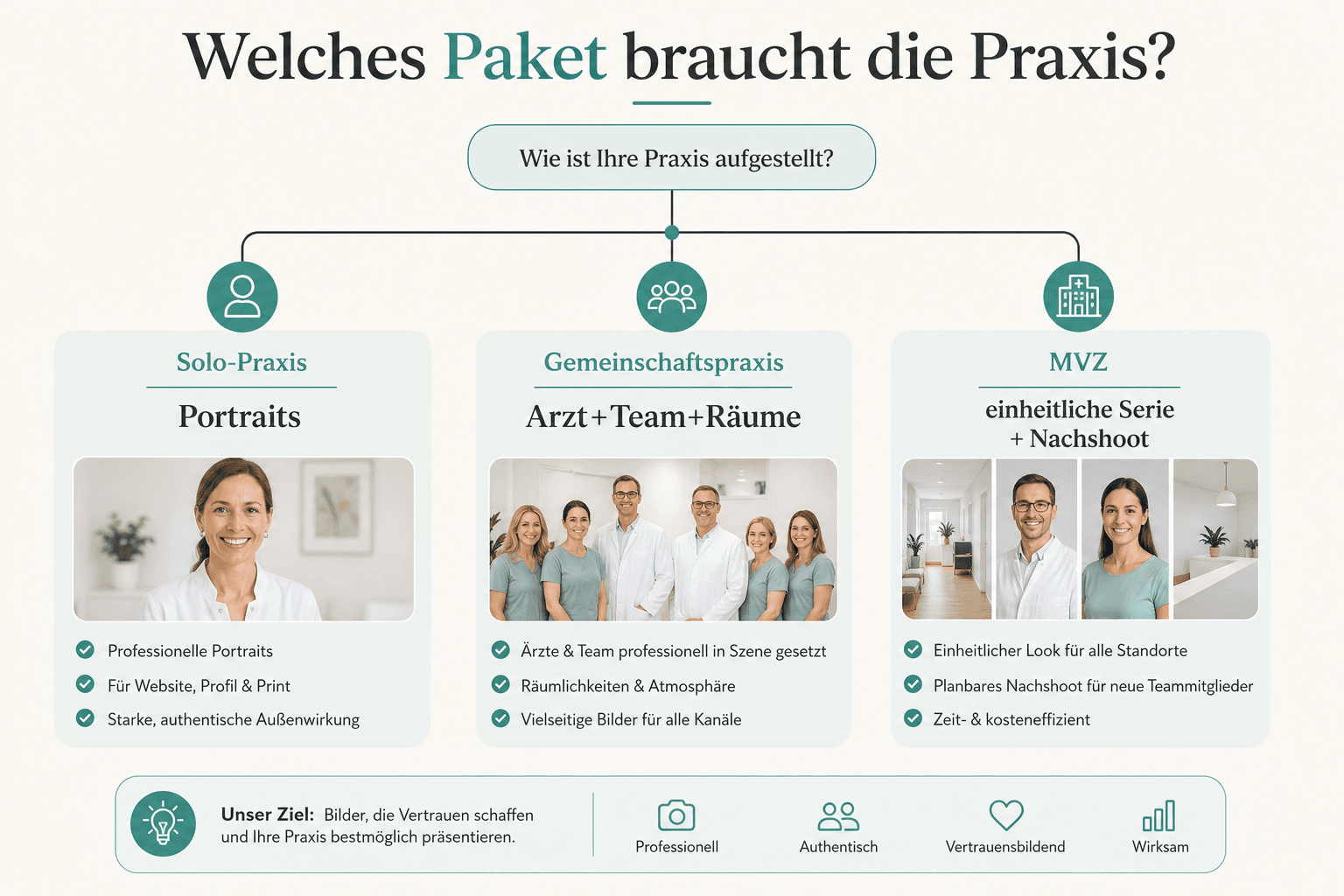
What belongs in the package
Visual language alone is not enough — you need a clear scope. A practice shoot is rarely "just a portrait". A usable production thinks website, team page, Jameda, Doctolib, Google Business Profile, LinkedIn and optionally spaces. Clarify scope beforehand — otherwise crops and rights are missing afterwards.
Individual portraits (headshots)
Per person: master file plus crops for web and portals. One consistent setup for everyone present — doctors and medical assistants.
Coat and business variant
Often both in one session: white coat for practice/portal, business look for LinkedIn and website about. More in section 05.
Team / group shot
Optional, but strong for about and careers pages. Short posing guidance, calm arrangement — no "ad pose".
Spaces & ambience
Reception, waiting area, treatment rooms without patients and without visible patient data. Shows atmosphere and organisation — not square metres.
Delivery package & rights
Clear usage rights for website, social, print, portals. Name channels and duration in the quote.
Scope example for a mid-size practice: all doctors and medical assistants as portraits (maybe coat + business), optional team photo, two to three room shots, delivery crops for web/portal/LinkedIn, usage rights for online and print. What's missing gets reshot later at higher cost — what's too much sits unused on a hard drive. Better to prioritise clearly.
Scope and delivery rights are set — now the channels: the same master file has to serve website, portals and LinkedIn.
04
Technique
Channels & crops
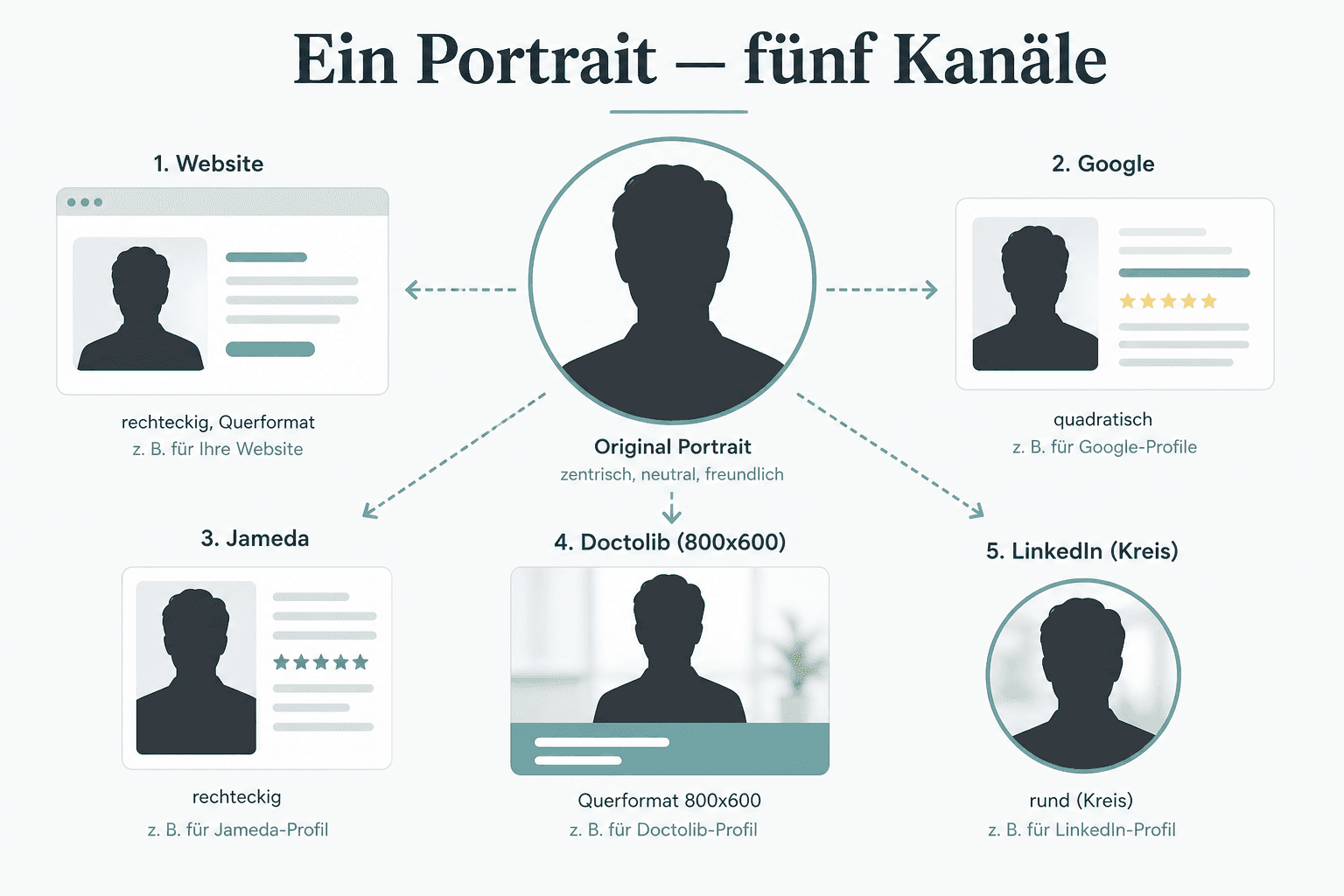
The package holds the master file — the channels need crops. The same portrait has to work on the website as a portrait crop, on LinkedIn as a circle, on Jameda as a small square and on Doctolib often more landscape. Anyone who delivers only "one nice studio photo" delivers rework to practice management and agency.
One master, several crops: website portrait, LinkedIn circle, Jameda ≥100×100, Doctolib ~800×600 orientation
Often min. 100 × 100 px (square); better upload clearly larger
Check sharpness; face centred — read platform help before upload
Doctolib
Orientation often ~800 × 600 (landscape) or portal-typical
Choose the master so a landscape crop carries face and shoulders
Google Business Profile
Square to slight portrait; high resolution
Recognisability small on mobile — face large enough
Print / flyer
Higher resolution from the master
Clarify print rights explicitly
Specs can change — check the platform help briefly before upload. Orientation as of: July 2026. No conversion claims about portals.
Rule of thumb: Jameda often at least 100 × 100, better upload larger. Doctolib often thinks landscape (~800 × 600) — so don't deliver portrait only. LinkedIn eats shoulders in the circle — crop separately. Google Business Profile needs recognisability on a small phone thumbnail. Specs change (orientation as of July 2026) — check platform help before upload. DIY basics: How to Create a Profile Picture — does not replace a consistent team setup. No conversion claims about portals.
Crops are technique — the look decides the first impression. Next: coat and business in one session.
05
Outfit
White coat vs. business — both in one session
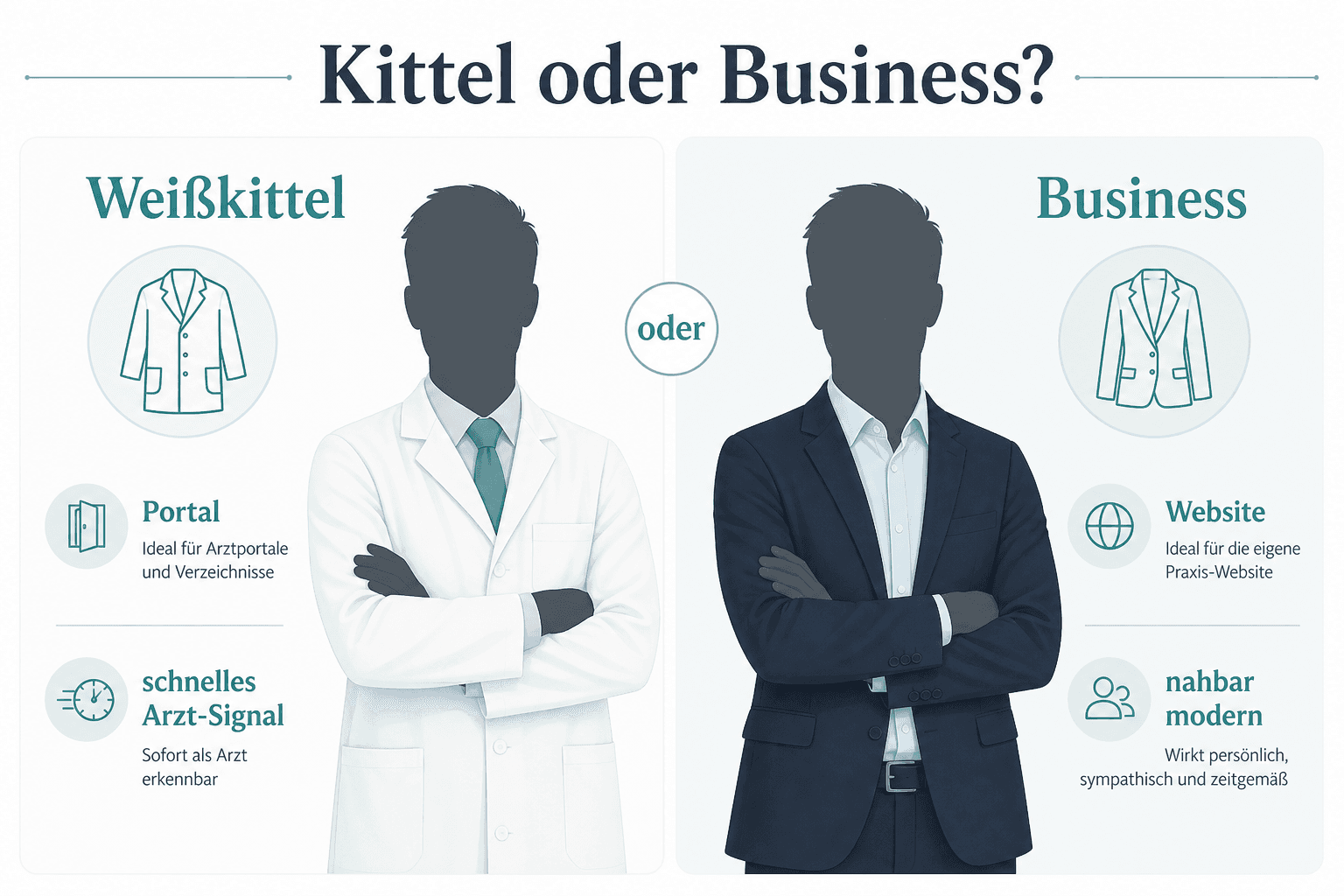
In practices the question is rarely "coat or business?" — what makes sense is often both. A coat signals role and proximity to practice day-to-day; a business look carries website about and LinkedIn. On set I change outfit, keep light and background — so the series stays consistent. What I see on site again and again: a wrinkled or too-loose coat, name badge crooked, scrubs with a stain — and then a business look that suddenly feels "too private". Briefing both in advance saves the awkward pause mid-slot.
One setup, two looks: coat for practice and portals, business for LinkedIn and about — same light quality
White coat / scrubs
Clean, ironed, correct size. No stained or too-loose coats. Name badge only if it fits the brand and should stay readable — otherwise leave it off.
Business under / instead of coat
Matte, well fitting, calm colours. Navy and anthracite stay defaults. Depth on colours and moiré: Clothing for Business Photos.
Medical assistants / team
Consistent team clothing or calm business basics — same formality level in the team. Quality like for doctors.
Change on the day
Plan a changing space or protected area. Order from my practice: often business first (less wrinkle risk), then coat — or the reverse if the calendar needs the coat look first. Five minutes changing plus a short outfit check beats ten minutes of retouch discussion later.
◆Matte over shine; fit over brand
◆Coat clean and low-wrinkle — second coat as backup
◆Glasses: on if everyday — clean the lenses
◆Backup top for the business look
◆No loud logos at chest height
◆Keep doctors and medical assistants in the same light quality
A concrete set moment: doctor arrives in a coat straight from consultation, scrubs fit, light is set — then the business change for LinkedIn. If changing space and time are missing, the second look feels rushed. That's why I plan the dual look into the slots from the start, not as "we'll quickly do one more". Medical assistants get the same standard: no "coat only for the lead physician, phone snapshot for the team".
Looks are set — now the day: slots, location and briefing so the series doesn't fail on organisation.
06
Organisation
Preparing team day & practice
The best photographer cannot save a chaotic slot plan between consultations. In practices series fail on missing briefings, overbooked calendars and unclear locations — not on the camera. Plan the day like a short OR block: clear start, clear order, buffer for delays.
Especially helpful — and in my practice appointments often the difference between a calm series and stress: shooting outside peak hours or in a room fully released for the block. Reception knows, patients are not routed through the portrait corner, and the team can focus on expression and outfit instead of the next doorbell.
Timeline
Briefing 5–7 working days ahead, reminder the day before, catch-up for absentees. Details: Prepare Employee Photos.
Slots
Realistic minutes per person including outfit change. Owners not "in between" — same calm as medical assistants.
Location
A quiet room with daylight or space for a mobile studio. Busy reception and waiting rooms with patients are unsuitable as a portrait location — default: no recognisable patients on set.
Consent & usage
Clarify internally who may appear where. Templates and orientation: Model & Property Release — not legal advice, only organisational help; if unsure, have it checked legally.
Practice management or marketing should have one contact person on the day: order, stand-ins, outfit emergencies, agreements with reception. The prep guide covers timeline, briefing email and location — and section 07 (hygiene & privacy) should be read before the first slot.
Organisation is set — now the set rules without which no practice day runs cleanly.
07
Set practice
Hygiene, privacy & discretion on set
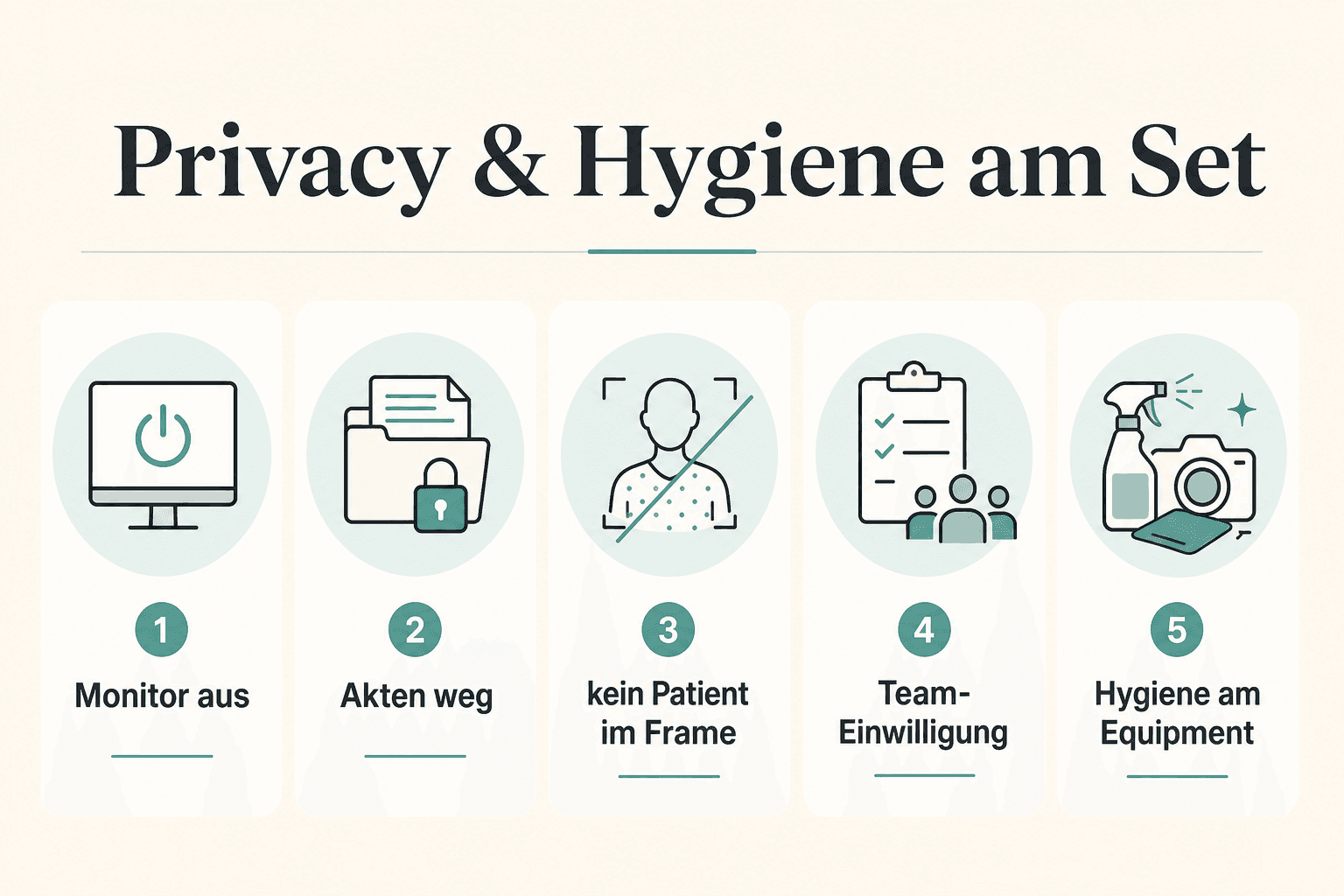
Prep organises the day — privacy and hygiene protect patients and practice. This is the section I address before every practice appointment — and it is not legal advice. It is about photographic and organisational care on site: what may enter the frame, what stays out, how we behave in treatment rooms.
Before releasing the shutter: no recognisable patients, screens without data, treatment rooms "empty" and tidy
Set check before the first portrait
◆☐ Default: no recognisable patients in the frame (waiting room, hallway, treatment room)
◆☐ Monitors off, locked or with a neutral wallpaper — no open patient data, appointments, emails
◆☐ Files, cards, prescription pads: closed, covered or out of frame
◆☐ Whiteboards / day lists at reception: check or move
◆☐ Treatment rooms: instruments sensible, but without a chaotic "post-OR" look; surfaces calm
◆☐ Hygiene look: visible cleanliness, no distractions — photographic, not a hygiene audit
◆☐ Team informed: noise, paths, when rooms are free
I work deliberately restrained in practices: little equipment show at reception, clear agreements on where we may stand, and a look over the shoulder at the background before releasing the shutter. Even an open appointment calendar on a monitor, a patient file on the desk or a name badge on a waiting-room chair is enough to make an otherwise good portrait unusable — set experience, not a data-protection opinion. Privacy is part of the service, not an extra and not a certificate.
Hygiene on set I mean photographically: visible order, calm surfaces, no chaotic instrument pile in the foreground. Typical moment: clear the tray or change angle, disposable materials out of frame, surface clear. That is not a hygiene audit — only the visual impression for the website. If something doesn't belong "in the picture", we tidy or change the angle.
If a room cannot be made "clean" — ongoing public traffic, shared reception, open monitors — we change location instead of hoping for retouch. Soft focus helps with shapes, not with readable names. Default remains: no recognisable patients on set. Care on set does not replace specialist counsel.
Image rights of people depicted
Have employees consent; communicate usage scope internally. Template orientation: Model / Property Release — without any claim of legal advice.
Property / spaces
For rented floors or shared receptions: clarify what may be shown (third-party logos, art, neighbour signs).
Delivery
Secure hand-off of files; no public gallery links with unprotected team photos if that is not wanted.
Set care applies to every practice form — the visual-language nuances differ. Next: dentists, specialists and MVZ.
08
Special
Dentists, specialists & MVZ
GP practices are often the core of this guide. Dentists, specialists and medical care centres (MVZ) share the same trust claim — with their own nuances in visual language and set.
Dentists — clean, modern, friendly
Dental practices live on a hygiene look and quiet modernity. Photographically, from my on-site experience, that means a somewhat brighter, clearer setting, a friendly expression, treatment rooms without patients and without a chaotic instrument landscape — often only after a short set check of tray and monitor. Before-and-after of treatments stays deliberately out — team and rooms carry the brand. No "smile-ad" gloss, no clinic-lab look and no healing promise in the image.
Specialists — competence with nuance
Specialists often need a bit more formal clarity than a GP practice — without tipping into sterility. Orthopaedics, dermatology, internal medicine: the patient clientele steers along. Consistent team page and portal crops matter just as much; privacy with screens and documents likewise.
MVZ — series across roles and sites
In an MVZ consistency is the biggest lever: many faces, often several sites, same brand. One setup, clear crops, catch-up for absentees, optional site room shots. Hierarchy and specialty appear in text — not in different photo quality.
Area
Image tone
Set focus
GP / general
Warm, approachable, calm
Team unity, portal crops, reception/waiting area
Dentist
Clean, modern, friendly
Bright rooms, hygiene look, no before-and-after focus here
Specialist
Competent-approachable, a bit clearer
Specialty nuance without sterility
MVZ
Consistent brand series
Align roles/sites, plan catch-up
Four practice worlds — one quality standard, different warmth and formality.
Whether solo practice or MVZ: doctors and medical assistants get the same quality. Scope and region steer the price — book via Business Photography if you're planning the day in Hannover or the region.
09
Cost
Budget — orientation
Prices depend on headcount, location, final images, retouch, outfit changes and usage rights — not on the label "doctor shoot". For ranges and building blocks: What Does Business Photography Cost.
Small practice (2–8 people, on site)
Often in the corridor of mid-size team/practice packages — portraits, maybe coat+business, maybe spaces. Factor in rights for web and portals.
Larger team / MVZ day
Slot plan, catch-up, consistent setup, maybe site logistics. Consistency is the value here — not the cheapest per-minute rate.
Usage rights
Name website, LinkedIn, print, Jameda, Doctolib & co. in the quote. Unclear rights get more expensive than a clear scope.
Openly: I earn from bookings via Business Photography. The orientation in the pricing guide remains market practice — whether or not you book with me. No guaranteed prices, no invented portal conversion numbers.
Budget clarified — where the day happens steers setup and privacy along.
10
Region
Hannover & region
I photograph doctors, dentists and practice teams in Hannover and the surrounding area — on site in your rooms or in a calm setup we choose together. On site has the advantage: real environment, short paths for the team, spaces in the same look as the portraits. As a business photographer on site I know the typical constraints: tight treatment rooms, glass walls, busy reception — and I plan privacy from the start.
Many practices sit in period buildings with narrow corridors or in modern medical centres. Both are doable — what matters is a room we can "own" for 10–15 minutes per person without patients walking through the frame. A short location check beforehand (photo of the room, power outlets, windows, when the waiting area is quiet) saves setup puzzles on the day.
◆City centre, List, Südstadt, Limmer, Kirchrode — clarify arrival and parking beforehand
◆Surrounding area and region: possible, factor travel into the quote
◆Noise and privacy: factor in reception and waiting area
◆Best windows: often before consultations start, in break blocks or clearly blocked afternoons
If you want a series for website, portals and LinkedIn that shows doctors and medical assistants as equals: enquire at Business Photography. I brief you on outfit, crops and set privacy — as photographic practice, without medicinal advertising or professional-rules counsel.
Before you book or release the day: the checklist — organisation, set and follow-up at a glance.
11
Check off
Checklist practice shoot
Everything above condensed — organisation, set and follow-up. Checking off beats "we already said that".
◆☐ Coat and/or business look defined; changing space planned
◆☐ Briefing email with outfit, slot, meeting point (5–7 working days ahead)
◆☐ Consent / usage clarified internally
◆☐ Location: quiet room without patient traffic, power, maybe changing space
◆☐ Delivery crops defined (web, LinkedIn, Jameda ≥100×100, Doctolib landscape)
◆☐ Usage rights checked in the quote
◆☐ Contact person named for shoot day
Set / hygiene & privacy
◆☐ No recognisable patients in the frame
◆☐ Screens without patient data
◆☐ Files, lists, prescriptions out of sight
◆☐ Team informed (noise, paths, free rooms)
◆☐ Doctors and medical assistants in the same setup
◆☐ Two expression variants and maybe two looks per person
◆☐ Outfit check: coat clean, business matte — Clothing Guide
After the day
◆☐ Approve selection / use feedback window
◆☐ Right crops to website, portals, LinkedIn
◆☐ Replace old, inconsistent photos
◆☐ Filenames and storage for future new hires
12
FAQ
FAQ on the practice shoot
Is this guide legal or medicinal advertising advice?+
No. No medicinal advertising / professional-rules advice and no medical or legal counsel. Notes on data protection, consent or portals are photographic and organisational practice — no interpretation, no compliance review. For legal questions: your internal guidelines or specialist counsel.
What distinguishes practice photos from law-firm photos?+
At law firms understatement and client discretion matter. Here warm competence, patient proximity, plus privacy and hygiene on set. Technically similar (one setup, crops, consistency) — the tone is warmer, the default clear: no recognisable patients.
Do doctors and medical assistants have to be photographed the same way?+
The same light, retouch and delivery quality: yes. Hierarchy belongs in title and text, not in "good vs. bad photo". Inconsistent team pages look unfinished.
Coat or business clothing?+
Often both in one session: coat for practice and portals, business for LinkedIn and about. Light and background stay the same. Outfit depth: Clothing for Business Photos.
What size does the photo need for Jameda and Doctolib?+
Orientation: Jameda often at least 100 × 100 pixels (better upload larger); Doctolib often landscape around 800 × 600. Platform requirements can change — check briefly before upload. Better to crop cleanly from a high-resolution master. No conversion promises about portals.
Practically from on-site set experience: default no for recognisable patients; files, calendars and monitors without visible data — often a name badge or an open screen is enough to make the frame unusable. That is privacy on set — not a legal opinion, not a GDPR review and not a conformity claim. See section 07 and, if useful, GDPR for Photographers with the same disclaimer.
Do you do before-and-after of treatments?+
This guide focuses on team and rooms. Whether before-and-after is professionally and advertising-law presentable belongs with your practice's specialist counsel — no advice and no offer as a compliance solution here.
What does a practice shoot cost?+
Depends on people, looks (coat/business), spaces, retouch and rights — orientation ranges, no fixed price list here. Details: What Does Business Photography Cost. For a concrete quote, name purpose and scope.
Do you offer practice photography in Hannover?+
Yes. I am a business photographer in Hannover — portraits, team and rooms for doctors, dentists and practice teams. Enquire: Business Photography. Openly: I earn from bookings; the guide remains the practice on warm competence, crops and privacy — even without a booking. No medicinal advertising advice, no invented certificates or conversion claims.
13
Close
Takeaway: warm competence over clinic sterility
Practice photography is not a clinic commercial and not a startup moodboard. It is trust work from practice — the way I deliver it as a business photographer on site in Hannover: warm, credible portraits, consistent quality for doctors and medical assistants, coat and business in one session, crops for website, Jameda, Doctolib and LinkedIn — and a set without recognisable patients and without patient data in the background.
**Transparency:** I am a business photographer in Hannover and offer [Business Photography](/en/business-photography/) myself — portraits, team series and practice rooms for doctors, dentists and practice teams. Openly disclosed; you do not need a booking to use this guide. **No medicinal advertising / professional-rules advice and no medical or legal counsel:** keywords such as HWG, MBO-Ä, GDPR or consent explain only visual tone and set care here — no interpretation, no compliance review, no conformity seal. Before-and-after of treatments belongs with your practice's specialist counsel — here the focus is team and rooms. No invented certificates, no conversion studies, no brand sponsored this article. As of: July 2026.
◆ Next step
Practice images clarified — and photographed professionally?
I am a business photographer in Hannover: warm, credible portraits, coat and business in one session, consistent series for doctors and medical assistants, crops for website, Jameda, Doctolib and LinkedIn — with privacy and hygiene on set. Write me headcount, channels and preferred date. Openly: I earn from the booking; the guide stays usable without it. No medicinal advertising / professional-rules advice.