
Which Lens for What? The Honest Buying Guide for Beginners

Portrait, family, travel or street — which lens actually fits how you shoot? Mid-range primes instead of expensive pro glass, concrete recommendations for Canon, Sony, Nikon and Fujifilm — and a clear buying decision at the end.

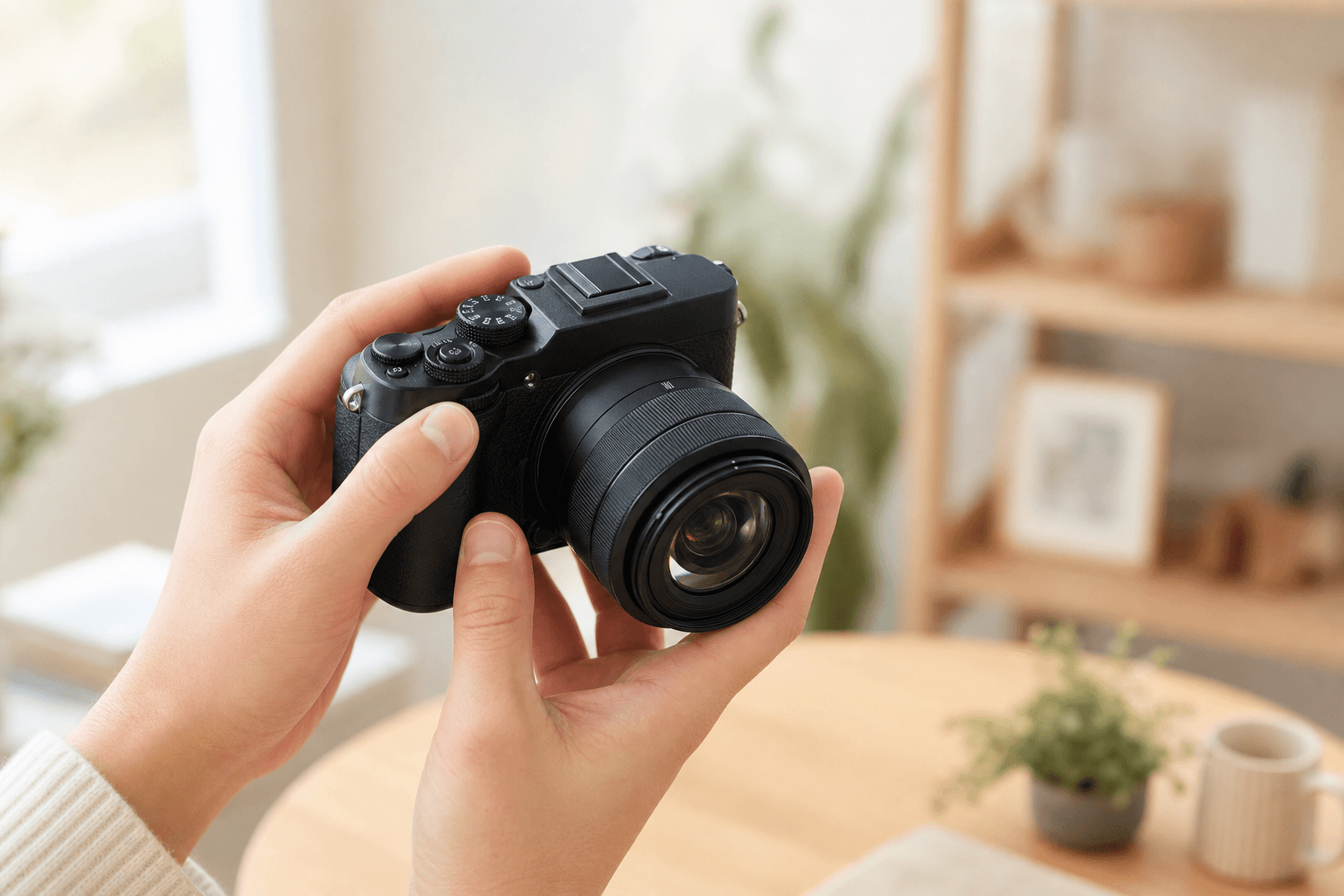
Which lens for what — camera with interchangeable lens and lens choice for beginners
Martin Kleinheinz
Author
Martin Kleinheinz
Photographer · Hannover
Updated
July 3, 2026

You have a camera — usually with a kit lens — and you're wondering which second lens will actually make your photos better. Or you're facing your first purchase and getting overwhelmed by zooms, primes, f-numbers and prices between €150 and €3,000. Most guides list lenses as if "more expensive = better" were a law of nature.

That's not true — especially if you shoot as a hobby and don't earn 40 hours a week with a camera. A solid mid-range lens you actually use beats high-end glass sitting in a cupboard because it's too heavy, too expensive or too specialised.

This guide answers a different question: Which lens fits what you want to photograph? With a focus on mid-range primes and concrete models for the common systems. What mm numbers mean is explained in depth in Which Focal Length for What. Which camera to start with: Camera for Beginners.

00
Quick

Which lens for which use case?

The fastest answer — before we get into details and brands:

You mainly shoot …Lens typeTypical prime focal lengthWhy
Portraits, friends, partnerFast prime50 mm or 85 mmBeautiful bokeh, flattering perspective
Kids, family, indoorsWide prime35 mmMore room, low light, close to the action
Holiday, landscape, architectureKit zoom is enough — or wide-angle16–35 mm (zoom) or 24 mm primeLots in frame, flexible on the go
Street, café, everyday momentsCompact prime23–35 mmUnobtrusive, fast, close to the subject
Sports, concert, zooTele zoom (exception)70–300 mmPrimes too inflexible at changing distances
Flowers, products, detailsMacro or macro prime35 mm macro or 90 mm macroGet close, sharp in detail

Lens by subject — full-frame equivalents; for APS-C see section 01

01
Basics

Thinking about lens choice the right way

The most common bad-buy logic: "I want better photos → I need a better lens." Better then means: more expensive, bigger, faster. In reality you want different photos — brighter, more freely composed, sharper or closer to the subject. That's a use case problem, not a quality problem.

Three questions before every purchase:

  • What do I shoot most often? (Portrait? Kids? Holiday?)
  • What's missing on my kit? (Too dark at f/5.6? Not enough bokeh? Not enough wide-angle?)
  • Which system do I have? (Canon RF, Sony E, Nikon Z, Fujifilm X — the lens has to fit.)

APS-C or full frame — why it matters

The same focal length looks tighter on APS-C than on full frame. A 35 mm lens on a Canon R10 or Sony ZV-E10 feels roughly like 50–56 mm "full-frame feel" — ideal for half-length portraits. A 50 mm lens on APS-C feels like a short tele — good for portraits, less for tight rooms. The tables in this article use full-frame equivalents; on crop you multiply by 1.5 (Sony/Nikon/Fuji) or 1.6 (Canon APS-C).

02
Prime

Why I recommend primes to beginners

Zooms are practical — and your kit lens is a zoom. That's exactly why your first upgrade should often be a prime. Not because zooms are bad, but because a prime forces you to move, use light consciously and really learn one focal length.

Aperture
Typically f/1.8 instead of f/5.6 on the kit — 3–4 stops more light. Indoors, evenings, cloudy days: the biggest difference.
Bokeh & separation
Background blur comes from a wide aperture and the right focal length. A 50 mm f/1.8 delivers the "pro look" cheaper than any kit zoom.
Sharpness & weight
Simple optics = often very sharp, light and affordable. A 50 mm f/1.8 often weighs under 200 g.
Learning curve
One focal length = clearer composition. You get more creative with position instead of turning the zoom ring.
03
Budget

Mid-range is enough — high-end is for pros

Lens marketing lives on superlatives: f/1.2, "L" series, "GM" Master, "S-Line". Those are tools for photographers who earn money with them — weddings by candlelight, sports at f/2.8 throughout, commercial with tethering. As a hobbyist you pay for margins you don't need in everyday use.

CategoryTypical priceFor whomHobby alternative
Entry-level prime€150–350All beginners50 mm f/1.8 — best value
Mid-range prime€350–700Ambitious hobbyists35 mm f/1.8, 85 mm f/1.8, macro with IS
Mid-range zoom€500–1,200Travel, versatility24–70 mm f/4 or f/2.8 (not f/2.8 L)
High-end / f/1.2 / L glass€1,200–3,000+Pros, very experiencedOnly if you really use the difference

Price categories realistically ranked — as of 2026

A 50 mm f/1.8 for €220 on your camera delivers 80% of the look a 50 mm f/1.2 for €2,000 brings — in daylight and normal use. The rest is nuance you only see after years of shooting. Invest in one lens you carry and time to practise instead.

04
Portrait

Which lens for portraits?

Portraits live on three things: flattering perspective, soft background and eyes in focus. You don't need an 85 mm f/1.2 L lens — a fast mid-range lens is plenty.

Portrait typeIdeal focal length (FF eq.)Lens typeTip
Face / headshot85–105 mm85 mm f/1.8 primeDon't get too close — noses look too big otherwise
Half-length / upper body50–85 mm50 mm f/1.8 or 56 mm (APS-C)Classic all-rounder for beginners
Full body / environment35–50 mm35 mm f/1.8More context, place subject in scene
Couples, two people50–70 mm50 mm f/1.8, a bit of distanceBoth in the sharp zone at f/2.8

Portrait by framing — full-frame equivalent

Portrait buying advice (hobby): Full frame → 85 mm f/1.8 or 50 mm f/1.8 as a cheaper entry. APS-C → Sigma 56 mm f/1.4 (portrait classic) or your brand's 50 mm f/1.8. Aperture f/1.8–f/2.8 — more than enough bokeh.

05
Family

Family, kids & everyday indoors

Kids move. Rooms are tight. Light is rarely ideal. Here the longest tele doesn't win — it's the wider focal length with a large aperture. You want to be close to the action without distortion and without flash.

Best prime
35 mm f/1.8 on full frame — or 23–24 mm on APS-C (roughly 35 mm eq.). Enough room for toys, sofa, kitchen.
Alternative
50 mm f/1.8 if you want more distance and stronger bokeh — good for calmer moments, less for tight kids' rooms.
When a zoom?
Keep the kit lens for birthdays and movement. Prime for moments where you want to compose consciously.

Family buying advice: As first extra lens almost always 35 mm class (physical focal length depending on sensor). Second lens later: 50 mm f/1.8 for nicer individual portraits of the kids.

06
Travel

Travel, landscape & architecture

On the road weight and flexibility count. Here the kit zoom (usually 18–55 mm or 18–150 mm) is often the best choice — not the expensive prime. Landscape wants wide-angle; architecture sometimes needs 24 mm, sometimes 35 mm.

SubjectRecommendationPrime?Note
General holidayKeep kit zoomOptional: 24 mm f/2.8 primeOne zoom = fewer changes
Landscape with foreground16–35 mm zoom or 24 mm prime24 mm f/2.8Tripod at dusk
Cities & architecture24–35 mm28 mm or 35 mm primeStraight lines, little distortion
Travel portrait50 mm f/1.8YesEvenings at the beach or in the old town

Travel = often zoom first — prime as supplement

07
Street

Street, café & reportage

Street photography needs discretion and speed. Big lenses stand out; wide primes are unobtrusive and snap to focus fast. The classic street focal length is 28–35 mm full-frame equivalent — close enough for intimacy, wide enough for context.

Street buying advice: 35 mm f/1.8 or 28 mm f/2 — compact, light, good in low light. On Fujifilm: XF 23 mm f/2 (≈ 35 mm eq.). On APS-C: 24 mm class (Canon RF-S 24, Sony 24, Nikon Z DX 24).

08
Sports

Sports, events & distant subjects

Here I'm honest: primes are the exception. Football, riding, concert — the subject is far away and moving. You need a tele zoom (70–300 mm or 100–400 mm). An 85 mm prime is enough for indoor sport up close, not from the stands.

SituationRecommendationBudget range
Kids' football, near the touchline70–200 mm f/4 zoom€400–900
Club sport, medium distance70–300 mm consumer zoom€300–600
Concert / theatre (not always allowed)70–200 mm or 85 mm prime + sit closevaries
Birds / wildlife (hobby)100–400 mm zoom€800–1,500

Sports = zoom required — prime only at fixed distance

09
Macro

Macro, products & small details

For flowers, jewellery, food photos or technical details you need close focus. Real macro lenses offer 1:1 magnification. Affordable entry: 35 mm f/1.8 macro (Canon RF, Nikon Z) — works as a normal everyday lens too.

Budget macro
35 mm macro with 1:2 or 1:1 — versatile, not just macro.
Classic macro
90–105 mm macro — more distance to the subject (insects, products).
Without an extra lens
Close-up lens on a prime — cheap, but quality limited. Close-up lens calculator.
10
Brands

Concrete mid-range recommendations by system

Here are the models I really recommend to beginners and advanced hobbyists — mid-range primes, not high-end glass. We'll add shop links together; the names are deliberately concrete so you can compare directly.

Canon RF & RF-S (R10, R50, R8, RP …)

Use caseRecommended lensApprox. priceNote
All-round, first upgradeRF 50 mm f/1.8 STM~€220Best entry for the Canon system
Family, indoors, streetRF 35 mm f/1.8 Macro IS STM~€500Macro bonus, image stabiliser
APS-C compactRF-S 22 mm f/2 STM~€280Very small — vlog-friendly
Full-frame portraitRF 85 mm f/2 Macro IS STM~€600No L glass needed — enough for hobby
Travel wide-angleRF 24 mm f/2.8 STM~€280Light, affordable, sharp

Canon RF — mid-range primes 2026

Sony E (ZV-E10 II, a6700, a7C II …)

Use caseRecommended lensApprox. priceNote
Full-frame all-roundSony FE 50 mm f/1.8~€200Light, affordable, solid
APS-C portraitSigma 56 mm f/1.4 DC DN~€450Best APS-C portrait value
APS-C familySigma 30 mm f/1.4 DC DN~€350≈ 45 mm eq. — versatile indoors
Full-frame portraitSony FE 85 mm f/1.8~€500Classic, compact
Street / compact FFSigma 65 mm f/2 DG DN~€550A bit pricier, but very nice
FF familySony FE 35 mm f/1.8~€650With OSS — good for video

Sony E — OEM and Sigma Contemporary/DG DN

Nikon Z (Z50 II, Zfc, Z5, Z6 III …)

Use caseRecommended lensApprox. priceNote
Compact & affordableNikkor Z 40 mm f/2~€280Tiny — ideal on the go
All-roundNikkor Z 50 mm f/1.8 S~€500Pricier, but very sharp
Family & streetNikkor Z 35 mm f/1.8 S~€700Upper mid-range
APS-C streetNikkor Z DX 24 mm f/1.7~€300Very compact for Z50/Zfc
PortraitNikkor Z 85 mm f/1.8 S~€700If portrait is your main subject

Nikon Z — focus on compact f/2 and f/1.8 lines

Fujifilm X (X-T30 II, X-S20, X-T50 …)

Use caseRecommended lensApprox. priceNote
Budget entryXC 35 mm f/2~€200≈ 53 mm eq. — unbeatable value
StreetXF 23 mm f/2 R WR~€400≈ 35 mm eq. — weather-sealed
All-roundXF 35 mm f/2 R WR~€400≈ 53 mm eq. — classic
PortraitXF 50 mm f/2 R WR~€400≈ 75 mm eq. — nice for faces
Compact travelXF 27 mm f/2.8 R WR~€400≈ 41 mm eq. — pancake

Fujifilm X — small f/2 lenses, ideal for hobby

11
Decision

Your buying decision — step by step

By the end of this article you should have exactly one lens in mind — not five. Go through the steps:

Step 1: Use the kit for 3 months
Note each week: How often is light missing? How often do you want more bokeh? How often do you miss wide-angle or zoom?
Step 2: Choose main subject
Portrait → 50/85 mm. Family indoors → 35 mm. Street → 28–35 mm. Travel only → keep kit. Sports → tele zoom.
Step 3: Brand table above
Pick your brand in section 10 and the matching model.
Step 4: Set budget
€150–350 = perfect entry. €400–700 = if you already know you'll shoot that subject for years.
Step 5: Buy and shoot only with it for 6 weeks
Don't order a second lens right away. Learn to push one prime to its limits.
If your main subject is …Then buy …Concrete (examples)
Portrait & people50 mm f/1.8 or 85 mm f/1.8Canon RF 50 · Sony FE 50 · Fuji XF 35 f/2
Kids & family indoors35 mm f/1.8 (FF eq.)RF 35 Macro · Sigma 30 (APS-C) · Nikon Z 40
Street & everyday28–35 mm primeRF 24/35 · Fuji XF 23 f/2 · Nikon Z DX 24
Holiday & landscapeKeep kit (+ optional 24 mm)RF 24 f/2.8 · travel zoom later
Sports & far away70–300 mm zoomNo prime purchase — tele zoom

The final decision table — one lens, one clear purpose

The best lens is the one you have with you — and the one you know how to use.

Martin Kleinheinz
12
FAQ

Frequently asked questions

Which lens first after the kit?
In 70% of cases: your system's 50 mm f/1.8. If you mainly shoot in tight rooms (kids, apartment): 35 mm f/1.8. If you mainly want portraits and use APS-C: 56 mm f/1.4 (Sigma) or 50 mm f/1.8.
Do I need an expensive lens for good photos?
No. A mid-range lens for €200–500 on a modern camera is enough for excellent hobby photos. Light, composition and practice beat expensive glass — every time.
Zoom or prime — what's better for beginners?
For learning: a prime after the kit. For travel and family parties: keep the kit zoom. Ideal: kit zoom + one prime — don't replace everything at once.
Do Sigma and Tamron lenses fit my camera?
Usually yes — check the correct mount (Canon RF, Sony E, Nikon Z, Fuji X). Sigma Contemporary is often the best choice for beginners alongside OEM.
Which lens for portrait with Canon R10 / Sony ZV-E10?
APS-C: Sigma 56 mm f/1.4 for classic portrait or Sigma 30 mm f/1.4 for more environment. Cheaper: each brand's 50 mm f/1.8.
What's the difference from "Which Focal Length for What?"
The focal length guide explains mm numbers and perspective. This article answers: which concrete lens to buy for your use case and system.
We'll add concrete product links to the recommended lenses shortly. Once affiliate links are included: buying through them supports the blog — at no extra cost to you. My recommendations are based on experience on the job and in workshops, not on commission.
Newsletter

Stay in the loop.

Camera and photography news, honest gear tests and new articles — in your inbox. Infrequent but relevant. No spam, unsubscribe anytime.

Keep reading

From the journal.

Fotograf, Martin Fernando Mera Kleinheinz · Franz-Bork-Straße 21, 30163 Hannover · 0179 4085297