APS-C vs. full-frame, honestly explained: crop factor, bokeh, ISO, dynamic range and cost — so you make the right decision before buying a camera.
Author
Martin Kleinheinz
Photographer · Hannover
Updated
May 25, 2026
If you're reading this article, you're probably facing one of the most fundamental and confusing questions any aspiring photographer asks: should I buy a camera with a crop sensor (APS-C) or one with a full-frame sensor? This decision is much more than a technical detail. It's a fork in the road that will shape not only your first steps in photography but your entire future gear, your creative possibilities, and even how you see the world through the viewfinder.
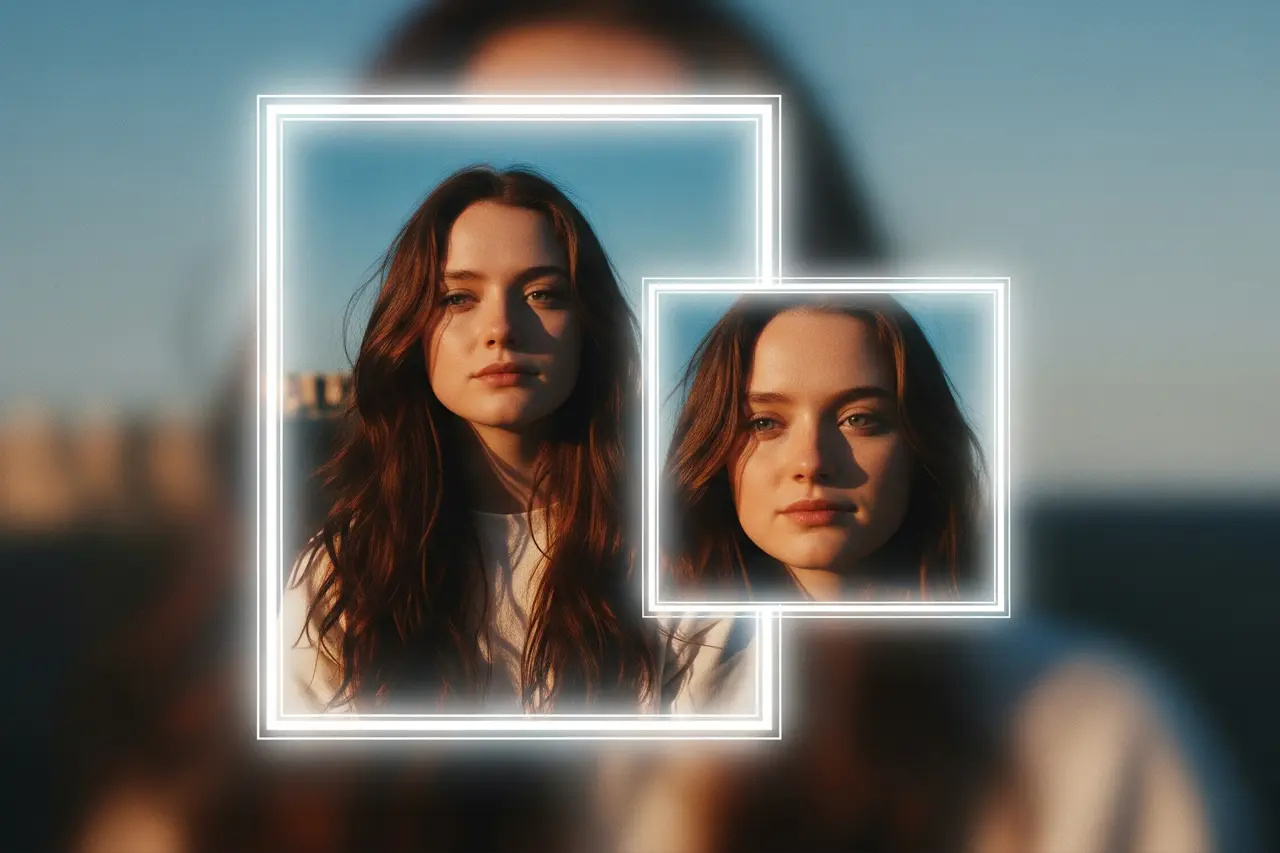
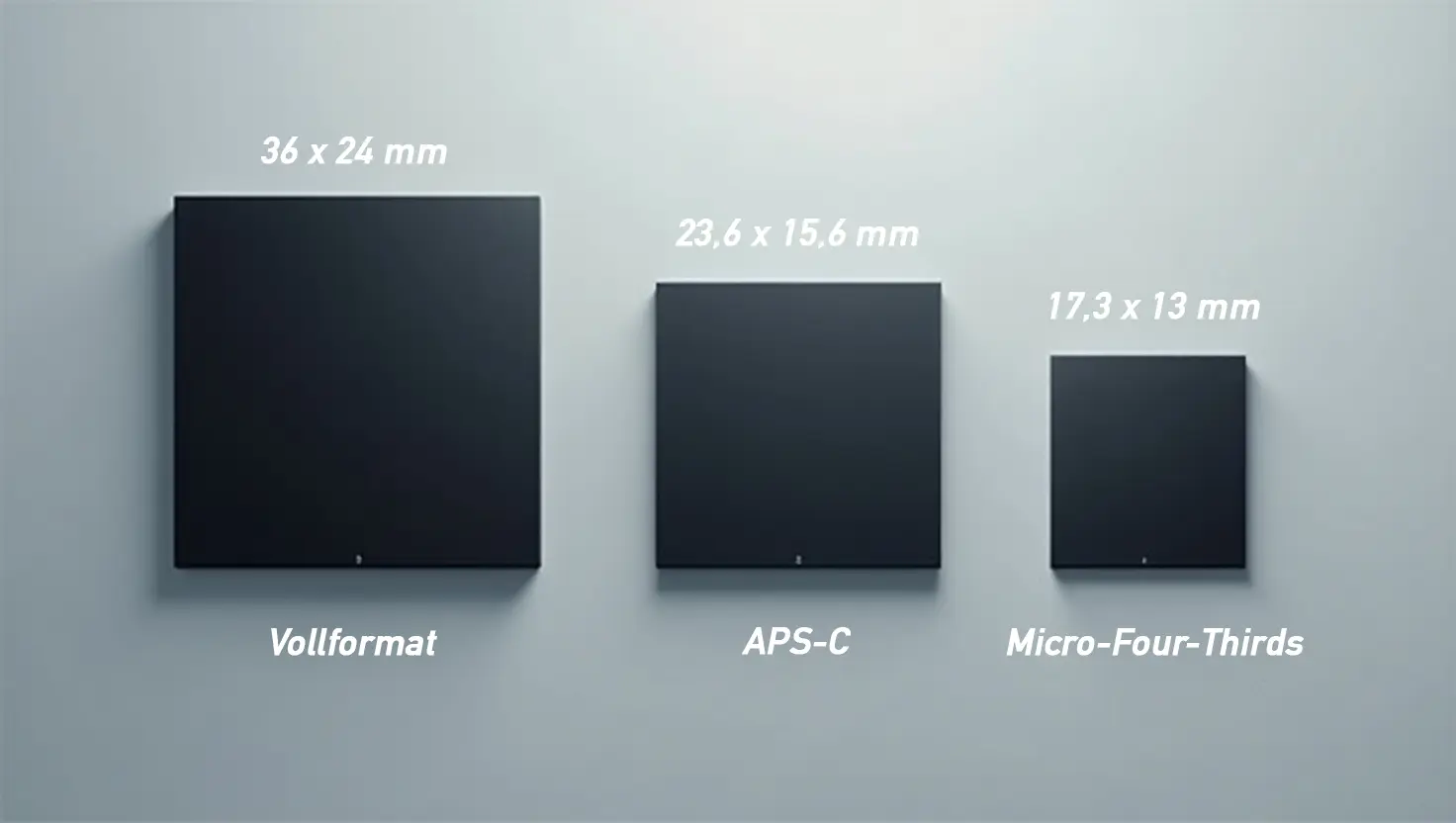
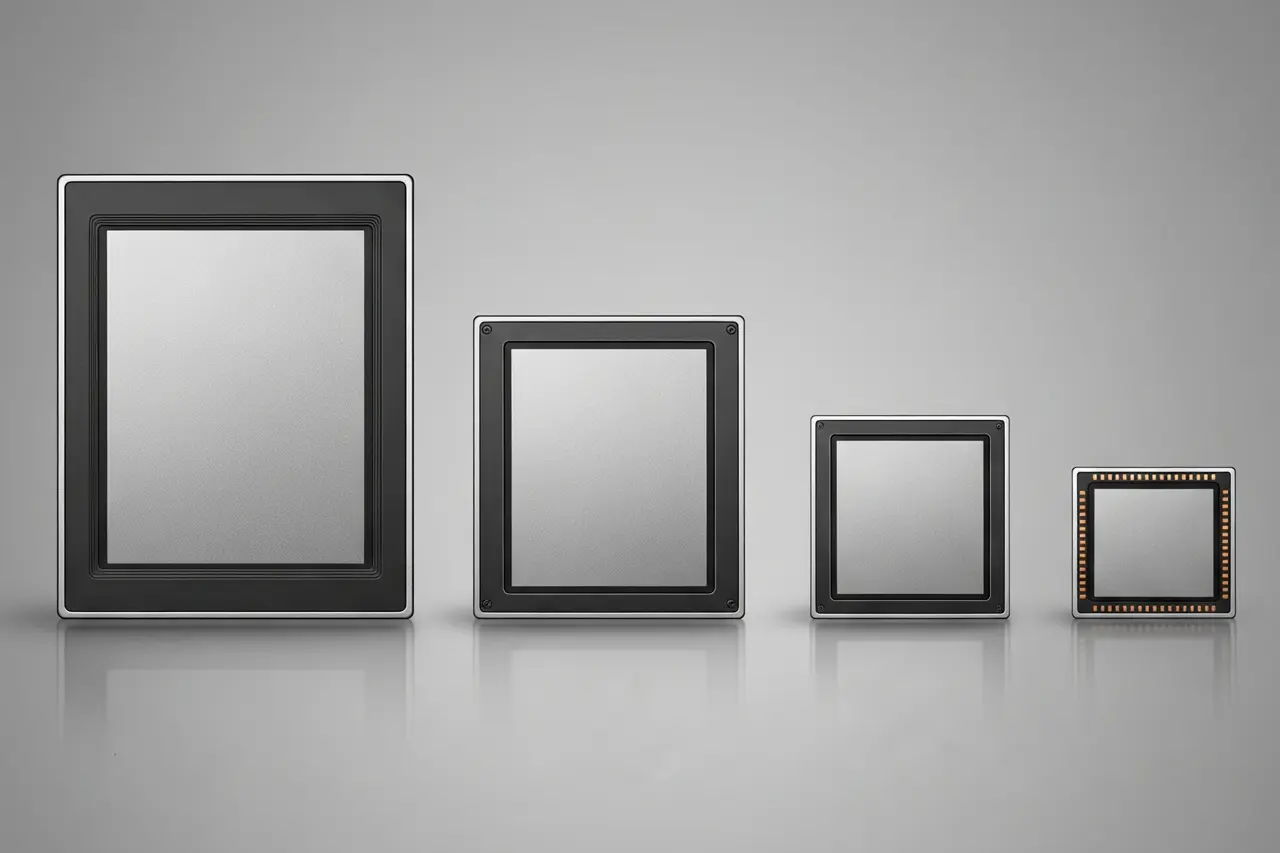
A visual comparison makes the size difference obvious immediately. Place the sensors side by side and the full-frame sensor has a significantly larger surface area than the APS-C sensor. Even smaller formats like Micro Four Thirds (MFT) or the 1-inch sensors often found in high-end compacts also exist. If you want to think bigger still, the guide to digital medium-format cameras covers the next step up.
01
Starting Point
The Most Important Decision Before Buying a Camera
The choice between crop sensor and full-frame is the fundamental fork in your photographic career. It doesn't just affect the first camera purchase — it touches your entire gear collection, your lens investments, the weight you carry around, and your creative latitude: depth of field, noise performance and the effective reach of your focal lengths.
Many beginners are confronted with sweeping statements: "Full-frame is better." That statement is correct in narrow technical areas — but misleading as a general truth. APS-C is cheaper, more compact and in certain applications even superior. Full-frame wins in low light, in maximum depth-of-field control and in post-processing high-contrast scenes. This guide works through every aspect — no myths, no marketing.
02
Basics
What Is a Crop Sensor (APS-C) — and What Is Full-Frame?
The camera sensor is the digital heart of your camera. It is the light-sensitive surface that captures the image — the digital successor of analog film. Its size has a direct influence on almost everything that makes up a photo: image quality in low light, the ability to isolate a subject against a beautifully blurred background, and even the effective reach of your lenses. Choosing a sensor isn't just choosing a component — it's investing in a complete camera system. The sensor size determines which lenses you need, how big and heavy your gear will be, and ultimately how deep you'll have to dig into your pocket.
Definitions for beginners
◆Full-frame: Picture a classic 35 mm film, the analog standard for decades. A full-frame sensor has exactly the same dimensions as a single negative of that film: typically 36 × 24 mm. Because the format was so widespread, it became the reference point for all other sensor sizes today. The name "full-frame" stuck, even though "small format" would be more accurate technically. It implies that the sensor uses the "full" image circle of a lens designed for that format.
◆APS-C (crop sensor): This sensor is physically smaller than a full-frame sensor. The name comes from "Advanced Photo System Classic" (APS-C), a film format introduced in 1996 with a slightly smaller negative. The word "to crop" means to cut or trim — and that's effectively what this sensor does: it captures only the central section (a "crop") of the image a full-frame sensor would see with the same lens at the same position.
A visual comparison makes the size difference clear at a glance. Side by side, the full-frame sensor has a significantly larger surface area than the APS-C sensor. Smaller still are formats like Micro Four Thirds (MFT) or the 1-inch sensors often used in high-end compact cameras.
Comparison: camera sensors placed side by side.
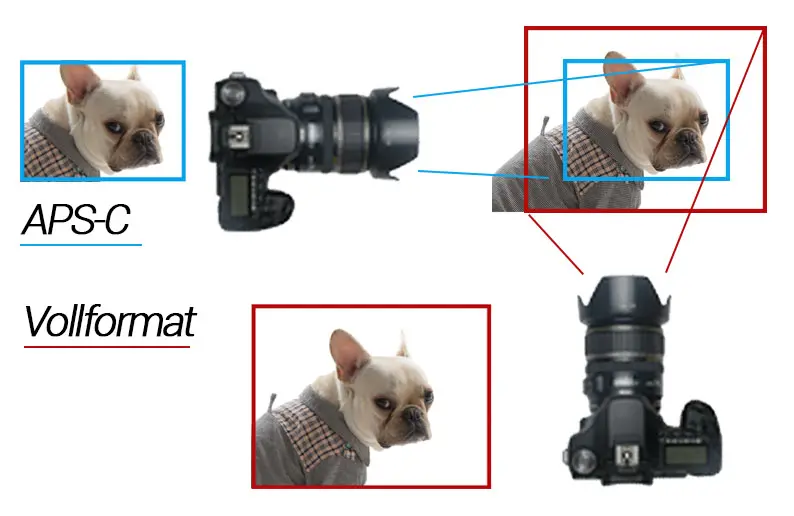
What changes is the field of view — the slice of the scene the camera captures. Imagine you are looking through a large panoramic window (full-frame). You see a wide landscape. Now place a smaller canvas (the APS-C sensor) in the middle of the window. That canvas captures only a central crop of the landscape. The result on the canvas looks as if you had zoomed into the scene with a telescope — even though you haven't moved. That is exactly the effect of the crop factor.
A simple formula will help you compare the visual impression: focal length × crop factor = equivalent focal length (relative to a full-frame field of view). A 50 mm lens on a Sony APS-C camera (crop factor 1.5×) gives the same field of view as a 75 mm lens (50 × 1.5) on a full-frame body. On a Canon APS-C camera (crop factor 1.6×) it becomes 80 mm (50 × 1.6).
◆ Lightroom PresetsBundle
Photos with film character
9 Lightroom presets inspired by Portra, Kodak, Fuji & Ilford — for street, portrait and landscape. One-time €29, no subscription.
Technical Differences in Detail: What Sensor Size Really Means
The crop factor: more than just a number
This is probably the most discussed and often misunderstood concept. The key insight first: the crop factor does not change the physical focal length of your lens. A 50 mm lens is and remains a 50 mm lens, no matter which camera you mount it on.
What changes is the field of view — the slice of the scene the camera captures. Imagine a wide panoramic window (full-frame). You see a wide landscape. Now place a smaller canvas (the APS-C sensor) in the middle of that window. The canvas captures only the central section of the landscape. The result looks as if you had zoomed in with a telescope, even though you haven't changed position. That is the crop-factor effect.
Comparison: the field of view from a crop sensor and a full-frame sensor side by side.
A simple formula helps in practice: focal length × crop factor = equivalent focal length (referenced to a full-frame field of view). A 50 mm lens on a Sony APS-C body (crop factor 1.5×) gives the same field of view as a 75 mm lens (50 × 1.5) on full-frame. On a Canon APS-C body (crop factor 1.6×) it becomes 80 mm (50 × 1.6).
Table: focal-length equivalence in practice
Focal length on full-frame
Typical use
Equivalent on APS-C (1.5×)
Equivalent on APS-C (1.6×)
16 mm
Ultra-wide (architecture, astro)
approx. 11 mm
approx. 10 mm
24 mm
Wide (landscape, reportage)
16 mm
15 mm
35 mm
Reportage, street
approx. 23 mm
approx. 22 mm
50 mm
Standard, portrait
approx. 33 mm
approx. 31 mm
85 mm
Classic portrait
approx. 56 mm
approx. 53 mm
200 mm
Telephoto (sport, wildlife)
approx. 133 mm
approx. 125 mm
400 mm
Super telephoto (wildlife, birds)
approx. 267 mm
250 mm
Depth of field and the magic word "bokeh"
One of the most prized aspects of photography is the ability to play with sharpness and blur. A sharp subject against a wonderfully soft background — that's the "full-frame look".
Full-frame look. Nikon Z6 II with Nikon Z 50 mm f/1.8.
Here, full-frame has a clear, physics-based advantage.
Full-frame sensors produce a shallower depth of field (DoF) than APS-C sensors when shooting the same framing and the same aperture. The chain of cause and effect is simple:
◆To get the same framing as a full-frame camera with an APS-C body, you either have to move further away from the subject or use a lens with a shorter focal length (see table above).
◆Both a greater subject distance and a shorter focal length physically lead to greater depth of field.
◆Conversely, with a full-frame camera — where you can get closer for the same framing or use a longer focal length — it is easier to dissolve the background into blur.
ISO sensitivity and noise
Here it's pure physics. Picture a camera sensor as a surface paved with millions of tiny light buckets (the pixels). With the same megapixel count (e.g. 24 MP), those pixels are packed more tightly on the smaller APS-C sensor than on the larger full-frame sensor. That means: the individual pixels on a full-frame sensor are physically larger.
Larger pixels can capture more light (photons) before their signal is "full". That delivers a better signal-to-noise ratio. In practice: full-frame cameras produce cleaner, less noisy images at high ISO values.
Hardly any noise on full-frame: Nikon Z8 at ISO 2500 with Nikon Z 50 mm f/1.8.
When you shoot in low light (a church, a concert, at night), you have to crank up the sensor's sensitivity artificially — the ISO value. On an APS-C camera, a high ISO produces visible noise (grainy, ugly artefacts) faster than on a full-frame body. That's a decisive advantage for anyone who often works in difficult light.
Dynamic range: the gap between white and black
Dynamic range describes the sensor's ability to capture the contrast range of a scene — from the darkest shadows to the brightest highlights — with detail, without clipping to pure black or pure white.
Here too, full-frame sensors usually lead thanks to larger pixels and better light gathering, offering higher dynamic range. The practical benefit is enormous, especially when shooting RAW:
◆You have more headroom in post — provided you work on a calibrated wide-gamut monitor that can actually display shadows and highlights correctly.
◆You can far better "rescue" accidentally over- or underexposed areas in your photo, without ugly noise appearing in the lifted shadows or unnatural colors in the recovered highlights.
◆A blessing for landscape photography, where you often fight extreme contrast between a bright sky and a dark foreground.
04
APS-C
Advantages of APS-C (Crop Sensors): Small but Mighty
Price advantage: significantly cheaper
This is probably the most obvious — and for many beginners decisive — advantage. APS-C systems are significantly cheaper. Not just the camera body itself (the sensor is one of the most expensive components), but the whole ecosystem. Lenses designed specifically for the smaller image circle of APS-C sensors (e.g. Canon EF-S/RF-S, Nikon DX, Sony E, Fujifilm X) can be more compact, lighter and therefore more affordable than their full-frame counterparts. For the same money you often get a more versatile system with multiple lenses.
Compactness and low weight: your constant companion
The price advantage goes hand in hand with a tangible practical benefit: APS-C systems are smaller and lighter. A camera that fits, with two lenses, into a small bag or a daypack will accompany you far more often than a heavy, bulky kit you leave at home because it's too cumbersome. As the old photographers' saying goes:
“The best camera is the one you have with you.”
For travel, long hikes, city trips or simply family outings, this advantage is not to be underestimated.
Effective focal-length extension: the "built-in teleconverter"
What is technically described as the "crop factor" turns out, in practice, to be a superpower for certain photography genres. The smaller sensor "extends" the effective reach of your telephoto lenses by a factor of 1.5 or 1.6 — without any quality loss from an additional teleconverter. A relatively cheap and light 70–300 mm lens becomes, on an APS-C camera, a powerful telezoom with an equivalent reach of up to 480 mm (at 1.6×).
◆Wildlife and bird photography: you get closer to shy animals without spending thousands of euros on extremely long, heavy super-telephotos.
◆Sports photography: you can fill the frame from the sideline without sitting in the front row.
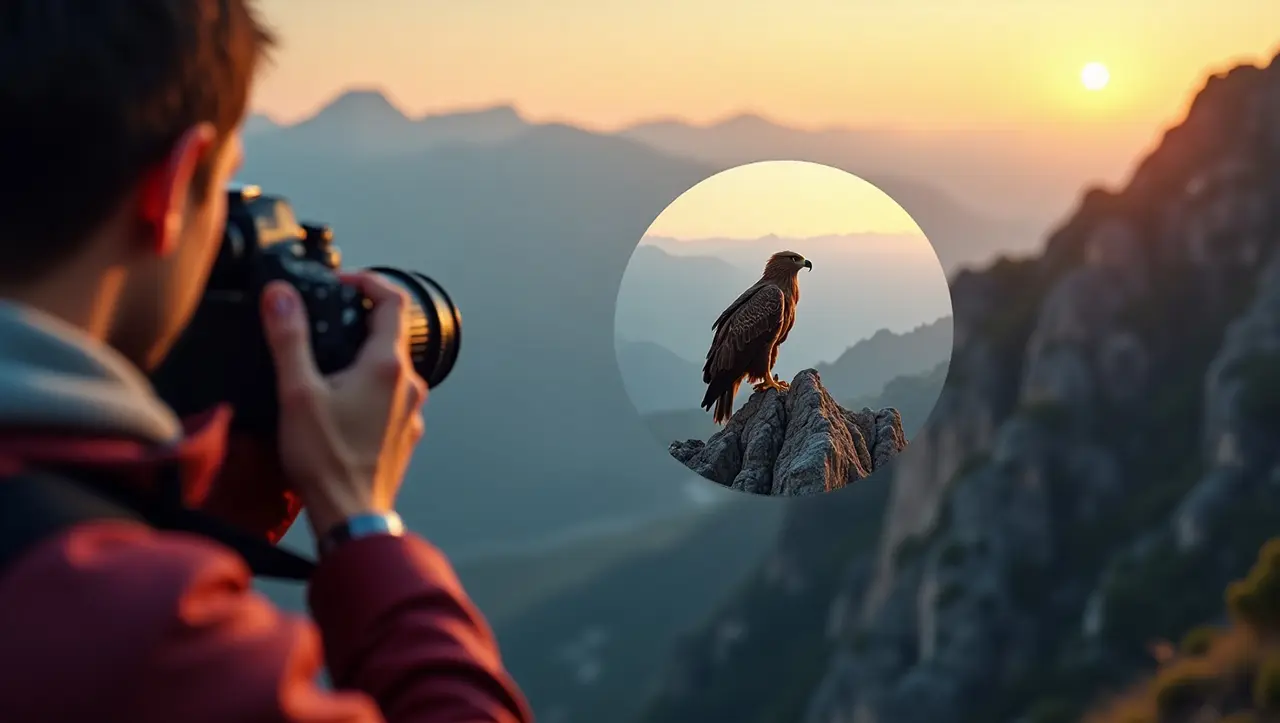
Image created with AI. A clear illustration of the APS-C advantage.
Discretion for street and travel photography
A large, professional-looking camera can feel intimidating on the street and destroy the naturalness of a scene. People behave differently when they feel watched. A compact APS-C camera is worth its weight in gold here. It's less obvious, feels less "threatening" and lets you capture moments without becoming the center of attention. The result is often more authentic and honest images.
05
Full-Frame
Full-Frame Advantages: Top-Tier Image Quality
Higher image quality and resolution
Thanks to their larger surface area, full-frame sensors offer the potential for extremely high resolutions without the individual pixels becoming so tiny that light sensitivity suffers. Modern cameras like the Sony A7R V with 61 megapixels, the Canon EOS R5 Mark II with 45 megapixels, or the Nikon Z8 deliver breathtaking detail. That detail isn't only relevant for huge gallery prints. It also gives you enormous headroom for cropping in post. You can crop a small section of your photo aggressively and still end up with a sharp, detail-rich image — effectively turning a prime lens into a zoom in post.
Better noise performance and dynamic range
As we saw in the technical section, this is the core advantage of full-frame. The superior light gathering of larger pixels translates directly into two decisive benefits:
◆Less image noise at high ISO values: your photos at dusk, indoors or under a starry sky will be cleaner and more detailed.
◆Higher dynamic range: you have more reserves to preserve details in bright clouds and dark shadows alike in high-contrast scenes.
Sky and clouds are not blown out. Shadows are still acceptable in post: Nikon Z6 II with Nikon AF-S 14–24 mm f/2.8.
Shallower depth of field for creative bokeh
The famous "full-frame look" is often synonymous with an extremely shallow depth of field. Rendering the subject tack-sharp while foreground and background melt into a soft, creamy blur (bokeh) is easier and more pronounced with full-frame. That's a powerful creative tool to:
◆guide the viewer's eye precisely to the main subject
◆eliminate distracting background elements
◆give portraits a professional, almost three-dimensional feel
Better low-light performance
Combine the advantages of lower noise and better subject isolation and you get unbeatable performance in poor light. You can shoot at wider apertures to gather more light (which reduces depth of field) while also pushing ISO higher without the image becoming unusable. That combination makes full-frame the first choice for demanding available-light photography — weddings in dark churches, events and concerts, reportage at dusk or astrophotography.
Lightroom Presets9 film looks inspired by Portra, Kodak & Fuji —View pack →
06
Trade-offs
Drawbacks and Challenges: Nothing Without Compromise
No system is perfect. The choice between APS-C and full-frame is always a trade-off. What is a drawback for one photographer may be irrelevant to another. This "reality check" helps you decide which drawbacks would actually affect your photography.
APS-C: the limits of the system
◆Limited choice of professional lenses: the overall APS-C lens lineup is often broad, but the range of absolute high-end pro lenses — extremely fast, optically perfect, ruggedly built — is far more extensive for full-frame. Third parties like Sigma's acclaimed "Art" series focus many of their best designs on full-frame.
◆Fewer specialty lenses: if you want to push into niche areas, APS-C hits walls faster. A classic example is tilt-shift lenses, essential in professional architecture photography to correct converging lines. There's a wide selection for full-frame; for APS-C you'll find only a few — mostly manual — options from third parties like TTArtisan or AstrHori.
◆The "low-light" disadvantage: as good as modern APS-C sensors have become, the physical ceiling is reached sooner when light is truly scarce. Noise becomes visible earlier and dynamic range drops more aggressively than on a comparable full-frame body.
Full-frame: the price of perfection
◆Higher weight and larger gear: this cannot be stressed enough. A full-frame body is heavier, but the real weight driver is the lenses. Quality glass that has to illuminate a large sensor is inevitably bigger, thicker and heavier. A full kit with three zoom lenses can easily reach several kilograms and become a real burden — especially on trips or long photo walks.
◆High cost: full-frame is a serious investment. Not just the bodies are pricier — the whole ecosystem costs more. Professional lenses can easily run €2,000, €3,000 or more — often a multiple of the camera price.
◆Larger files: more megapixels and a higher dynamic range produce huge RAW files. A 61-MP file can exceed 100 MB. You'll need larger, faster memory cards, more hard-drive space for backups and a powerful computer to edit those data volumes smoothly.
07
Recommendation
Who Should Pick Which Format?
The beginner and hobby photographer
For most people getting into photography or doing it as a hobby, APS-C is the ideal starting point. The system offers a fantastic compromise between price, performance and portability. You get excellent image quality that is sufficient for anything you can think of — from social media through photo books to large prints. You can learn the fundamentals (aperture, shutter speed, ISO) without being deterred by the high cost and weight of a full-frame system.
The ambitious amateur
Here you reach the fork in the road. The question is no longer which system is "better", but: are you hitting the limits of your current system?
◆Do you consistently want more subject isolation and softer bokeh in your portraits than you can get with your APS-C lenses?
◆Do you shoot a lot of concerts or events and the noise of your APS-C camera at ISO 3200 or 6400 bothers you massively?
◆Are you a landscape photographer who wants maximum dynamic range to master even the toughest lighting conditions?
If you answer one of those questions with a clear "yes", switching to full-frame can be the next logical step to realize your creative vision. But beware: modern high-end APS-C cameras like a Fujifilm X-T5, a Fujifilm X-H2 or a Canon EOS R7 are real powerhouses and can often be a better choice than a budget entry-level full-frame body.
The professional
Many professional photographers rely on full-frame because it delivers the uncompromising image quality, reliability and flexibility they need for paid assignments. The investment is justified by the results delivered to clients. But pros also think pragmatically. A sports or wildlife photographer will often value the reach and speed of a professional APS-C camera like the Canon EOS R7 more than the last few percent of image quality from a full-frame body. Many also use APS-C systems intentionally as lighter second kits for travel or less critical jobs. Anyone thinking further ahead can find the next level in the medium-format comparison — with prices in 2026 starting under €5,000 for the first time.
Typical use cases in detail
◆Landscape photography: a classic draw with a slight edge for full-frame. Higher dynamic range is a blessing at sunrise and sunset, and the selection of excellent ultra-wide lenses is larger. APS-C, however, scores massively with lower weight — which can make the difference on long hikes into the mountains. Image quality is more than enough for impressive landscape shots.
◆Portrait photography: full-frame is king here. The ability to create an extremely shallow depth of field and isolate the subject perfectly is exactly the "look" many portrait photographers chase. With fast primes (e.g. a 56 mm f/1.4), however, you can also create absolutely professional, beautifully blurred portraits with APS-C.
◆Wildlife and sports photography: the most difficult field. APS-C delivers invaluable, "free" reach via the crop factor. You save money and weight on expensive telephoto lenses. Full-frame pulls ahead when light is poor (indoor sports, animals at dusk) and when you need the fastest autofocus and highest burst rates of top-end pro models.
◆Travel and street photography: there's a clear winner here: APS-C. Small, light, compact and discreet — those are the decisive criteria. You are more flexible, more spontaneous and can capture the moment without lugging around heavy gear. If you plan to use the system abroad, the photo trip guide covers planning, customs and gear logistics.
08
Verdict
Verdict and Decision Help: Find Your Perfect Camera
We've worked through a lot of technical detail and practical thinking. In the end, the choice between crop and full-frame comes down to a very personal balance. There is no universally "better" camera — only the better camera for you and your specific needs.
To summarize, here are the core arguments compared directly: APS-C is the smart all-rounder — affordable, compact, light and with a superpower for telephoto shots. Full-frame is the uncompromising specialist — unmatched in image quality in low light, with maximum creative latitude over depth of field and the biggest reserves for professional post-processing.
Table: pros and cons compared directly
Criterion
APS-C (crop)
Full-frame
Cost (system)
Lower
High
Size & weight
Compact & light
Large & heavy
Image quality (low light)
Good, but tends to be noisier
Excellent, very low noise
Dynamic range
Good
Very high, more editing headroom
Depth of field / bokeh
Greater DoF, less pronounced bokeh
Shallower DoF, maximum bokeh
Lens choice
Very large, many affordable options
Largest selection of pro lenses
Reach (telephoto)
Advantage via crop factor ("free zoom")
No crop factor, requires longer/pricier lenses
The decisive questions to ask yourself
◆What is my budget? Be realistic. Plan not only the camera price but also at least one good lens and essential accessories like cards and a spare battery.
◆What do I want to shoot mainly? Are you a landscape hunter, a portrait artist, a sports fan or a world traveler? Your genre points the way.
◆How important are size and weight to me? Are you willing to carry 3–4 kg of gear for the best image quality, or will the camera then live in the cupboard?
◆What is missing from my photos so far? If you've been shooting on a phone, what bothers you most? Are images bad at dusk? Do you want a blurred background? Your frustration points are the best signposts.
At the end of the day, technical specs are only half the story. The camera that feels good in your hand, that you enjoy operating and that inspires you to get out and discover the world will always make the best images — regardless of which sensor size sits inside.
09
FAQ
Frequently Asked Questions on Crop vs. Full-Frame
Is full-frame always better than APS-C?+
No, that's a myth. Full-frame has clear technical advantages in certain areas like low-light performance and the ability to achieve shallower depth of field. APS-C, however, has equally clear advantages in cost, size, weight and the effective reach of telephoto lenses. Modern APS-C cameras deliver such excellent image quality that the difference is irrelevant for many applications. They are different tools for different jobs.
Can I use APS-C lenses on a full-frame camera (and vice versa)?+
APS-C lens on a full-frame body: technically often possible but not recommended. The image circle produced by the lens is too small to illuminate the large full-frame sensor. The result is massive black borders or corners (heavy vignetting). Many cameras therefore switch automatically into a "crop mode" that uses only part of the sensor — and that throws away exactly the advantages (resolution, sensor size) you bought an expensive full-frame body for. Full-frame lens on an APS-C body: yes, that works without issue, often via an adapter. You only need to account for the crop factor which tightens the framing. This can be a smart strategy if you already own high-quality full-frame lenses or plan to move to a full-frame system later.
Does the crop factor change the focal length or just the field of view?+
It only changes the field of view. The physical properties of a lens — its focal length and its maximum aperture (e.g. f/1.8) — always stay the same. The "zoom effect" is purely a visual consequence of the smaller sensor's narrower field of view. A 50 mm f/1.8 lens always remains a 50 mm f/1.8 lens.
How important is the noise difference in practice?+
It depends heavily on your use case. If you shoot mostly in good light and use photos for Instagram, Facebook or your website, you'll barely notice the difference between a good APS-C and a full-frame camera. The difference becomes decisive when you shoot in very low light and need high ISO values (above 1600/3200), when you want to print images large, or when you have to lift dark areas heavily in post.
Is it worth switching from APS-C to full-frame?+
A switch only makes sense when you hit the concrete technical limits of your current APS-C system and have a clear reason to change. Ask yourself: "What exactly is missing that I can't achieve with my current system?" If the answer is "better low-light performance", "more subject-isolation potential" or "higher dynamic range for my landscapes", then it can pay off. But if you simply believe your images will get "automatically better" with a full-frame camera, you'll likely be disappointed. Switching is expensive, your gear becomes heavier, and the learning curve for the new creative possibilities (e.g. shallower depth of field) should not be underestimated.
10
Bonus
The Ultimate Camera-Buying Checklist
Step 1: Define your needs & your budget
◆Primary purpose: what do I mainly want to do? Photos, video or both equally?
◆Favorite genres: which kind of photography excites me most? Landscape, portrait, sport, wildlife, travel, street?
◆Budget: what is my absolute maximum budget for the starting kit (body + first lens + memory card + spare battery)?
Step 2: The camera's core features
◆Camera type: a mirrorless system camera (DSLM) is the future-proof and, for beginners, often easier-to-learn choice.
◆Sensor size: your decision based on this article — the affordable all-rounder APS-C or the quality specialist full-frame?
◆Resolution: 20–24 megapixels are an excellent starting point. Don't be blinded by the megapixel race — more is not automatically better.
◆Autofocus: is it fast and reliable? Does the camera have eye AF? That's a decisive advantage for portraits of people and animals.
◆Burst speed (fps): only important if you shoot fast action or sport. For everything else it's secondary.
◆In-body image stabilization (IBIS): a huge advantage! It stabilizes any attached lens and enables sharper handheld shots at longer shutter speeds.
◆Video features: do you need 4K resolution? High frame rates (e.g. 120 fps) for nice slow motion? A jack for an external microphone?
Step 3: Ergonomics and handling (the feel-good factor)
◆Ergonomics: does the camera feel good in your hand? Is the grip big enough? Can you reach the important buttons and dials without contorting your fingers?
◆Operation: is the menu logical for you? Are there enough control dials to change aperture, shutter and ISO quickly in manual mode?
◆Display: does the camera have a tilting or fully articulating screen? That is extremely helpful for unusual perspectives (low to the ground, overhead) and for vlogs or selfies.
Step 4: The lens system
◆Lens range: how big is the lens selection for the system that interests you? Are there also affordable options?
◆Third parties: are there good and often cheaper lenses from brands like Sigma, Tamron or Viltrox for this system? That expands your possibilities enormously.
◆The first lens: resist the temptation to take only the cheap kit zoom. A fast prime (e.g. 35 mm or 50 mm f/1.8) delivers much better image quality, enables creative subject isolation and trains your photographic eye.
Step 5: Essential accessories for the start
◆Memory cards: buy at least one, better two fast SD cards. A capacity of 64 GB or 128 GB is a good start. Watch the speed class (e.g. V60 or V90), especially if you want to record 4K video.
◆Spare battery: mirrorless cameras use more power than DSLRs. A second battery in the bag is an absolute must so you're not out of power at the decisive moment.
◆Camera bag/backpack: protect your investment! A well-padded bag is essential for transport.
◆Cleaning kit: a simple rocket blower to remove dust from the sensor and a microfiber cloth for the lens belong to the basic setup.
From my workflow
35mm & 120mm film presets
Portra, Kodak Gold, Velvia, HP5 & more — ready-made XMP presets for Lightroom Classic and mobile.