
Exposure Triangle 2026: Aperture, Shutter & ISO Explained

The exposure triangle explained — how aperture, shutter speed and ISO work together, what a stop means, which camera mode fits when, and which settings work for portrait, sport, landscape and events.

Exposure triangle — aperture, shutter speed and ISO explained
Martin Kleinheinz
Author
Martin Kleinheinz
Photographer · Hannover
Updated
June 21, 2026

Your photo is too dark. You turn the aperture — now the background is soft but you didn't want that. You raise ISO — now the image is bright but noisy. Welcome to the exposure triangle — the foundation of all manual photography.

The exposure triangle describes how aperture, shutter speed and ISO together control your photo's brightness. Each of the three has side effects: depth of field, motion blur, image noise. Understand that and you no longer fight the camera — you work with it.

This guide explains the exposure triangle from scratch: the math of stops, practical settings by situation, camera modes and how to read the histogram. Related: Exposure Correction for the quick EV lever, Take Better Photos for composition and light, and the Depth of Field Calculator for precise planning.
00
Quick

The exposure triangle at a glance

Before the details: the essence in four sentences.

Aperture (f-number)
Controls how much light passes through the lens — and how soft the background is. Small number (f/1.8) = lots of light, shallow depth of field. Large number (f/11) = less light, deep depth of field.
Shutter speed
How long the sensor collects light. Short (1/500 s) freezes motion. Long (1/30 s) shows motion as streaks — and shakes when hand-held.
ISO
Sensor signal amplification. Low (100) = best quality. High (3,200+) = more light, but more noise.
The rule
Change one parameter by one stop (half/double light) and you must compensate another by one stop — otherwise the image gets brighter or darker.
ParameterPrimarily controlsSide effectTypical range
ApertureLight + depth of fieldBokeh, star burstsf/1.4 – f/16
Shutter speedLight + motionShake, motion blur1/8000 s – 30 s
ISOLight sensitivityImage noise100 – 51,200

The three pillars of the exposure triangle — what each parameter affects

01
Basics

What is the exposure triangle?

Picture a triangle. At each corner sits a parameter: aperture, shutter speed, ISO. All three together determine how bright or dark your photo is — the exposure. Change one value and brightness changes. To keep brightness, adjust at least one of the other two.

That's the core: it's not just about brightness. Each parameter has a creative side effect. Aperture decides if your portrait subject is isolated from the background. Shutter speed decides if a waterfall looks silky or frozen. ISO decides if you can still shoot in a dark church — or if the image is noisy.

Exposure value (EV) and stops

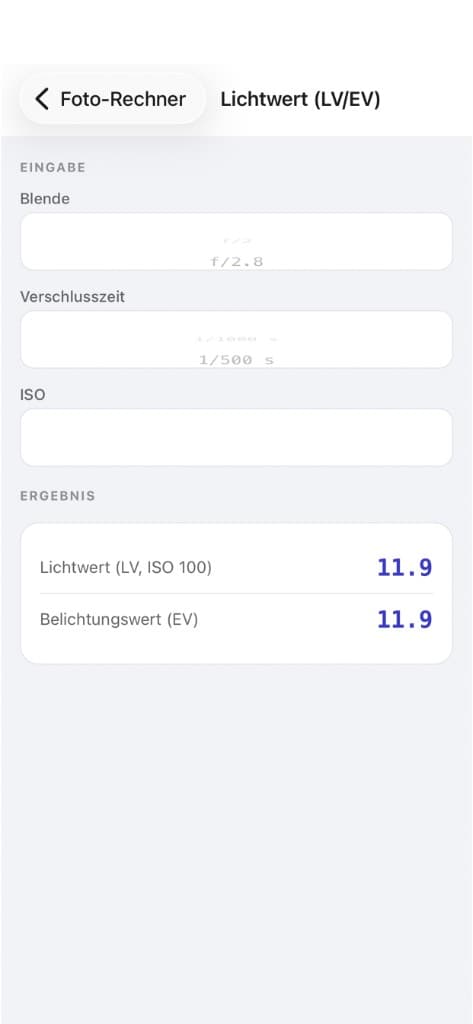
Photographers think in stops. One stop means: half or double the light. f/2.8 to f/4 is one stop — half the light. 1/125 s to 1/250 s is also one stop. ISO 400 to ISO 800 too. That's the common language of the exposure triangle.

StopApertureShutter speedISO
+3 EVf/2.81/15 s100
+2 EVf/2.81/30 s100
+1 EVf/2.81/60 s100
Referencef/2.81/125 s100
-1 EVf/2.81/250 s100
-2 EVf/2.81/500 s100
-3 EVf/2.81/1000 s100

Same exposure at f/2.8 and ISO 100 — only shutter speed changes per stop

02
Aperture

Understanding aperture

The aperture is a mechanical iris in the lens. It opens and closes — and determines how much light hits the sensor. The f-number (e.g. f/2.8) is inversely proportional: small number = large opening = lots of light. Large number = small opening = less light. That confuses beginners — but after a week it's muscle memory.

Depth of field and bokeh

Aperture is your strongest creative tool for portraits. An open aperture (f/1.4 – f/2.8) creates shallow depth of field: only a narrow zone is sharp, the rest melts into soft bokeh. A closed aperture (f/8 – f/16) keeps foreground and background sharp — ideal for landscapes and group photos.

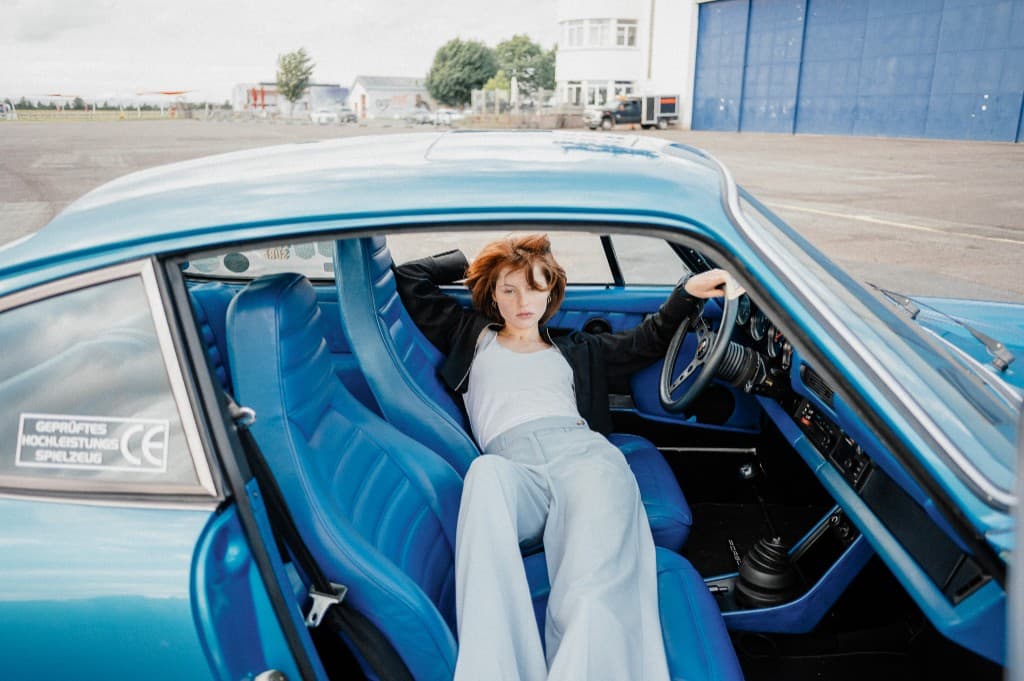
Portrait with open aperture and soft bokeh background
Open aperture (approx. f/2.8): The eye is sharp, the background dissolves into bokeh.
f-numberLightDepth of fieldTypical use
f/1.4 – f/2Very muchVery shallowPortrait, low light, bokeh
f/2.8 – f/4MuchShallowAll-round portrait, reportage
f/5.6 – f/8MediumMediumGroups, street, everyday
f/11 – f/16LittleDeepLandscape, architecture
f/22+Very littleMaximumSun stars, long exposure (caution: diffraction)

Aperture by situation — starting points, not dogma

03
Shutter speed

Understanding shutter speed

The shutter is a curtain in front of the sensor. It opens for a fraction of a second — or longer. 1/125 s means: the shutter is open for 1/125 of a second (0.008 s). 1 s means: a full second of light on the sensor.

Freeze or show motion

1/1000 s and shorter
Sport, birds in flight, splashing water — all frozen.
1/250 – 1/500 s
Running people, children, everyday movement — safe range.
1/60 – 1/125 s
Standing people, slow walk — rule of thumb for hand-held.
1/30 s and longer
Motion blur, light trails, waterfall effect — tripod only.

Avoid camera shake

The classic rule: shutter speed at least 1/focal length. At 50 mm that's at least 1/50 s. At 200 mm tele at least 1/200 s. Modern cameras with IBIS allow 2–4 stops more — but with moving subjects only a shorter time helps. Better a noisy image than a shaky one.

04
ISO

ISO — sensitivity and noise

ISO describes how sensitive the sensor is to light. ISO 100 is the base — little amplification, best image quality. ISO 3,200 is 5 stops brighter — but with visible noise. ISO is your emergency reserve when aperture and shutter speed are maxed out.

ISOLight gainNoiseTypical situation
100 – 200BaseNoneSunshine, tripod, studio
400 – 800+1–2 stopsMinimalClouds, shade, indoors
1,600 – 3,200+3–4 stopsVisibleEvening, church, event
6,400 – 12,800+5–6 stopsClearConcert, night, emergency
25,600+MaximumStrongOnly when you must

ISO levels and typical uses

ISO in 2026: what modern cameras deliver

Full-frame cameras like Sony A7 IV, Canon R6 II or Nikon Z6 III still deliver usable results at ISO 6,400 — especially in RAW with AI denoise in Lightroom. Crop sensors (APS-C) have roughly 1–1.5 stops less headroom. My workflow: Auto ISO with cap 6,400 in A/Av — the camera adjusts, I focus on aperture and moment.

05
Interaction

How the three parameters work together

The exposure triangle becomes practical when you understand compensation. Example: you shoot a portrait at f/2.8, 1/125 s, ISO 400. Exposure is good. Now you want more depth of field — you close to f/5.6 (2 stops less light). Without compensation the image is 2 stops too dark.

Your options: lengthen shutter from 1/125 to 1/30 s (2 stops more light) — risky with motion. Or raise ISO from 400 to 1,600 (2 stops) — more noise. Or use flash. Or accept that f/5.6 isn't possible in this light without sacrificing a parameter.

Ask the right question

Pros don't think "which aperture?" but: what is my creative priority? Want bokeh? → aperture first. Want to freeze motion? → shutter first. Is light miserable? → ISO or flash. The other parameters get compensated.

Portrait with bokeh
Open aperture (f/1.8–f/2.8) → adjust shutter → ISO only if needed.
Landscape all sharp
Closed aperture (f/8–f/11) → tripod for longer time → ISO 100.
Sport action
Short shutter (1/500+) → wide open aperture → high ISO.
Silky waterfall
Long shutter (1/4–1 s) → tripod → compensate aperture and ISO.
06
Modes

Which camera mode when?

You don't have to set everything manually right away. Camera modes are gradations of control — from full auto to manual.

ModeYou chooseCamera choosesWhen to use
P (Program)ISO, EV correctionAperture + shutterQuick start, tourist mode
A / Av (aperture priority)Aperture, ISOShutter speed~80% of my paid work
S / Tv (shutter priority)Shutter speed, ISOApertureSport, waterfall, action
M (Manual)EverythingNothingStudio, tripod, flash setup
M + Auto ISOAperture + shutterISOEvents, changing light — very strong

Camera modes at a glance — A/Av is the sweet spot for most

Smartphone and exposure triangle

In your smartphone's Pro mode (iPhone Camera → More → ProRes/RAW, or Halide, Lightroom Mobile) you control the same triangle: aperture is often fixed (phone lenses have no variable aperture), but shutter speed and ISO are manual. The logic stays identical.

07
Practice

Cheatsheet: 10 situations with settings

Theory is good. Here are concrete starting values — starting points, not laws. Always check the histogram and adjust.

SituationApertureShutter speedISOPriority
Portrait (bokeh)f/1.8 – f/2.81/125 s100–800Aperture
Group photof/5.6 – f/81/125 s200–1,600Depth of field
Landscape (day)f/8 – f/111/125 s100Sharpness + tripod
Landscape (evening)f/8 – f/111/30 s+100Tripod, long exposure
Sport / actionf/2.8 – f/41/500 – 1/1000 s800–3,200Shutter speed
Street photographyf/5.6 – f/81/250 s400–1,600Speed
Event (dark)f/2.81/125 s1,600–6,400ISO + flash
Macrof/8 – f/111/125 s100–400Depth of field + flash
Night / astrof/2.815–30 s1,600–3,200Tripod, long exposure
Silky waterfallf/11 – f/161/4 – 1 s100Tripod, long exposure

Exposure triangle in practice — 10 typical situations with starting values

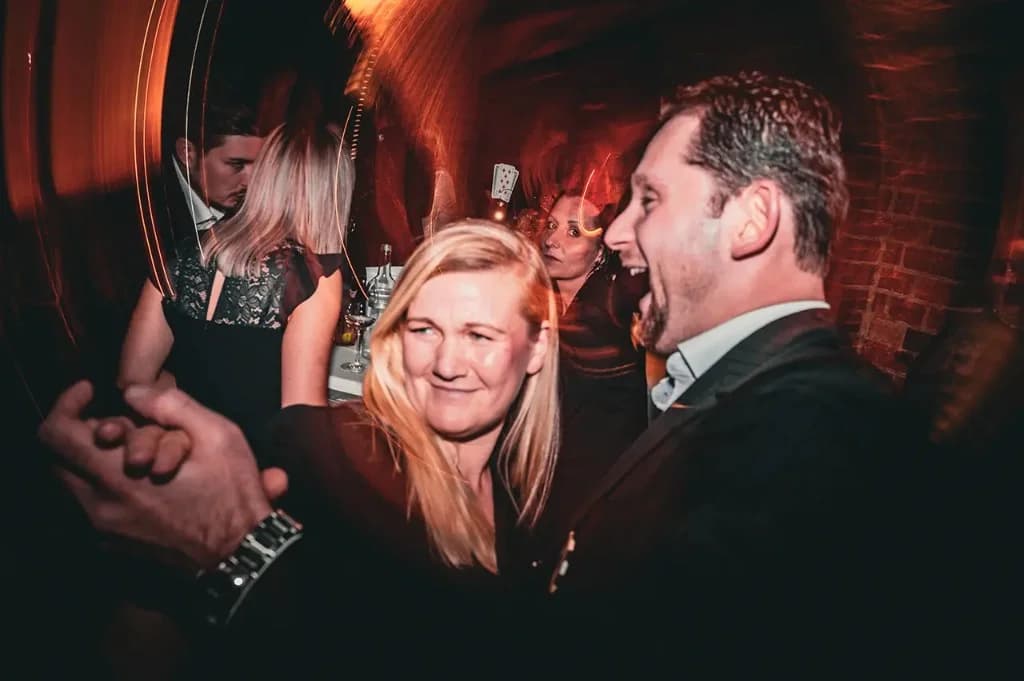
Event photography in difficult light — exposure triangle in practice
Events: Open aperture, short shutter, high ISO — and often flash as a fourth variable.
08
Control

Reading the histogram and understanding metering

The histogram is your exposure compass. It shows brightness distribution: left = dark tones, right = bright tones. A "bell-shaped" histogram with data in the middle is often correctly exposed — but not always.

Histogram to the left
Underexposed — too dark. More light: longer time, wider aperture or higher ISO.
Histogram to the right
Overexposed — too bright. Less light or exposure correction -1 EV.
Clipping on the right
Highlights blown — not recoverable, even in RAW. Better slightly underexpose (avoid ETTR on high-contrast scenes).
Black subject
Histogram may sit left — otherwise the camera turns black to grey.

Camera metering modes

  • Matrix/evaluative metering — measures whole scene, default for 90% of shots
  • Center-weighted metering — weights image centre, good for backlit portraits
  • Spot metering — measures small point (1–5%), precise for studio and difficult light
  • Incident metering — measures on middle grey; systematically off with snow and black subjects
09
Mistakes

The 6 most common mistakes

Only thinking about brightness
Open to f/1.4 because it's dark — and wonder why only the nose is sharp. Creative priority first, then compensation.
ISO as first solution
ISO 12,800 when flash or longer shutter with tripod was possible. ISO is the last reserve.
Blind trust in 1/focal length
With tele and high resolution it's not enough. One stop faster than shaky.
Auto in difficult light
Snow, black clothing, backlight — auto fails. Exposure correction or manual.
Ignoring histogram
Looks fine on display — blown on computer. Check histogram after every important series.
Switching to M too early
Manual without understanding the triangle frustrates. Start with A/Av, learn connections, then M.
10
Training

5 exercises for the exposure triangle

Understanding comes from doing. These five exercises I've run countless times in workshops.

Exercise 1: One stop
Shoot the same subject at f/2.8, f/4, f/5.6, f/8 — same exposure by adjusting shutter. Compare depth of field.
Exercise 2: Feel motion
Shoot a moving tram at 1/30, 1/125, 1/500, 1/1000 s. When is it sharp, when blurred?
Exercise 3: Find ISO limit
Shoot at ISO 100, 800, 3,200, 6,400, 12,800 — same scene. At what value is noise unacceptable for you?
Exercise 4: Manual for a week
7 days M mode only. Choose aperture, shutter, ISO yourself. After a week the triangle sits.
Exercise 5: Master backlight
Portrait against the sun. Start matrix, then centre-weighted, then spot on face. Compare exposure.

More fundamentals in Take Better Photos and for beginners Camera for Beginners. Composition: Golden Ratio.

11
FAQ

Frequently asked questions

What is the exposure triangle in simple words?
Three settings — aperture, shutter speed and ISO — together determine how bright your photo is. Change one value and you must adjust another to keep the same brightness. Each parameter has side effects: depth of field, motion, noise.
Which setting matters most?
None — it depends on the subject. Portrait: aperture first. Sport: shutter first. Dark location: ISO or flash. The question is always: what is my creative priority?
Do I have to use manual mode?
No. A/Av (aperture priority) with Auto ISO is ideal for most situations. Manual pays off in studio, on tripod and when you want full control. The mode matters less than understanding the triangle.
What's the difference between exposure triangle and exposure correction?
The exposure triangle describes aperture, shutter and ISO. Exposure correction (±EV) is a quick control in auto modes that makes the camera exposure brighter or darker — without touching all three parameters individually. Details: Exposure Correction.
At what ISO does it get too noisy?
Depends on camera and sensor. Full frame often still usable at ISO 6,400, crop critical from ISO 3,200. Do Exercise 3 from this guide — find your personal limit.
How do I expose correctly in snow?
The camera underexposes snow (meters for grey). Fix: +1 to +2 EV exposure correction or manually one stop brighter. Check histogram — right side should have data without clipping.
Transparency notice: This article contains affiliate links. If you buy through them I earn a small commission at no extra cost to you. Editorial content is unaffected.
Newsletter

Stay in the loop.

Camera and photography news, honest gear tests and new articles — in your inbox. Infrequent but relevant. No spam, unsubscribe anytime.

Keep reading

From the journal.

Fotograf, Martin Fernando Mera Kleinheinz · Franz-Bork-Straße 21, 30163 Hannover · 0179 4085297