Is the Zf worth it in 2026 — and when do the Z6 III or Z5 II fit better?
Author
Martin Kleinheinz
Photographer · Content Creator · Hannover
Updated
September 1, 2026
You’re googling “Nikon Zf” because you want retro full-frame: dials instead of a menu marathon, a body that feels like a classic camera — and still modern focusing, stabilization and full-frame character. You don’t want to “somehow replace a DSLR.” You want a camera that slows you down and still keeps up when faces, eyes and subjects move.
Plain English: the Nikon Zf is an experience body with the brain of a current Nikon generation — EXPEED 7, subject autofocus (same family as the Z5 II), IBIS (stabilization in the body against shake) and deliberate extras like mono and pixel shift. The crux is often not image quality, but intent: street pricing often sits near the Nikon Z6 III. If you want events and hybrid, the modern box is often more honest. If you need high-res and crop, look at the Nikon Z8. And if you mainly want “always with you” and a fixed compact vibe: Fujifilm X100VI — different system, different job.
00
Short
Is the Nikon Zf worth it in 2026? The short verdict
Short version: the Nikon Zf is the camera I’d recommend in 2026 when you want retro full-frame as an experience — classic dials, mono look, deliberate photography — and still need a modern autofocus brain. New typically $1,800 to $2,200, anchor often around $2,000. On top come a lens, memory card and batteries. Plan that from day one.
What you get: a full-frame sensor (larger than a smartphone and many APS-C cameras — more control over blur and often more reserve in low light) with about 24 megapixels, EXPEED 7, strong subject autofocus, IBIS, mechanical dials for shutter speed, ISO and exposure compensation, a real monochrome mode and pixel shift for high-detail still scenes. What you honestly have to plan for: the flat grip (with large lenses often grip accessories), the second card slot as microSD (not classic dual-SD backup) and the fact that the price often sits near the Z6 III — then intent decides, not the specs line.
If you want events, pace and serious hybrid video: [Z6 III](/en/nikon-z6-iii-review/). If you want to save on the body and need two real SD slots: Z5 II. If you need crop and high-res: [Z8](/en/nikon-z8-review/). If you want a compact camera with a fixed focal length and street vibe: [X100VI](/en/fujifilm-x100vi-review/). Sensor sizes: Crop sensor vs. full-frame.
Top 3
My three recommendations
The Nikon Zf is my recommendation when you want retro full-frame with dial feel, mono and modern autofocus — typically around $1,800 to $2,200, anchor often near $2,000. The Nikon Z6 III fits when you’d rather spend a similar or slightly higher body budget on modern hybrid, a deeper grip and stronger video — full detail in the Nikon Z6 III review. The Nikon Z5 II is the pick when you want to stay clearly under about $1,700 on the body and need two real SD slots, without the retro premium.
Vergleich
Nikon
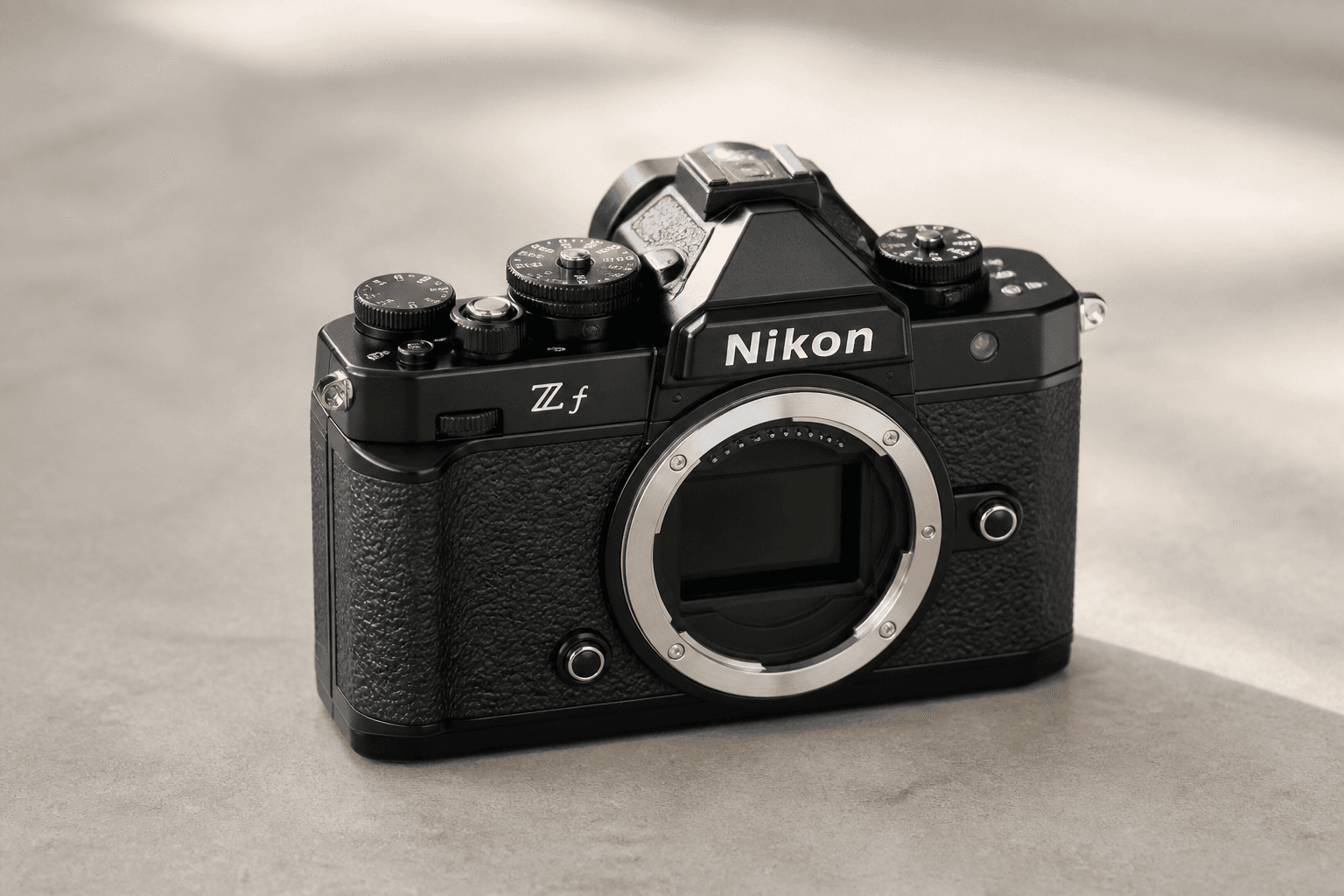
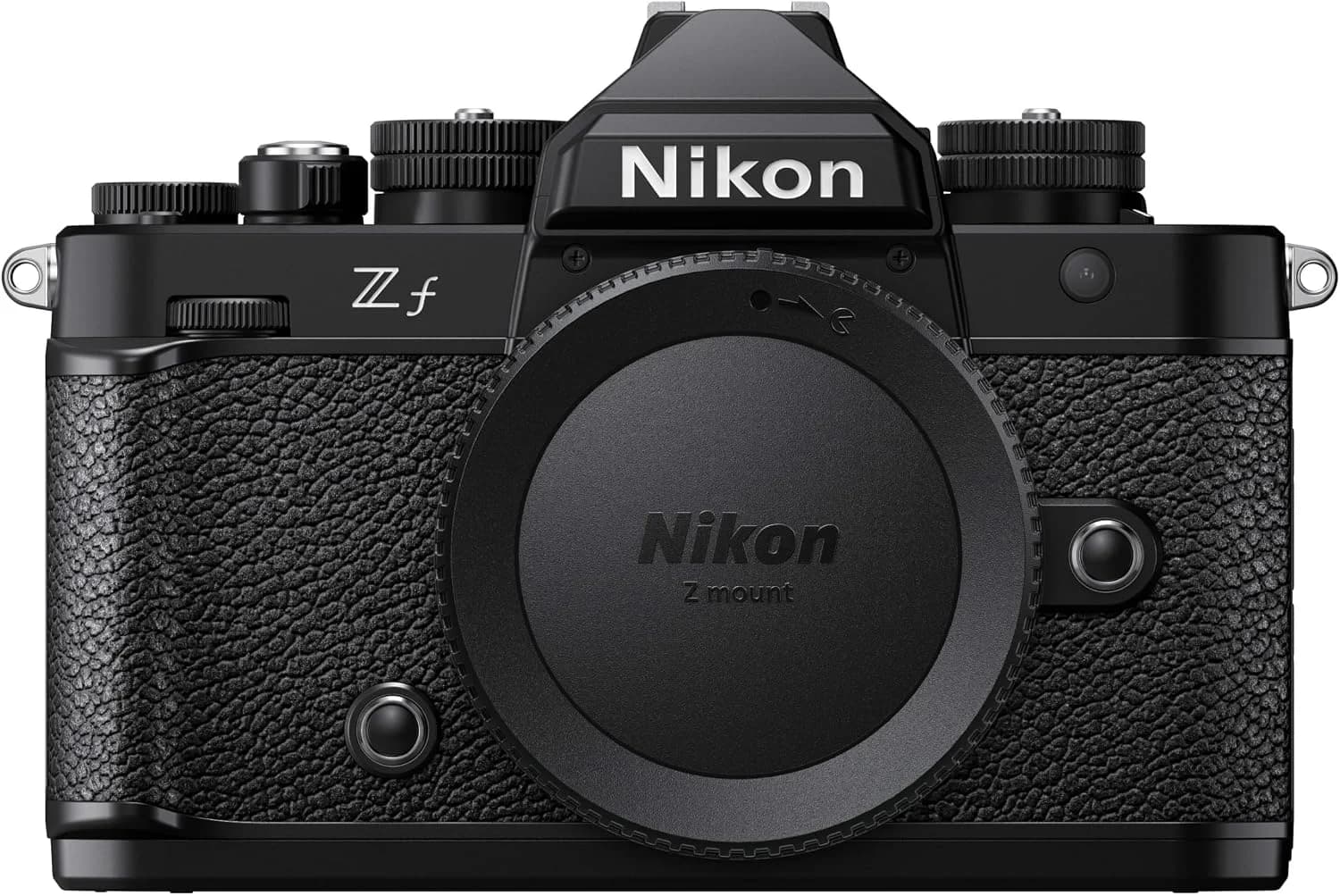
Nikon Zf (body)
Nikon
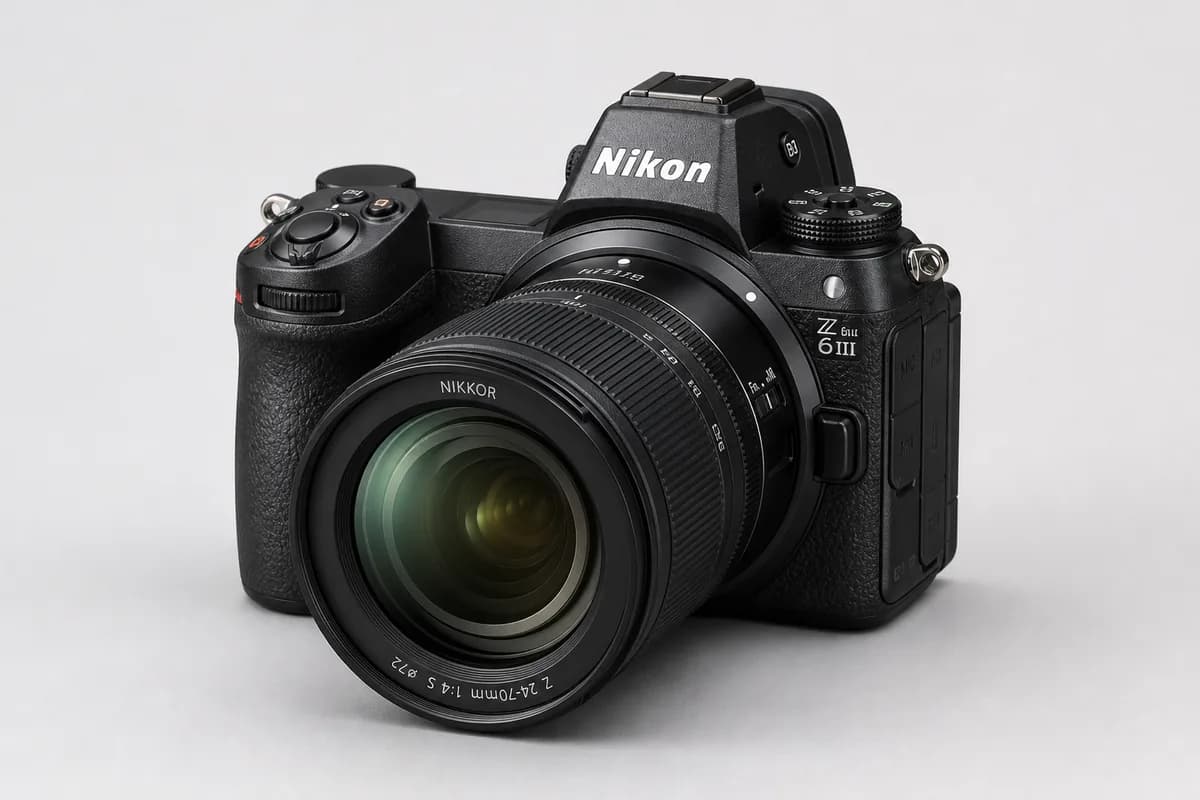
Nikon Z6 III (body)
Nikon
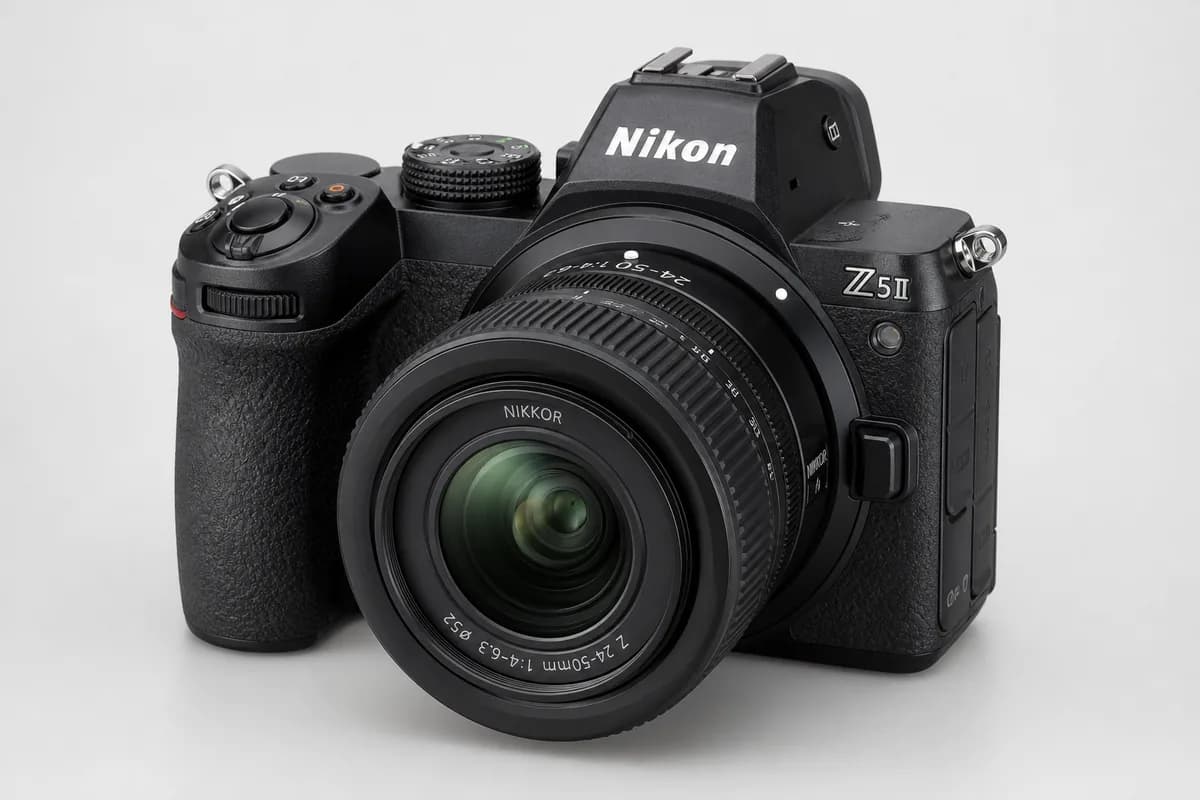
Nikon Z5 II (body)
Bild
Empfehlung
Editor’s pick
Upgrade
Alternative
Sensor
Full-frame · ~24 MP
Full-frame · ~24 MP · hybrid pace
Full-frame · ~24 MP
ISO-Bereich
EXPEED 7 (modern AF brain)
strong IBIS in the body
EXPEED 7 · subject AF
Autofokus
in-body IBIS (against shake)
strong hybrid · 6K path
4K everyday · not Z6 III hybrid
Detail
Dial controls · mono mode
CFexpress B + SD
2× SD UHS-II
Stärken
+Retro experience with real dials — feels like photography
+Strong subject autofocus (same generation as Z5 II)
+IBIS helps visibly in low light and handheld
+Mono mode and pixel shift for deliberate still jobs
+Full-frame character without high-res ballast
+Hybrid peak of the class: pace, AF, video, EVF
+Deep grip — calmer on long days
+Dual slot CFe-B + SD — real backup
+Articulating screen and workflow for events and clips
+Clearly cheaper than Zf and Z6 III
+Same AF family of the EXPEED 7 generation
+Two real SD slots — simple backup
+Solid stills all-rounder without a retro premium
Schwächen
−Flat grip — large lenses often need grip accessories
−Second slot is microSD — not classic dual-SD backup
−Price often near the Z6 III — intent must be clear
−Not the hybrid pace or video level of the Z6 III
−Less “classic camera” feel than the Zf
−No mono-dial experience of the Zf
−Often a similar or higher price — you pay for hybrid, not retro
−EN-EL15c gets tight on hybrid days — plan spares
−No dial-retro and no mono experience of the Zf
−Not the hybrid level of the Z6 III
−Less “special” camera aura
−Less burst and video headroom
Geeignet für
Street, portrait, everyday and deliberate still photography — when you want retro and mono and accept the flat grip.
Events, hybrid photo+video and Nikon everyday use where pace and handling beat dial aesthetics.
Photo-focused Nikon buyers who want AF and dual SD — without a retro or hybrid premium.
In the rest of this article I’ll explain the terms, the everyday use and especially the flat grip, microSD honesty, same AF brain as the Z5 II and when the X100VI is smarter — so you don’t just think “Zf looks cool,” but know which job it actually does.
01
Audience
Who the Zf really fits
Before we talk pixel shift and HEIF: the most important question is whether you want a camera that makes you deliberately slower — or one that carries you through events and hybrid days. The Zf feels like a classic camera idea with a viewfinder, dials and a body that gets attention. You shoot through an EVF (electronic viewfinder at the eye) and a screen. For many people that’s the jump from a smartphone into “real” photography — and for some it’s the moment they realize they actually needed a more modern hybrid box.
It fits well when you shoot street, portrait, everyday, light travel and documentary still jobs and want the camera’s character as much as the files. You like ISO, shutter speed and compensation on a dial. You want black and white straight out of camera. You accept that the grip is flatter than a classic pro box. It fits poorly when your main job is long event days, fast hybrid video and a deep grip — then the Z6 III is more honest. Also a poor fit: when you only want “retro” and actually need a pocket camera with a fixed focal length. Then the X100VI is often the smarter vibe — without Z-system and lens budget.
Fit by practice and user consensus — as of September 2026
If you’re unsure whether full-frame is needed at all: for street, web and typical deliveries, APS-C is often enough. I explain the difference here: Crop sensor vs. full-frame. And if you’re thinking “which camera feels like photography without a backpack?”: the Zf is a system camera. The X100VI is a compact with a fixed focal length. Both can feel “magical” — but everyday use is different.
A typical scenario: you shoot city, people, travel and portraits. You want dials, mono and the feeling that the camera makes you think — without autofocus reacting like 2015. Then the Zf is often exactly right. Another scenario: you’re on a wedding for eight hours, shoot trailers, switch between wide and portrait and want a grip that doesn’t slip. Then the Z6 III is more honest — not because the Zf is “weak,” but because the job is different.
And a third scenario I see often: you want “finally the Zf,” but while reading you realize you actually want a small camera with one focal length and don’t want to build a Z system. Then don’t buy a Zf for Instagram reasons. The X100VI often makes you happier in street everyday life — and saves you lens chaos. A system switch and a fixed focal length are one deal. The Zf is a different deal: retro body plus interchangeable lenses.
02
Understand
What the tech means — without datasheet vibes
Here come the numbers — explained so you know what they mean for you. The three cameras in this review do related but different jobs. If you’re coming from a smartphone or an entry camera, some terms are new. So I’ll translate them once — after that, the everyday consequences are enough.
Full-frame and about 24 megapixels: Full-frame means: the sensor is larger than on many APS-C and smartphone cameras. Practically you often get more control over the background (blur) and more headroom in low light — details in the Crop sensor vs. full-frame guide. About 24 megapixels means: enough detail for web, social, most prints and deliveries — without high-res ballast. If you want extreme crops and huge prints, lean toward the Z8 with 45 megapixels.
EXPEED 7 — the modern brain: The processor drives autofocus, the image pipeline and features. That means for you: the Zf isn’t “only a retro shell with old guts.” Subject recognition for people, animals and vehicles, fast tracking, modern still extras. Important and honest: the AF brain sits in the same generation as the Z5 II. So with the Zf you’re not automatically buying “better AF” than the value sibling — you’re mainly buying experience, handling and character.
IBIS (In-Body Image Stabilization): Stabilization in the body against shake. Practically: in low light and at longer shutter speeds you save more handheld shots. Handheld video also feels calmer — no substitute for calm technique or a gimbal on extreme walk-and-talks, but a big everyday helper. The Z6 III is strong here too; the difference is less “whether IBIS” and more the hybrid package as a whole.
Pixel shift and HEIF — plain English:Pixel shift means: the camera shifts the sensor slightly and combines several frames into one image with more detail and often cleaner color — useful for still life, product and architecture on a tripod. Not for sports and street. HEIF is a modern image format alongside JPEG: often more efficient files at high quality — practical when your workflow and devices support it. Otherwise stick with RAW/JPEG and skip the format drama.
Card slots, honestly: The Zf has SD plus microSD. That means for you: there is a second slot — but not the classic “two full-size SD cards for backup” many event photographers want. microSD is tiny, easy to lose and often unfamiliar in the workflow. The Z5 II has two real SD slots. The Z6 III has CFexpress Type B + SD — for high load and video often the more professional idea. Orientation: Best SD card for camera.
Flat grip — physics, not a taste judgment: The Zf is built flatter than a classic event box. With small primes that often feels right. With heavy zooms or long portrait lenses the balance changes — many then add grip accessories. That isn’t a dealbreaker, but a cost and weight factor specs pages like to skip.
Topic
Zf
Z6 III
Z5 II
Resolution (plain)
≈24 MP — often plenty
≈24 MP — hybrid pace
≈24 MP — value all-round
Character
Retro · dial · mono
Modern hybrid
Classic Z body
AF generation
EXPEED 7 · subject AF
EXPEED 7 · hybrid strong
EXPEED 7 · same family
Grip
Flat — check accessories
Deep · event-ready
Classic modern
Cards
SD + microSD
CFexpress B + SD
2× SD
Video
Good · supporting role possible
Strong hybrid · 6K path
4K everyday
Job
Retro full-frame experience
Modern hybrid
Value full-frame
Price approx. (US 2026)
$1,800–2,200 (anchor ~$2,000)
$2,200–2,500 (anchor ~$2,300)
$1,400–1,700 (anchor ~$1,500)
Three philosophies at a glance — as of September 2026
If you remember the table, that’s almost enough for the buying decision: retro experience with a modern brain → Zf. Modern hybrid and events → Z6 III. Value with dual SD → Z5 II. High-res → Z8. Compact vibe → X100VI.
03
Everyday
How the Zf really feels
Datasheets rarely tell you whether you’ll happily carry the camera all day. That’s what decides whether it makes pictures — or sits in a cupboard. The Zf feels like a grown-up full-frame camera with character: metal feel, dials, viewfinder at the eye, a body people comment on. With a battery it has real presence in the hand — often lighter in the mind than an event box, but clearly a tool and not an impulse gadget.
You work through the EVF and the screen. In harsh sun the viewfinder saves you. The dials for shutter speed, ISO and exposure compensation are the real point: you set things instead of tapping through menus. Coming from a smartphone takes a short adjustment — and you often gain exactly the slowdown that makes better pictures. Coming from a Nikon DSLR, the numbers feel familiar, but you still have to feel the flat grip and the electronic world.
Day to day you notice the character less as “wow in the viewfinder” and more in the pace of your decisions: ISO on a dial, shutter on a dial, mono switched on deliberately. That’s therapy against autopilot — and also a risk if you shoot hectic events and prefer a modern layout with a deeper grip. Then the Z6 III isn’t a “more boring camera,” it’s the more honest one.
Flat grip
With small primes often pleasant and “classic.” With heavy zooms and long portrait glass, balance and hold become a topic. Grip accessories help — they cost money and change the silhouette. Try that honestly with your planned glass, not body-only in the store.
SD + microSD
Second slot is there — but microSD. For many that’s fine (overflow, small backup idea). For event backup with two full-size cards, less ideal. Then check Z5 II (2× SD) or Z6 III (CFe + SD). See Best SD card for camera.
EN-EL15c battery
Familiar Nikon Z battery family. For long days with viewfinder and bursts I plan a spare. One battery rarely covers a full event day. Think USB power where possible.
Z-mount and adapters
Native Z lenses are the modern path. Many F lenses keep running via adapter — good for switchers. Still plan at least one strong all-round or portrait lens from day one.
In reviews and user reports I hear the same theme again and again: design, dial feel, mono, AF and IBIS get praised — grip and microSD get criticized. That matches what I see. The Zf isn’t a compromise camera “somehow max everything hybrid.” It’s a clear decision for experience and character — with honest limits on handling and card slots.
If you’re coming from a smartphone, plan handling honestly too: the Zf rewards you when you carry it often, understand the dials and use them — not when it waits “for later” in a cupboard while the phone keeps doing everything. And if you only want “retro” as a look without thinking lenses and workflow through, you underestimate the package.
04
Image
Image and video: what you really notice
Many people buy the Zf not for a specs line, but because the files deliver full-frame character and the camera feels right while shooting. In decent light with good glass you notice full-frame as calm and reserve — not as a magic look button. The look still comes from light, lens and editing. Mono out of camera is a real style tool here — not a filter gimmick when you use it deliberately.
In video you mainly notice: the Zf can do clips. For light YouTube, Reels, short interviews and event highlights that’s often enough. It is not a hybrid flagship like the Z6 III. That means for you: if video equals photo and you want long takes, higher data rates and calmer hybrid handling, the similar body money is better spent on the Z6 III. If video stays a supporting role, the Zf is plenty for many people.
Versus the Z5 II you mainly gain experience, dial control and character — not automatically a different AF universe. Versus the Z6 III you gain retro and mono feel — and give up hybrid pace, a deeper grip and a CFexpress workflow. Versus the Z8 you stay with manageable 24 MP files and deliberately skip crop extremes. Versus the X100VI you stay in an interchangeable-lens system — more flexible, but heavier and more expensive to build.
◆Street / everyday: dial + mono + full-frame — strong use case
◆Portrait: eye AF and blur — look via glass and light
◆Events: stills strong — grip and hybrid lean Z6 III
◆Content / light YouTube: clips possible — not the hybrid primus
One more word on files and computers: 24 MP RAWs are calmer for most laptops than 45 MP high-res. If you later develop crop hunger, the upgrade topic is more Z8 than “more retro.” Editing orientation: PC for photo editing, Monitor for photo editing.
In practice you notice the Zf’s character less in a single specs line and more in the whole picture: calm portraits, street with dial feel, mono series with intent, clips that “come along,” and handling that either makes you fall in love — or sends you to grip accessories after three event hours. Coming from a smartphone, don’t get blinded by “pixel shift” or “HEIF” — those are tools for clear jobs. What matters: you get enough sensor and AF for serious still work, but no guarantee for hybrid marathons without matching ergonomics.
05
Sharp
Autofocus in everyday use: modern — and related to the Z5 II
Autofocus means: the camera keeps faces and eyes sharp while you move. On the Zf — subject detection in the EXPEED 7 world — that’s one reason it’s taken seriously despite the retro shell. You can shoot street, portrait and everyday without constantly pulling focus by hand. Coming from a smartphone: that’s the difference between “always tapping the display” and “just walk with it and shoot.”
That doesn’t replace good timing and light. In extreme backlight, frantic action or deliberate cinematic rack focus (manual focus pull as a style tool), manual focusing can still help. But for the everyday of many photo jobs, AF here is a real tool — not a retro gimmick with weak guts.
Versus the Z5 II you’re in the same AF family. The difference is less “whether it’s sharp” and more handling, character and price. Versus the Z6 III: both are AF-strong. The Z6 III adds hybrid pace and event ergonomics on top. The Zf stays absolutely confident for portrait and street — as long as you don’t define the job as a sports/event marathon.
Practically that means for solo creators and portrait photographers: you can hold conversations, move and still keep eyes sharp. For street that’s gold. For action, pre-release capture can help catch the moment depending on setup — but if you want extremes, still check Z6 III or Z8. For deliberately slow studio work, manual focus remains a stylistic choice — AF doesn’t take the choice away.
06
Photo
Stills with dials and mono: here is the payoff
Unlike pure video cameras, stills are the Zf’s main job. About 24 megapixels, full-frame, viewfinder, IBIS, dial control and strong AF — that’s the core. You buy experience and control: shutter and ISO on a dial, mono deliberate, pixel shift for still scenes on a tripod. If you need extreme crops and huge prints, 24 MP often gives too little resolution — then lean Z8.
Burst and buffer are strong enough for everyday and portrait as long as you keep realistic expectations. The crux is less “which specs line” and more whether you hit the moment, like the grip with your glass and can still edit the files afterward. Mechanical shutter and quiet options help for reportage and street — depending on the situation.
If you take stills and character equally seriously and want dials + mono: Zf — often the most honest retro full-frame buy in the Z system. If you take photo and video equally seriously and need pace: [Z6 III](/en/nikon-z6-iii-review/). If you only want to save and need dual SD: Z5 II. If you only want street vibe without a system: [X100VI](/en/fujifilm-x100vi-review/).
Practically that means: a portrait series with mono, street everyday with dials, travel with character, a business gallery with full-frame — yes. A camera only because “retro looks cool” while you actually film events and hate the grip — better check whether the Z6 III or the value Z5 II is more honest. Then budget deliberately and invest in glass.
07
Video
Video in everyday use: what the Zf really can do
This is the section where many specs pages either oversell or undersell. The Zf is not a pure cinema flagship — and it doesn’t have to be. It’s a photo-first body with usable video: 4K for content and short takes, Log/color room depending on setup, IBIS for handheld shots, and handling you mainly operate while shooting stills.
Plain English for you: short and medium takes — light interviews, B-roll, social clips, event highlights — run fine for many users day to day. Long hybrid sessions, maximum data rates, relaxed event video — then the Z6 III is often the more honest box. A video-first camera can be even calmer for pure cinema jobs. The Zf stays strong as long as your job is photo and video comes along.
Why mention the grip again here? Because handheld video lasts longer than a street snapshot. Flat grip plus heavy glass gets tiring. IBIS helps. External power and spare batteries aren’t optional on hybrid days — they’re part of the setup.
◆Everyday content: 4K, manageable takes — usually fine
◆Light event clips: possible — Z6 III often calmer
◆Handheld: IBIS helps — check grip and gimbal
◆Maximum hybrid: lean Z6 III
◆Cinema-only: lean a video-first box
Practical tips without drama: match resolution to the job, external mic from day one, strong cards, pauses between takes where needed, and honestly check whether you need a hybrid body at all. Many people who google “video” later upload short clips — and could have skipped the hybrid premium.
If after this section you think “my clips are short, stills are the main job, I want dials” — stay calm with the Zf. If you think “I film and shoot equally” — then this section is your hint toward the Z6 III. If you think “I don’t want a system at all” — then the X100VI is often smarter.
08
Honest
Honest limits — what the Zf is not
Every camera gets rated unfairly when you expect the wrong job. The Zf has clear limits — and you should know them before buying, not after.
No deep event grip out of the box: With large lenses often accessories. No classic dual SD: Second slot is microSD. No hybrid primus: The Z6 III is more honest here. No high-res: 24 MP — crop extremes lean Z8. No “body alone and done”: Z glass and batteries cost. No automatic AF win over the Z5 II: same family. No pants-pocket compact: If you only want vibe without a system, check X100VI.
Then there’s the expectation trap of “retro means better”: since character bodies arrived, modern hybrids can look “boring” on paper. In practice they remain the more honest buy for many — because the Zf premium buys features and feel you may not want on events. Anyone who confuses “pretty” with “better for my job” spends money that would work harder in glass.
If you accept these limits and your everyday is street, portrait, everyday and deliberate still photography: you’re in the right film. If not: Z6 III, Z5 II, Z8 or X100VI — more honest and often cheaper in the end, because you don’t buy wrong.
09
Decision
Zf, Z6 III or Z5 II — which question are you asking?
Many people compare cameras as if there were one objectively best. There are three different questions. The Zf answers: “I want retro full-frame with dials, mono and modern AF — and I accept a flat grip plus microSD.” The Z6 III answers: “I want modern hybrid, pace and event handling — retro is secondary.” The Z5 II answers: “I want full-frame and the same AF family, save on the body and need two real SD slots.”
You need …
Lean Zf
Lean Z6 III
Lean Z5 II
Dial / mono / retro feel
Yes
No
No
Modern hybrid / events
Conditional
Yes
Conditional
Deep grip out of the box
No
Yes
Conditional
Classic dual SD
No (microSD)
CFe + SD
Yes
Value under ~$1,700
No
No
Yes
Same AF family
Yes
Yes (hybrid)
Yes
High-res / crop
→ check Z8
→ check Z8
→ check Z8
Compact vibe, no system
→ X100VI
→ X100VI
→ X100VI
Which question are you really asking? — as of September 2026
If you google “Zf” but actually shoot events and clips all day, you’re often better with the Z6 III — not because the Zf is weak, but because the job is different. If you’d never miss dials, the character body helps little. And if you only want to save: the Z5 II shares the AF family and lets you invest in glass sooner.
Why the Zf still makes sense next to the Z6 III: Because “more modern” doesn’t automatically mean “better for you.” The Zf delivers experience and deliberate control — often at a similar body price. The Z6 III feature jump pays off when you use hybrid and handling. Otherwise you buy pace and video while the money in a second lens or Zf grip accessories would have made more everyday pictures. That’s exactly why the Zf stays my default recommendation in 2026 when the retro intent is clear.
One more honest check: the X100VI answers street vibe with a fixed focal length and no system. The Z8 answers high-res hybrid with crop. Switch systems and jobs only when ecosystem and everyday life truly fit — not because of one specs line or an Instagram look.
If you’re still unsure: write down three real jobs for the next months. Dials and mono needed? Hybrid and events? Is value enough? The camera that covers two of three days calmly is usually right — not the one that sounds “maximally cool” on paper.
10
Comparison
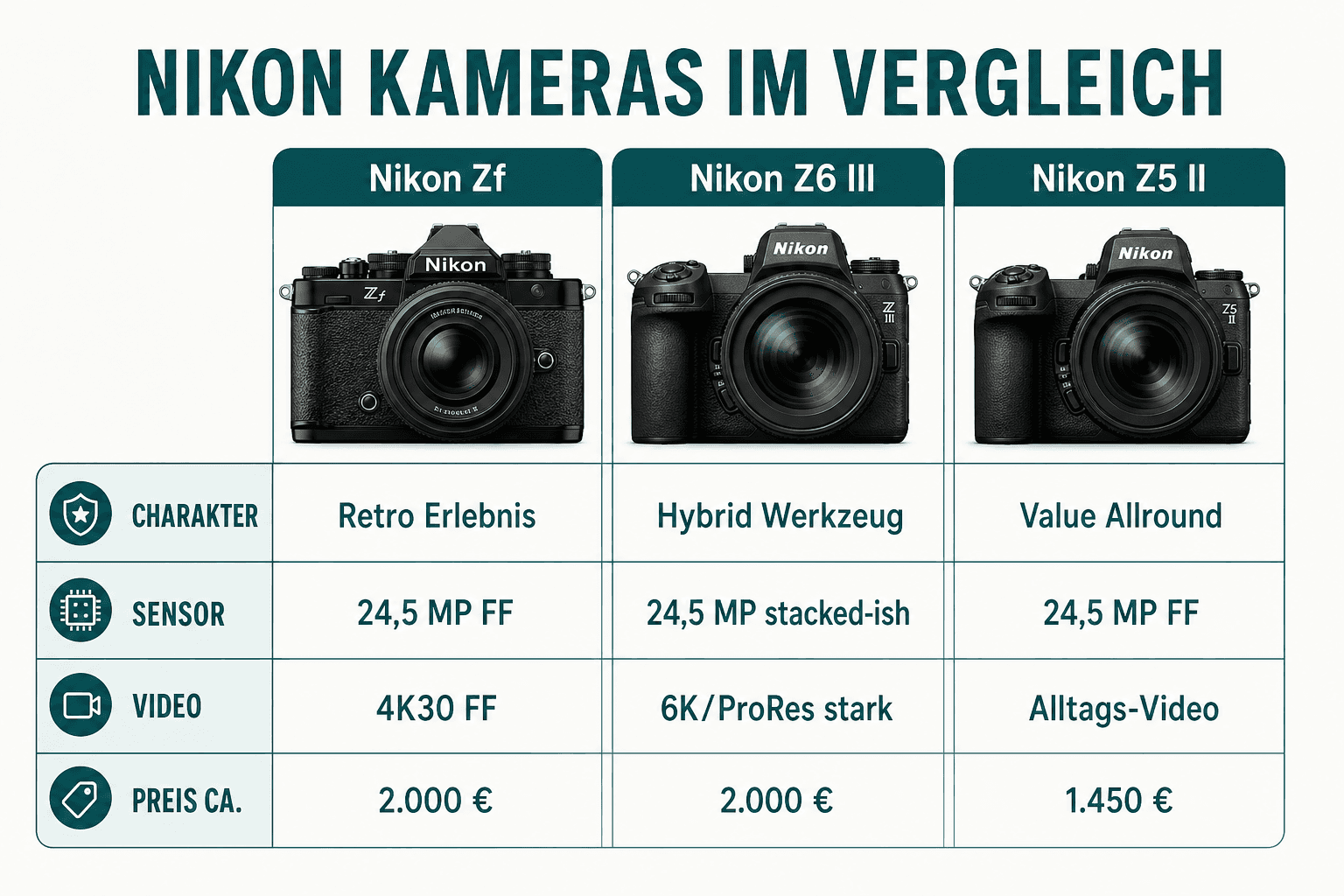
Three cameras at a glance
The graphic and table summarize what you read above. Takeaway: the Zf delivers a retro full-frame experience. The Z6 III pays for modern hybrid. The Z5 II delivers value with dual SD and the same AF family.
Zf vs. Z6 III vs. Z5 II — as of September 2026
Criterion
Zf
Z6 III
Z5 II
Resolution
≈24 MP
≈24 MP
≈24 MP
Character
Retro · dial · mono
Modern hybrid
Value all-round
Grip / slots
Flat · SD+microSD
Deep · CFe+SD
Modern · 2× SD
Video
Good · supporting role
Strong hybrid
4K everyday
Job
Retro experience
Modern hybrid
Value full-frame
Price approx.
$1,800–2,200 · anchor ~$2,000
$2,200–2,500 · anchor ~$2,300
$1,400–1,700 · anchor ~$1,500
As of September 2026 — check prices in the shop
Versus the Z6 III you often don’t save on the body — you choose character over hybrid. Versus the Z5 II you pay for dials, mono and aura — and should honestly check whether you need that day to day. High-res: Z8. Compact vibe: X100VI.
11
Decision
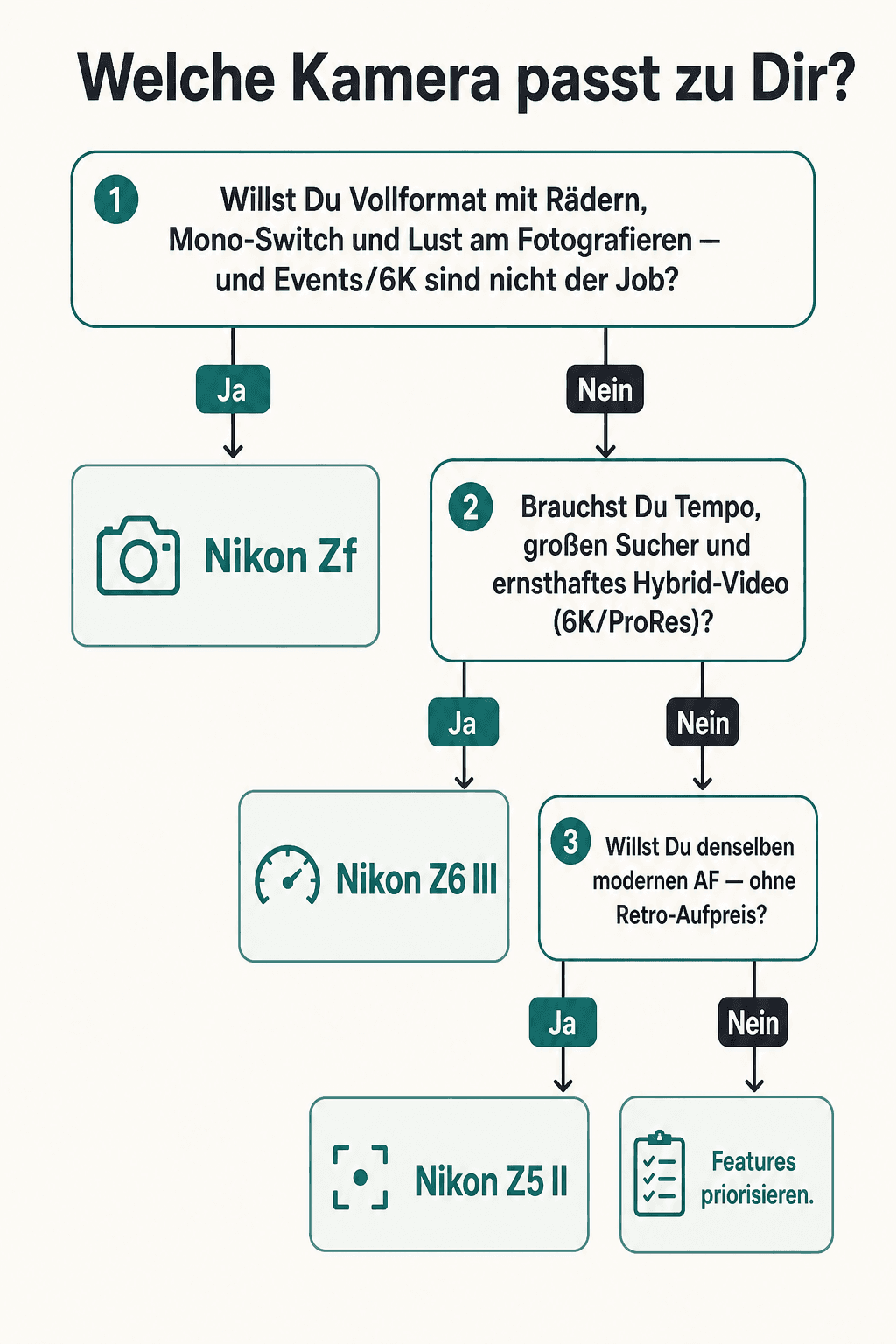
The decision tree: which camera fits you
Walk the questions top to bottom. The first honest answer counts more than any specs line. If you catch yourself between “retro sounds cool” and “I actually film events”: take the hybrid path. A cooler name on the box won’t help you on set.
From use case to camera — as of September 2026
◆Retro full-frame with dials, mono and modern AF? → Nikon Zf
◆Modern hybrid, events, pace, deep grip? → [Nikon Z6 III](/en/nikon-z6-iii-review/)
For most people who deliberately want retro full-frame, use mono and accept the flat grip plus microSD, the path lands on the Zf — typically around $1,800 to $2,200, anchor often $2,000.
12
Detail
Nikon Zf: is the retro full-frame worth it?
After all that, the simple balance: the Zf convinces when you want the job “retro full-frame with dials, mono and modern AF” and neither hybrid marathon nor high-res is your core. It frustrates when you expect dual-SD backup, hate the flat grip or pay a similar price to the Z6 III without really wanting retro.
What convinces
Dial feel, mono, EXPEED 7 AF, IBIS, pixel shift for stills, full-frame character without high-res ballast — typically $1,800–2,200.
What you have to accept
Flat grip (often accessories), microSD as second slot, price often near Z6 III, video as a supporting role, no AF edge over Z5 II in the family.
If that fits you, the Zf is the clear recommendation in this retro full-frame class in the Nikon system in 2026. If not, you’re often happier — and more honest — with Z6 III, Z5 II, Z8 or X100VI.
My practice filter is simple: if after reading you’re still stuck on hybrid events and a deep grip, the Zf probably isn’t your camera. If instead you think “dials, mono, modern brain, full-frame — and body around $2,000,” then you’re exactly right here. Then plan glass, cards and maybe a grip — and get outside.
Editor’s pick
Nikon
Nikon Zf (body)
My pick for retro full-frame with a modern brain
Full-frame camera with classic dials and modern EXPEED 7 autofocus — typically around $1,800 to $2,200, anchor often near $2,000. The honest choice when you want experience, mono and deliberate controls, and you accept the flat grip plus microSD second slot.
Was überzeugt
+Retro experience with real dials — feels like photography
+Strong subject autofocus (same generation as Z5 II)
+IBIS helps visibly in low light and handheld
+Mono mode and pixel shift for deliberate still jobs
+Full-frame character without high-res ballast
Was Du wissen solltest
−Flat grip — large lenses often need grip accessories
−Second slot is microSD — not classic dual-SD backup
−Price often near the Z6 III — intent must be clear
−Not the hybrid pace or video level of the Z6 III
Editor's Statement
“Retro full-frame — when intent, dial feel and mono matter more than hybrid pace”
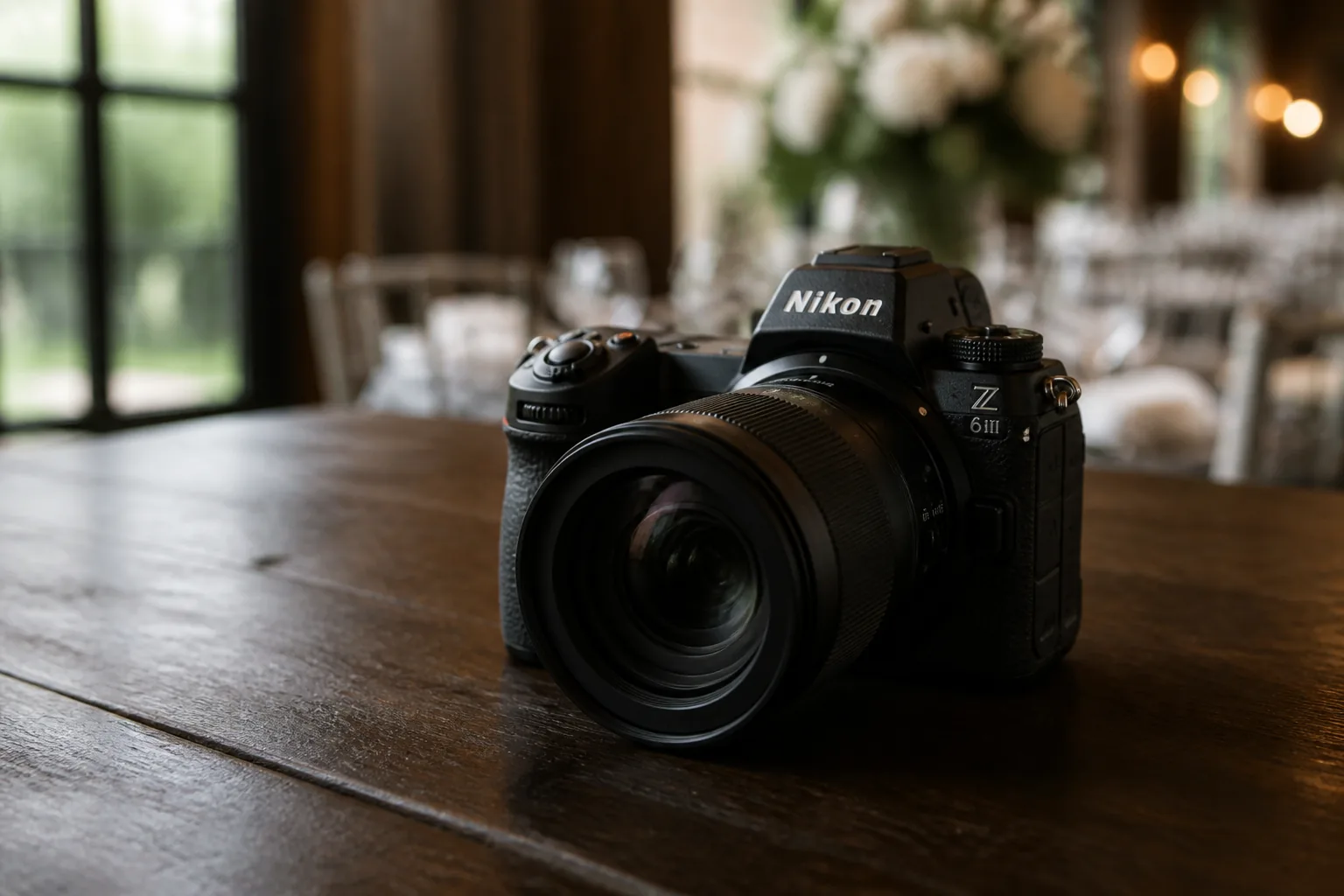
The Nikon Z6 III is the modern hybrid answer — typically often around $2,200 to $2,500, anchor near $2,300. You pay for pace, stronger video, a deeper grip and CFexpress plus SD — not just a different nameplate. Full detail: Nikon Z6 III review.
Pick the Z6 III when events, clips and handling are worth the similar or higher body price — and when you notice that dials and mono slow you down more than they inspire you on the job. Stay with the Zf when character and deliberate control are your everyday and video stays a supporting role.
Both cameras are full-frame in the Z system with about 24 megapixels and modern AF. The difference isn’t “Nikon quality yes/no,” but intent: retro experience versus hybrid tool — often at a related body price. Anyone who buys the Z6 III only because it sounds “more modern” and then shoots slow street as before has often invested at the wrong end. Anyone who buys the Zf and then expects hybrid marathons likewise.
Upgrade
Nikon
Nikon Z6 III (body)
Upgrade — when modern hybrid and pace matter
The modern hybrid answer in the Nikon Z system: stronger video, faster sensor character, deeper grip and CFexpress plus SD. Typically around $2,200 to $2,500. The upgrade pick when events, clips and pace are your everyday — and retro feel is secondary.
Was überzeugt
+Hybrid peak of the class: pace, AF, video, EVF
+Deep grip — calmer on long days
+Dual slot CFe-B + SD — real backup
+Articulating screen and workflow for events and clips
Was Du wissen solltest
−Less “classic camera” feel than the Zf
−No mono-dial experience of the Zf
−Often a similar or higher price — you pay for hybrid, not retro
−EN-EL15c gets tight on hybrid days — plan spares
Editor's Statement
“When photo+video, events and pace matter more than dial-retro”
Nikon Z5 II: when value with dual SD is the smarter idea
The Nikon Z5 II answers a different job: value full-frame with the same AF family — typically around $1,400 to $1,700, anchor near $1,500. You save on the body and get two real SD slots. What you consciously accept: no dial-retro, no mono experience of the Zf and no hybrid level of the Z6 III.
Pick the Z5 II when you want to start or save in the Z system, need dual SD and would never miss retro. Stay with the Zf when dials, mono and character are your reason to buy. Cross-check high-res: Z8. Cross-check compact vibe: X100VI.
Many who google “Zf” land more honestly on the Z5 II — because they actually want full-frame and modern AF and never need character. That can fit. It isn’t a 1:1 substitute. Without dials and mono the experience changes noticeably. That isn’t downgrade talk — that’s intent and practice.
Alternative
Nikon
Nikon Z5 II (body)
Alternative — value with the same AF family
Full-frame with modern EXPEED 7 autofocus and two classic SD slots — typically around $1,400 to $1,700, anchor often near $1,500. The value pick when you want to start or save in the Z system and don’t need retro dials or hybrid premium.
Was überzeugt
+Clearly cheaper than Zf and Z6 III
+Same AF family of the EXPEED 7 generation
+Two real SD slots — simple backup
+Solid stills all-rounder without a retro premium
Was Du wissen solltest
−No dial-retro and no mono experience of the Zf
−Not the hybrid level of the Z6 III
−Less “special” camera aura
−Less burst and video headroom
Editor's Statement
“When you want to stay clearly under ~$1,700 on the body and need dual SD”
The body price is only the start. A realistic Zf setup in the US quickly lands $600 to $2,000 on top — depending on glass, cards, batteries and an optional grip. Anyone who only counts the body underestimates the package. Same for the Z6 III — plus maybe CFexpress. With the Z5 II you save on the body, not on glass.
Lens
No glass, no camera. At least one fast all-round or portrait lens. Z native or F via adapter — but plan quality. The Zf shows character; weak glass stays weak glass.
Memory cards
Strong SD for the main slot. Choose microSD deliberately if you use the second slot — and don’t lose it. For event backup with two full-size cards, lean Z5 II or Z6 III. See Best SD card for camera.
Second / third battery
EN-EL15c. For longer days plan a spare — one battery rarely covers the whole day with viewfinder and bursts.
Grip accessories
Often useful with heavy lenses. Changes handling and silhouette — check with your glass first, don’t order blindly.
Audio and stabilization
External mic for usable sound. IBIS helps — on walk-and-talk still check calmer technique or a gimbal.
Coming from a smartphone, people often underestimate exactly this list. The camera alone doesn’t make a portfolio. Light, audio and a lens that fits the job decide more than the last specs line. Plan the setup honestly — then the Zf stays a strong tool instead of expensive décor in the cupboard.
16
Verdict
The clear buying decision
The Nikon Zf is 2026’s honest retro full-frame buy: dial feel, mono, EXPEED 7, IBIS, about 24 megapixels — a modern brain in a body that feels like photography. Typically $1,800 to $2,200, anchor often around $2,000. You get character without high-res ballast. You don’t get a guarantee of hybrid ergonomics and no classic dual-SD workflow.
That isn’t “Z6 III with makeup” just because the price is related. It’s its own sensible decision for a clear job: deliberate still photography with modern AF, when video stays a supporting role and intent is clear. Respect that and you get a lot of camera for the feel. Expect hybrid at a retro price or buy only the look and you buy disappointed — and that would have been avoidable.
Want modern hybrid: [Z6 III](/en/nikon-z6-iii-review/). Need value and dual SD: Z5 II. High-res: [Z8](/en/nikon-z8-review/). Compact vibe without a system: [X100VI](/en/fujifilm-x100vi-review/). Sensor basics: Crop sensor vs. full-frame. Cards: Best SD card for camera.
17
FAQ
Common questions about the Nikon Zf
Is the Nikon Zf worth it in 2026?+
Yes, if you want retro full-frame with dial feel, mono and modern autofocus — and you accept a flat grip plus microSD. Typically $1,800–2,200, anchor often around $2,000. For modern hybrid and events the Z6 III is often more honest. For value with dual SD the Z5 II fits. High-res: Nikon Z8. Compact vibe: Fujifilm X100VI.
Zf or Nikon Z6 III — which should I get?+
Zf when character, dials and mono are your reason to buy and video stays a supporting role. Z6 III when events, pace, a deeper grip and stronger hybrid video count. Body prices are often related — so intent decides, not the specs line. Full detail: Nikon Z6 III review.
Zf or Nikon Z5 II?+
Zf when you really use dials, mono and the retro experience. Z5 II (around $1,400–1,700, anchor ~$1,500) when you want the same AF family, need dual SD and save on the body. AF is related — with the Zf you mainly buy experience, not automatically “better focus.”
Is it true that the Zf and Z5 II share the same AF family?+
At the core yes: both sit in the EXPEED 7 world with subject autofocus. That means for you: the Zf isn’t an automatic AF win over the value sibling. The difference sits in handling, character, features and price — not in “sharp yes/no” as marketing magic.
How bad is the flat grip really?+
With small primes often pleasant and part of the character. With heavy zooms and long portrait lenses, hold and balance become a topic — many then use grip accessories. Try that with your planned glass. For event marathons the Z6 III is often calmer.
Is the microSD slot a dealbreaker?+
For many street and portrait users no — the main slot is SD, the second is a bonus or overflow. For classic event backup with two full-size SD cards, more yes: then Z5 II (2× SD) or Z6 III (CFexpress + SD) are more honest. Orientation: Best SD card for camera.
What do mono mode and pixel shift give you day to day?+
Mono is a deliberate black-and-white workflow straight out of camera — strong for street and portrait when you stick with it. Pixel shift combines several frames into more detail (still life, product, architecture on a tripod) — not for action. HEIF is a modern image format; use it only with a matching workflow.
Zf or Fujifilm X100VI?+
Different jobs. The Zf is a full-frame system camera with interchangeable lenses and dial-retro. The X100VI is a premium compact with a fixed focal length, viewfinder and street vibe — often the smarter pick when you don’t want to build a system and want maximum “always with you.” Cross-link: Fujifilm X100VI review.
Is the Zf enough for YouTube and content?+
For short and medium clips yes — with good glass, light and an external mic. For hybrid everyday use with long takes and event video the Z6 III is often calmer. IBIS helps handheld, but doesn’t replace a concept or grip comfort.
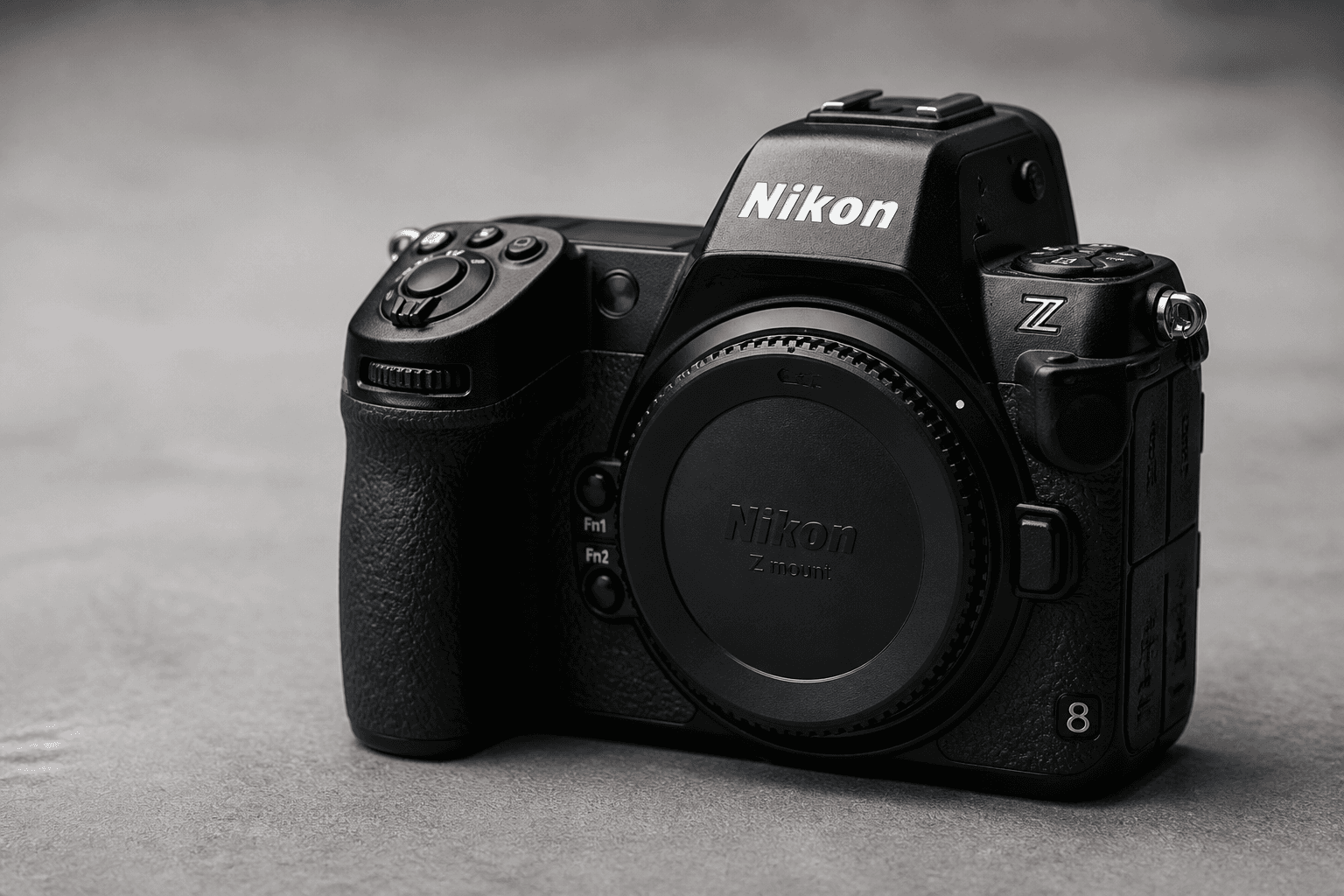
When do I need the Nikon Z8 instead?+
When you want crop reserve, large prints and high-res hybrid — 45 megapixels instead of about 24. The Zf stays with manageable files and the retro experience. Full detail: Nikon Z8 review.
Is the Zf good for beginners?+
Technically usable — financially and as a setup it’s a grown-up package: body, glass, cards, batteries, maybe a grip. Many beginners learn faster and cheaper with the Z5 II and put the rest into lenses and practice. The Zf rewards you when you already know the character job or deliberately work toward it.
Body only or with a lens — what should I buy?+
If you don’t have Z or adaptable F glass yet: plan a usable lens from day one, otherwise you own a pretty box with no pictures. Body-only makes sense when you already have glass or deliberately pick a specific Z lens separately. Better Zf plus good glass than a retro shell with a compromise lens.
Affiliate links marked with * — Amazon product links use partner ID martinkleinhe-20. I earn a small commission if you buy through these links; it costs you nothing extra. Assessments are based on my own practice, manufacturer specs and the consensus from reviews and user reports — no brand sponsored this article.
◆ Newsletter
Stay in the loop.
Camera and photography news, honest gear tests and new articles — in your inbox. Infrequent but relevant. No spam, unsubscribe anytime.