Nikon Z6 III Review: Nikon Z6 III for Events and Hybrid
Which Nikon is worth it in 2026 for events and photo/video — and when the Z5 II or Sony A7 IV is enough?
Author
Martin Kleinheinz
Photographer · Content Creator · Hannover
Updated
August 28, 2026
You’re looking for a full-frame camera that takes photo and video seriously — for events, reportage or content where both matter. The Nikon Z6 III is built for exactly that: fast autofocus, strong video, a bright viewfinder and dual card slots. Typically you’re looking at about $2,200 to $2,500 for the body alone.
Next to it sit two alternatives that come up in the same breath: the cheaper Nikon Z5 II (roughly $500–800 less) when you mainly shoot stills — and the Sony A7 IV if you’re already on Sony or want more megapixels and dynamic range. I’ll only mention the Z8 briefly: it makes sense when you truly need 45 megapixels and 8K — otherwise it’s too much camera.
Here you get a clear buying call from practice, manufacturer specs and what reviews and user reports agree on in 2026. Fit table, tech, handling, image quality (including dynamic range explained honestly), autofocus, video, direct comparison and a decision tree. Weighing APS-C instead of full frame: Sony A6700 review. By the end you’ll know which camera fits your job.
00
Short
Is the Nikon Z6 III worth it in 2026? The quick verdict
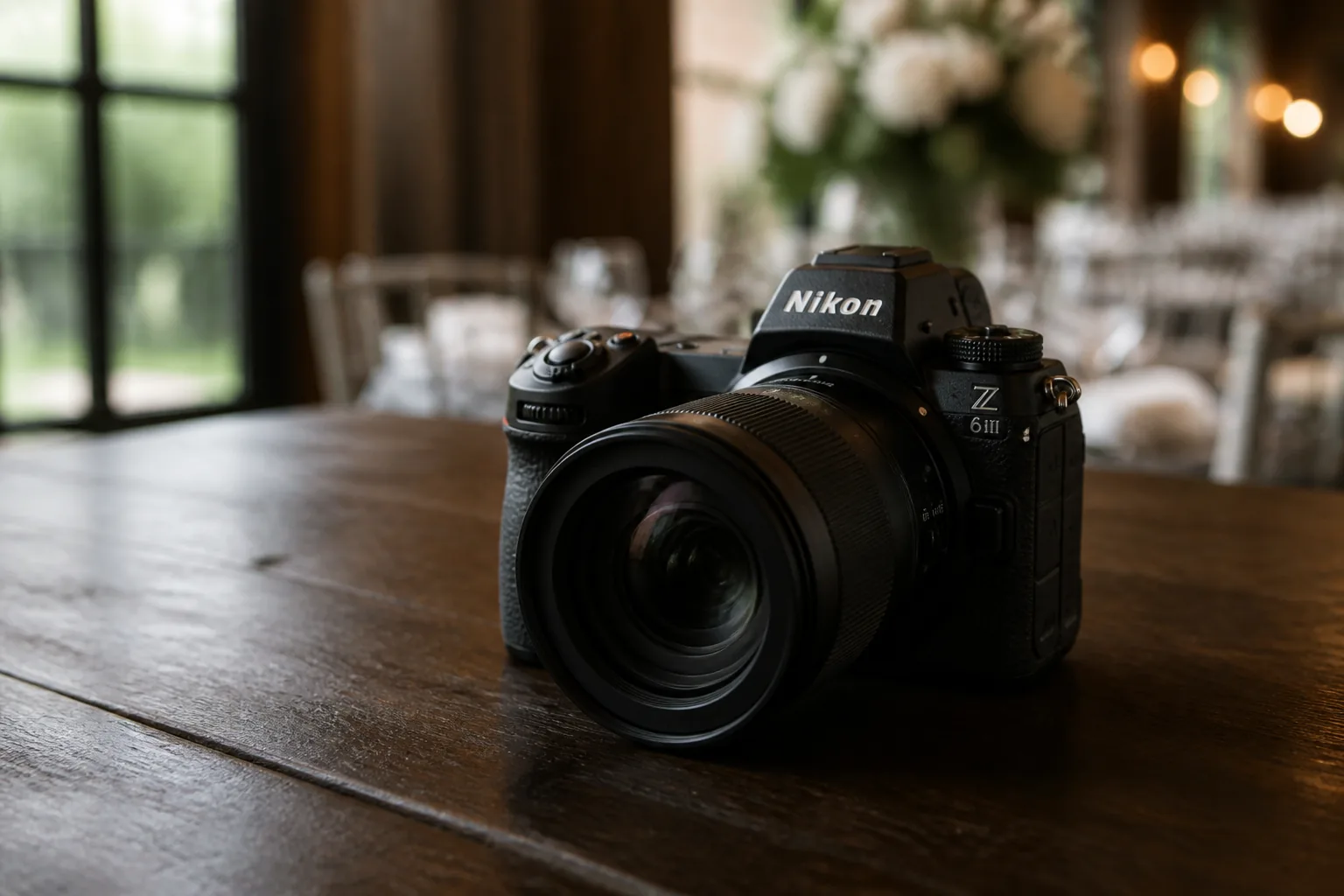
Short version: the Z6 III is the Nikon I’d put in my hands for events and hybrid jobs. It’s fast in autofocus, strong for video and has a genuinely good viewfinder — for that you typically pay about $2,200 to $2,500 for the body alone.
On the tech side you get 24.5 megapixels full frame, modern autofocus, in-body stabilization, burst up to 20 fps in RAW, strong video including 6K/ProRes and 4K/60, plus dual card slots. The body weighs about 760 g — noticeable, but everyday-usable.
The Z5 II often sits around $1,400–1,700 and stays in the same Nikon system: strong autofocus, dual SD cards — but without 6K and without the Z6 III’s speed. The Sony A7 IV (about $2,000–2,400) is the alternative if you’re already on Sony or want 33 megapixels and more dynamic range. Different system — not automatically “better.” The Z8 only if you truly need 45 megapixels and 8K.
Top 3
My three recommendations
**#1 Nikon Z6 III** — when photo and video, events and speed matter in the Nikon system. **#2 Nikon Z5 II** — when you mainly shoot stills and want to save $500–800. **#3 Sony A7 IV** — when you’re already on Sony or prioritize more resolution and dynamic range.
Vergleich
Nikon
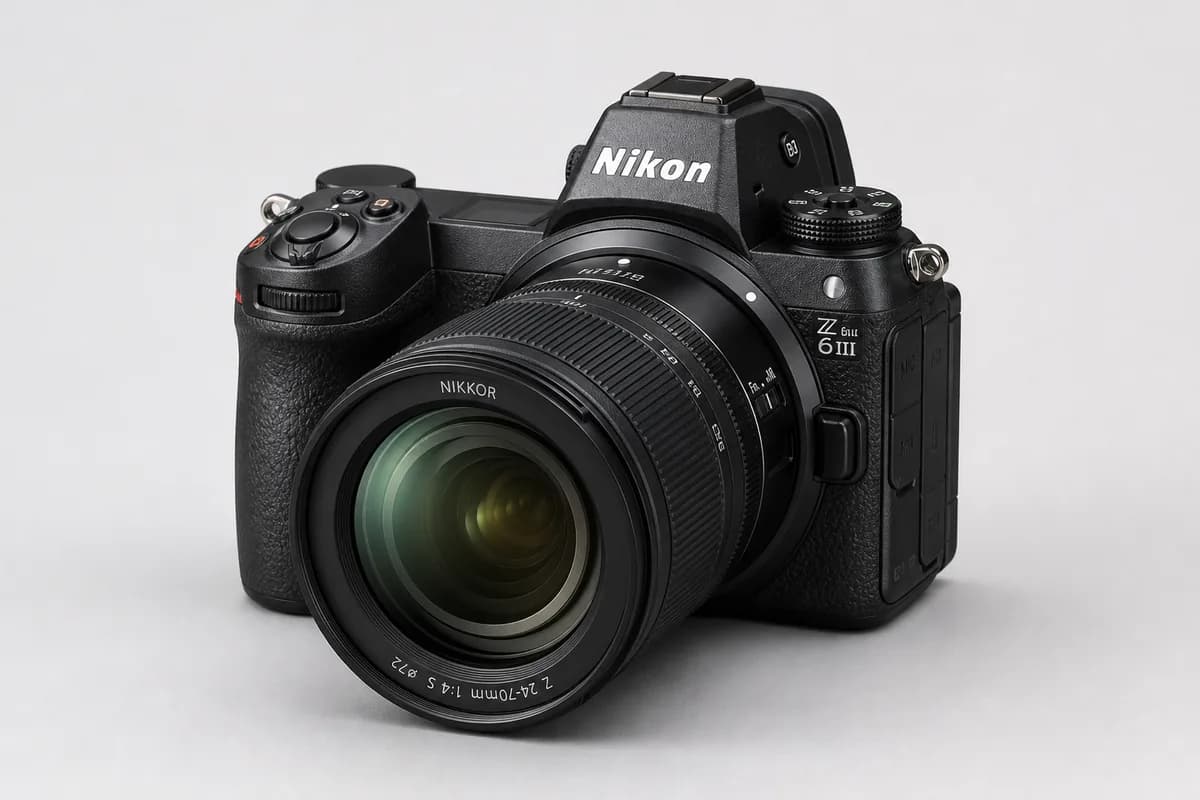
Nikon Z6 III (body)
Nikon
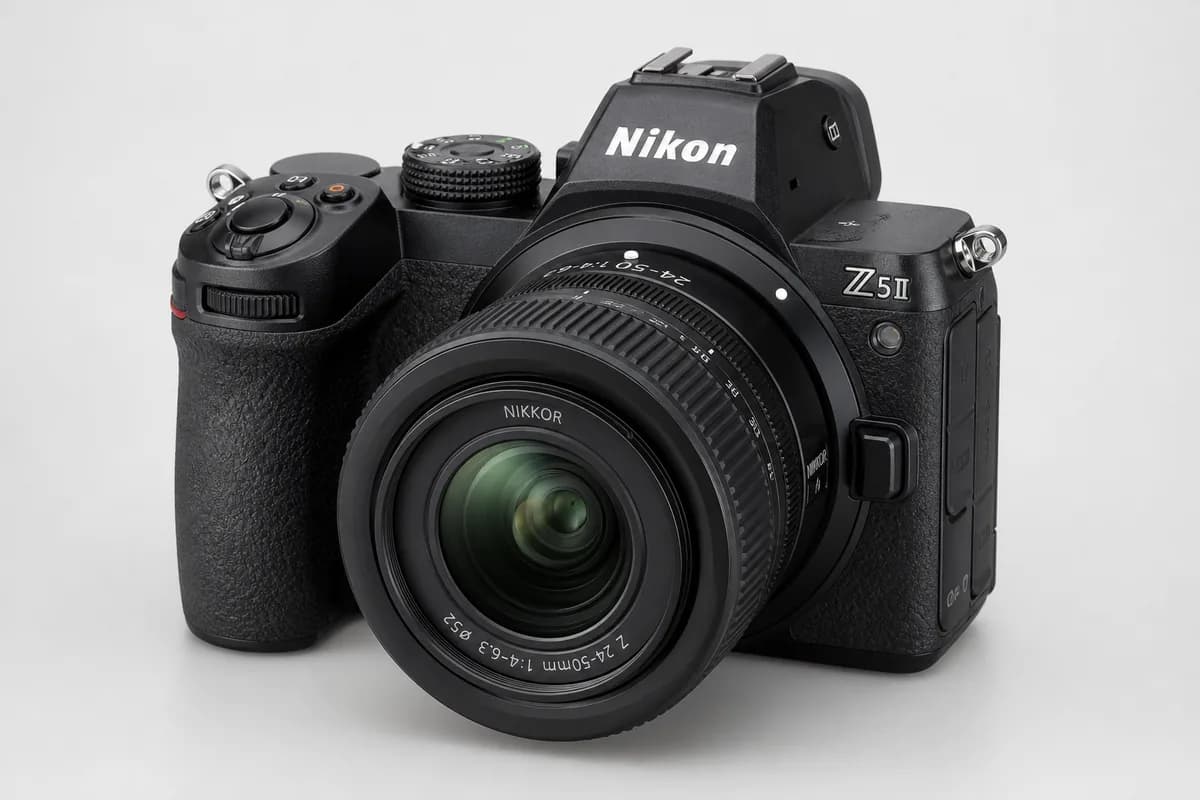
Nikon Z5 II (body)
Sony
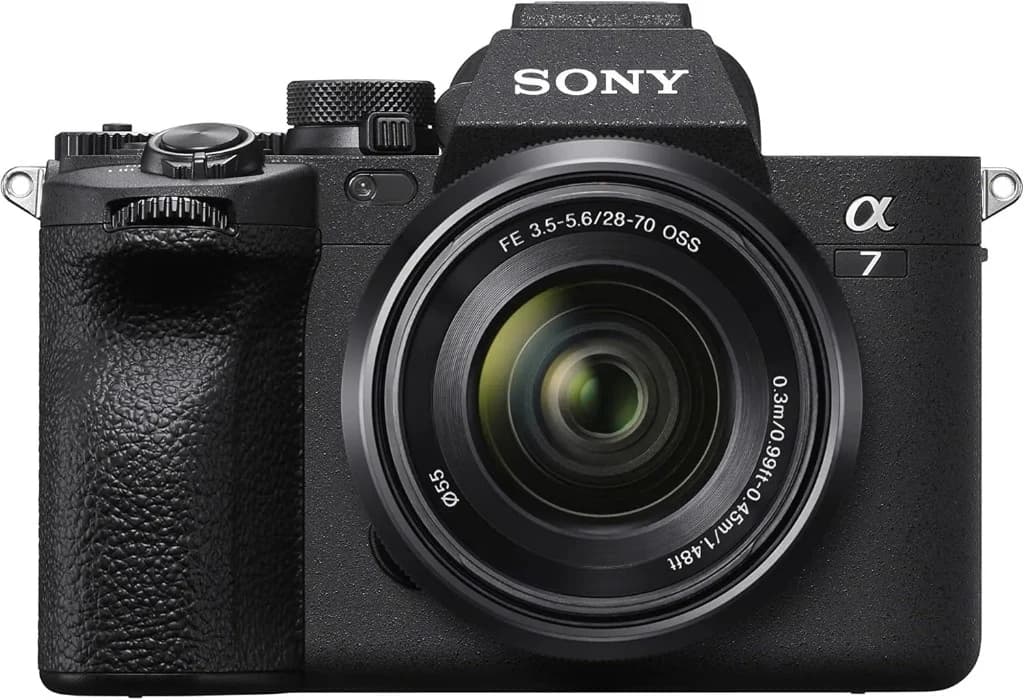
Sony A7 IV (body)
Bild
Empfehlung
Editor’s pick
Value
Alt system
Sensor
24.5 MP FX partially stacked
24.5 MP FX BSI
33 MP full-frame BSI
ISO-Bereich
up to ~8 EV (CIPA)
EXPEED 7
~5.5 EV
Autofokus
273 · subject detection / 3D
Subject AF · pre-release
Real-time tracking / Eye AF
Detail
6K/60 N-RAW · 4K/60 oversampled
4K/30 FX · 4K/60 DX crop
4K/60 · 10-bit · S-Log3
Stärken
+Hybrid peak of the class: speed, AF, video, EVF
+Internal 6K/ProRes path and strong 4K/60
+Dual slot CFe-B + SD — backup workflow
+Articulated screen and strong IBIS
+Z-mount with adapter path to F lenses
+Clearly cheaper than Z6 III with strong AF
+Dual SD — simpler and cheaper backup
+Same Z-mount and EXPEED 7 line
+Solid stills all-rounder for light events
+More resolution and strong peak DR
+Huge E-mount ecosystem
+Better everyday battery reserve
+Proven hybrid all-rounder
Schwächen
−Peak DR below ISO ~800 a bit behind classic sensors
−EN-EL15c gets tight on hybrid days
−24 MP limit for crop-heavy jobs
−CFe-B cards cost more than pure SD workflows
−No 6K/ProRes level of the Z6 III
−Weaker rolling shutter / video feel
−Smaller EVF than Z6 III
−Less burst “pro” speed
−Video/speed behind the Z6 III
−System-switch costs if you’re coming from Nikon
−Older menu feel vs. current Nikon hybrids
−No internal 6K/ProRes like Z6 III
Geeignet für
Events, hybrid photo+video and Nikon switchers who need speed and tracking.
Photo-first Nikon buyers who want AF and dual SD — without the hybrid premium.
Sony users and photo-first with 33 MP — not the automatic “better Z6 III.”
Before we dig into the tech: does your use case even fit a hybrid full-frame with interchangeable lenses and roughly 760 g of body? The Z6 III isn’t a pocket wonder and isn’t a 45-megapixel studio monster — it sits right in between.
Use case
Does the Z6 III fit?
Why
Hybrid photo + video
Excellent
Fast sensor, 6K/ProRes, 4K/60, strong stabilization, dual slots — built for exactly that
System switch costs — then often A7 IV instead of blind Nikon
Fit assessment from my own practice and user consensus — as of August 2026
If you shoot events or hybrid and need speed, tracking and video headroom, the Z6 III hits that exactly. Looking more for “small camera to carry everywhere”: compact mirrorless camera. Still unsure between entry and system: camera for beginners or mirrorless vs. DSLR.
02
Specs
The specs: Z6 III vs. Z5 II vs. A7 IV at a glance
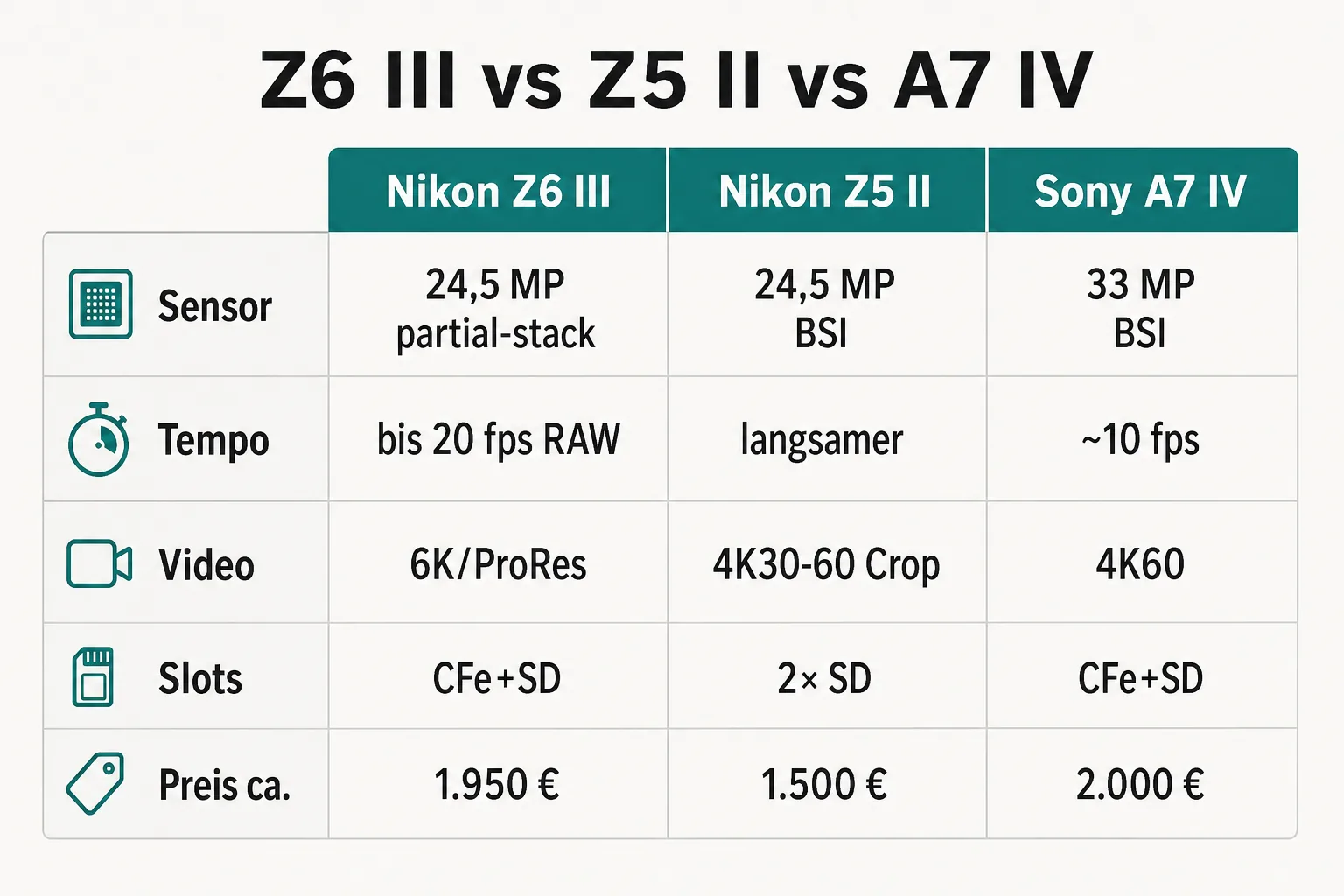
Here are the numbers per Nikon/Sony and spec consensus — short version: Z6 III and Z5 II share Z-mount and the same processor family (EXPEED 7). The difference is speed and video kit, not “Nikon yes or no.” The A7 IV plays in a different system: Sony E-mount, 33 megapixels, different lens ecosystem.
Category
Nikon Z6 III
Nikon Z5 II
Sony A7 IV
Sensor
24.5 MP FX, partially stacked (fast readout)
24.5 MP FX BSI (classic, not stacked)
33 MP full-frame BSI
Processor / AF
EXPEED 7 · subject detection / 3D tracking
EXPEED 7 · subject detection
BIONZ XR · Real-time Tracking
Burst
up to 20 fps RAW
solid stills burst (less speed)
up to ~10 fps
Video
6K/60 N-RAW · ProRes · 4K/60 (oversampled)
4K/30 full frame · 4K/60 with crop — no 6K
4K/60 (often Super35) · 10-bit · S-Log3
Viewfinder (EVF)
5.76 MP — bright and sharp
smaller / less detailed viewfinder
yes (solid hybrid class)
Stabilization
IBIS up to ~8 stops (CIPA)
IBIS (full-frame entry)
IBIS ~5.5 stops
Storage
CFexpress B + SD UHS-II
2× SD UHS-II
CFe A / SD dual
Weight (approx.)
~760 g (body)
~700 g (body)
~658 g (body)
Battery
EN-EL15c
EN-EL15c
NP-FZ100 · often longer reserve
Mount
Nikon Z (FX)
Nikon Z (FX)
Sony E (full frame)
Street price US 2026
Body ~$2,200–2,500
Body ~$1,400–1,700
Body ~$2,000–2,400
Z6 III vs. Z5 II vs. A7 IV — core specs, as of August 2026
On paper the Z5 II looks like “almost the same Nikon cheaper.” In daily use you miss 6K, the stacked sensor’s speed and the big viewfinder — it thinks more photo all-round. The A7 IV shares the hybrid full-frame class, but switches mount, resolution and dynamic-range character. How the viewfinder, stabilization and weight feel comes next.
03
Everyday
Handling, viewfinder and stabilization: what the datasheet skips
Numbers say little about how the camera feels when you shoot and film events and hybrid days with it. Here’s the practice check: viewfinder, stabilization, weight, battery and cards.
5.76 MP viewfinder — worth gold at events
The bright, high-res viewfinder helps on stage, in church and in daylight: exposure and focus without display glare. The Z5 II saves here on purpose — fine for stills-only. If you work with the camera to your eye, you feel the Z6 III advantage immediately.
In-body stabilization (up to ~8 stops)
IBIS steadies handheld video and stills at tight shutter speeds — even with lenses that have no IS of their own. Absolute numbers are lab (CIPA); in practice it means you shoot and film more relaxed.
Size & weight (~760 g)
Noticeable, but everyday-usable for a hybrid full-frame. Versus the Z5 II (~700 g) barely a dealbreaker. Versus APS-C like the A6700 it’s more camera — often the right price for low light and bokeh. Maximum pants-pocket: compact mirrorless camera.
EN-EL15c battery
Familiar Nikon battery — for hybrid days often tighter than some Sony bodies with NP-FZ100. Practice: two to three spares belong in the event kit. The A7 IV often scores longer reserve here.
Dual slots: CFexpress B + SD
Backup for events: CFexpress for speed and high video bitrates, SD as the second path. The Z5 II stays on dual SD — simpler and cheaper, less headroom for 6K/ProRes. Card logic: best SD card for camera.
Articulating screen & ergonomics
Flip/tilt screen helps content and floor/portrait framing. Grip and buttons feel like a “real camera.” The menu stays Nikon-dense — once you’ve set custom setups, it works fast.
In reviews and user reports, the Z6 III’s autofocus, speed, video and viewfinder often get praise. The criticism repeats: dynamic range at low ISO a bit behind classic sensors, battery on hybrid days, 24 MP limit for heavy crops, CFexpress cost. That matches what I see: clear hybrid strengths, clear limits — no universal wonder and no Z8 stand-in at 45 MP/8K.
04
Image
Image quality: 24.5 MP — and honesty on dynamic range
24.5 megapixels full frame with a fast sensor and EXPEED 7 isn’t megapixel hype in 2026 — and that’s exactly why it’s strong for hybrid and events: enough detail for web, print and light crops, plus readout speed for burst and video. The photographic difference vs. the Z5 II in daily use is not primarily “more megapixels.” Vs. the A7 IV it is: 33 MP and a different dynamic-range profile — see crop sensor vs. full frame.
◆Daylight / studio light: crisp, detailed in RAW, JPEG with typical Nikon color character
◆Dynamic range at low ISO: honest — below about ISO 800 the Z6 III can have roughly 0.8 stops less shadow reserve than classic (non-stacked) sensors in the same resolution class. Plain English: if you shoot landscape or studio at base ISO and pull shadows hard, you’ll notice sooner. For events and hybrid (often higher ISO, speed matters more) it usually plays a smaller role.
◆ISO practice full frame: up to roughly ISO 6400–12800 often everyday-usable depending on subject and output; beyond that, job-dependent
◆Bokeh: comes mainly from the lens (focal length, aperture, distance) — not the body name
◆Z6 III vs. Z5 II: related 24.5 MP class — buying decision is speed, video and viewfinder, not a “magic look”
◆Z6 III vs. A7 IV: A7 IV often ahead on resolution and dynamic range; Z6 III on speed and video kit
The real point, honestly: many chase “better image quality” and actually mean a better lens, better light or better technique. A kit zoom shows you the world; a fast prime changes the look more than the jump from Z5 II → Z6 III. Portrait and business glass: lenses for business portraits, which lens for portrait.
Subject detection and 3D tracking with EXPEED 7 are one reason the Z6 III works as an event and hybrid camera: people, animals, vehicles — the autofocus delivers what photo and video need in practice. Burst up to 20 fps in RAW comes from the fast sensor — a clear splitter vs. the Z5 II and the A7 IV (more like the ~10 fps class).
Eye AF & subject detection
For portraits, events, kids and content in front of the lens, the everyday win: you focus on moment and composition. In tough light, backlight or occlusions you occasionally need a nudge — normal.
Viewfinder = faster AF everyday
This is exactly where the Z6 III separates from cheaper paths: AF and framing in the big viewfinder without fighting the display. If you often work with the EVF — events, reportage — you notice the difference immediately.
Use 20 fps RAW with intent
Short sequences for action, stage, kids: yes. Continuous fire without purpose: no — buffer, card and culling workload grow. CFexpress helps; details: best SD card for camera.
Limits, honestly
Pro sports and wildlife at distance need telephoto, light and practice first — not just “subject AF” on the box. The Z6 III is strong for hybrid and events, not a pure wildlife pro body. And: the Z5 II shares the AF family — speed and sensor readout are the hybrid premium.
For the typical Z6 III buyer (hybrid, events, wanting to grow in the Z system), autofocus is a real buying argument. Together with stabilization, viewfinder and dual slots, that becomes the package I recommend for this job.
06
Video
Video: 6K, ProRes, 4K/60 — real hybrid, not a stills add-on
The Z6 III delivers internally among other things 6K/60 in N-RAW, ProRes paths and strong 4K/60 (oversampled, i.e. downsampled from higher resolution). For events with B-roll, YouTube, light short film and hybrid everyday use, that’s one of the strongest mid-class packages in 2026. Stabilization helps handheld; the articulating screen helps framing. For run-and-gun walking shots a gimbal often remains the more honest add-on.
◆Z5 II: 4K/30 full frame · 4K/60 with crop — no 6K (stills focus)
◆A7 IV: 4K/60 often Super35 · 10-bit · S-Log3 — strong hybrid, less speed/6K headroom than Z6 III
◆Audio / workflow: plan external mic and monitoring; high bitrates need CFexpress and heat awareness
◆Creators without full-frame budget: lean APS-C hybrid — Sony A6700 review
Short: video is a core strength of the Z6 III — together with speed and dual slots the reason I recommend it for hybrid. A stills-only job often lands more honestly on the Z5 II. Next: the direct Z6 III vs. Z5 II comparison.
07
Decision
Z6 III vs. Z5 II: your job decides — not megapixels
This is the core of the decision: Z6 III and Z5 II feel related at the system level — same Z-mount, EXPEED 7, subject AF, 24.5 MP class. Still, they’re not interchangeable. The splitter is job and kit: speed, 6K/ProRes, viewfinder and CFexpress+SD vs. a cheaper entry with dual SD and a stills focus.
You need …
Lean Z6 III
Lean Z5 II
Hybrid photo + video with 6K/ProRes
Clearly better
No — no 6K
Speed / 20 fps RAW / fast sensor
Yes
Less speed
Squeeze budget hard (~$500–800)
More expensive (~$2,200–2,500)
Clearly cheaper (~$1,400–1,700)
Dual SD without CFexpress cost
CFe-B + SD
2× SD — simpler/cheaper
Large / bright viewfinder
5.76 MP — clear advantage
Smaller viewfinder
Image quality 24.5 MP full frame
Strong (watch low-ISO DR)
Strong — related class
Mostly stills / light events / all-round
Can be overqualified
Often the better fit
My recommendation 2026
My pick for hybrid and events
Save in the Nikon system, photo-first
Decision matrix Z6 III vs. Z5 II — as of August 2026
Why not the Z8 as the third recommendation?
The Z8 stays visible in pro conversations — but for this buying guide it’s the wrong third place: 45 MP, 8K, different budget and weight. It answers “exit upward,” not “save” or “Sony alternative.” Here what counts is Z5 II (cheaper in the Nikon system, photo-first) and A7 IV (if you’re already on Sony). Z8 only when 45 MP and 8K are mandatory — not ahead of the Z6 III.
Plain English: the Z5 II isn’t a bad camera — it’s the thriftier pick in the Nikon system in 2026 when you mainly shoot stills. The Z6 III remains the camera I’d put in your hands for hybrid and events, because speed, video and viewfinder matter day to day.
08
Comparison
Three options in direct comparison
Above was Z6 III vs. Z5 II. Here all three: graphic for the overview, table for details — Z6 III for hybrid/events, Z5 II to save on photo-first, A7 IV as the Sony alternative.
Z6 III vs. Z5 II vs. A7 IV — as of August 2026
Criterion
Z6 III
Z5 II
A7 IV
Sensor
24.5 MP FX, fast readout
24.5 MP FX BSI
33 MP full-frame BSI
Role 2026
Hybrid / events (my pick)
Photo-first, save money
Sony alternative
Viewfinder / IBIS
5.76 MP / ~8 stops
smaller / IBIS
yes / ~5.5 stops
Video highlight
6K/ProRes · 4K/60
4K/30 FX · 4K/60 crop
4K/60 · 10-bit · S-Log3
Burst / speed
up to 20 fps RAW
solid stills burst
~10 fps class
Slots
CFe-B + SD
2× SD
Dual (CFe A / SD)
Body weight approx.
~760 g
~700 g
~658 g
Body price approx.
$2,200–2,500
$1,400–1,700
$2,000–2,400
As of August 2026 — check exact prices and availability at the retailer
Versus the Z5 II the Z6 III wins on speed, video, viewfinder and CFexpress backup; it loses on price and card simplicity. Versus the A7 IV the Z6 III often wins on speed and internal 6K/ProRes; it loses on resolution, dynamic-range profile and E-mount breadth — and often on battery reserve. No option is objectively best — each answers a different job. Brand context: camera brands. APS-C hybrid: Sony A6700 review. Events: event photography tips.
09
Decision
The decision tree: which camera fits you
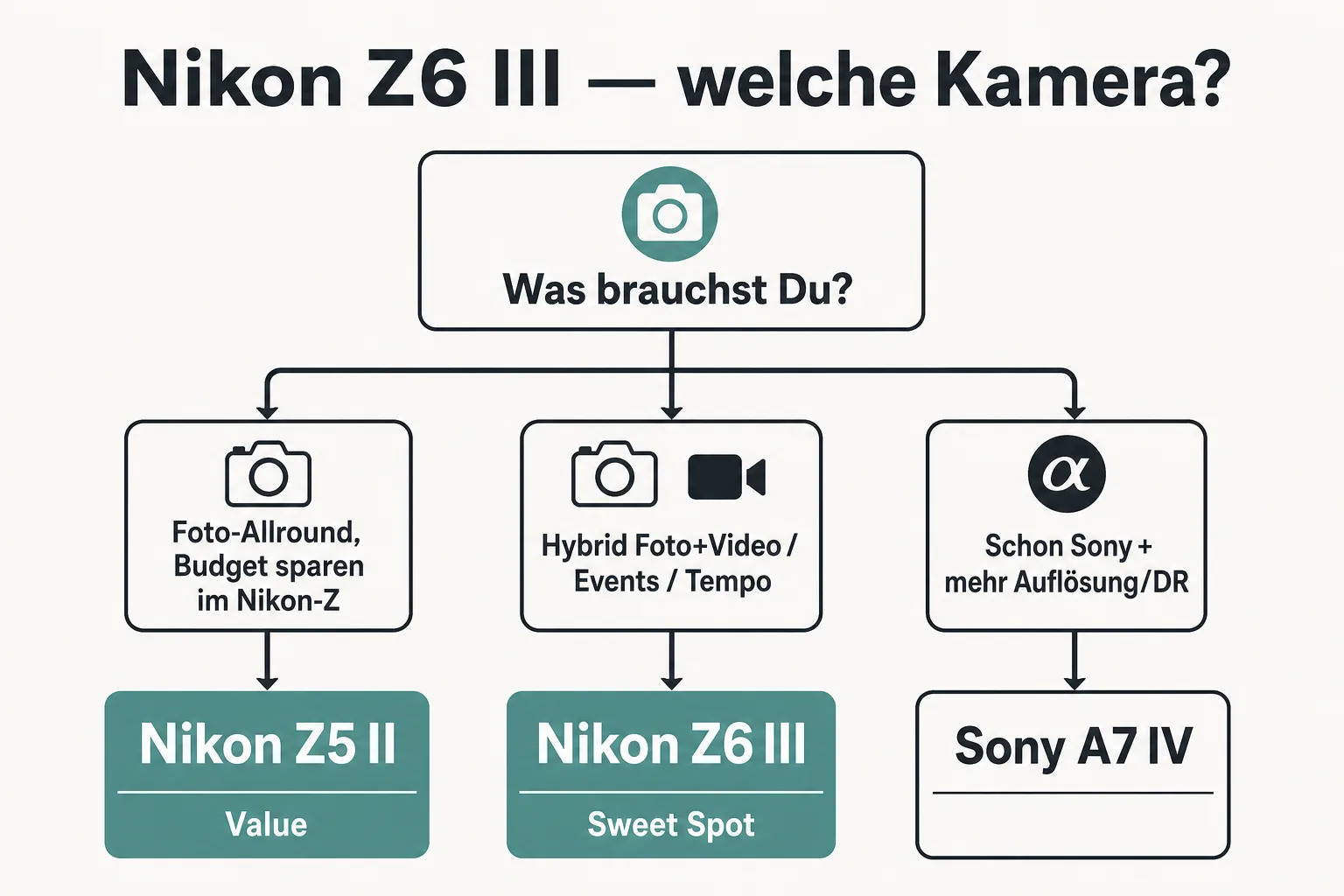
Enough specs — now the path. Walk the tree top to bottom. The first question (hybrid vs. photo-first vs. system) decides more than any single number from the tables above.
Decision tree — from use case to the right camera, as of August 2026
◆Want hybrid photo+video with speed, 6K/ProRes and a strong viewfinder in the Z system → Nikon Z6 III
◆Want to mainly shoot stills and skip the hybrid premium (~$500–800) → Nikon Z5 II
◆Already deep in Sony / E-mount or prioritize 33 MP and dynamic range → Sony A7 IV
◆Need 45 MP and 8K → Z8 (otherwise don’t)
◆APS-C hybrid is enough and you want to cut weight/budget → lean Sony A6700
For most readers who want hybrid or events, the path lands on the Z6 III. The Z5 II stays right when stills and budget have priority. The A7 IV stays right when system and 33 MP/dynamic range are the deliberate job.
10
Detail
Nikon Z6 III in detail: my hybrid recommendation
After tables and tree, the balance: does what convinces outweigh what annoys on the Z6 III? Short, before the verdict card — and why it remains my hybrid full-frame recommendation in the Nikon system.
Everyday strengths
Fast sensor, EXPEED 7, subject AF, ~8-stop stabilization, 5.76 MP viewfinder, 20 fps RAW, 6K/ProRes, 4K/60, dual-slot CFe+SD, articulating screen, Z-mount with adapter path. Typically ~$2,200–2,500 body: a camera you can grow with for years on hybrid and events — not as a “cheap Z8.”
The trade-offs
Dynamic range at low ISO a bit behind classic sensors (~0.8 stop), EN-EL15c on hybrid days, 24 MP limit for crop-heavy jobs, CFexpress cost. Want 45 MP/8K: Z8. Want photo-first and save: Z5 II. Want maximum pants-pocket: compact mirrorless camera.
On price the Z6 III isn’t undercutting the Z5 II — it’s the honest answer to “which Nikon for hybrid full frame?”: you pay for speed, video and viewfinder. In 2026 that often means Z6 III, not blindly the cheapest Z mid-class and not the Z8 “because pro.”
Editor’s pick
Nikon
Nikon Z6 III (body)
Editor’s pick — hybrid full frame with speed, AF and 6K video
24.5 MP FX partially stacked, EXPEED 7, strong subject AF, IBIS up to ~8 EV, 5.76 MP EVF. Bursts up to 20 fps RAW, internal 6K/ProRes path, dual slot CFe-B + SD. Typically around $2,200–2,500 body — the hybrid/event sweet spot in the Nikon Z system.
Was überzeugt
+Hybrid peak of the class: speed, AF, video, EVF
+Internal 6K/ProRes path and strong 4K/60
+Dual slot CFe-B + SD — backup workflow
+Articulated screen and strong IBIS
+Z-mount with adapter path to F lenses
Was Du wissen solltest
−Peak DR below ISO ~800 a bit behind classic sensors
−EN-EL15c gets tight on hybrid days
−24 MP limit for crop-heavy jobs
−CFe-B cards cost more than pure SD workflows
Editor's Statement
“When photo+video, events and speed matter in the Nikon Z system”
Nikon Z5 II: save in the Nikon system — with a clear reason
Many people see the Nikon Z5 II next to the Z6 III — fair: often around ~$1,400–1,700 (roughly $500–800 less), same EXPEED 7 family, subject AF, dual SD cards. As a 2026 value tip it applies when stills and budget have priority in the Nikon system — not because it’s the better hybrid camera.
Right when you want Z-mount and full frame, mainly shoot stills and consciously skip 6K/ProRes and sensor speed. Wrong when you want hybrid with video headroom and speed and have the Z6 III budget — then don’t save at the wrong end. Straight talk: the Z5 II is a smart photo-first pick, never my first choice ahead of the Z6 III as a hybrid — and also not a “worse camera,” just a different priority.
Many compare both — that makes sense. As a buying recommendation the Z5 II only applies under the photo-first/budget condition. Otherwise my recommendation intentionally points to the Z6 III.
Value
Nikon
Nikon Z5 II (body)
Value — same AF family, clearer price win
24.5 MP FX BSI (not stacked), EXPEED 7 with subject AF, dual SD UHS-II. Typically around $1,400–1,700 body — the real money-saving answer on the Nikon path in 2026 when 6K/ProRes and partial-stack speed aren’t mandatory.
Was überzeugt
+Clearly cheaper than Z6 III with strong AF
+Dual SD — simpler and cheaper backup
+Same Z-mount and EXPEED 7 line
+Solid stills all-rounder for light events
Was Du wissen solltest
−No 6K/ProRes level of the Z6 III
−Weaker rolling shutter / video feel
−Smaller EVF than Z6 III
−Less burst “pro” speed
Editor's Statement
“When you stay in Nikon Z and want to skip the hybrid premium”
Sony A7 IV: the Sony alternative — not the better Z6 III
The Sony A7 IV answers a related but different question: not “best hybrid full frame in the Nikon system,” but “proven hybrid all-rounder in E-mount with 33 megapixels.” Typically ~$2,000–2,400 body, strong dynamic range, Real-time Tracking, huge lens ecosystem, often better battery reserve (NP-FZ100). Short: not automatically the better Z6 III — and no reason to tear down a working Nikon system.
Go A7 IV when you’re already on Sony, prioritize 33 MP and dynamic range, or have built FE glass long-term. Don’t go A7 IV just because forums write “Sony is always better” — while the Z6 III already solves your hybrid/event job. Then the Nikon stays the more honest camera; a system switch costs more than adapter illusions. APS-C on the Sony path: Sony A6700 review.
Alt system
Sony
Sony A7 IV (body)
Alt system — 33 MP, strong stills DR, huge E-mount
33 MP full-frame BSI, real-time tracking, ~10 fps, 4K/60 (often Super 35), NP-FZ100 with strong CIPA reserve. Typically around $2,000–2,400 body — the classic cross-brand peer when you’re already on Sony or prioritize resolution/DR.
Was überzeugt
+More resolution and strong peak DR
+Huge E-mount ecosystem
+Better everyday battery reserve
+Proven hybrid all-rounder
Was Du wissen solltest
−Video/speed behind the Z6 III
−System-switch costs if you’re coming from Nikon
−Older menu feel vs. current Nikon hybrids
−No internal 6K/ProRes like Z6 III
Editor's Statement
“When Sony is already your system or 33 MP/DR matter more than Z6 III video speed”
The shopping list is short, but not optional. A few pieces make the difference between “system camera in the closet” and “camera you use weekly on events and hybrid jobs.”
Spare EN-EL15c battery (better two to three)
Hybrid and event days eat reserve. OEM is reliable; vetted third-party often works, with some risk on capacity and long-term stability. Plan more generously than the lab number suggests.
CFexpress Type B + fast SD UHS-II
Take dual-slot seriously: CFexpress for speed and high bitrates, SD as backup. Capacity and speed class: best SD card for camera.
A solid shoulder or sling bag and a good strap lower the barrier. For events: second medium and a clear backup workflow — see event photography tips.
Optional: external mic (+ gimbal if needed)
Once video with voice matters: external mic. For walking shots: check a gimbal — IBIS doesn’t replace every stabilizer setup.
14
Verdict
The clear buying call
Quick take: the Nikon Z6 III is my 2026 recommendation for events and hybrid photo/video in the Nikon system — fast autofocus, strong video, solid viewfinder, typically ~$2,200–2,500 body. The Z5 II (~$1,400–1,700, roughly $500–800 less) remains the thriftier pick when you mainly shoot stills. The A7 IV is the Sony alternative: 33 MP, dynamic range, E-mount — different system, not automatically “better.” Plan low-ISO dynamic range honestly once and relativize it for events/hybrid. Z8 only for 45 MP/8K.
Yes, if you want events and hybrid photo/video in the Nikon system — typically around $2,200–2,500 for the body alone. If you mainly shoot stills and want to save, lean Z5 II. If you’re already on Sony and prioritize 33 MP plus dynamic range, lean A7 IV.
Z6 III or Z5 II — which is worth it?+
The Z5 II saves roughly $500–800 and shares the same strong autofocus family plus dual SD cards. The Z6 III justifies the premium with a faster sensor, stronger video (6K/ProRes), a better viewfinder and CFexpress plus SD.
Is the Z5 II worse than the Z6 III?+
No — different priority. As a photo-first pick in the Nikon system it’s often the smarter value call. For hybrid with speed and 6K the Z6 III stays ahead.
Z6 III or Sony A7 IV?+
Different systems. Z6 III: speed and strong video. A7 IV: 33 megapixels, dynamic range and a broad Sony ecosystem. Not automatically the “better” camera — and no automatic reason to switch systems.
Is it true the Z6 III has less dynamic range?+
Below about ISO 800, lab consensus says it can have roughly 0.8 stops less shadow reserve than classic sensors. For events and hybrid that often relativizes. For landscape/studio at base ISO with maximum shadow pulls, check the A7 IV or a camera with a more classic sensor.
Does the Nikon Z6 III have IBIS?+
Yes, in-body stabilization up to around 8 stops per CIPA — strong for the class.
Can the Z6 III do 6K and ProRes?+
Yes, internally among other things 6K/60 N-RAW and ProRes plus strong 4K/60 — one of the reasons it fits hybrid so well.
Which memory cards does the Z6 III need?+
Dual slots: CFexpress Type B (or XQD) plus SD UHS-II. For high video bitrates prioritize CFexpress; details in the SD card guide.
How heavy is the Nikon Z6 III?+
About 760 g ready to shoot — noticeable, but everyday-usable for a hybrid full-frame. The Z5 II sits around 700 g, the A7 IV around 658 g.
Which battery does the Z6 III use?+
EN-EL15c. Plan spare batteries — for hybrid days the lab rating gets tight fast.
Is the Z6 III good for event photography?+
Yes — autofocus, speed, dual cards and low light make it one of the clear full-frame candidates for events. See also event photography tips and tricks.
When should I get the Z8 instead of the Z6 III?+
When 45 megapixels and 8K are truly mandatory and budget plus weight play along. Otherwise the Z6 III is the more honest pick — not the “cheap Z8.”
Affiliate links marked with * — Amazon product links use partner ID martinkleinhe-20. I earn a small commission if you buy through these links; it costs you nothing extra. Assessments are based on my own practice, manufacturer specs and the consensus from reviews and user reports — no brand sponsored this article.
◆ Newsletter
Stay in the loop.
Camera and photography news, honest gear tests and new articles — in your inbox. Infrequent but relevant. No spam, unsubscribe anytime.