Still buy an X100V — or go straight to the X100VI? And when the RX100 VII is the better travel camera.
Author
Martin Kleinheinz
Photographer · Content Creator · Hannover
Updated
August 28, 2026
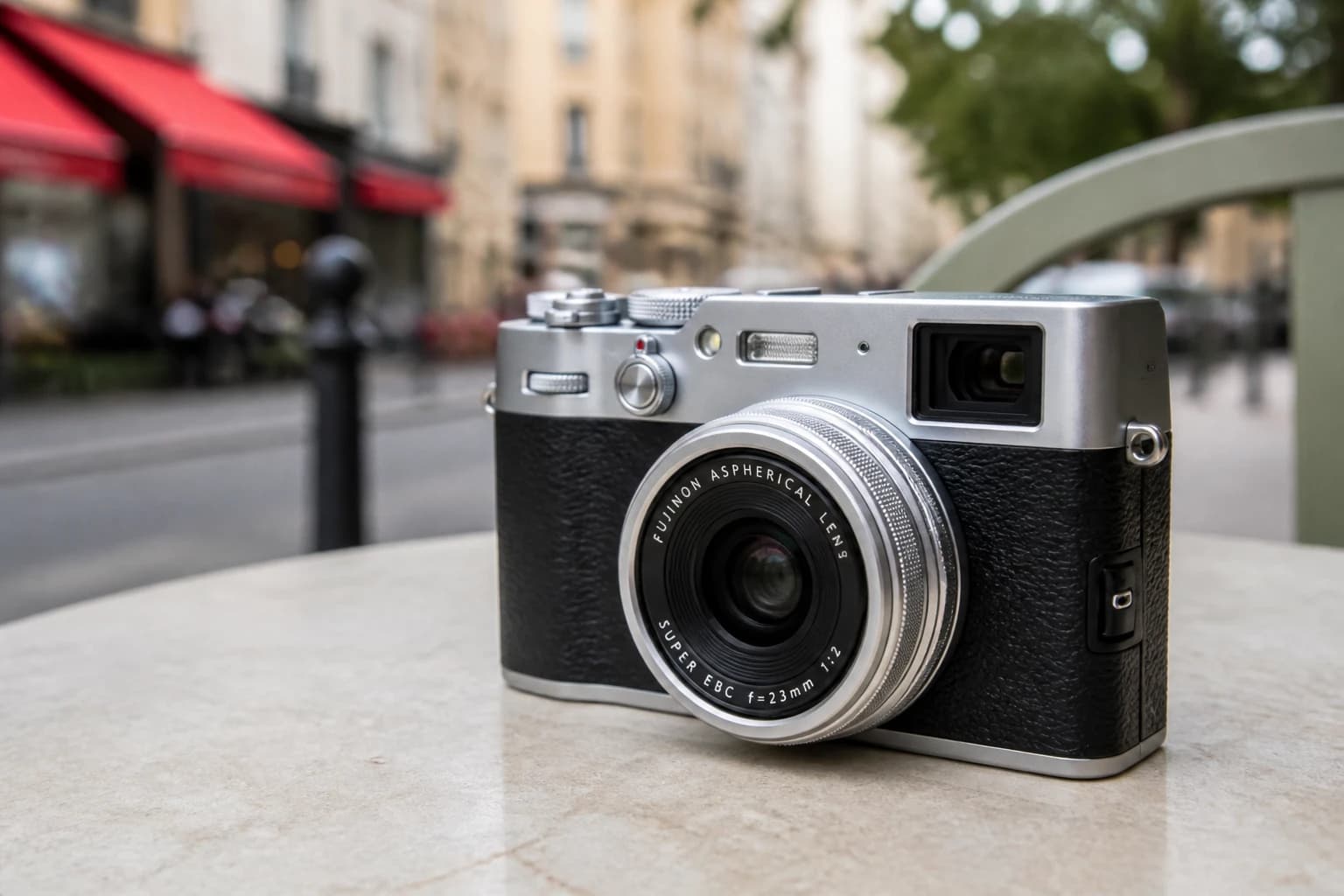
A camera that feels like a little rangefinder tool, brings film simulations many people only chase in post — and still fits a jacket pocket: that’s the promise of the Fujifilm X100 series. The X100V was the hype king of premium compacts for years. In 2026 it’s discontinued, often expensive used, and the X100VI sits on the shelf with IBIS and 40 megapixels. That’s exactly where the honest question behind “Fujifilm X100V review” starts.
I’ve used the X100 logic for street, travel and everyday shooting: always with me, fixed 23mm f/2, hybrid viewfinder, JPEGs you can often send straight out. What specs and forums underplay: if a used V’s price creeps toward a new VI’s street price, you’re paying near-new money for a camera without IBIS. That’s not a bargain — that’s nostalgia with a surcharge.
You won’t get a datasheet dump or a hype piece here — you’ll get a clear buying call: when the X100VI is the better pick in 2026, when a used X100V still makes sense — and when you’re better off with the Sony RX100 VII as a zoom travel camera.
00
Short
Is the Fujifilm X100V still worth it in 2026? The quick verdict
Short version: you don’t buy a new X100V in 2026 — and you shouldn’t want to. The Fujifilm X100VI is the better choice: same 23mm f/2 feel, but in-body stabilization, 40 megapixels and a current processor.
The discontinued X100V only stays sensible if you get it used clearly cheaper than the VI (often roughly $1,100–1,400, as of August 2026) and you check condition, shutter count and seller warranty. If the used price sits near $1,600–1,800 for a new VI, the V is a bad deal.
Top 3
My three recommendations
**#1 Fujifilm X100VI** — when you’re buying new (IBIS, 40 MP). **#2 Fujifilm X100V** only used with a clear price gap and checked condition. **#3 Sony RX100 VII** when you need zoom to 200mm instead of a fixed prime.
Vergleich
Fujifilm
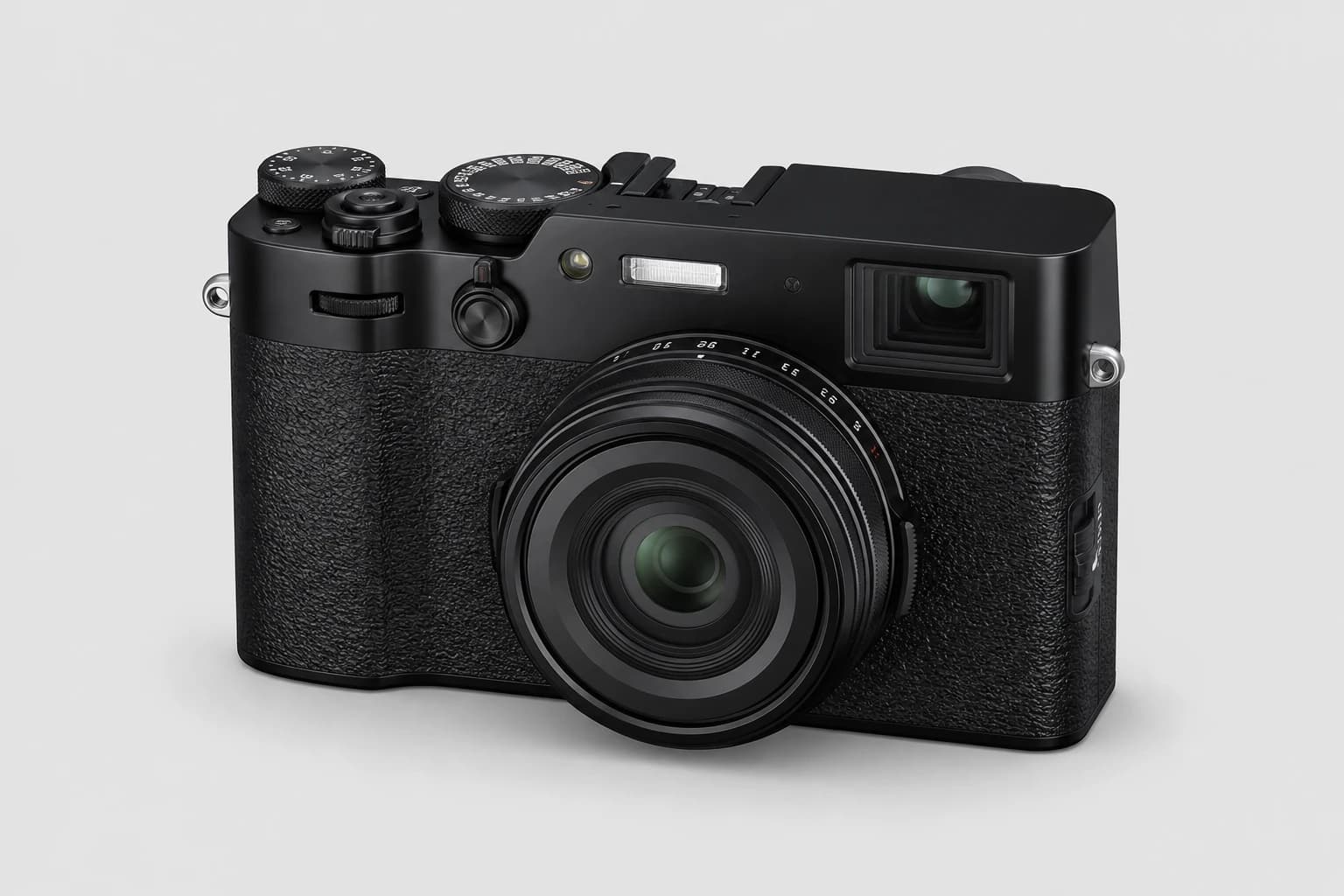
Fujifilm X100VI
Fujifilm
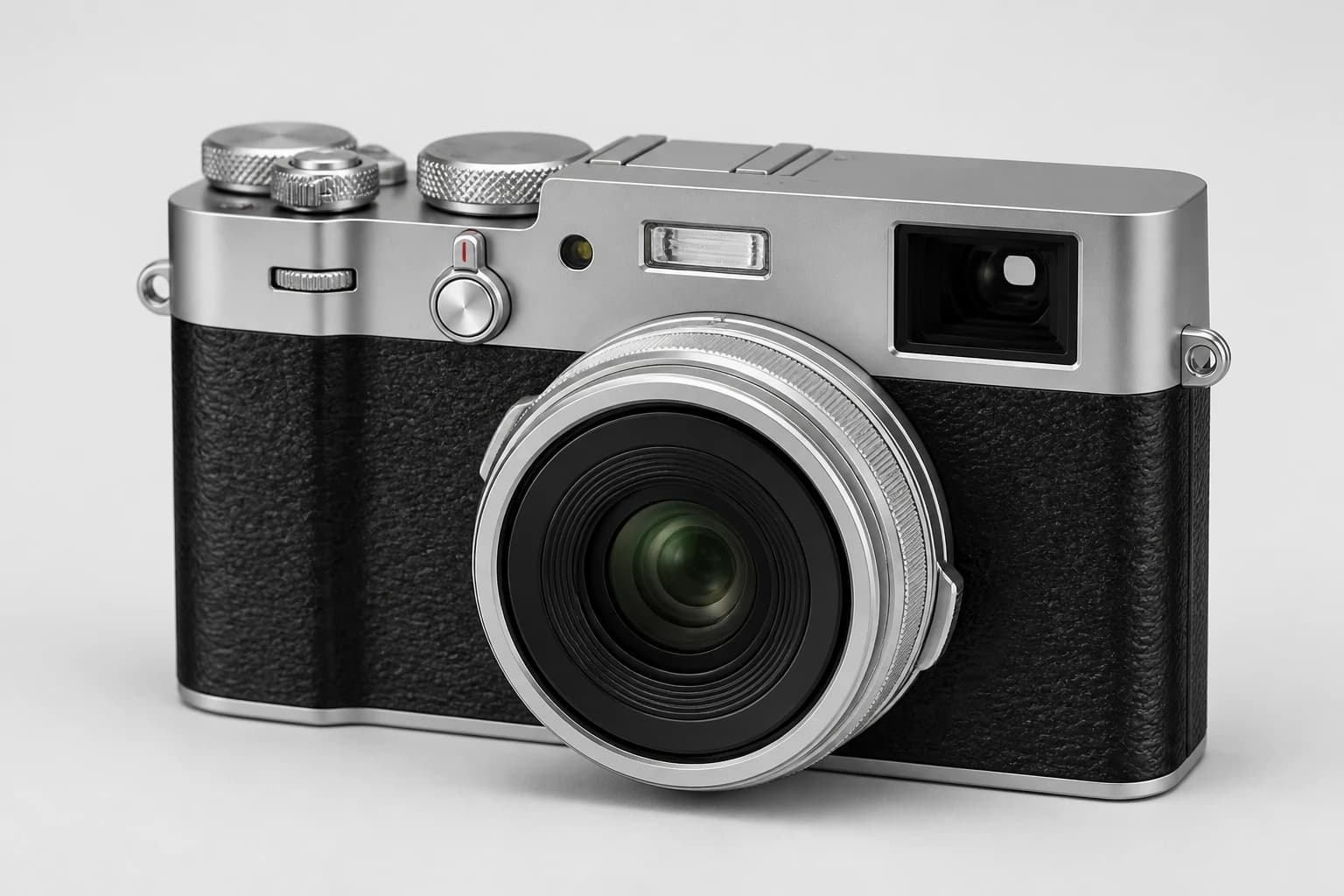
Fujifilm X100V
Sony
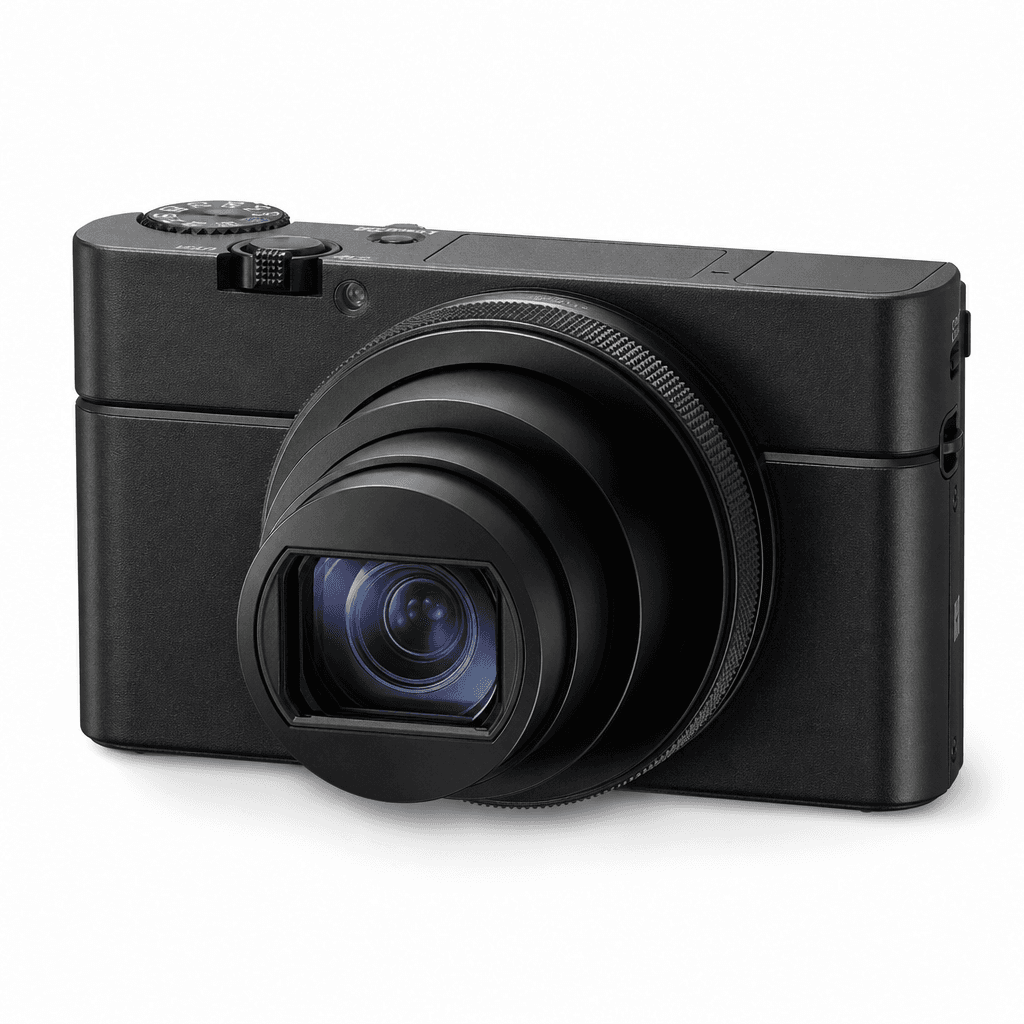
Sony Cyber-shot DSC-RX100 VII
Bild
Empfehlung
Editor’s pick
Budget
Alternative
Sensor
40.2 MP APS-C X-Trans 5 HR
26.1 MP APS-C X-Trans 4
20.1 MP 1" Stacked CMOS
ISO-Bereich
FUJINON 23mm f/2 (≈35 mm)
FUJINON 23mm f/2 (≈35 mm)
ZEISS 24–200mm f/2.8–4.5
Autofokus
IBIS up to ~6 EV
no IBIS
OIS + electronic
Detail
Hybrid VF, film sims, 6.2K video
Hybrid VF, film sims, ND 4 stops
20 fps, pop-up EVF, pocket zoom
Stärken
+IBIS makes low light and handheld shooting clearly more relaxed
+40 MP lets you crop without going soft immediately
+Same 23mm f/2 language and handling as the X100V
+Current processor and longer firmware outlook
+More film simulations for a JPEG-first workflow
+Same core look and 23mm handling as the VI
+Lighter and often cheaper than a new VI
+Strong JPEG film sims and APS-C quality
+Hybrid OVF/EVF for street and precision
+Proven series with DPReview Gold reputation
+Real telephoto to 200mm without swapping lenses
+Clearly smaller and lighter than an X100
+Very fast autofocus for the class
+Cheaper than current X100VI street prices
Schwächen
−Premium price — hype can distort availability and street price
−A bit heavier than the X100V
−Still a fixed prime — no zoom
−Too rigid if you want a system that grows with lenses
−No IBIS — low light and video trail the VI
−Used prices often too close to the VI = poor value
−Discontinued — support and new stock are limited
−4K clips can overheat
−Smaller sensor — less APS-C look
−Battery is the real weakness
−No film-sim character like Fuji
−No hybrid OVF
Geeignet für
Street, everyday carry and travel with a fixed 35mm language — when you’re buying new and want IBIS.
Anyone who wants the X100 look and finds a checked used V clearly under VI pricing.
Travel and street with zoom needs — when the X100’s fixed 35mm feels too tight.
Why “still buy an X100V” is often the wrong search in 2026 — and when it still holds up — is what the rest of this Fujifilm X100V review covers. For the broader premium-compact vs. system framing, also see camera brands and the best travel camera.
01
Audience
Who the X100 series really fits
Before you dig through megapixels and film sims: the most important question is whether your use case fits the X100 family at all. Fixed 23mm f/2 (about 35mm full-frame equivalent on APS-C) is a statement — no zoom, no “cover everything.” The table shows where the series is strong and where another camera makes more sense.
Use case
Does the X100 series fit?
Why
Street / everyday
Excellent
Discreet, hybrid VF, fast JPEGs, 35mm-FF feel
Travel (fixed prime)
Excellent
One lens, little weight — if you can live with 23mm
Works, but no vlog specialist — more ZV-1 territory
Sports / wildlife
No
Fixed prime and AF character aren’t built for action
Fit assessment from my own practice and user consensus — as of August 2026
Street and everyday shooters who want to work intentionally with one focal length get exactly what many system cameras only imitate with a kit and a backpack: a camera you actually carry. If you’re a beginner and unsure whether APS-C and a fixed prime fit you, check camera for beginners and crop sensor vs. full frame / APS-C first. For budgets under $1,000 the X100 class is usually too expensive — then lean best camera under $1,000.
02
Data
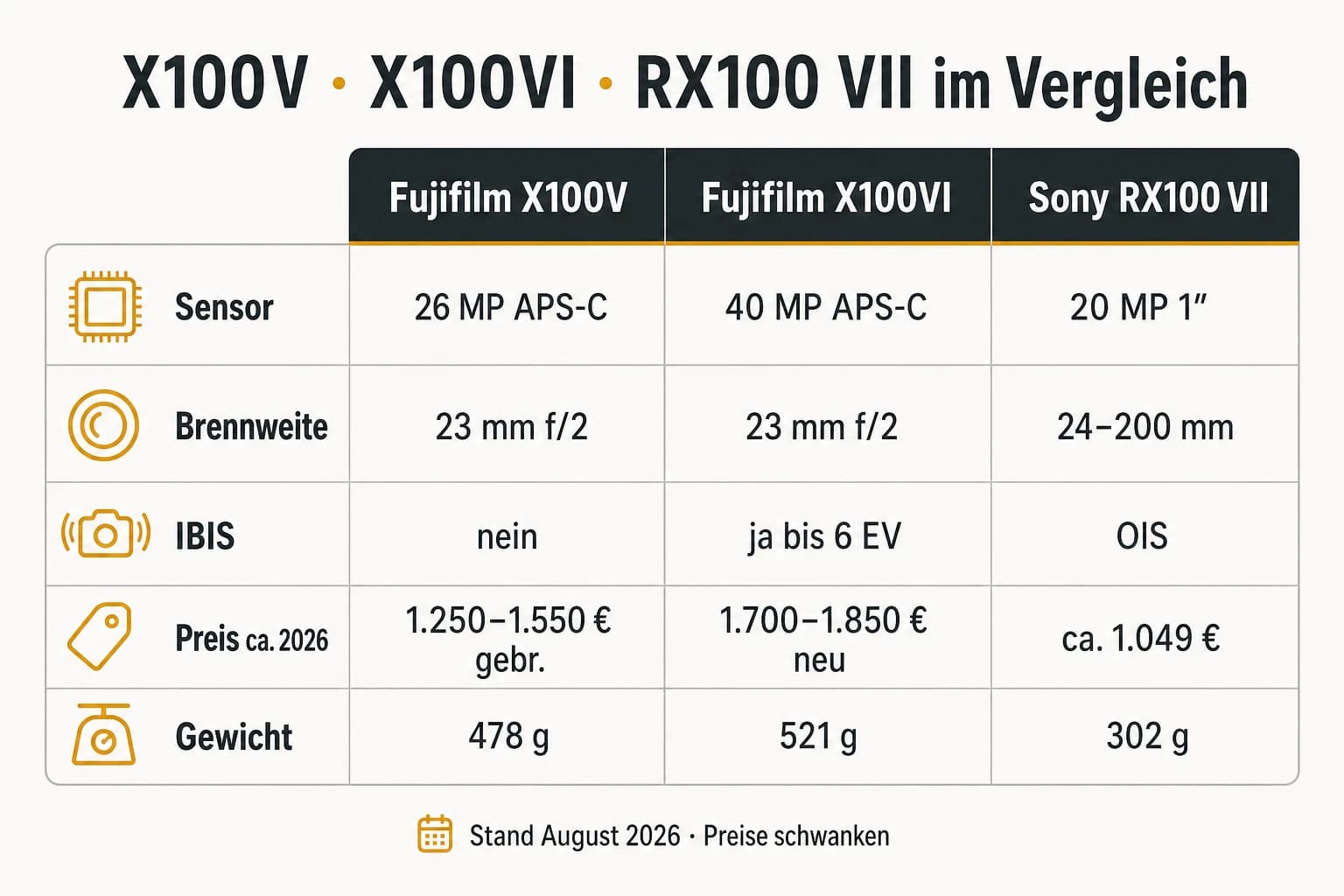
The specs: X100V vs. X100VI at a glance
Before everyday usability: here are the numbers per Fujifilm and the common spec consensus. Important for this Fujifilm X100V review: the V runs on X-Processor 4 and the 26.1 MP X-Trans CMOS 4 — not Processor 5. Bad product pages and reseller copy happily confuse that with the VI. Every row shows up again later in the real-world check.
Category
Fujifilm X100V
Fujifilm X100VI
Sensor
26.1 MP X-Trans CMOS 4 (APS-C)
40.2 MP X-Trans CMOS 5 HR (APS-C)
Processor
X-Processor 4
X-Processor 5
Lens
23mm f/2 (≈35mm FF equiv.)
23mm f/2 (same optical concept)
ND filter
Built-in, ~4 stops
Built-in, ~4 stops
Stabilization
No IBIS
IBIS, up to ~6 EV (per Fujifilm)
Viewfinder
Hybrid OVF + EVF, EVF ~3.69M dots
Hybrid OVF + EVF (refined)
Display
3" touch, tilting
3" touch, tilting
Video
4K up to 30p
Up to 6.2K / stronger video package
Film simulations
Classics incl. Classic Chrome and more
More sims, including newer looks (e.g. Reala Ace depending on firmware/region)
Battery
NP-W126S, ~350–420 shots (CIPA, mode-dependent)
NP-W126S, similar class — often a bit more usable in practice
Weight
Approx. 478 g (with battery/card)
Approx. 521 g (with battery/card)
Launch / MSRP
Feb 2020, MSRP was $1,399
2024, MSRP $1,599
Street price US 2026
Used typically ~$1,100–1,400
New typically ~$1,600–1,800
Fujifilm X100V vs. X100VI — core specs, as of August 2026
On paper, V and VI share the lens, ND and the hybrid-viewfinder idea. The everyday splitter is IBIS — and the sensor jump. Whether that justifies your purchase price is what the next section clarifies.
03
Everyday
Handling, viewfinder and battery — what the datasheet leaves out
Numbers say little about how an X100 feels when you wear it all day around your neck or in a jacket. Here’s the everyday check — from my own practice with the series plus consensus from reviews and user reports, not a lab measurement series.
Handling & size
Both generations are premium compacts with a grip indent and classic analog dials (shutter speed, exposure compensation, aperture on the lens ring). The VI is a bit heavier (~521 g vs. ~478 g). You notice the difference day to day, but both stay “always with you” cameras — as long as you don’t expect a zoom kit.
Hybrid viewfinder
OVF for street feel and little lag, EVF for exposure and film-sim preview. That’s one reason people love the series — and why a flip screen alone, as on some vlog compacts, doesn’t replace what the viewfinder does. If you shoot a lot in bright light, you’ll use the finder more often than the LCD anyway.
No IBIS on the V — the everyday breaker
Without in-body stabilization you need clean technique, enough shutter speed or luck with light. At dusk, indoors and with longer effective focal lengths (crop/digital) that becomes obvious. The VI softens exactly that point — and that’s the main reason I recommend the VI new in 2026.
NP-W126S battery
CIPA figures roughly 350–420 shots depending on viewfinder/LCD use. In practice: a second battery belongs in the bag, especially if you use EVF and review a lot. That applies similarly to V and VI — not a drama, but plan for it.
Menus & controls
Fuji-typical: a lot via dials, Q menu and film sims. Beginners need a learning curve — if you’re coming from a phone, budget for that. In return the camera rewards you with a workflow that feels like photography, not an app.
Reviews and user reports often praise JPEG look, hybrid viewfinder and compactness. The criticism repeats: premium price, no zoom — and on the V, missing IBIS. That matches what I see day to day: clear strengths, clear limits — no universal wonder.
04
Image
Image quality & film simulations: the JPEG look that drives the hype
APS-C with X-Trans isn’t a marketing buzzword here — it’s why many people want the X100V at all: usable to excellent JPEGs straight out of camera, plus film simulations that feel like film without needing a preset pack immediately. The V’s 26.1 MP gives enough reserve for web, print and light cropping. The VI’s 40.2 MP gives more room to reframe — and a bit more demand on technique and memory cards.
◆Daylight: crisp, rich color, film sims like Classic Chrome / Astia / Provia as look tools
◆ISO practice V: up to roughly ISO 1600–3200 often fine for everyday use; beyond that it depends on subject and output
◆ISO practice VI: finer detail, but physics stays APS-C — no full-frame miracle
◆23mm f/2: nice everyday bokeh at short distance, not an 85mm portrait monster
◆ND 4 stops: helps wide open and for video/stills in bright light
The photographic crunch between V and VI isn’t “the lens is better” — it follows the same 23mm f/2 concept. The difference sits in resolution, processor, newer sims and above all how many sharp handheld frames you get in low light, because the VI is stabilized. Anyone who develops RAW gets a lot from both; anyone who works JPEG-first gets the more current film-sim package on the VI.
If you want the broader APS-C vs. larger-sensor framing, the technical overview is under crop sensor vs. full frame. And if you’re thinking Fuji in medium format: the digital medium format cameras overview is a completely different league — different price, file and workflow reality. For storage and bursts, the best SD card for camera guide helps.
05
AF
Autofocus & burst: good enough for street — not for sports
The X100 series is not a sports camera. For street, everyday portraits and documentary moments, the V’s AF usually does the job in practice — face/eye and zone AF work when light and contrast are decent. The VI benefits from the newer processor and sensor AF package; the jump feels noticeably more modern, but it doesn’t replace a dedicated action system camera.
Street & everyday
Zone or wide area, pre-focus, wait for the moment — classic X100 working style. The hybrid viewfinder helps you read scenes before you shoot. That’s how I often shoot street faster than with a big zoom system.
Face / eye
Reliable enough for portraits and people in a café for what this camera is meant to do. In strong backlight or partial occlusion you occasionally need to help with a focus point — normal for the class.
Burst
Usable for short sequences, not a 20 fps blackout-free monster like some 1" stacked compacts. If you want kids’ sports or wildlife, you’re in the wrong product category — then a system camera or an AF-heavy compact like the RX100 VII.
Manual & hyperfocal
Many X100 users deliberately work with zone focus and f/5.6–8. That’s not a step backward — it’s part of the camera culture — and it takes pressure off AF in hectic street moments.
In practice that means: for the typical X100 buyer (street, travel with one focal length, JPEG look) AF isn’t a dealbreaker. For anything that needs tracking on steroids, there are more honest tools.
06
Video
Video: usable, but not the reason to buy
The X100V delivers 4K up to 30p — totally fine for Reels, short docs and travel clips if you accept the fixed prime and missing IBIS. Handheld walking and low light are harder without stabilization; many people add a gimbal, tripod or shorter clips. The X100VI clearly steps up the video package (including higher resolution potential up to the 6.2K class per Fuji) and above all with IBIS — which is why video is another argument for the VI, not for an expensive used V.
◆X100V: 4K30, built-in ND, no IBIS — a stills camera with video as a side role
◆X100VI: stronger video feature set + IBIS — still not a dedicated vlog cam
◆Audio: usable onboard; for speech an external mic often makes sense
◆Vlog in front of the lens: flip screen helps, but the ZV-1 mic/creator workflow is built for that
Short version: video works. Alone it doesn’t justify a premium price — and certainly not a used price near a new VI without IBIS.
07
Decision
X100V vs. X100VI: same character, different everyday life
This is the core of this Fujifilm X100V review: V and VI feel related — same focal-length feel, similar controls, same “little rangefinder camera” charm. The VI still isn’t a cosmetic update. It shifts everyday shooting in a real way.
You need…
Lean X100V (used)
Lean X100VI (new)
IBIS / low light handheld
Weaker (no IBIS)
Clearly better (~6 EV per Fuji)
Resolution / crop reserve
26.1 MP — solid
40.2 MP — more room
Current processor / sims
X-Processor 4, classic sims
X-Processor 5, newer sim package
Video ambition
4K30 okay
Stronger package + IBIS
2026 price logic
Only with a clear discount
Recommendation when buying new
Weight
Lighter (~478 g)
A bit heavier (~521 g)
Decision matrix X100V vs. X100VI — as of August 2026
Simply put: the VI is the better everyday and travel X100 in 2026. The V is a used value option when the price truly offsets missing IBIS and the older generation. Anyone who googles “X100V” and then buys a V at near-VI pricing is optimizing hype — not usefulness.
08
Compare
Four options in a direct comparison
Instead of isolated datasheets, a direct comparison helps. The graphic summarizes the candidates; the table fills in the details — including a smartphone as an honest baseline and the RX100 VII as the zoom alternative.
X100VI vs. X100V vs. RX100 VII vs. smartphone — as of August 2026
Criterion
X100VI
X100V
RX100 VII
Smartphone
Sensor
40.2 MP APS-C
26.1 MP APS-C
20.1 MP 1"
small, model-dependent
Focal length
23mm f/2 fixed
23mm f/2 fixed
24–200mm zoom
fixed / multi-cam
Stabilization
IBIS ~6 EV
no IBIS
OIS + electronic
very good (software)
Viewfinder
Hybrid OVF/EVF
Hybrid OVF/EVF
Pop-up EVF
Display
JPEG look / sims
Very strong
Very strong
Sony look, less “film”
Computational
Weight
approx. 521 g
approx. 478 g
approx. 302 g
always with you
Price approx.
$1,600–1,800 new
$1,100–1,400 used
approx. $1,050
$0–1,500
As of August 2026 — check exact prices and availability at the shop
Versus a smartphone, both X100 models win on viewfinder, manual feel and a consistent photo look. Versus the RX100 VII they win on APS-C and film sims — and lose on zoom and pocket size. No option is objectively best; each answers a different question. For brand and system context, see camera brands.
09
Decision
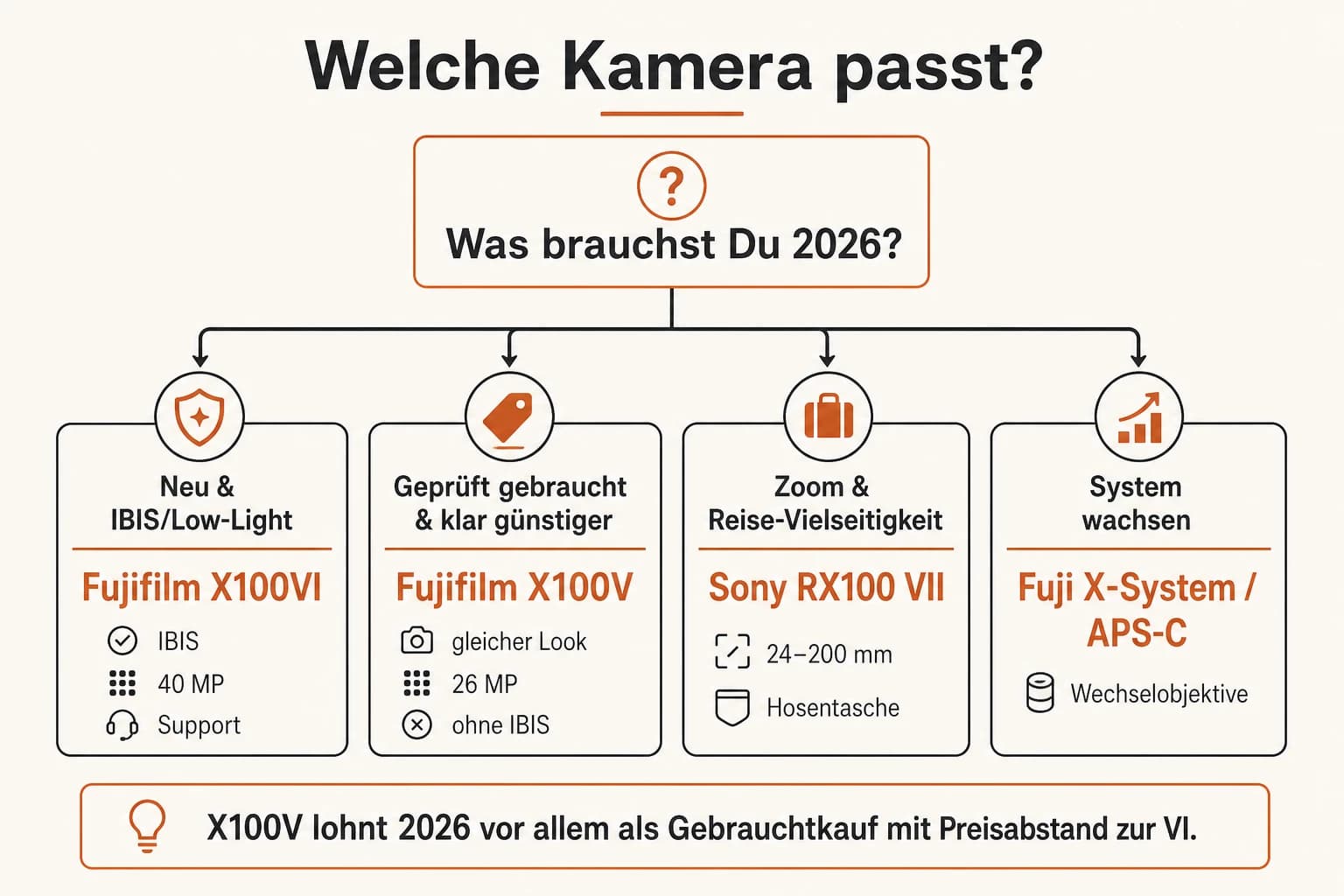
The decision tree: which camera fits you
Instead of comparing more specs, walk the tree from top to bottom. The first question decides more about your purchase than any single number from the tables above.
Decision tree — from use case to the right camera, as of August 2026
◆Want to buy new and can live with 23mm → Fujifilm X100VI
◆Find a checked X100V clearly cheaper than the VI and accept no IBIS → used X100V
◆Need 24–200mm zoom and maximum compactness → [Sony RX100 VII](/en/sony-rx100-vii-review/)
◆Mostly film in front of the lens (vlog) → lean Sony ZV-1, not X100
◆Your smartphone already covers everyday snaps → don’t buy any of the three — see FAQ
For most readers who made it this far and are investing new in 2026, the path lands on the X100VI — which is why it’s my recommendation in this review. The X100V stays often searched, rarely the smartest new/near-new buy. If you’re unsure between travel compact and system, the best travel camera guide helps.
10
Detail
Fujifilm X100VI in detail: my 2026 recommendation
After all the tables, the question remains: on the X100VI, does what convinces outweigh what annoys? Here’s the short balance before the verdict card.
Everyday strengths
IBIS turns the same lens into a more relaxed camera at dusk, indoors and for video. 40 MP gives crop reserve. Processor 5 and the newer sim package keep the JPEG workflow current. Hybrid viewfinder and analog controls stay the character people want Fuji for.
The compromises
Premium price typically around $1,600–1,800. Still fixed 23mm — no zoom. A bit heavier than the V. Anyone expecting “one camera for everything” will be disappointed; anyone who wants a fixed prime on purpose gets the most sensible X100 in 2026.
Price-wise the VI isn’t a bargain — but it’s the honest answer to the search behind “X100V review”: you want the X100 experience. New and future-proof in 2026 means VI, not a discontinued V at near-VI pricing.
Editor’s pick
Fujifilm
Fujifilm X100VI
Editor’s pick — the rational new buy in 2026
40.2 MP APS-C X-Trans CMOS 5 HR, X-Processor 5, fixed FUJINON 23mm f/2 (≈35mm full-frame equiv.) and IBIS for the first time at up to ~6 EV. Hybrid viewfinder, film simulations including newer looks, stronger video. Typically around $1,600–1,800 — the consistent choice when you’re buying new and want low-light ease, cropping headroom and longer support.
Was überzeugt
+IBIS makes low light and handheld shooting clearly more relaxed
+40 MP lets you crop without going soft immediately
+Same 23mm f/2 language and handling as the X100V
+Current processor and longer firmware outlook
+More film simulations for a JPEG-first workflow
Was Du wissen solltest
−Premium price — hype can distort availability and street price
−A bit heavier than the X100V
−Still a fixed prime — no zoom
−Too rigid if you want a system that grows with lenses
The X100V is discontinued. Used prices swing a lot — often roughly $1,100–1,400 (as of August 2026), depending on condition, accessories and hype waves. The problem: some listings sit so close to the new X100VI street price (~$1,600–1,800) that you pay almost the same for a camera without IBIS and with an older sensor/processor. Then the V isn’t value — it’s a bad trade.
When the V still makes sense: you get a checked body with a clear gap to the VI, you know the limits (no IBIS, 26 MP, Processor 4) and you want to save on purpose. Then you keep the photographic DNA — same 23mm f/2 feel, hybrid viewfinder, strong JPEG look — without paying new-premium for features you’re consciously giving up. Without that gap: leave it.
As a money keyword, “Fujifilm X100V” stays understandable: many know the name from 2020–2024. As a 2026 buying recommendation it only holds under the value condition above — otherwise the verdict deliberately points to the VI.
Budget
Fujifilm
Fujifilm X100V
Value — money keyword, mainly as checked used
26.1 MP X-Trans CMOS 4, X-Processor 4, redesigned 23mm f/2, hybrid viewfinder, tilting touchscreen, built-in ND. No IBIS. Typically around $1,100–1,400 used — worth it in 2026 mainly when the price sits clearly below a deliverable X100VI and condition/serial are verified. New stock is effectively discontinued.
Was überzeugt
+Same core look and 23mm handling as the VI
+Lighter and often cheaper than a new VI
+Strong JPEG film sims and APS-C quality
+Hybrid OVF/EVF for street and precision
+Proven series with DPReview Gold reputation
Was Du wissen solltest
−No IBIS — low light and video trail the VI
−Used prices often too close to the VI = poor value
−Discontinued — support and new stock are limited
−4K clips can overheat
Editor's Statement
“Only buy with a clear price gap to the VI and checked condition”
The Sony RX100 VII answers a different question: not “35mm feel and Fuji JPEG,” but “one pocket camera with zoom to 200mm.” With a 1" sensor, ZEISS 24–200mm, strong AF and a pop-up EVF, it’s the classic travel all-rounder — often around approx. $1,050. Less APS-C look, less film-sim romance, but reach the X100 will never deliver.
Go RX100 VII when you need architecture and telephoto without swapping lenses, want to stay maximally compact, and care more about IBIS/OIS plus zoom than Fuji character. Stay with the X100 series when you work intentionally with one focal length and prioritize viewfinder plus JPEG look. Details and a decision tree are in the Sony RX100 VII review; the broader travel framing is under best travel camera. Thinking more vlog in front of the lens: Sony ZV-1 review.
Alternative
Sony
Sony Cyber-shot DSC-RX100 VII
Alternative — zoom travel instead of a fixed prime
20.1 MP 1" sensor, ZEISS 24–200mm, hybrid AF, pop-up viewfinder. Typically around $1,050 — the right alternative when you need reach and pocket zoom instead of a fixed 35mm language. Different philosophy from the X100 series.
Was überzeugt
+Real telephoto to 200mm without swapping lenses
+Clearly smaller and lighter than an X100
+Very fast autofocus for the class
+Cheaper than current X100VI street prices
Was Du wissen solltest
−Smaller sensor — less APS-C look
−Battery is the real weakness
−No film-sim character like Fuji
−No hybrid OVF
Editor's Statement
“When zoom and travel versatility matter more than film sims”
The shopping list is short, but not optional. A few pieces separate “nice camera” from “camera you use every day.”
Spare NP-W126S battery
A second battery is mandatory for travel days and longer street rounds. OEM packs are reliable; checked third-party packs often work, with some risk on capacity and long-term stability.
Adapter ring + protective filter
Protects the front element and improves weather ambition. Many X100 users run a filter permanently — sensible as long as quality is good (check for ghosting in night lights).
Wrist strap / small strap
The camera is valuable and compact — a good strap prevents the classic “out of the hand” moment better than any marketing feature.
Suitable memory card
For 4K and the VI’s 40 MP RAWs, a solid, fast SDXC. Classes and capacity are covered in the best SD card for camera guide.
Optional: lens hood / case
A hood helps against flare and fingerprints on the filter; a slim case protects in a jacket without blocking the controls.
14
Verdict
The clear buying decision
Quick take from this Fujifilm X100V review: the X100V is a strong camera — and in 2026 often the wrong order if you’re thinking “new” or “near-new at VI pricing.” My recommendation is the X100VI: same 23mm f/2 feel, but IBIS, 40 MP and a current processor. The X100V remains an option used, when price and condition truly offset the missing stabilizer.
Need zoom instead of a fixed prime: the Sony RX100 VII is the more honest travel alternative. Shoot in front of the lens: look at the ZV-1, not the X100. If your smartphone already covers everyday snaps — save the premium budget and invest in time shooting rather than hype. Brand and system context: camera brands.
15
FAQ
Common questions about the Fujifilm X100V
Should I still buy the Fujifilm X100V in 2026?+
New: no — get the X100VI. Used: only if the price sits clearly under the VI street price, condition is checked and you can live without IBIS. If the V is priced near the VI, it’s a bad deal.
What’s the most important difference between X100V and X100VI?+
Everyday-relevant above all: IBIS (~6 EV per Fuji) and the jump to 40.2 MP with X-Processor 5. Lens (23mm f/2) and core character stay related — the VI is the more relaxed and current version of the same idea.
Does the Fujifilm X100V have an X-Processor 5?+
No. The X100V uses X-Processor 4 and the 26.1 MP X-Trans CMOS 4. Processor 5 belongs to the X100VI. Listings that mix that up are factually wrong.
Does the X100V have image stabilization?+
No, no IBIS. That’s the central weakness versus the X100VI — especially in low light, indoors and handheld video.
Is the X100V good for beginners?+
Conditional: the controls reward photographic thinking (dials, sims, fixed prime), but it’s not an “auto everything” entry. If you’re still orienting yourself in general, camera for beginners helps. Budget under $1,000: lean best camera under $1,000.
X100V or Sony RX100 VII — which is better?+
Different jobs. X100: APS-C, fixed prime, hybrid viewfinder, Fuji JPEG/film sims. RX100 VII: 1" sensor, 24–200mm zoom, aggressive AF, even more compact. Details in the RX100 VII review — choose by zoom vs. fixed prime, not by hype.
Is the X100V a good travel camera?+
Yes, if you can live with 23mm and want little weight. Need zoom flexibility: the RX100 VII or our best travel camera overview is often the better category.
How good is the X100V for video?+
Usable (4K30), but not the reason to buy. Without IBIS, handheld is more demanding. For creators in front of the lens the ZV-1 is more specialized; if you mean video seriously and want X100 feel, lean toward the VI.
Which film simulations should I use first?+
Start with Provia (neutral), Classic Chrome (street/doc) and Astia or portrait-oriented sims for skin. Better a few sims consistently than every menu item once — that’s how a recognizable look forms.
Which SD card fits the X100V / X100VI?+
A solid UHS-I/UHS-II SDXC with enough speed class for 4K and RAWs. The 40 MP VI especially benefits from faster cards. Details in the best SD card for camera guide.
How long does the X100V battery last?+
CIPA roughly around 350–420 shots depending on viewfinder/display. In practice: plan a spare NP-W126S — especially with lots of EVF, review and colder temperatures.
Is Fuji medium format worth it instead of an X100?+
Only if you’re looking for a completely different league (resolution, file size, price). The digital medium format cameras overview shows the madness and the reality — that’s not an X100 upgrade, it’s a different tool.
Is APS-C enough — or do I need full frame?+
For street, travel and web/print in typical X100 use, APS-C is absolutely enough. The technical comparison is under crop sensor vs. full frame / APS-C.
Affiliate links marked with * — Amazon product links use partner ID martinkleinhe-20. I earn a small commission if you buy through these links; it costs you nothing extra. Assessments are based on my own practice, manufacturer specs and the consensus from reviews and user reports — no brand sponsored this article.
◆ Newsletter
Stay in the loop.
Camera and photography news, honest gear tests and new articles — in your inbox. Infrequent but relevant. No spam, unsubscribe anytime.