Portrait Photography Tips 2026: Reliably Good Portraits as a Hobby Photographer
Portrait photography for beginners: light, pose, lens choice and camera settings explained clearly — with a cheat sheet at the end so you know what counts at your next shoot.
Author
Martin Kleinheinz
Photographer · Hannover
Updated
July 3, 2026
You have a camera, a willing subject — partner, child, friend — and still the images look flat, harsh or just "not like on Instagram". That's rarely missing talent. Usually three things are missing: good light, suitable settings and a calm workflow in front of the camera.
This guide is for hobby photographers who want to shoot portraits — indoors, outdoors, with a mirrorless camera or even smartphone. I explain portrait photography step by step and at the end you get a cheat sheet you can take straight to your next shoot.
00
Foundation
What good portrait photography really means
A portrait isn't a passport photo or a random snapshot. It shows a person — face, mood, gaze. Whether you mean portrait photography as a genre or simply want to photograph portraits: the rules are the same. The camera barely matters. What counts is light, connection to your subject and a few technical basics you learn once and apply again and again.
As a hobby photographer you don't need a studio with four flashes. Most portraits people love — family photos, partner portraits, friend shoots — happen with one window, a fast prime lens and ten minutes of calm. Pro gear doesn't automatically make portraits better. It only makes them more expensive when fundamentals are missing.
1. Light
Soft, directional, predictable — not random from the ceiling.
2. Eyes
Sharp, visible, with direction — the viewer's eye lands there first.
3. Background
Calm, not distracting, ideally softly blurred.
4. Connection
A relaxed face comes from conversation, not "Smile!" commands.
01
Light
Light — the main lever in portrait photography
In portrait photography light isn't decoration — it shapes the face. Hard light from above creates shadows under eyes and nose. Soft light flatters skin tones and makes wrinkles less harsh. As a hobby photographer you have two reliable sources that almost always work: window light and the golden hour.
Window light — your best studio at home
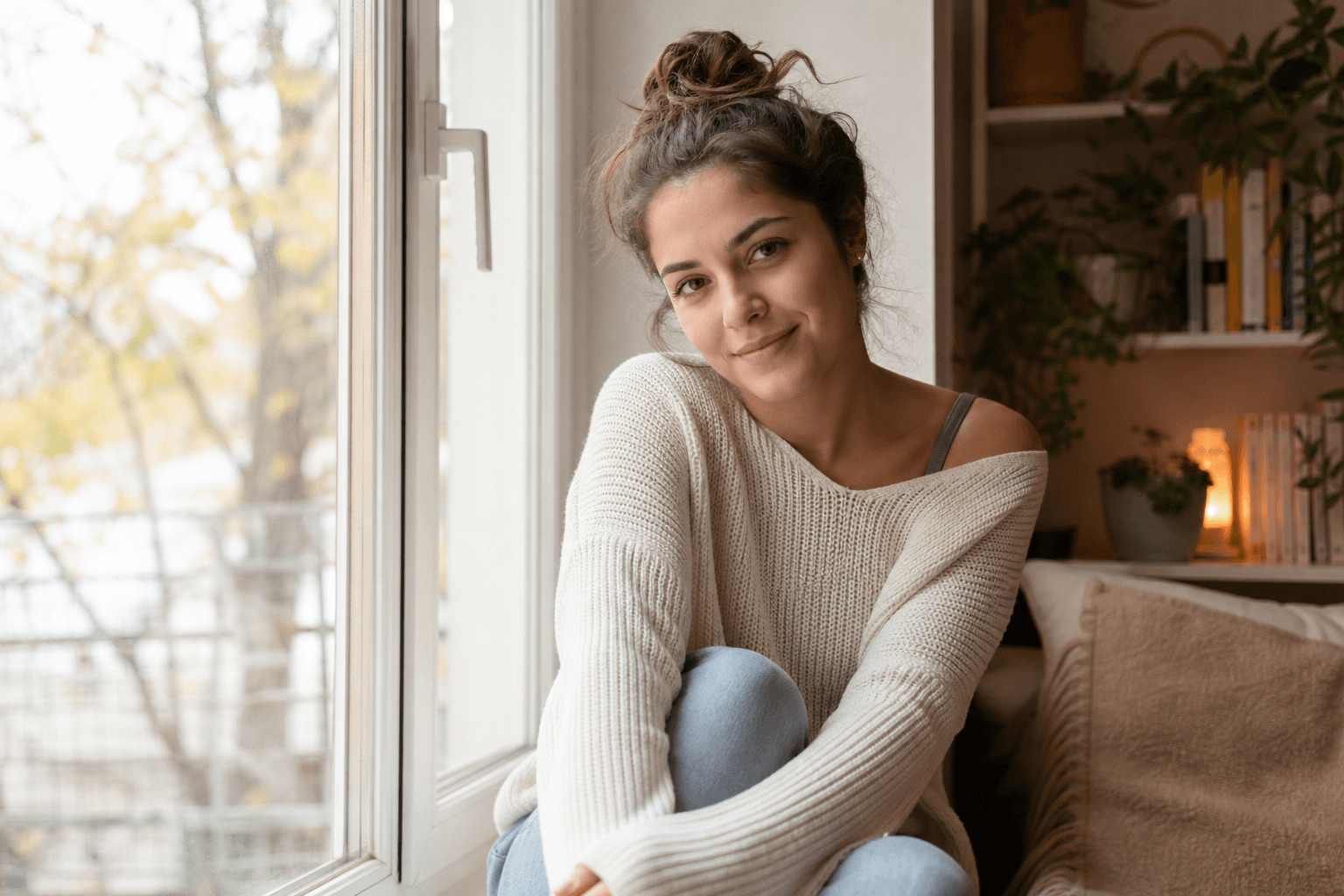
Place your subject sideways to the window — not head-on, not with their back to the light. The face gets a bright and a shadow side. That looks three-dimensional and professional without adjusting anything except position and distance. A large window with indirect daylight (no direct midday sun) is ideal. A white curtain diffuses the light further.
Sideways window light: the easiest path to soft portraits
Golden hour outdoors
Shortly after sunrise and before sunset the light is warm and soft. Perfect for outdoor portrait photography. Position yourself so the sun falls sideways or slightly from behind on your subject — not straight into their eyes. A reflector (or white wall, bright T-shirt) from the front can fill shadows on the face.
Three lighting situations to avoid
◆Midday sun from above — harsh shadows, squinting eyes.
For photographing portraits as a hobby the kit lens often suffices — but upgrading to a fast prime (f/1.8) makes the biggest visible difference. You get more background blur, better light in low brightness and sharper images at the same aperture.
Situation
Focal length (full-frame eq.)
Why
Half-length, everyday
50 mm
Natural perspective, affordable, versatile
Classic portrait
85 mm
Flattering perspective, beautiful bokeh
Tight space, family
35 mm
More environment, close to the action
APS-C camera
50 mm or 56 mm
Roughly 75–85 mm full-frame feel
Focal lengths for portrait photography — in depth in [Which Focal Length for What](/en/which-focal-length-for-what/)
My standard tip for beginners: 50mm f/1.8 for your system — unless you shoot almost only in small rooms, then 35mm f/1.8. Which specific model fits is in the Lens Guide.
03
Background
Keep the background calm — bokeh without pro glass
A good portrait directs the eye to the face. The background should not compete — no running people, no colourful signs, no messy shelf right behind the head. Three simple tricks for hobby portrait photography:
Create distance
Place the subject well in front of the background. The farther the background, the softer it looks — even with a kit lens.
Open the aperture
f/1.8 to f/2.8 (prime) or f/4–f/5.6 (zoom). The more open, the softer the background.
Simple surfaces
Wall, hedge, water, sky — uniform or calmly textured.
Distance + open aperture = calm background without an expensive lens
04
Technique
Camera settings for portraits — without overwhelm
You don't have to set everything manually. For photographing portraits as a hobby A mode (aperture priority) or P with a little help is usually enough. Here's how to start:
Setting
Recommendation
Note
Mode
A (Av) — aperture priority
You choose aperture, camera chooses shutter
Aperture
f/1.8 – f/2.8 (prime)
More bokeh; for groups f/4 – f/5.6
ISO
As low as possible
In low light ISO 800–1600 is ok
Shutter
Auto — min. 1/125 s
For kids/movement prefer 1/250 s
White balance
Auto or daylight
With window light often "Daylight" or "Cloudy"
Format
RAW or RAW+JPEG
RAW gives more room for skin tones
Starter settings for portrait photography — fine-tune per situation
If the face is too dark: exposure compensation +0.3 to +1.0 EV — especially with bright backgrounds (window, sky). Slightly bright and pull back in editing beats too dark with noisy shadows.
Lightroom Presets9 film looks inspired by Portra, Kodak & Fuji —View pack →
05
Sharpness
Eyes sharp — always
In portrait photography: the nearer eye (to the camera) must be sharp. Sharp background and soft eyes — the portrait is gone. Use eye autofocus (Eye-AF) if your camera has it. Otherwise: single-shot AF, focus point on the eye, half-press, recompose, shoot.
◆Single portrait: Eye-AF or focus on the front eye.
◆Profile: Focus on the visible eye.
◆Child moving: burst mode, 1/250 s or faster, AF-C (continuous).
◆Too soft at f/1.8: close aperture to f/2.2 or f/2.8 — more depth of field.
06
Composition
Crop and composition
Portraits don't live on the face alone. The crop decides too. Three proven variants for hobby portrait photography:
Classic
Head and shoulders — eyes on the upper third line, some space in the gaze direction.
Half-length
To the hips — hands visible, good for relaxed poses.
With environment
Full body or person in scene — tells a story, needs a calm background.
The rule of thirds is your friend: face not dead centre, slightly offset. For profile shots: space in front of the gaze. More on composition in general: Golden Ratio in Photography and Take Better Photos.
07
People
Pose & communication — relaxed faces
Technique alone isn't enough. Portrait photography is also conversation. Most people are tense in front of the camera — especially when they "should smile". Your job as a hobby photographer isn't to be a posing coach but to create calm.
Explain beforehand
"I'll take a few test shots — no pressure." That lowers expectations.
Relax the body
Drop shoulders, chin slightly forward-down (don't tuck in), weight on one leg.
Keep hands busy
Pockets, cup, hair, jacket — hands in trouser pockets often look stiff.
Real reactions
Ask questions, make them laugh, tell something — instead of "Say cheese".
Breaks
Every 20 shots a short pause — no machine-gun 200 images.
“A good portrait doesn't only show a face — it shows a moment when the person forgot the camera was there.”
— Martin Kleinheinz
08
Mistakes
The most common mistakes in hobby portrait photography
Before the cheat sheet — the mistakes I see most often in workshops:
Mistake
Why it hurts
Quick fix
Hard ceiling light
Unflattering shadows
To the window, light from the side
Too close to subject
Distorted faces (wide angle)
Step back, zoom or longer focal length
Soft eyes
Portrait looks "cheap"
Eye-AF, close aperture, burst mode
Chaotic background
Distraction from face
Move subject, open aperture, change angle
Commanding "Smile!"
Stiff faces
Talk, wait, catch real moment
Too many images without selection
No learning
20 good attempts > 200 random shots
JPEG only, too dark
Skin tones not recoverable
RAW + slight overexposure
Typical mistakes when photographing portraits — and what helps immediately
09
Cheat Sheet
Your portrait cheat sheet — to take with you
This is your overview at a glance. Save the table or screenshot it — and run through it once before your next shoot. If you check these points you get reliably better portraits — without rethinking everything each time.
Step
Check
Concrete
1 · Light
✓ Soft, sidelight
Window sideways OR golden hour — no ceiling light, no frontal midday sun
2 · Location
✓ Calm background
Subject 2–3 m in front of wall/hedge; no distractions behind head
3 · Lens
✓ Suitable focal length
50–85 mm (eq.); f/1.8 prime if available
4 · Mode
✓ A (aperture priority)
Aperture f/1.8–f/2.8 (solo) or f/4–f/5.6 (group)
5 · ISO
✓ As low as possible
800–1600 in low light is ok; don't stay at 100 out of fear
6 · Shutter
✓ No motion blur
Min. 1/125 s — 1/250 s for kids
7 · Focus
✓ Eyes sharp
Eye-AF or focus on front eye, half-press, recompose
Portrait photography cheat sheet — 11 steps to reliably good portraits
Three standard scenarios — copy & paste
Scenario
Setup in 30 seconds
Portrait at home
Subject 1 m sideways to window · 50 mm · f/2 · A mode · Eye-AF · 20 images, pick best 3
Portrait outdoors (evening)
Sun sideways · background far away · 85 mm or 56 mm · f/2 · +0.3 EV · reflector optional
Child / movement
Shady spot or overcast sky · 1/250 s · f/2.8 · AF-C · burst · focus on eyes
Quick setups for photographing portraits — without long thinking
“Good portrait photography isn't luck. It's a checklist — and you have it now.”
— Martin Kleinheinz
10
FAQ
Frequently asked questions about portrait photography
Which camera do I need for portrait photography?+
Any modern camera is enough — smartphone, mirrorless or DSLR. What counts is light and lens (ideally 50mm f/1.8). More: Camera for Beginners.
Which aperture is ideal for portraits?+
Single portrait: f/1.8 to f/2.8 for beautiful bokeh. Group or uncertain sharpness: f/4 to f/5.6. Slightly closed and sharp eyes beats wide open and soft.
How do I photograph portraits in bad light?+
Use window light, raise ISO (800–3200), open aperture, tripod or steady hands. Avoid ceiling light. No flash without diffuser unless you're practised.
Do I need a flash for portraits?+
No, not to start. Window light and daylight are enough for most hobby portraits. A flash pays off later for controlled light — with softbox or bounce, not aimed hard.
How do I edit portraits?+
Adjust brightness, contrast, skin tones gently — don't overdo it. In Lightroom: HSL for skin, slight clarity reduction. Basics: Photo Editing for Beginners.
What's the most important thing in portrait photography?+
Soft, sidelight — e.g. window light or golden hour. Then: sharp eyes, calm background and relaxed communication with your subject.
From my workflow
35mm & 120mm film presets
Portra, Kodak Gold, Velvia, HP5 & more — ready-made XMP presets for Lightroom Classic and mobile.
Transparency notice: This article contains affiliate links. If you buy through them I earn a small commission at no extra cost to you. Editorial content is unaffected.
◆ Newsletter
Stay in the loop.
Camera and photography news, honest gear tests and new articles — in your inbox. Infrequent but relevant. No spam, unsubscribe anytime.