Canon EOS R10 Review: Canon R10 Straight Talk for Beginners
Which Canon is worth buying to learn in 2026 — and when the R50 or R8 is enough?
Author
Martin Kleinheinz
Photographer · Content Creator · Hannover
Updated
August 28, 2026
You want a mirrorless camera you can actually learn on: a real viewfinder, a joystick for the AF point, Dual Pixel AF, an RF system with room to grow — and a price that doesn’t smell like pro cosplay. That’s the promise of the Canon EOS R10. Behind “Canon R10” and “Canon EOS R10 review” in 2026 sits the same question: do I need the R10 — or is the cheaper R50 enough? And should I jump straight to the R8?
I put the R10 in beginners’ hands on purpose — not because it has the loudest spec sheet, but because it does the right things well for learning: EVF in bright sun, joystick instead of touch fumbling, two control dials, AF that holds faces and eyes. What short tips often skip: R10 and R50 deliver similar image quality in practice. The splitter is handling and features — not megapixel theater.
Here you get a clear buying call from practice, manufacturer specs and what reviews and user reports agree on in 2026. Why the R10 stays the right pick for learning (as under camera for beginners), when the R50 honestly works as the cheaper, more compact alternative — and why the R8 is full frame, not “the better R10.” By the end you’ll know which Canon fits your start.
00
Short
Is the Canon EOS R10 worth it in 2026? The quick verdict
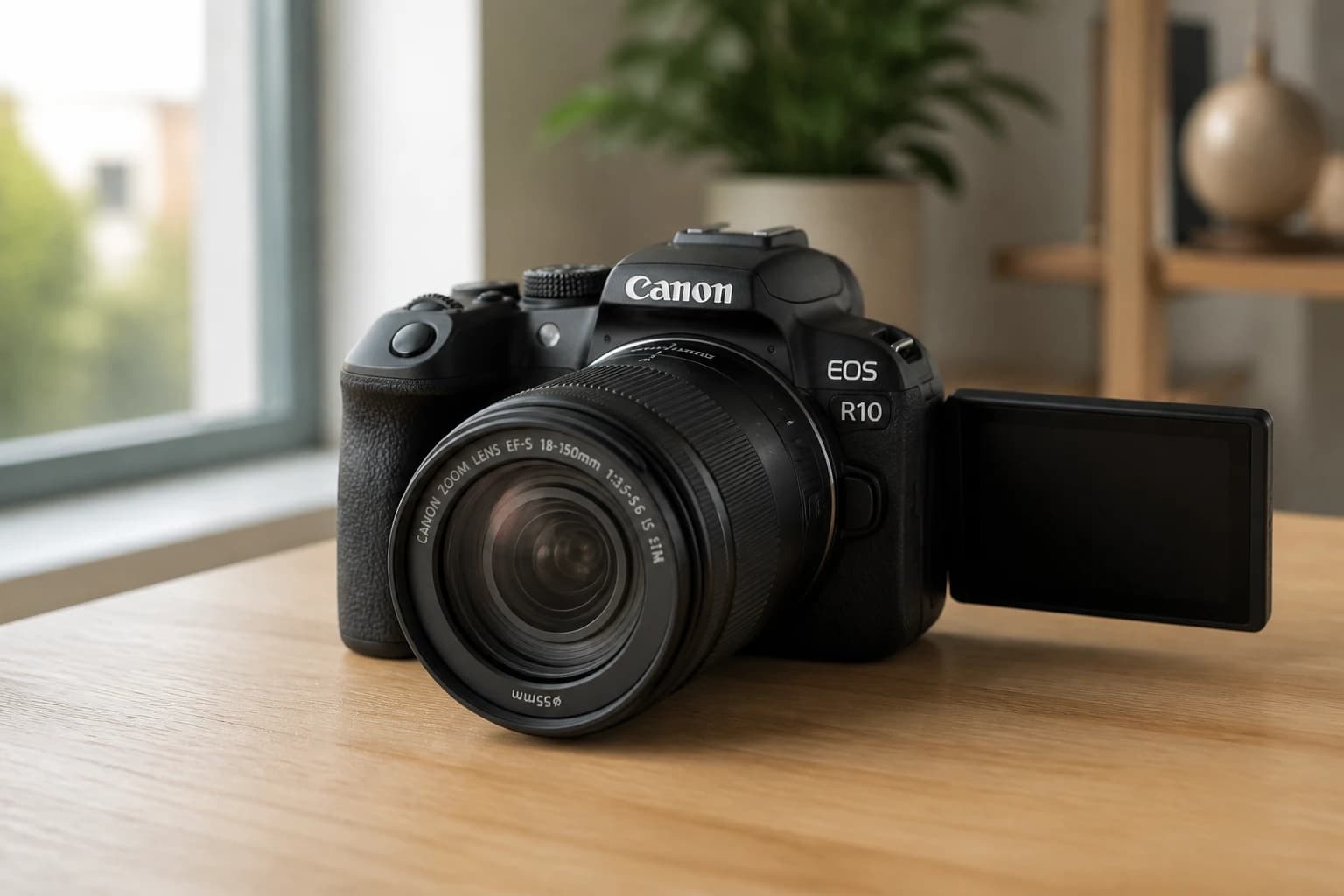
Short version: the Canon EOS R10 is the camera I put in beginners’ hands in 2026. It has a real viewfinder, joystick, Dual Pixel AF and an RF system you can grow into — typically around $1,100 to $1,250 as a kit.
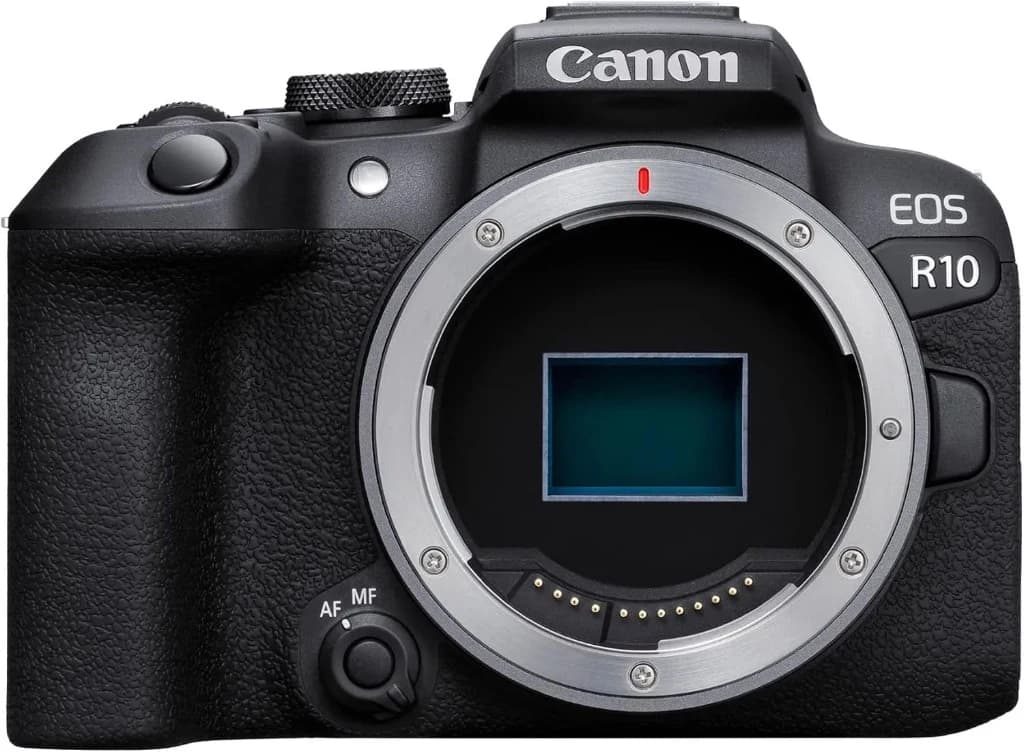
On the tech side you get 24.2 megapixels APS-C, DIGIC X, Dual Pixel CMOS AF II, an EVF with 2.36 million dots, two control dials, burst up to 15/23 fps, 4K30 oversampled plus 4K60 with crop. The body weighs about 429 g, the battery is LP-E17. No IBIS — honest, but everyday-usable with IS lenses and solid technique.
The Canon EOS R50 (roughly $600–800) is the cheaper, lighter pick when budget and compactness come first — less handling, no joystick, no 4K60, UHS-I. The Canon EOS R8 (about $1,000–1,300 body only) is the full-frame entry: more low light and bokeh, a different price band and a different philosophy. Not a “better R10.”
Top 3
My three recommendations
**#1 Canon EOS R10** — when you want to learn and grow (EVF, joystick, Dual Pixel AF, solid handling). **#2 Canon EOS R50** — when budget and compactness come first, not because it’s better for learning. **#3 Canon EOS R8** — when you consciously want full frame and low light/bokeh matter more than beginner handling at the best price.
Vergleich
Canon
Canon EOS R10 (RF-S 18–150 kit)
Canon
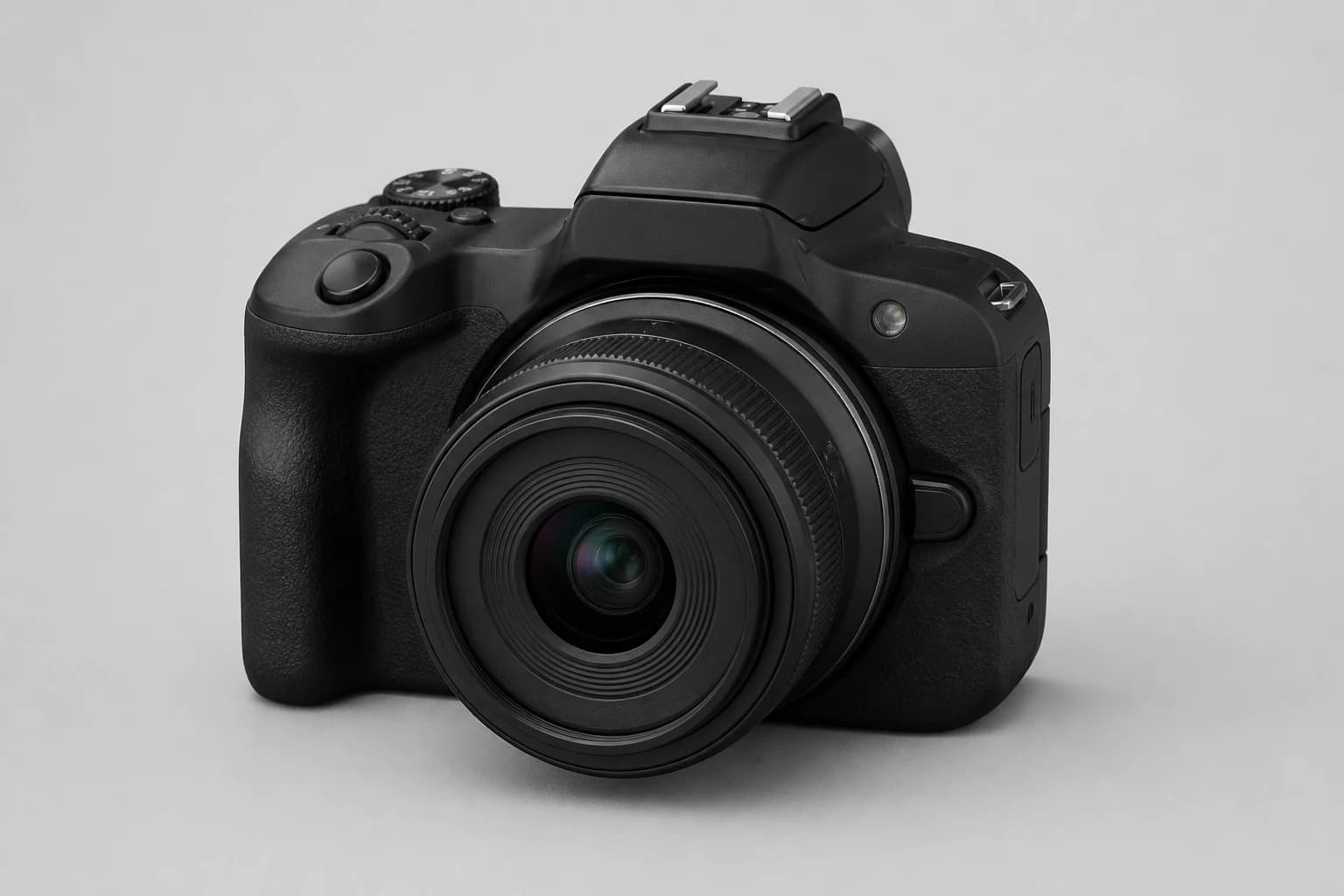
Canon EOS R50 (18–45 kit)
Canon
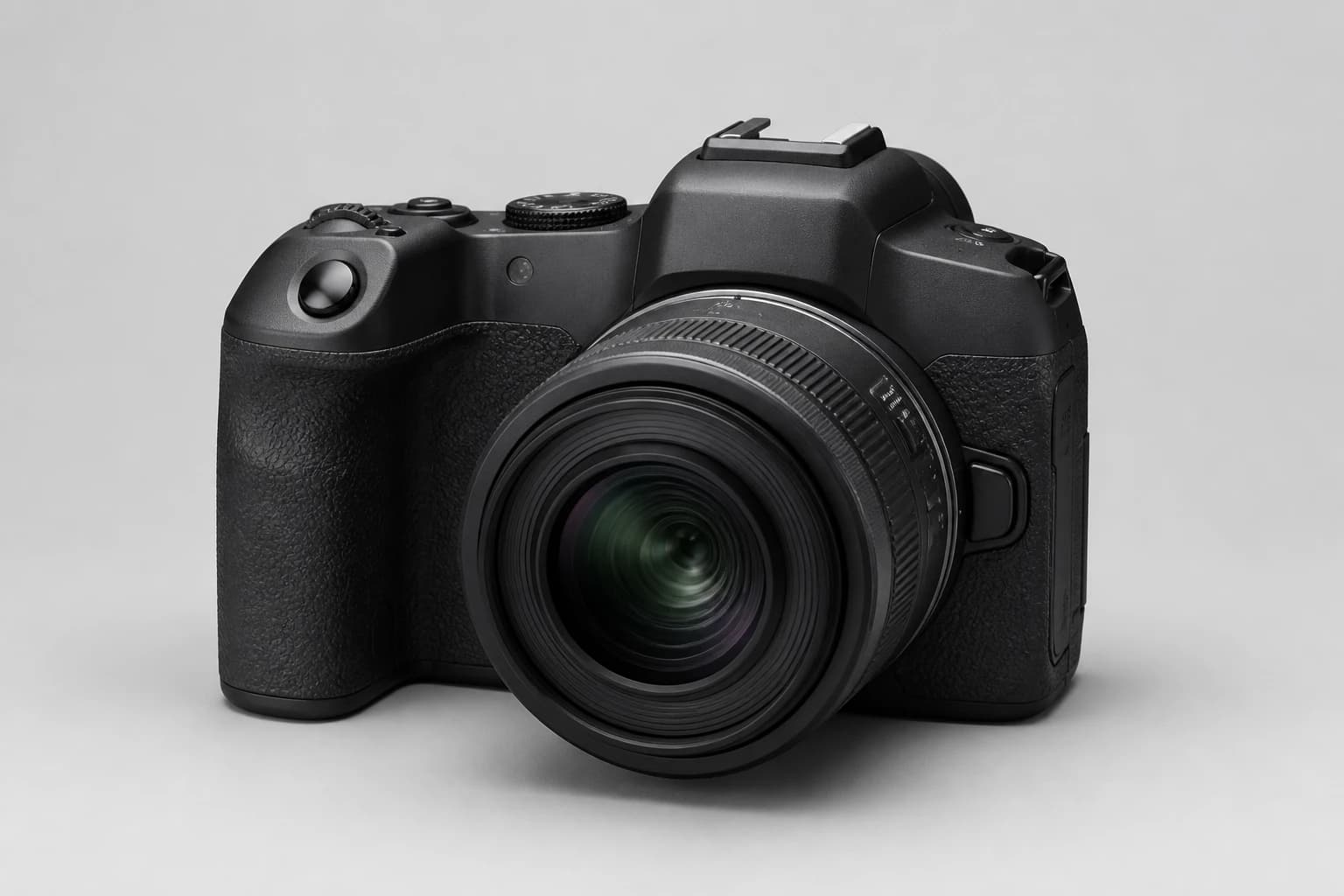
Canon EOS R8 (body)
Bild
Empfehlung
Editor’s pick
Budget
Upgrade
Sensor
24.2 MP APS-C CMOS
24.2 MP APS-C CMOS
24.2 MP full-frame CMOS
ISO-Bereich
Dual Pixel CMOS AF II
Dual Pixel CMOS AF II
Dual Pixel CMOS AF II
Autofokus
15 fps mech. · 23 fps electronic
up to 12 / 15 fps
up to 40 fps electronic
Detail
4K/30 OS · 4K/60 crop
4K/30 (no 4K/60)
4K/60 full width
Stärken
+Joystick + dual dial — a real learning and working camera
+Very strong AF and fast burst for the class
+EVF and grip: better entry than display-only
+RF system with adapter path to EF
+4K/60 (crop) as a plus vs. the R50
+Clearly cheaper and lighter than the R10
+Same strong Canon AF character for beginners
+Very compact for travel and everyday use
+RF-S entry without a big premium
+Real full frame — more low light and bokeh
+Strong hybrid video (4K/60)
+Lightest Canon FF body in the class
+Same RF path as the R10 — lenses stay
Schwächen
−No IBIS — lens IS helps, but not everywhere
−No headphone jack
−LP-E17 gets short with lots of EVF use
−Native RF-S lineup still narrower than Sony E
−No joystick, fewer physical controls
−No 4K/60 per Canon specs
−UHS-I instead of UHS-II
−Less “learning camera” feel than R10 with grip/dials
−Body alone already in R10 kit price range — glass extra
−No joystick
−No IBIS
−Same small LP-E17 battery
Geeignet für
Beginners and switchers who want to grow with a viewfinder, AF and a system — family, travel, hobby action.
Budget and travel-light entries — when handling matters less than price and size.
Portrait, low light and hybrid — when you step into full frame on purpose.
Before specs and burst rates: does your use case even fit a beginner mirrorless with APS-C and interchangeable lenses? The R10 isn’t a pocket wonder and isn’t a full-frame studio tool — it sits right in between. The table shows where it’s strong and where another camera makes more sense.
Use case
Does the R10 fit?
Why
Starting a hobby / learning
Excellent
EVF, joystick, Dual Pixel AF, RF system with room to grow — my pick under camera for beginners
Family / kids / everyday
Excellent
Fast AF, burst, handy — without pro weight
Travel (system kit)
Good
Light for an APS-C system; 18-150 kit often more practical than 18-45 — see best travel camera
Then lean R50 — lighter and cheaper, less handling
Low light / maximum bokeh
Conditional
APS-C has limits — then R8/full frame or fast lenses
Sports / wildlife (serious)
Conditional to good
AF and burst are strong for the class; telephoto and budget decide — not the body alone
Fit assessment from my own practice and user consensus — as of August 2026
Beginners who want to learn photography and grow get exactly what phones and bare compact cameras often don’t deliver with the R10: a viewfinder, manual control and a system you can buy lenses into. If you’re more after “a small camera to carry,” find orientation under compact mirrorless cameras. Unsure between old DSLR baggage and mirrorless: mirrorless vs. DSLR.
02
Data
The specs: R10 vs. R50 vs. R8 at a glance
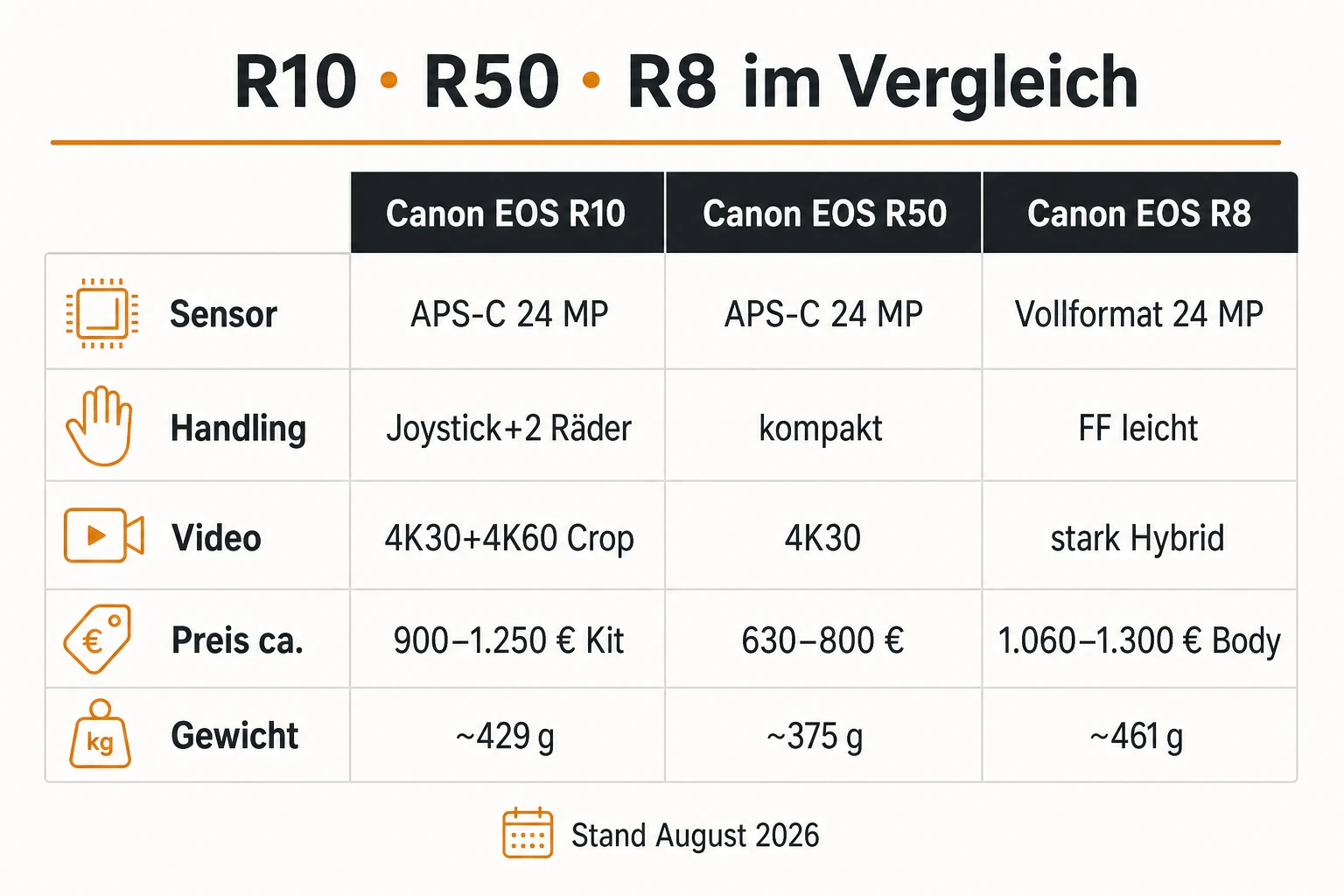
Here are the numbers per Canon and spec consensus — short version: R10 and R50 sit in the same APS-C entry class. The splitter is features and handling, not a magic image-quality jump. The R8 plays in another league: full frame. Every row shows up again in the practice check later.
Category
Canon EOS R10
Canon EOS R50
Canon EOS R8
Sensor
24.2 MP APS-C CMOS
24.2 MP APS-C (similar class)
24.2 MP full frame
Processor
DIGIC X
DIGIC X
DIGIC X
Autofocus
Dual Pixel CMOS AF II
Dual Pixel CMOS AF II
Dual Pixel CMOS AF II
Burst
up to 15 fps mech. / 23 fps electronic
up to 12 / 15 fps class (per spec)
up to 40 fps electronic (per spec)
Video
4K30 oversampled · 4K60 with crop
4K30 (no 4K60)
strong 4K package (full-frame hybrid)
Viewfinder (EVF)
2.36 million dots
2.36 million dots
2.36 million dots
Stabilization
No IBIS
No IBIS
No IBIS
Controls
Joystick · dual dial · more grip
no joystick · more compact
full-frame handling, different body feel
Card slot
UHS-II SD
UHS-I SD
UHS-II SD
Audio
Mic in, no headphone
Mic in, no headphone
Mic in + headphone (per spec)
Battery
LP-E17
LP-E17
LP-E17
Weight (approx.)
~429 g (body)
lighter / more compact
~461 g (body, full frame)
Mount
RF (APS-C)
RF (APS-C)
RF (full frame)
Street price US 2026
Kit ~$1,100–1,250
~$600–800
Body ~$1,000–1,300
R10 vs. R50 vs. R8 — core specs, as of August 2026
On paper the R50 looks like “almost the same camera cheaper.” Day to day you miss the joystick, second dial and 4K60 crop — and the card slot is UHS-I. The R8 shares DIGIC X and Dual Pixel DNA but switches sensor philosophy. Whether that justifies your purchase price is what the next section clears up.
03
Everyday
Handling, viewfinder and kit: what the datasheet leaves out
Numbers say little about how the R10 feels when you shoot family, a city walk or your first course. Here’s the everyday check — from my own practice with Canon’s RF entry class plus consensus from reviews and user reports. Not a lab protocol, but what decides the buy: viewfinder, joystick, weight, battery and kit choice.
EVF — the underrated learning lever
The electronic viewfinder with 2.36 million dots is gold for beginners: in sun you see exposure and focus without fighting the screen. Many budget cameras cut exactly here — the R10 doesn’t. Anyone who only shoots off the display often loses speed and precision in practice.
Joystick & dual dial — why I prefer the R10 for learning
Move the AF point with the joystick, aperture/shutter on two dials — that’s craft you keep. The R50 is lighter and cheaper, but you work more through touch and menus. For “learn fast and stay in control,” the R10 stays clearer. That’s the core difference — not file size.
Size & weight (~429 g)
Light enough for everyday and travel, grippy enough for confidence. Versus true pocket cameras it’s a system: lens changes, some bulk. Versus full-frame bodies APS-C stays handier — see also compact mirrorless camera.
Battery LP-E17
Same battery type as R50 and R8 entry: solid for the day if you’re not running endless review and Wi‑Fi. Practice: a spare belongs in the kit — especially on travel days and light events.
Kit 18-45 vs. 18-150
The RF-S 18-45 is light and cheap — ideal to start, but short on tele. The RF-S 18-150 costs more, but often saves you a second lens buy for vacation, zoo and everyday reach. For travel logic: lean 18-150; for pure learning at wide/standard: 18-45 often enough. Travel priority details: best travel camera.
Weather & toughness
Entry body, no pro sealing. In rain: common sense and a bag — not “action-cam mentality.” Totally fine for hobby everyday if you’re honest about it.
In reviews and user reports, AF, viewfinder and value of the R10 get praised often. The criticism repeats: no IBIS, kit zooms more “okay than spectacular,” video without a headphone jack. That matches what I see: clear strengths for learning, clear limits — no universal wonder.
04
Image
Image quality: APS-C 24.2 MP — enough to grow on
24.2 megapixel APS-C with DIGIC X isn’t a hype topic in 2026 — and that’s exactly why it’s strong for beginners: enough detail for web, print and light crop, without files and workflow overwhelming you. The photographic difference vs. the R50 day to day is not in the sensor look. The difference vs. the R8 is: full frame changes low-light headroom and bokeh potential at the same f-stop — see crop sensor vs. full frame.
◆Daylight: crisp, punchy Canon JPEG color, RAW with reserve for corrections
◆ISO practice APS-C: up to roughly ISO 1600–3200 often everyday-usable; beyond that depends on subject and output — full frame (R8) has more headroom here
◆Dynamic range: solid for the class; highlights and shadows usable, no medium-format theater
◆Bokeh: comes mainly from the lens (focal length, aperture, distance) — not the body name
◆R10 vs. R50 image quality: practically sibling class — buy decision on handling and features
The knack point is honest: many beginners hunt “better image quality” and really mean a better lens, better light or better technique. An RF-S kit zoom shows you the world; a fast prime changes the look more than jumping R50→R10. Portrait glass: which lens for portrait.
For storage and burst, the best SD card for camera guide helps — the R10 can do UHS-II, the R50 stays UHS-I. Brand and sensor context: camera brands.
05
AF
Autofocus & burst: Dual Pixel for learning and locking on
Dual Pixel CMOS AF II is one reason the R10 works as a learning camera: face/eye, animals, vehicles — AF delivers what beginners need in practice without a tracking seminar. Burst up to 15 fps mechanical and 23 fps electronic (per spec) is strong for family, light sports and action moments in this price class.
Eye AF & subject detection
For portraits, kids and pets, the everyday win: you focus on moment and composition, the camera often holds focus reliably. In tough light or occlusion you occasionally need a nudge — normal, not a marketing myth.
Joystick = faster AF point
Exactly where R10 separates from R50 in learning day-to-day: move the AF area without a finger on the screen while using the viewfinder. Anyone who works the EVF a lot feels the difference immediately.
Use burst with intent
Short sequences for kids, sports, animals: yes. Endless spray without purpose: no — buffer, card and culling load grow. UHS-II on the R10 helps with faster cards; details: best SD card for camera.
Limits, honest
Pro sports and wildlife at distance need telephoto, light and practice first — not just “23 fps” on the box. The R10 is strong for the class, not a 1D replacement.
In practice that means: for the typical R10 buyer (getting started, family, wanting to grow), AF is a purchase argument — not a footnote. The joystick only makes it more usable day to day.
06
Video
Video: strong for hybrid light — not a pure creator body
The R10 delivers 4K30 oversampled (good detail base) and 4K60 with crop. For Reels, Shorts, family clips and hybrid everyday that’s often enough. There’s mic in, but no headphone jack — monitoring external audio stays blind. No IBIS means: handheld video benefits from IS lenses, a steady stance and electronic stabilization if needed — or a gimbal if you’re seriously in front of the lens.
◆R10: 4K30 oversampled · 4K60 crop · mic in · no headphone
◆R50: 4K30, no 4K60 — still fine for many creators when budget matters
◆R8: full-frame hybrid with a different video claim and price band
◆Audio: external mic recommended as soon as voice matters
Short: video is a real strength of the R10 in the beginner class — but not the sole buying reason. Photo handling and learning curve stay the core of this review.
07
Decision
R10 vs. R50 vs. kit: handling decides — not megapixels
This is the core of this Canon EOS R10 review: R10 and R50 feel related — similar sensor class, Dual Pixel DNA, RF-S ecosystem. They’re still not interchangeable “just take the cheaper one.” The splitter is controls and features. And in parallel, the kit lens decides how long you last without a second purchase.
You need …
Lean R10
Lean R50
Learning with EVF + joystick + dual dial
Clearly better — my recommendation
Works — more touch/menu
Squeeze the budget hard
More expensive
Clearly cheaper (~$600–800)
Lightest / most compact body
Slightly larger/grippier
Lighter / more compact
4K60 (with crop)
Yes
No (4K30)
Faster cards (UHS-II)
Yes
UHS-I
Image quality “better”
Practically equal
Practically equal
My recommendation 2026
For learning and growing
Budget / compact alternative
Decision matrix R10 vs. R50 — as of August 2026
Kit 18-45 vs. 18-150 — the second decision
The 18-45 is the light entry: cheap, compact, fine for standard everyday — tele is missing. The 18-150 covers vacation, light events and “one zoom for a lot” better and often saves a second lens. Travelers who don’t want to swap constantly often pay the 18-150 premium with less frustration. If you only want to learn and later buy primes on purpose, starting with 18-45 makes sense.
Simply put: the R50 isn’t a bad camera — it’s the cheaper, more compact sibling. The R10 remains the camera I put in beginners’ hands because handling matters when learning. Anyone who flips that and sells the R50 as “just as good for learning, only cheaper” undersells joystick, dual dial and viewfinder-speed.
08
Comparison
Three Canon options in direct comparison
The decision matrix above settled handling. Here’s the side glance at all three: graphic for overview, table for details — R10 for learning, R50 as budget, R8 for the conscious full-frame entry.
R10 vs. R50 vs. R8 — as of August 2026
Criterion
EOS R10
EOS R50
EOS R8
Sensor
24.2 MP APS-C
24.2 MP APS-C
24.2 MP full frame
Role 2026
My learning recommendation
Budget / compact
Full-frame entry
Handling
Joystick · dual dial
lighter, fewer dials
full-frame body, different feel
Video highlight
4K30 OS · 4K60 crop
4K30
stronger full-frame hybrid package
IBIS
No
No
No
Card slot
UHS-II
UHS-I
UHS-II
Weight body approx.
~429 g
lighter
~461 g
Price approx.
Kit $1,100–1,250
$600–800
Body $1,000–1,300
As of August 2026 — check exact prices and availability at the shop
Versus the R50 the R10 wins on learning handling and features; it loses on price and compactness. Versus the R8 the R10 wins on beginner price and APS-C tele reach; it loses on low-light headroom and the larger sensor’s natural bokeh potential. No option is objectively best — each answers a different question. Sensor context: crop sensor vs. full frame. Travel: best travel camera.
09
Decision
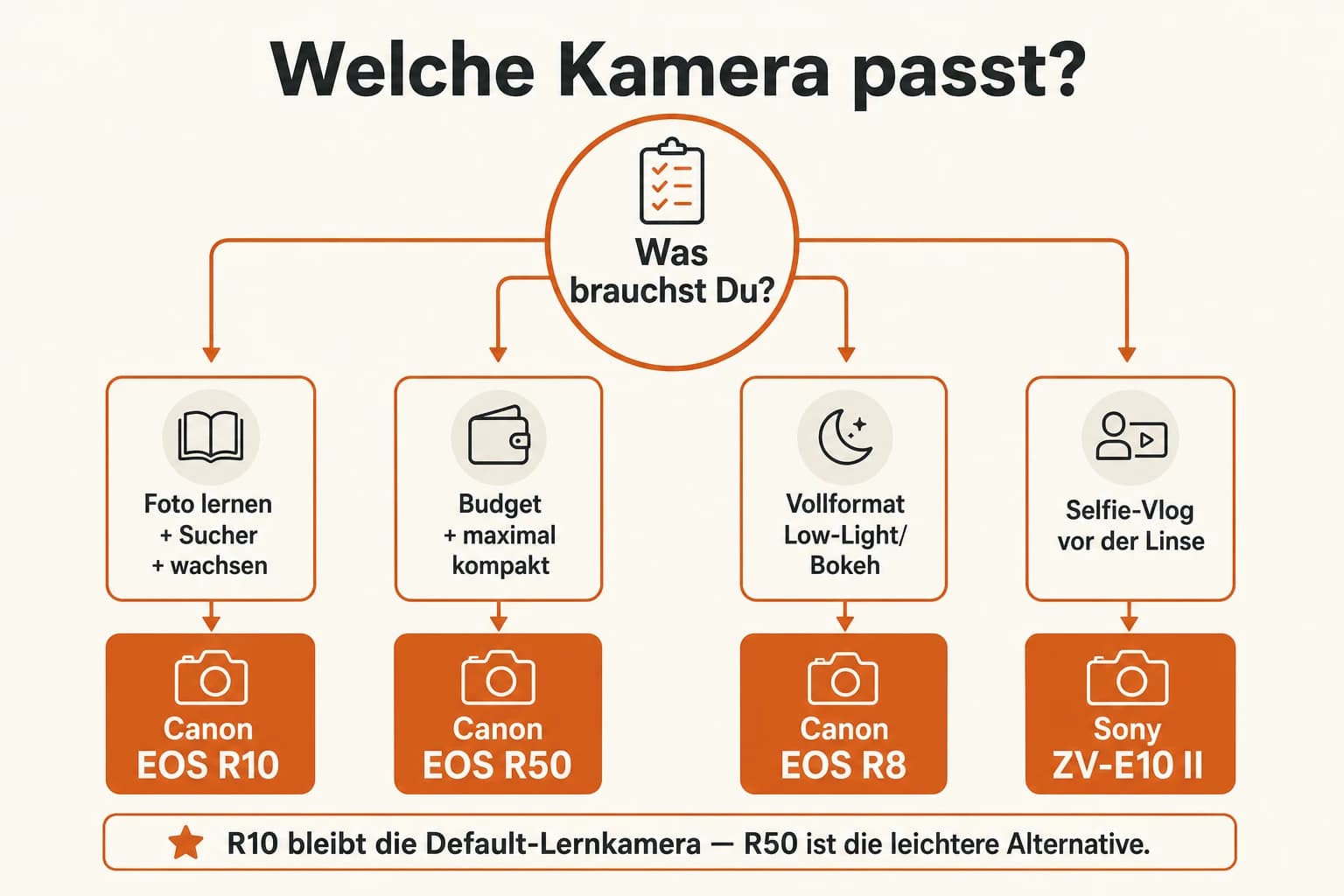
The decision tree: which Canon fits you
Specs enough — now the path. Walk the tree top to bottom. The first question (learn vs. budget vs. full frame) decides more than any single number from the tables above.
Decision tree — from use case to the right camera, as of August 2026
◆Want to learn, shoot family, grow a hobby with viewfinder and joystick → Canon EOS R10
◆Want to save hard / lighter body and accept less handling → Canon EOS R50
◆Want full frame on purpose (low light and bokeh) → Canon EOS R8
◆Travel with zoom priority in the kit → R10/R50 lean 18-150, see best travel camera
For most readers who’ve read this far and want to learn photography, the path lands on the R10 — that’s why it’s my recommendation in this review and stays consistent with camera for beginners. The R50 stays right when budget and compactness come first — not because it’s the better learning camera. The R8 stays right when full frame is the conscious next step.
10
Detail
Canon EOS R10 in detail: the camera I recommend for learning
After tables and tree, the balance: does what convinces outweigh what annoys on the R10? Short, before the verdict card — and why it stays my beginner recommendation.
Everyday strengths
EVF, joystick, dual dial, Dual Pixel AF II, strong burst for the class, 4K30 oversampled, RF system with real future. Typically ~$1,100–1,250 as a kit: you get a camera you can grow on for years without feeling you “started wrong.” That’s exactly why I recommend it for learning — not because of marketing.
The compromises
No IBIS, kit zooms are everyday glass (not portrait wonders), no headphone jack, LP-E17 needs a spare strategy on long days. Anyone who wants maximum bokeh and low light pays for glass sooner or later — or goes to full frame on purpose (R8).
On price the R10 isn’t undercutting the R50 for bargains — it’s the honest answer to “which Canon for learning?”: you pay for handling that makes you better. In 2026 that often means R10, not blindly the cheapest RF APS-C.
Editor’s pick
Canon
Canon EOS R10 (RF-S 18–150 kit)
My learning pick — viewfinder, joystick and speed
24.2 MP APS-C, Dual Pixel CMOS AF II, bursts up to 15/23 fps, EVF, joystick and two control dials. 4K/30 oversampled plus 4K/60 with crop. Typically around $1,100–1,250 in the 18–150 kit (18–45 cheaper) — the camera most beginners learn photography fastest with. No IBIS; LP-E17 battery is tighter at the EVF.
Was überzeugt
+Joystick + dual dial — a real learning and working camera
+Very strong AF and fast burst for the class
+EVF and grip: better entry than display-only
+RF system with adapter path to EF
+4K/60 (crop) as a plus vs. the R50
Was Du wissen solltest
−No IBIS — lens IS helps, but not everywhere
−No headphone jack
−LP-E17 gets short with lots of EVF use
−Native RF-S lineup still narrower than Sony E
Editor's Statement
“When you want to learn photography and grow in the RF system”
Canon EOS R50: budget & compact — with a clear purpose
Many people see the Canon EOS R50 next to the R10 — fair: lighter, often around ~$600–800, same RF-S world, similar image quality. As a value pick in 2026 it holds when budget and compactness come first — not because it’s the better learning camera.
Right when you want APS-C and RF, the budget is tight and you accept more touch plus skipping 4K60/UHS-II. Wrong when you want to learn with viewfinder and joystick on purpose and have the R10 budget — then don’t save at the wrong end. Straight talk: the R50 is the budget and compact alternative, never the first hand ahead of the R10.
Under “Canon R10” / “Canon EOS R10 review” the R50 stays visible because many people compare. As a buying recommendation it only applies under the budget/compact condition — otherwise my recommendation points intentionally at the R10.
Budget
Canon
Canon EOS R50 (18–45 kit)
Budget — lighter and cheaper, less handling
24.2 MP APS-C, Dual Pixel AF, very compact (~375 g). Typically around $600–800 in kit — the right pick when budget and weight come first. Fewer control dials, no joystick, officially no 4K/60. Image quality in the same league as the R10; the difference is handling.
Was überzeugt
+Clearly cheaper and lighter than the R10
+Same strong Canon AF character for beginners
+Very compact for travel and everyday use
+RF-S entry without a big premium
Was Du wissen solltest
−No joystick, fewer physical controls
−No 4K/60 per Canon specs
−UHS-I instead of UHS-II
−Less “learning camera” feel than R10 with grip/dials
Editor's Statement
“When you want to start as compact and cheap as possible”
Canon EOS R8: full frame — chosen on purpose, not a better R10
The Canon EOS R8 answers a related but different question: not “best APS-C learning camera,” but “full-frame entry in the RF system.” With 24.2 MP full frame, typically ~$1,000–1,300 body only, stronger low-light and bokeh potential, it’s a different price and lens path — often more expensive in the full system once fast full-frame glass joins.
Reach for the R8 when you want full frame on purpose (portraits with a full-frame look, available light, long-term matching lenses) and know budget and weight scale differently. Don’t reach for the R8 just because forums write “full frame is always better” — while you’re still learning aperture and ISO. Then the R10 is the more honest first camera; full frame can come later. Sensor framing: crop sensor vs. full frame.
Upgrade
Canon
Canon EOS R8 (body)
Upgrade — full frame for low light and bokeh
24.2 MP full frame, Dual Pixel AF II, 4K/60, up to 40 fps electronic, ~461 g. Typically around $1,000–1,300 body only — the step when you leave APS-C and want more low-light reserve plus full-frame bokeh. No joystick; lenses get more expensive. Not “a better R10,” but a conscious full-frame entry.
Was überzeugt
+Real full frame — more low light and bokeh
+Strong hybrid video (4K/60)
+Lightest Canon FF body in the class
+Same RF path as the R10 — lenses stay
Was Du wissen solltest
−Body alone already in R10 kit price range — glass extra
−No joystick
−No IBIS
−Same small LP-E17 battery
Editor's Statement
“When low light and full-frame look matter more than APS-C pricing”
The shopping list is short, but not optional. A few pieces make the difference between “system camera in the closet” and “camera you use weekly.”
Spare LP-E17 battery (better two)
A second battery belongs in the kit — especially for travel, light events and lots of display review. OEM is reliable; vetted third-party often works, with some risk on capacity and long-term stability.
Matching SD card (UHS-II makes sense)
The R10 speaks UHS-II — for burst and 4K a solid, fast SDXC pays off. The R50 stays UHS-I. Capacity and speed class: best SD card for camera.
Kit decision: 18-45 or 18-150
18-45 for cheap learning; 18-150 when travel and tele without an instant second buy matter. Later portrait glass on purpose: which lens for portrait.
Bag / strap
A slim shoulder or sling bag and a good strap protect and lower the barrier to bringing the camera — more important than the third gadget.
Optional: external mic
As soon as video with voice matters: use mic in. Headphone jack is missing — plan monitoring differently (level check, known setups).
14
Verdict
The clear buying decision
Quick take from this Canon EOS R10 review: the R10 is the camera I put in beginners’ hands in 2026 — with EVF, joystick, Dual Pixel AF and a real RF growth path, typically ~$1,100–1,250 kit. The R50 stays the value/budget pick when price and compactness come first — not because it’s the better learning camera. The R8 is the conscious full-frame entry: different price band, different philosophy — not a “better R10.”
Yes, if you want to learn photography and grow: EVF, joystick, Dual Pixel AF and the RF system make the Canon R10 my beginner recommendation — consistent with camera for beginners. On a hard budget the R50 can be enough; for full frame on purpose lean R8.
What’s the most important difference between R10 and R50?+
Handling and features: the R10 has a joystick, a stronger dual-dial feel, 4K60 with crop and UHS-II. Sensor-class image quality is practically related. The R50 is cheaper and more compact — not the better learning camera.
Is the R50 better for beginners than the R10?+
No. Cheaper and lighter yes — better for learning in my recommendation logic no. Joystick, viewfinder work and controls on the R10 help beginners noticeably more.
Does the Canon EOS R10 have IBIS?+
No. Stabilization comes from lens IS and technique. Plan for that honestly, but it’s not an automatic dealbreaker — many RF/RF-S zooms stabilize optically.
R10 or R8 — which should I get?+
Different questions. R10: APS-C learning and all-round at a fair kit price. R8: full frame on purpose with stronger low-light/bokeh potential and often a higher system budget. The R8 is not “the better R10.”
Which kit: 18-45 or 18-150?+
18-45 for a cheap start and if you plan primes soon. 18-150 when travel, zoo and everyday tele without a second buy matter. Many travelers later regret too little reach on the 18-45.
Can the R10 do 4K60?+
Yes, with crop. 4K30 is oversampled and often the better quality choice for calm clips; 4K60 helps with motion. Mic in yes, headphone jack no.
How heavy is the Canon EOS R10?+
The body sits around 429 g. With a kit lens it stays handy for a system camera — not pocket format, but everyday-usable.
Which battery does the R10 need?+
LP-E17. Plan at least one spare — especially for travel and longer shoots.
Which SD card for the R10?+
A solid UHS-II SDXC uses the R10’s slot sensibly (burst/4K). Details on class and capacity in the best SD card for camera guide.
Is the R10 good as a travel camera?+
Yes, as a light APS-C system — especially with 18-150. If you want maximum pocket, you’re in another category. Orientation: best travel camera and compact mirrorless camera.
Is the R10 good for portraits?+
Yes, with a suitable lens. The body delivers AF and sensor; bokeh and look come mainly from the glass. See which lens for portrait.
R10 or rather a vlog camera?+
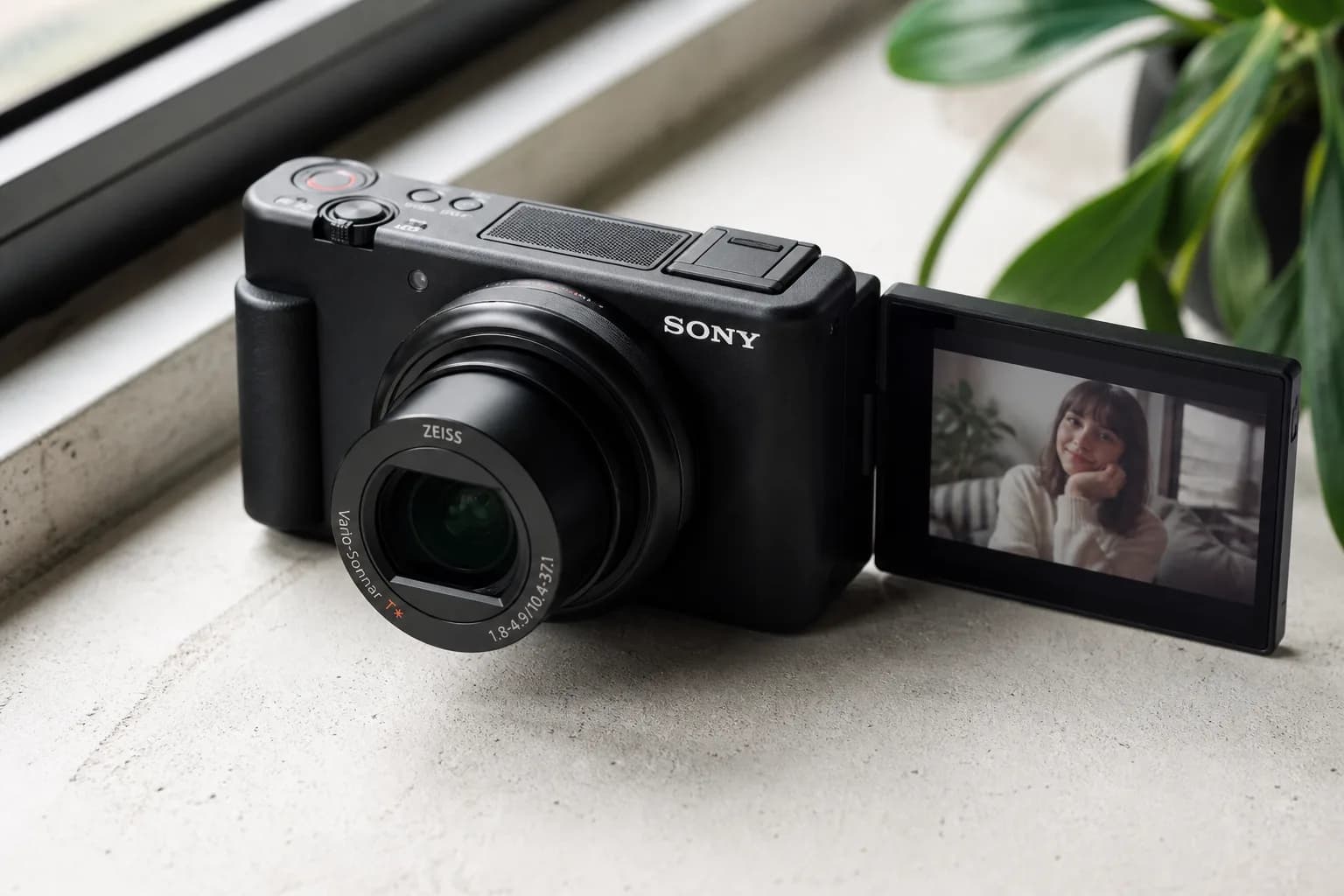
If you want to learn photography: Canon R10. If you mainly film in front of the lens: lean ZV-1 or vlog camera for YouTube — different focus.
Affiliate links marked with * — Amazon product links use partner ID martinkleinhe-20. I earn a small commission if you buy through these links; it costs you nothing extra. Assessments are based on my own practice, manufacturer specs and the consensus from reviews and user reports — no brand sponsored this article.
◆ Newsletter
Stay in the loop.
Camera and photography news, honest gear tests and new articles — in your inbox. Infrequent but relevant. No spam, unsubscribe anytime.