Kodak Gold 200: Warm Classic for Analog & Film Look
Kodak Gold 200 practical guide: ISO 200, daylight, C-41 — look, exposure and when not to use it. vs Portra, ColorPlus and Ektar; soft bridge to Lightroom film presets. Updated July 2026.
Author
Martin Kleinheinz
Photographer · Film & Lightroom · Hannover
Updated
July 31, 2026
Most people already know Kodak Gold 200 from the drugstore shelf: holidays, family, warm summer look — uncomplicated and affordable. That's exactly why it ends up back in cameras of people who shoot analog or want the same punch digitally without paying Portra prices.
This is straight talk from my practice in Hannover and from Kodak data. No emulsion mythology, no lab show-off. You'll learn what Gold 200 can do, when it's the right role, and where Portra or Ektar remain the better choice.
If you only want one line: Kodak Gold 200 is your warm daylight consumer film for sun, everyday life, travel and relaxed portraits — ISO 200, C-41, forgiving enough for beginners. Not the wedding default (that stays Portra territory), not the punchy product look (Ektar). Gold wants friendliness and color that smells like summer — not studio neutrality.
◆ Kodak Gold 200 presetSingle · €5
The Gold look as a single download
Just the Kodak Gold 200 preset from my workflow — XMP for Lightroom Classic & mobile. Intentionally priced as a €5 single. Want more looks? The 9-pack is €29.
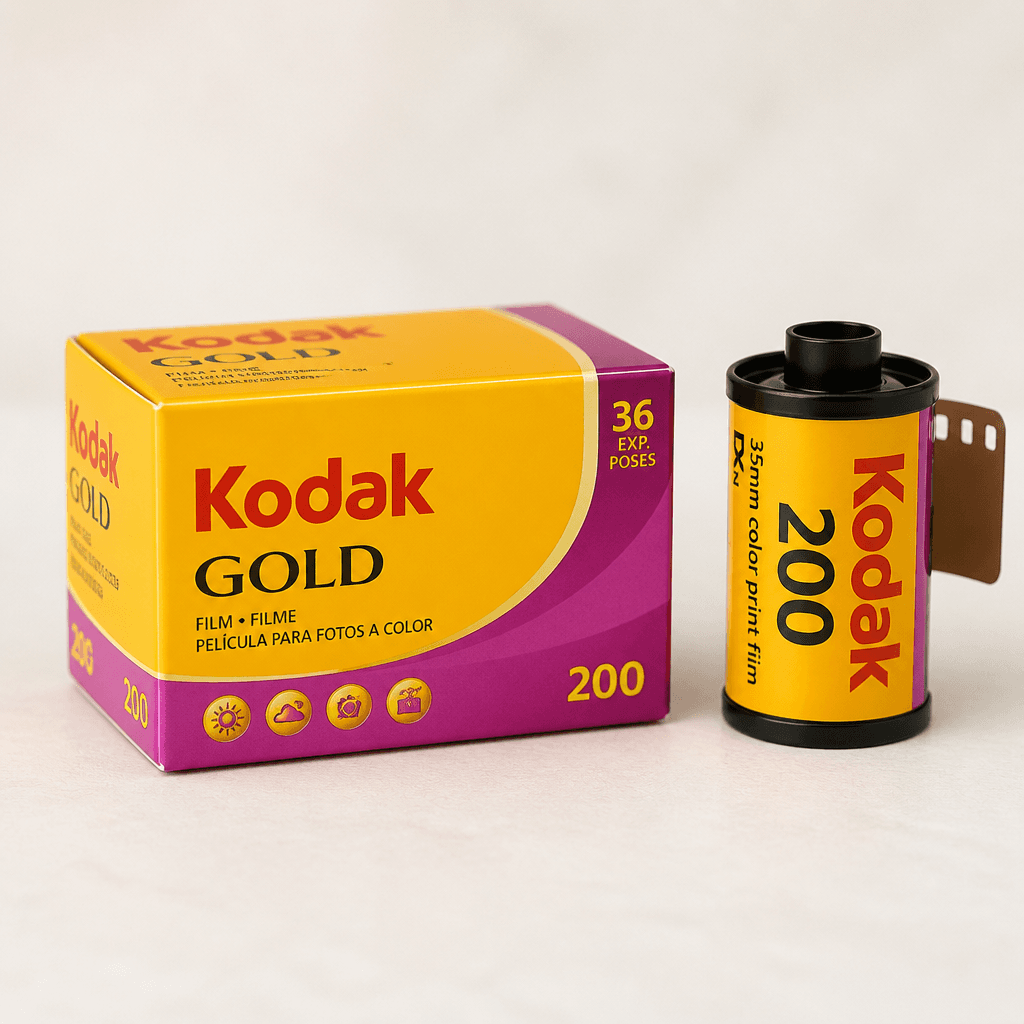
**Kodak Gold 200 36-exposure*** (example listing, ASIN B000JLI0K2) — daylight consumer stock for beginners and warm everyday shooting. Check prices and expiry date in the shop. Camera shops/drugstores are often cheaper; expiry date and storage matter more than the shop name.
Vergleich
Kodak
Kodak Gold 200 — 35mm / 36 exposures
Bild
Empfehlung
Film stock
Sensor
Color negative · daylight
ISO-Bereich
200
Autofokus
C-41
Detail
−2 / +3 stops (Kodak E-7022)
Stärken
+Warm, well-known Kodak look
+Wide availability, C-41 everywhere
+Forgiving latitude per E-7022 (−2/+3)
+Affordable compared to Portra class
Schwächen
−Amazon often pricier than camera shops/drugstores
−ISO 200: dark interiors without flash are tight
−Not a wedding/skin-tone default like Portra
−Marketplace: expiry/storage not always clear
Geeignet für
Daylight everyday, travel, casual — when you want character and price, not pro neutrality. Digital look only: my film preset pack (not an emulsion substitute).
Classic Kodak Gold 200 color negative film, ISO 200, daylight-balanced (per E-7022 also flash without filter), C-41. Latitude −2/+3 stops (Kodak E-7022). For sun, everyday life, travel and relaxed portraits — not the wedding/Portra default. Amazon link is affiliate convenience; camera shops and drugstores are often cheaper. Check expiry date and storage (≤ 21 °C sealed). Price is orientation only — check the shop for current pricing.
Was überzeugt
+Warm, well-known Kodak look
+Wide availability, C-41 everywhere
+Forgiving latitude per E-7022 (−2/+3)
+Affordable compared to Portra class
Was Du wissen solltest
−Amazon often pricier than camera shops/drugstores
−ISO 200: dark interiors without flash are tight
−Not a wedding/skin-tone default like Portra
−Marketplace: expiry/storage not always clear
Editor's Statement
“Editor tip: expiry date first · camera shops often cheaper than Amazon*”
Kodak Gold 200 is a daylight color negative film with nominal speed ISO 200, process C-41. It belongs to the consumer line: meant for everyday life, holidays, family photos — not positioned as a pro wedding stock. That DNA is exactly what makes it interesting today: accessible, warm, and delivering a look many recognize as the "classic Kodak summer" — without fighting through pro price lists.
Historically, Gold was the film you packed when you just wanted to photograph. Today it sits between nostalgia and deliberate look choice: some load it because it's affordable and developable everywhere. Others because they want exactly this warmth and find Portra too soft or too expensive for the job. Both are legitimate — as long as you know what you're buying.
ISO / light
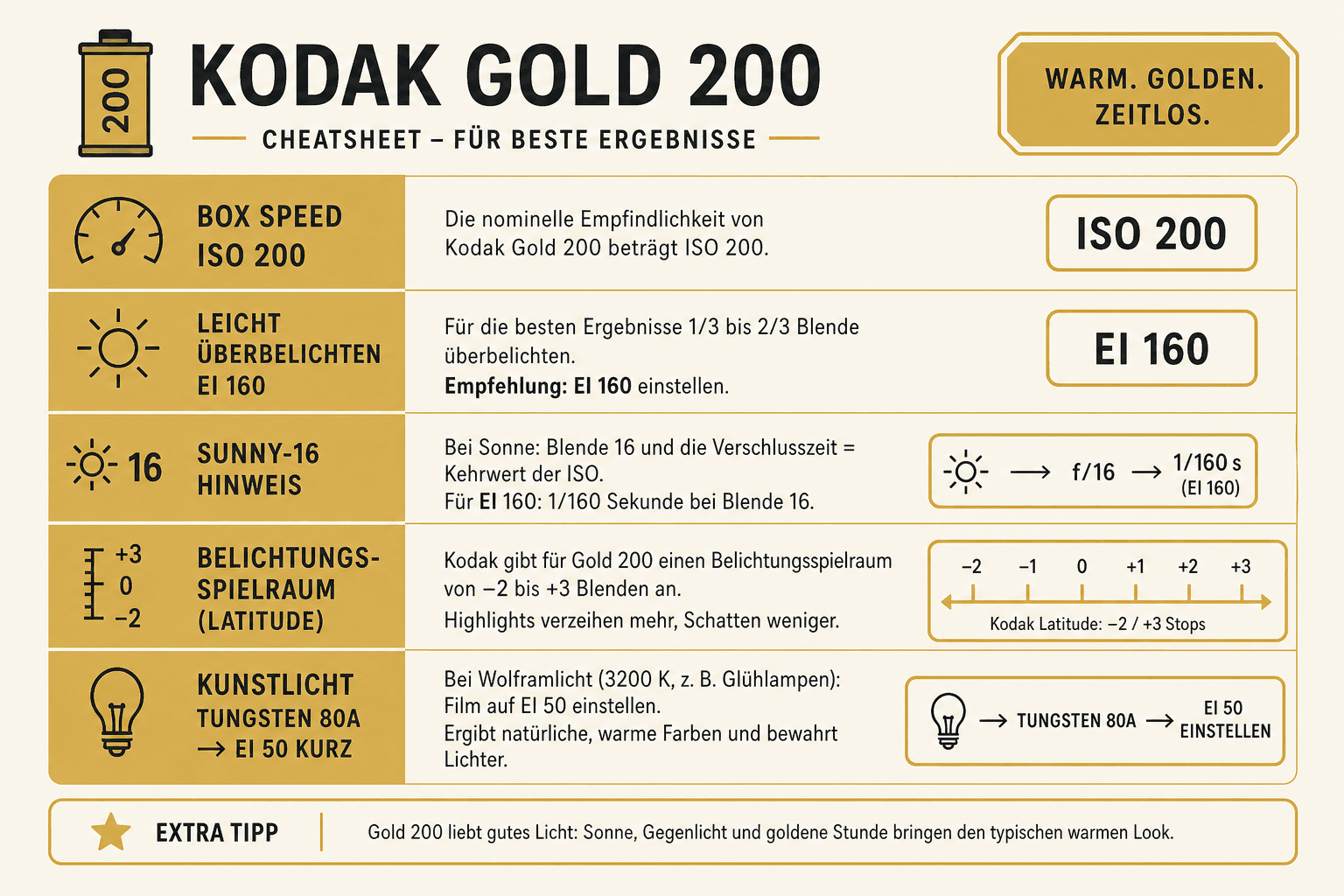
ISO 200, daylight-balanced; per E-7022 also with electronic flash without filter. Under artificial light without filter the look gets warmer or more yellow — sometimes intentional, often a nuisance. If you want clean photolamp/tungsten, plan filters and EI (section 05).
Process
Standard C-41 (Kodak mentions FLEXICOLOR chemistry among others). Every serious lab and most mail-order services know the workflow. No exotic process — that lowers the entry barrier and error risk. Kodak: develop as soon as possible after exposure.
Latitude (Kodak E-7022)
Kodak explicitly states two stops under to three stops over (−2 / +3) — more forgiving than many slides, not a free pass for blind exposure. Underexposure is tighter than overexposure.
Formats
Classic 35mm (135); 120 back on the market since the Kodak Moments announcement March 2022 as a 5-roll pro pack (check local availability). Format choice: section 06. Print Grain Index 44 is lab context only — details in section 07, not a purchase score.
Storage per E-7022 in short: unexposed film sealed at 21 °C or below, cool and dry; store exposed and unexposed cool/dry and develop as soon as possible. Expiry date, heat and expired stock: section 08 — when buying, the date often matters more than the shop name.
In short: Gold 200 isn't a mysterious pro film with hidden magic. It's an honest consumer daylight stock with warm character — and that's exactly why it's a strong entry point and a clear look building block. Accept that and you'll get more from every roll than someone treating Gold like Portra.
02
Character
The look — warmth, skin, contrast
When people say "Kodak" and mean holidays and skin, they often mean exactly this direction: warm highlights, friendly skin tones, colors that don't feel clinical. Gold 200 isn't flat pastel Portra and isn't punchy Ektar. It sits between — closer to everyday life than an editorial lookbook. That's not a weakness. It's the job description.
In my own work I notice the character most clearly when the same scene sits on two stocks: Gold pulls warmth and friendliness forward; Portra softens and smooths; Ektar sharpens color and contrast. Without side-by-side, forum opinions stay opinions. So: one test roll under your light and your scan beats ten threads — in Hannover just like anywhere else.
Skin & warmth
Tendency toward warm, inviting skin tones in daylight. In mixed light or evening sun that can turn "too gold" fast — intentional or correction in the scan. Corporate neutrality isn't the sweet spot.
Contrast
Consumer-typical: readable, not extremely hard. Shadows often hold with reasonable exposure; blown highlights no emulsion saves. Latitude helps — but doesn't replace metering.
Grain
ISO 200 class: visible, but rarely dominant in 35mm at normal scans. 120 feels quieter with the same emulsion — format, not magic. Heavy sharpening in the scan makes grain more aggressive, not more "pro".
Mood
Summer, street, travel, casual portrait. Less "luxury brand", more "real scene with color". If your moodboard screams champagne and softbox, Gold is often the wrong emulsion.
“Gold 200 is the film I load when the scene is already warm — sun, skin, everyday life. When I need neutral skin and expensive softness, I don't reach for Gold.”
— Martin Kleinheinz, photographer Hannover
Orientation: Gold = warm consumer friendliness — not Portra soft, not Ektar punch
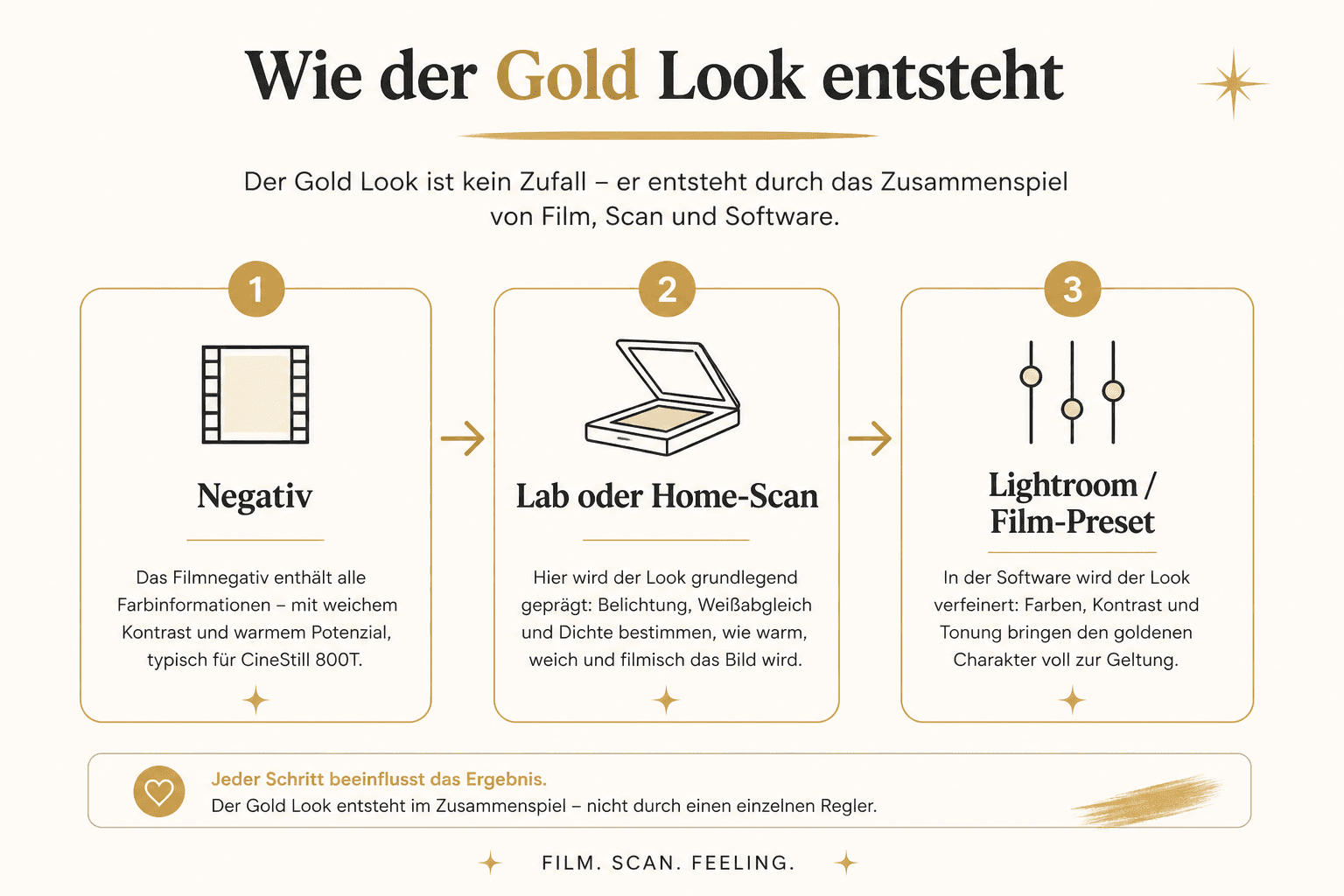
Important for the digital part later: what you see in the scan is emulsion plus lab plus scan profile. A Kodak Gold 200 preset can suggest this direction — it's not the same physics. Anyone selling preset and film as 1:1 is selling you an illusion. Honesty beats marketing — and saves you the frustration when the digital look "doesn't look like the roll".
03
Decision
When to use — and when not
The most common mistake: treating Gold 200 as a universal film for everything. It's strong — in its window. Outside that it gets unnecessarily warm, unnecessarily flat, or simply the wrong story. Decision question: do you want friendliness and everyday life — or luxury skin / product punch? The answer picks the emulsion, not the Instagram trend of the week.
From subject (everyday / pro portrait / product / budget) to emulsion — no mythology
Yes — everyday & travel
Daylight, walks, city, holidays. You want color and warmth without pro pricing. Gold rewards scenes that already bring light and mood. Travel workflow and packing list: Plan a photo trip.
Yes — casual portraits
Friends, street, lifestyle in sun or open shade. No corporate grid, no bridal lookbook. Skin can look friendly — not "retouched-neutral". Workflow and setup: Photographing portraits.
Yes — analog entry
C-41, forgiving latitude, easy to find. Learn without a Portra budget. Mistakes cost less and teach faster. Digital basics in parallel: Learn photography properly.
No — wedding / high-end skin
Then Portra direction (dedicated guide follows in the series — no dead link here). Gold can look too warm and "consumer" when the expectation is luxury softness. Clients notice the difference — even without film knowledge.
No — punchy product colors
Ektar territory (guide follows in the series — no dead link here). Gold is friendly, not maximally saturated-precise. Catalog and packshot need different priorities.
No — low light without a push plan
ISO 200 isn't a low-light hero. Better a faster film or light, or flash — don't blindly push and hope. Push changes contrast and grain; that's intent, not a emergency fix.
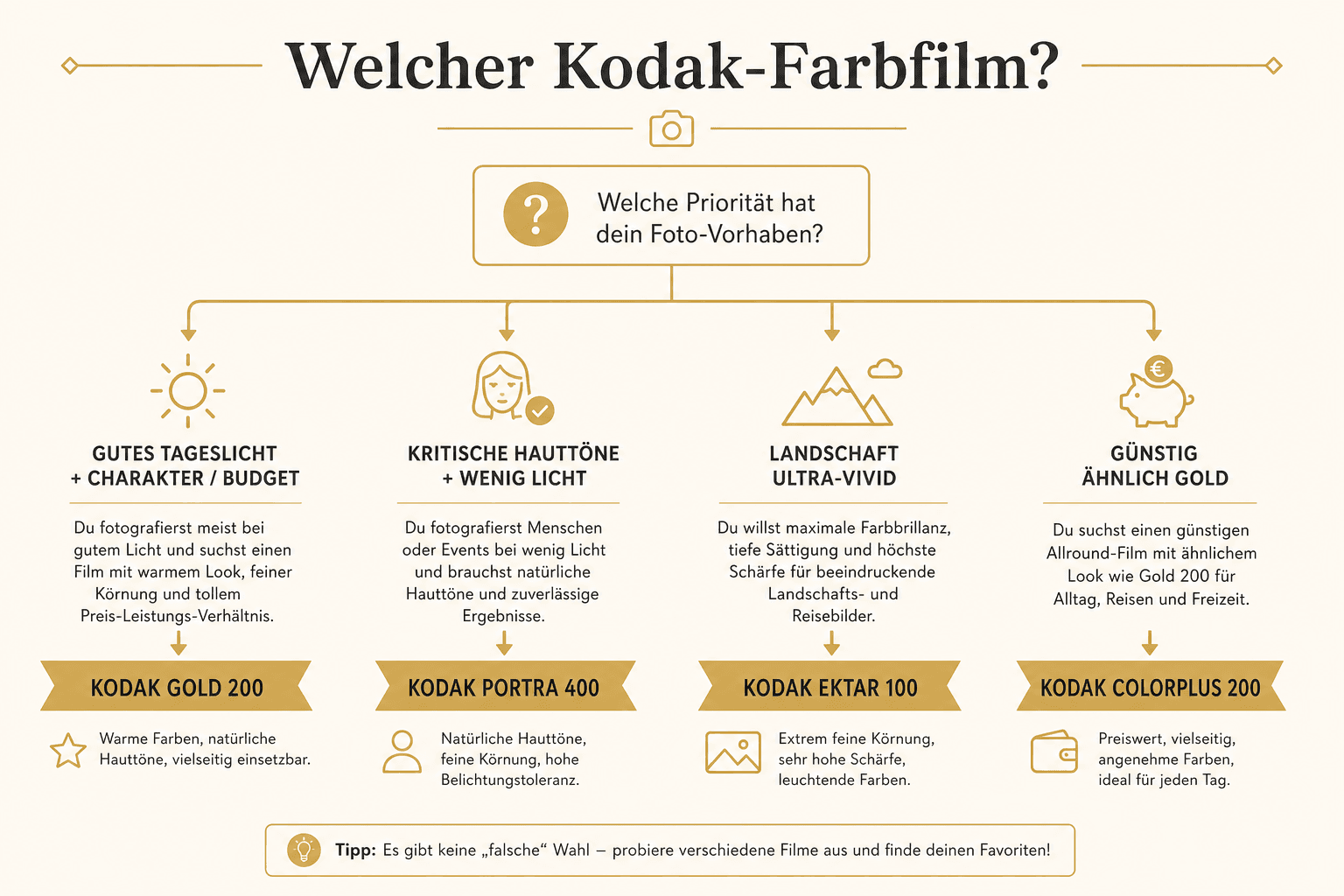
Decision roughly clear? Next the comparison to Portra, ColorPlus and Ektar — then you expose with intent. The decision tree above is default plus exceptions, not emulsion roulette on set.
04
Comparison
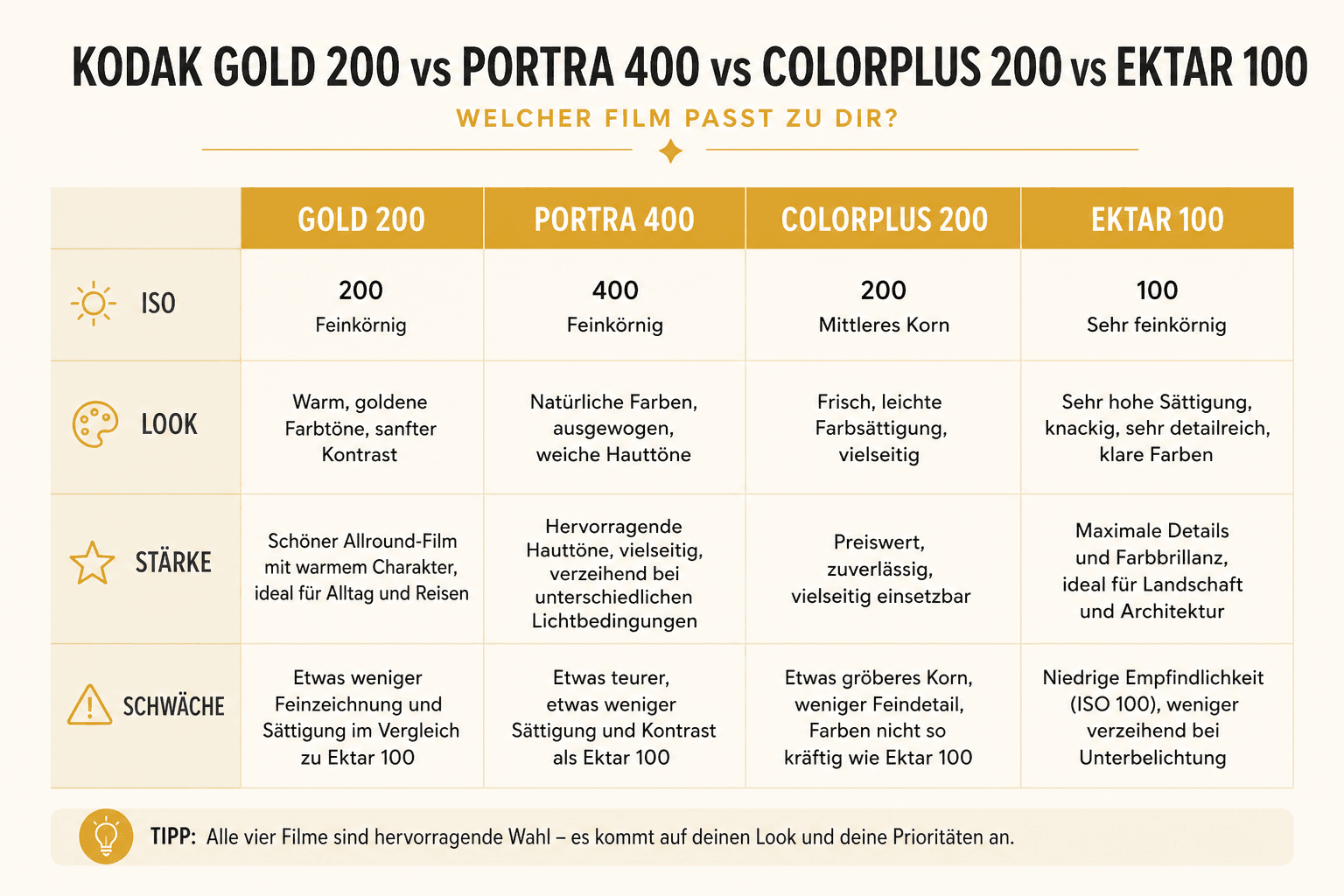
Gold vs Portra / ColorPlus / Ektar
Four names, four jobs. Anyone calling everything "Kodak color film" buys past the need. Here's the working distinction — without pseudo-MTF and without "better/worse" absolutism. Prices and batches fluctuate; character remains the decision aid.
Film
ISO class
Character
Typical job
Price range
Kodak Gold 200
200
Warm, consumer-friendly
Everyday, travel, casual
Low–mid
ColorPlus 200
200
Consumer, often simpler
Budget daylight
Often cheaper
Portra 400
400
Soft skin, pro portrait
Wedding, editorial skin
Higher
Ektar 100
100
Saturated, fine, high contrast
Landscape, product, color
Mid–high
Orientation July 2026 — looks and prices vary by batch, scan and retailer; Portra/Ektar deep dives follow
Gold vs ColorPlus
Both consumer daylight around ISO 200. Gold is the better-known warm classic; ColorPlus often the budget path. Side-by-side in your own scan beats forum faith. Expiry date and storage matter for both more than the name on the can.
Gold vs Portra
Portra targets skin and pro softness at higher speed (400 class). Gold is warmer-consumer and cheaper. Wedding expectation? Portra deep dive follows in the Film & Presets series (no dedicated post yet) — don't force Gold and retouch later what the emulsion never was.
Gold vs Ektar
Ektar wants saturation and precision at ISO 100. Gold wants friendliness. Product catalog and punchy landscape color → rather Ektar (deep dive follows in the series). Gold on Ektar jobs often looks too soft and too warm.
If you want not just Gold but also Portra, Ektar and Fuji looks digitally: the 9-pack is cheaper per preset than lots of singles. Gold only? The €5 single download above is enough.
◆ Lightroom PresetsBundle
Photos with film character
9 Lightroom presets inspired by Portra, Kodak, Fuji & Ilford — for street, portrait and landscape. One-time €29, no subscription.
Film chosen? Next up: exposure — latitude only saves what you roughly get right.
05
Practice
Exposure & light — using latitude
Color negative forgives — but not endlessly. Kodak states in E-7022 explicitly two stops under to three stops over (−2 / +3). That means: underexposure is tighter, overexposure often more forgiving — still expose with intent, not hope. "Negative holds everything" is the sentence after which shadows are empty and the scan tries to recover what was never there.
If you grew up digital, take latitude seriously but don't translate it 1:1 as "always +2". Every extra stop of density changes scan and look. Basics on time, aperture and ISO: Exposure triangle. Fine-tuning on subject: Exposure correction.
Orientation: nominal ISO 200, latitude −2/+3 (Kodak E-7022) — meter, don't guess
Shoot nominal ISO
Camera at ISO 200. Box speed is the default. "Always +1" is fashion, not law — and changes density and scan.
Daylight / flash
Sun, open shade and electronic flash are Gold territory per E-7022 without filter. Harsh midday sun: face in shade or fill — emulsion alone won't save black eye sockets.
Artificial light / filters (E-7022)
Photolamp 3400 K: Wratten 80B → EI 64. Tungsten 3200 K: Wratten 80A → EI 50. Without filter: warmer/yellower cast. Decide intent vs correction. TTL through the filter can affect the meter — Kodak warns about this; test exposures for critical work.
Shadows vs highlights
Negative often holds highlights better than underexposure holds shadows. Rather a bit of density for skin than empty shadows — within latitude.
Situation
Recommendation
Why
Open shade / overcast
ISO 200, normal exposure
Daylight sweet spot (E-7022)
Hard sun, face in light
Meter on skin / slight protection
Hold highlights, check eye sockets
Photolamp 3400 K
80B, EI 64 — or accept warm cast
Kodak E-7022
Tungsten 3200 K
80A, EI 50 — or accept warm cast
Kodak E-7022
Dusk / low light
Different film or light
ISO 200 hits limits
Deliberately "dense"
Slight over (within +3 range)
More density for scan — not blind +3
Exposure orientation Kodak Gold 200 — latitude −2/+3 per Kodak E-7022; practice over mythology
Exposure set? Next the format choice: same emulsion in 35mm or 120 — different breath, different frame count.
06
Format
35mm vs 120 — same emulsion, different breath
Gold 200 in 135 and 120 is the same emulsion family — format changes grain impression, resolution feel and handling, not the base color DNA. 120 often feels quieter and "bigger" at the same scans; 35mm remains the everyday and travel king. Anyone buying 120 just because it sounds "more pro" without body and pace pays tuition in frames, not look.
35mm (135)
More frames, smaller cameras, cheaper entry, developable everywhere. Grain visible, character stays Gold. Ideal for learning, street and travel where you don't celebrate every frame — compact bodies: Best travel camera.
120
Fewer exposures, larger negative, often quieter image. Kodak Moments announced 120 Gold on March 21, 2022 as a 5-roll pro pack (retailer/EU availability — check locally and online, don't assume). Lab and scan prices can run higher.
Choice rule
Travel & learning → 35mm. Slow portrait/landscape with medium format body → 120 if you already have the camera. Emulsion first, format second — not the other way around.
Format clear? Then the path from exposed stock to file — develop, scan, archive. Soft bridge to digital Gold look comes after.
07
Workflow
Develop, scan, archive
C-41 is standard — the quality lever sits in lab choice, scan and archive, not secret recipes. Bad scan turns good Gold into a flat JPEG compromise. Good scan pulls warmth and density; aggressive auto-correction lab can iron flat the character you actually wanted.
My workflow is deliberately boring: expose → C-41 as soon as possible → scan with traceable profile → archive negative plus master → only then look work in Lightroom. Kodak writes in E-7022 explicitly: develop film as soon as possible after exposure. Anyone slapping presets on broken lab JPEGs later argues "film vs digital" when they mean scan vs scan.
C-41 → scan (lab or own) → archive negative + master file — preset only after
1. Develop (C-41)
Local lab or mail-order with clear C-41 offering — as soon as possible after exposure (Kodak E-7022). "Cross process" only on purpose — not by accident. With mail-order: clarify tracking and cut option (uncut vs cut) beforehand.
2. Scan decision
Lab scan for speed; own scan/flatbed/dedicated for control. Tie resolution to use (web vs large print) — no fantasy megapixel promises. One clean 16-bit master beats three "maximal" JPEGs with auto saturation.
3. Color management
Scan profiles and monitor matter — ideally with calibrated monitor. If you continue in Lightroom: basics in What is Lightroom. Film look presets only on a reasonable neutral scan, not broken JPEG defaults. Otherwise you amplify errors instead of character.
4. Archive
Negatives cool, dry, light-protected. Digital masters (TIFF/RAW scan) plus working copies. Expired film and heat archives are two different risks — both can catch up months later.
Workflow clear? Next storage and expired film — why "cheap expired" often costs more than a fresh roll.
08
Storage
Expired film — honestly
Expired doesn't automatically mean unusable — and fresh doesn't automatically mean perfect if the film baked in a car. What matters is time, heat and humidity. The cheapest "bargain bulk" without date check is often the most expensive mistake of the year.
Fresh storage
Per E-7022: sealed 21 °C or below, cool and dry. Fridge only with care (avoid condensation when opening — acclimatize). Freezer is special case, not default for everyday purchase. Exposed: develop as soon as possible.
Expired, stored cool
Often still usable with slight contrast/color drift. Test roll before the important trip. No guarantee — and no substitute for fresh stock on paid jobs.
Heat / glove box
Fast quality killer: base fog, color cast, uneven density. Don't plan such film for paid jobs. Experiments ok — deliveries not.
Purchase check
Read expiry date, check retailer turnover. Drugstores/camera shops often cheaper than marketplace — but only if the date is right. Amazon listing* is convenience, not a freshness machine. ASIN example in article is orientation only.
Fresh or experiment clarified? If you want the look digitally: first how to approximate a Kodak Gold 200 preset yourself — and when buying ready-made makes sense.
09
Lightroom · DIY
Build a Kodak Gold 200 preset yourself
Many search exactly this: build a Kodak Gold 200 preset yourself. It works. But: a usable film look isn't a one-slider trick. You need direction in your head — and reference photos. Real scans help more than random "Gold filter" screenshots.
Target direction, deliberately vague: warmth without plastic sun, greens more toward olive/yellow than neon-digital, shadows not clinically black, highlights not digitally hard. Anyone approximating this in Lightroom typically works on tone curve, HSL and color grading — plus some grain if you want the consumer character. Leaving out concrete numbers is intentional: every RAW and every scan reacts differently; copy-paste values from the internet often just create another Instagram warm filter.
Reference first
Place one or two real Gold 200 scans next to the RAW. Without reference you're fiddling with mood, not film.
Separate look from exposure
Leave exposure and white balance per image. Save color, curve, grading, grain as preset — otherwise the look breaks on every new frame.
When you need consistency across series and don't want to refine every subject. Then a ready preset is a tool — not cheating the craft.
DIY direction clear? Next the ready products — and what they aren't.
10
Product
Ready Kodak Gold 200 preset & bundle
You shoot digital and still want Gold warmth — without tinkering yourself? A ready preset shifts tone, color and contrast in a direction that reminds you of Gold 200. It is not the same emulsion, same grain and same latitude.
Above in the text: the Kodak Gold 200 preset for €5 as single download. In the middle: the 9-pack film bundle for €29 when you need more looks. Both are digital products I earn from. You can use the analog guide without buying.
Kodak Gold 200 presetSingle download for €5 —View preset →
When preset makes sense
Series, social, moodboards, when no lab workflow is involved. Consistency across many digital frames.
When real emulsion
You want negative, scan character and process — including latitude and mistakes that make you a better photographer.
When bundle instead of single
You need Gold plus Portra, Ektar, Fuji, B&W — then €29 for nine looks is cheaper than singles.
◆☐ Analog: Gold 200 for daylight everyday / casual
◆☐ Exposure: ISO 200, latitude −2/+3 (E-7022)
◆☐ DIY preset: direction clear, values per image — or buy ready-made
◆☐ Digital: single preset €5 or bundle €29 — approximation, not emulsion
11
FAQ
Frequently asked questions about Kodak Gold 200
What is Kodak Gold 200?+
A daylight color negative film at ISO 200, C-41 process. Consumer line: warm, everyday-capable, entry and travel — not meant as pro wedding default.
How do I build a Kodak Gold 200 preset myself?+
Work with reference scans, suggest warmth and olive/yellow direction in curve, HSL and color grading, leave exposure/WB mostly out of the preset, then save as preset. Mechanics: Create your own Lightroom presets. Ready and consistent: Kodak Gold 200 preset · €5.
Are there ready-made Kodak Gold 200 Lightroom presets?+
Yes — from me as a single purchase for €5: Kodak Gold 200 Lightroom preset. In the film bundle the same look plus eight more film looks for €29. Approximation, not emulsion.
What exposure latitude does Gold 200 have?+
Per Kodak Publication E-7022: two stops under to three stops over (−2 / +3). Forgiving, but not a free pass — expose consciously. See Exposure triangle and Exposure correction.
Gold 200 or Portra 400?+
Gold: warm, cheaper, consumer everyday. Portra: softer pro skin, ISO 400 class, pricier — often wedding/editorial. Portra deep dive follows in the Film & Presets series.
Gold or ColorPlus 200?+
Both consumer daylight around ISO 200. ColorPlus often budget; Gold the better-known warm Kodak look. Side-by-side in your own scan decides.
Can I use Gold 200 under artificial light?+
Yes, with warm cast — or with filter per E-7022: photolamp 3400 K → 80B / EI 64; tungsten 3200 K → 80A / EI 50. Without filter consciously accept the cast or correct in scan.
How do I store the film?+
Per E-7022: sealed at 21 °C or below, cool and dry; develop as soon as possible after exposure. Avoid heat and car storage. Expired + cool stored can still work — for jobs prioritize fresh film.
Is Gold 200 available in 120?+
Yes — Kodak Moments announced 120 Gold on March 21, 2022 as a 5-roll pro pack. Check locally and online; 35mm remains the everyday default.
What does Print Grain Index 44 mean?+
Per E-7022 a graininess index for lab prints 135→4×6 (standard viewing) — not a general quality score for scans or film look presets.
Does a Lightroom preset replace real Gold 200 film?+
No. Presets approximate color/contrast/mood. Emulsion, grain and latitude stay physical. Exactly this look as single purchase: Kodak Gold 200 preset · €5. More looks: Film bundle · €29. Openly my own products I earn from — you don't need them for the analog guide.
Where should I buy Gold 200 most sensibly?+
Camera shops and drugstores are often cheaper — check expiry date. Marketplace listings (e.g. Amazon) are convenience and affiliate; compare freshness and price. Example slug in article: kodak-gold-200-36.
**Transparency:** Affiliate links marked with * — Amazon product links use partner ID martinkleinhe-20. I earn a small commission if you buy through these links; there's no extra cost to you. Camera shops and drugstores are often cheaper — check expiry date and storage. I also sell my own Lightroom presets: [Kodak Gold 200 as a single purchase for €5](/en/lightroom-presets/kodak-gold-200-lightroom-preset/) and the [9-pack film bundle for €29](/en/lightroom-presets/35mm-120mm-film-presets/) — clearly marked. Presets are digital approximations, not 1:1 emulsion; you don't need them to use this analog guide. No brand sponsored this article. Technical data (latitude −2/+3, filter/EI, storage ≤ 21 °C, Print Grain Index 44) from Kodak Publication **E-7022** (Feb. 2016) and manufacturer/announcement sources; no invented MTF/ROI numbers. Updated: July 2026.
◆ Film & Presets · Soft bridge
Gold look analog — or digital for €5?
Real roll: ISO 200, daylight, C-41, check expiry date. Digital only the warm punch? [Kodak Gold 200 preset](/en/lightroom-presets/kodak-gold-200-lightroom-preset/) as single purchase for €5 — or the 9-pack for €29. Approximation, not emulsion. Openly: I earn from the preset; this analog guide remains usable without purchase.