Canon EOS R100 Review: Canon R100 — Cheapest RF Entry?
When the stripped-down budget camera with a viewfinder is enough, why the R50 is often the smarter upgrade — and why I still recommend the R10 for learning.
Author
Martin Kleinheinz
Photographer · Content Creator · Hannover
Updated
August 28, 2026
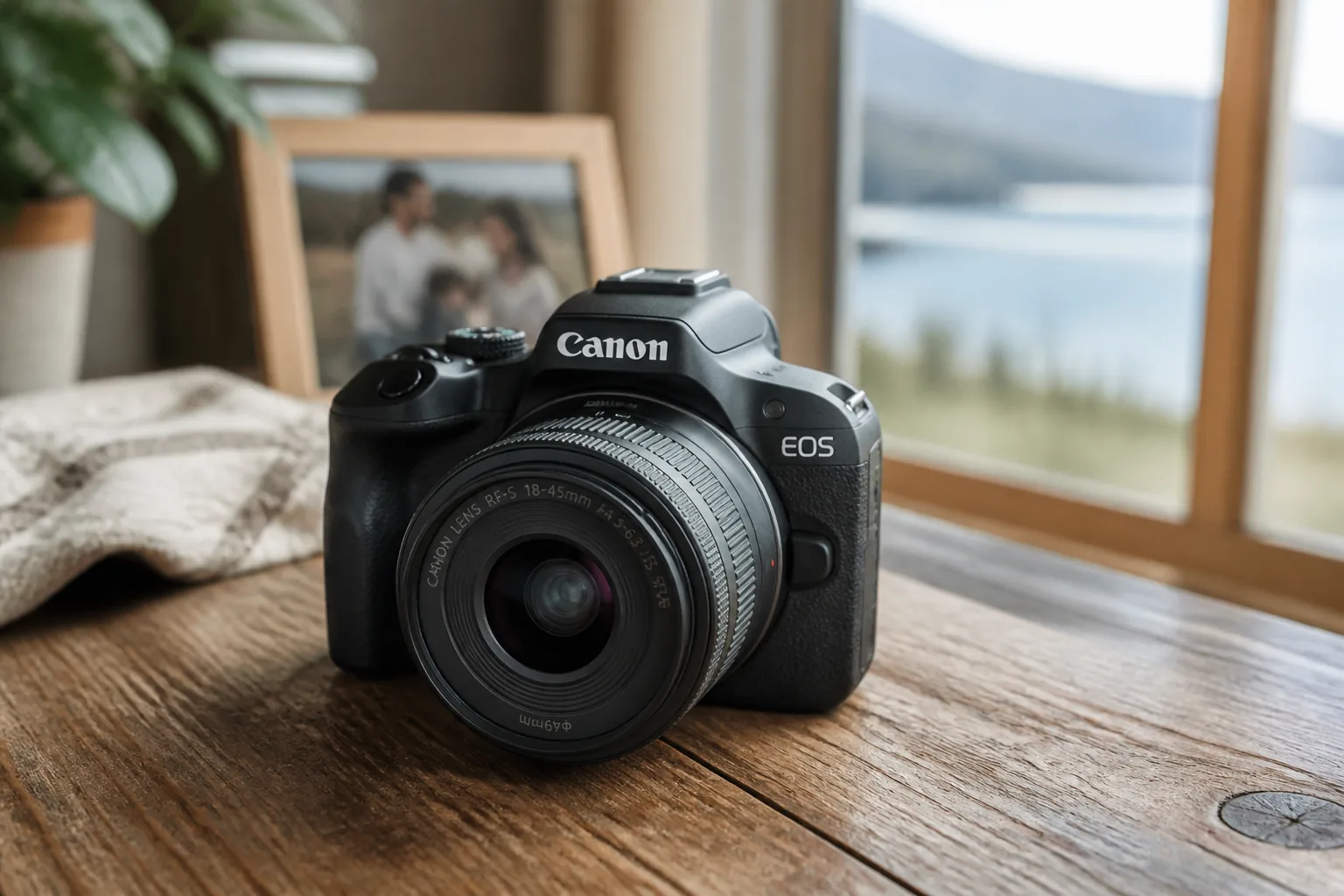
You want to spend as little as possible and still get a real system camera with a viewfinder — not just the phone. The Canon EOS R100 is exactly that promise: cheapest entry into the Canon RF system with an electronic viewfinder. Typically you pay around $400 to $550 as a kit with the 18–45 zoom.
The knack point: it’s deliberately stripped down. No touchscreen, older processor (DIGIC 8), slow continuous AF burst, 4K with a hard crop. This is not a camera I put in your hands for learning.
I rank budget bodies by what you feel day to day — not by what’s printed on the box. The R10 stays my recommendation for beginners (Canon R10 review, camera for beginners). The R50 is often the smarter upgrade from the R100 — touch, DIGIC X, more usable video — before you settle on “R100 and done.” By the end you’ll know which Canon fits your budget.
00
Short
Is the Canon EOS R100 worth it in 2026? The quick verdict
Short version: the R100 is 2026’s cheapest entry into the RF system with a viewfinder — typically $400–550 as an 18–45 kit. You get 24.1 megapixels APS-C, an electronic viewfinder and interchangeable lenses. You pay for that with a fixed non-touch display, DIGIC 8, burst of only about 3.5 fps with continuous AF and 4K that is heavily cropped and runs on contrast AF.
The R50 (about $600–800) is often the smarter next step: articulating touchscreen, DIGIC X, more modern autofocus. The R10 (about $1,100–1,250 kit) remains the camera I recommend for learning — joystick, two control dials, Dual Pixel AF II. The R100 is never “better for learning than the R10.”
Top 3
My three recommendations
**#1 Canon EOS R100** — when the budget is hard, you mainly shoot photos and still want a viewfinder. **#2 Canon EOS R50** — when touch, modern UX and video justify the upgrade. **#3 Canon EOS R10** — when you want to learn photography and grow ([camera for beginners](/en/camera-for-beginners/)).
Vergleich
Canon
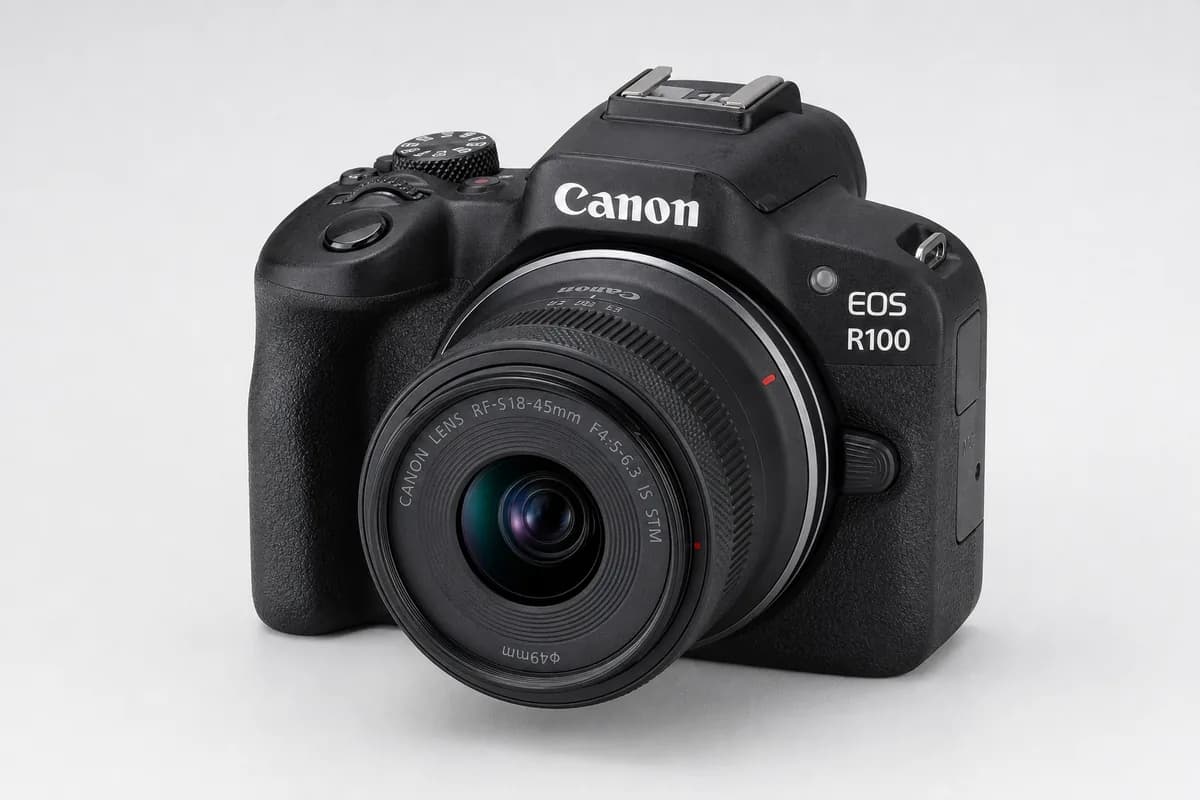
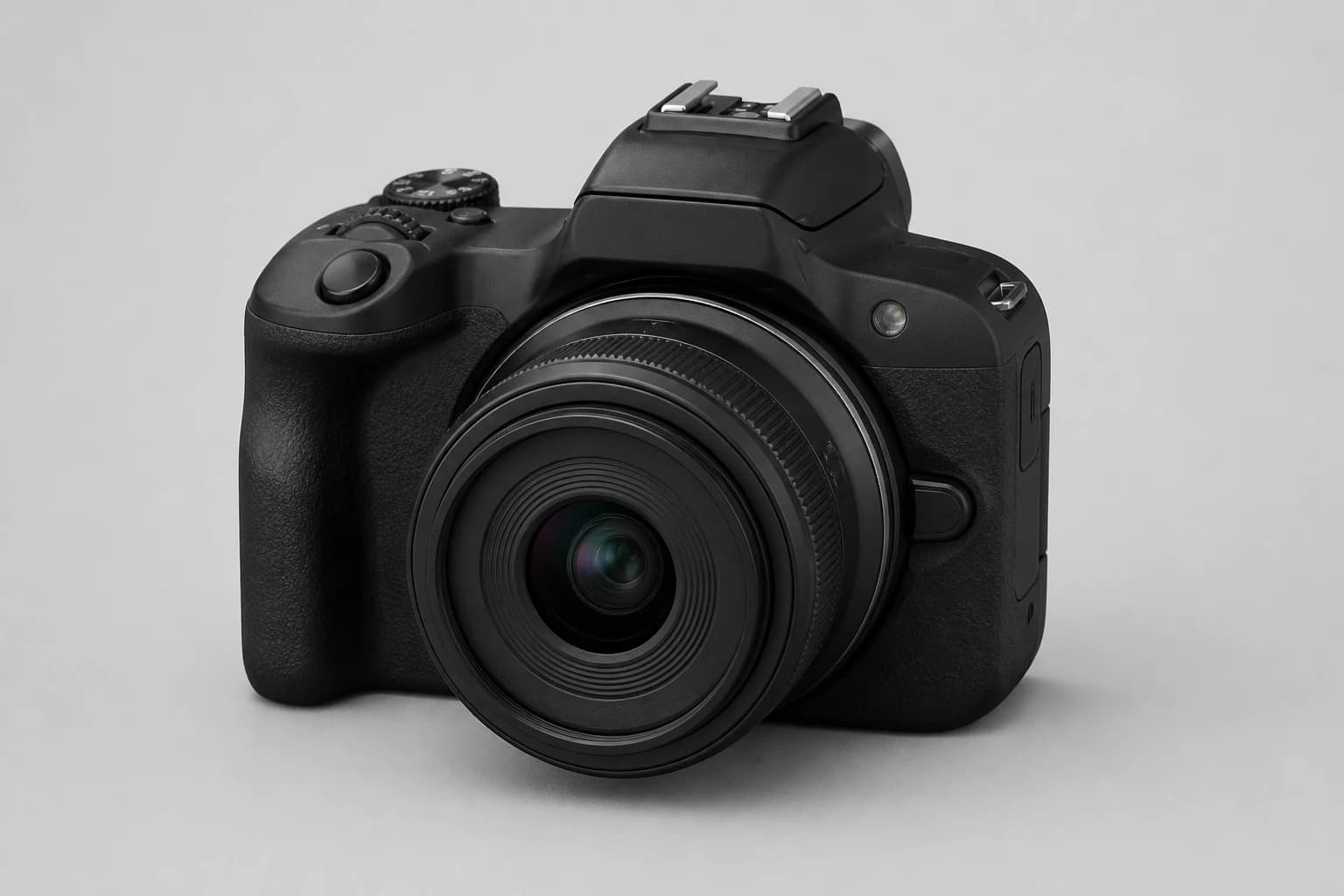
Canon EOS R100 (RF-S 18–45 kit)
Canon
Canon EOS R50 (18–45 kit)
Canon
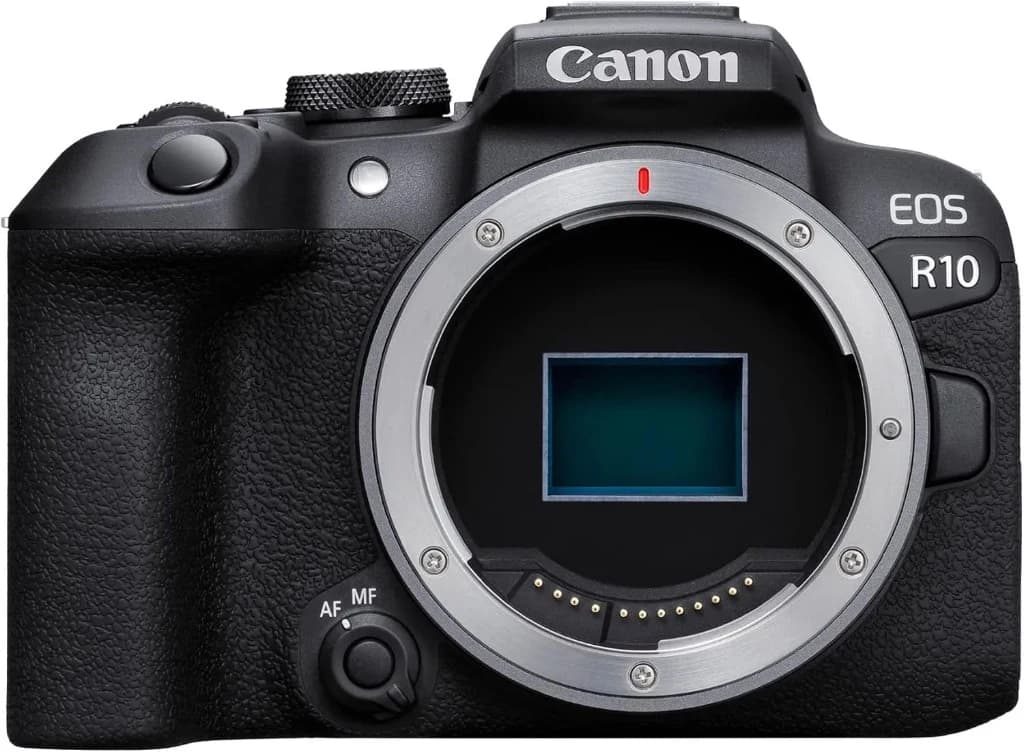
Canon EOS R10 (RF-S 18–150 kit)
Bild
Empfehlung
Budget
Value
Editor’s pick
Sensor
24.1 MP APS-C CMOS
24.2 MP APS-C CMOS
24.2 MP APS-C CMOS
ISO-Bereich
DIGIC 8
DIGIC X
DIGIC X
Autofokus
Dual Pixel (basic)
Dual Pixel CMOS AF II
Dual Pixel CMOS AF II
Detail
6.5 fps · Servo ~3.5 fps
up to 12 / 15 fps
15 fps mech. · 23 fps electronic
Stärken
+Cheapest real entry into the RF/RF-S system
+EVF included — rare at this price
+Light and compact, mic-in, built-in flash
+Creative Assist / SCN for phone switchers
+Flip touch and DIGIC X — clearly more modern than R100
+Better AF and faster bursts for everyday/family
+4K without the harsh R100 crop pain
+Compact and often the better “premium is worth it” answer
+Joystick + dual dial — a real learning and working camera
+Very strong AF and fast burst for the class
+EVF and grip: better entry than display-only feel
+RF system with adapter path to EF
Schwächen
−Fixed screen without touch — feels dated in 2026
−DIGIC 8: no modern subject tracking like R50/R10
−Servo bursts only ~3.5 fps — weak for action/kids
−4K heavily cropped + contrast AF (no Dual Pixel in 4K)
−No joystick — handling behind the R10
−No 4K/60 per Canon specs
−UHS-I instead of UHS-II
−More expensive than R100 — budget has to allow it
−No IBIS — lens IS helps, but not everywhere
−No headphone jack
−LP-E17 gets short with lots of EVF use
−Clearly more expensive than R100/R50
Geeignet für
Hard-budget beginners with a stills focus — when the step up to the R50 just isn’t possible.
Budget + video/touch — when the R100 feels too stripped and the R10 is still too expensive.
Beginners and switchers who want to grow with a viewfinder, AF and a system — family, travel, hobby action.
Before specs and 4K crop: does your use case even fit a stripped-down entry camera? The R100 isn’t a pocket wonder, isn’t a creator body and isn’t the learning camera of choice — it’s the price floor with a viewfinder.
Use case
Does the R100 fit?
Why
Hard budget / RF entry
Excellent
Cheapest entry with a viewfinder into the RF / RF-S system
Photo everyday / family (calm)
Good
24 MP APS-C is enough; servo and non-touch limit action and speed
Fit assessment from my own practice and user consensus — as of August 2026
Anyone who wants into the RF system on a hard budget and mostly shoots photos gets a real viewfinder and interchangeable lenses with the R100 — not the phone. Anyone who wants to learn and grow for years saves in the wrong place by buying the R100 as a “cheap learning camera.” Orientation: camera for beginners. Looking more for system flexibility under $1,000: best camera under $1,000. Unsure between DSLR and mirrorless: mirrorless vs. DSLR.
02
Data
The specs: R100 vs. R50 vs. R10 at a glance
Here are the numbers per Canon and spec consensus — short version: all three sit in the APS-C RF entry world. The splitter is generation and features, not “three identical cameras with different price tags.”
The R100 hangs on DIGIC 8 and clearly stripped-down controls. R50 and R10 share DIGIC X and Dual Pixel AF II — the R10 adds handling and speed on top.
Category
Canon EOS R100
Canon EOS R50
Canon EOS R10
Sensor
24.1 MP APS-C CMOS
24.2 MP APS-C CMOS
24.2 MP APS-C CMOS
Processor
DIGIC 8
DIGIC X
DIGIC X
Autofocus
Dual Pixel AF (basic)
Dual Pixel CMOS AF II
Dual Pixel CMOS AF II
Burst
6.5 fps OS · ~3.5 fps servo
up to 12 / 15 fps class
up to 15 fps mech. / 23 fps elec.
Video
4K 24/25p heavy crop · contrast AF
4K30 (no 4K60)
4K30 oversampled · 4K60 crop
Viewfinder (EVF)
2.36 million dots
2.36 million dots
2.36 million dots
Display
3″ fixed, no touch
Articulating touch
Articulating touch
Stabilization
No IBIS
No IBIS
No IBIS
Controls
stripped down · no joystick
no joystick · more compact
Joystick · dual dial
Audio
Mic in
Mic in, no headphone
Mic in, no headphone
Battery
LP-E17
LP-E17
LP-E17
Weight (approx.)
~356 g (body)
~375 g (body)
~429 g (body)
Mount
RF (APS-C)
RF (APS-C)
RF (APS-C)
Street price US 2026
Kit ~$400–550
~$600–800
Kit ~$1,100–1,250
R100 vs. R50 vs. R10 — key specs, as of August 2026
On paper the R100 looks like “almost an R50, just cheaper.” Day to day you miss touch, modern tracking and usable 4K behavior. Whether the upgrade to the R50 — or straight to the R10 — makes sense shows up in the handling check.
03
Everyday
Handling, viewfinder and display: what the datasheet leaves out
Numbers say little about how the R100 feels when you shoot family, a city walk or your first course. What decides the buy: viewfinder yes, touch no, weight, battery — and where the controls feel dated in 2026.
Viewfinder — the real plus
The electronic viewfinder with 2.36 million dots is why the R100 still makes sense as an RF entry despite the cuts: in sun you see exposure and focus without fighting the screen. Many cheap bodies skip exactly that — the R100 doesn’t. That’s its strongest argument beside the price.
Fixed display, no touch — often the dealbreaker
3 inches, fixed, no touch. For phone switchers and selfie / vlog angles that feels dated in 2026. AF point and menus run through buttons and dials — it works, but it feels a generation earlier. Exactly here the R50 often wins the upgrade.
Size & weight (~356 g)
Very light for a system camera with a viewfinder. Versus true pocket cameras it’s still a system: lens changes, some bulk. Versus the R10 a bit more compact — see also compact mirrorless camera.
Battery LP-E17
Same type as R50/R10: solid for the day if you don’t leave review and Wi‑Fi running forever. Practice: a spare battery belongs in the kit — especially on travel days.
Creative Assist / SCN
Helpful for phone switchers: guided looks and scenes. Good for getting started — but it doesn’t replace the R10’s learning controls with joystick and two dials if you really want to learn photography.
Weather & durability
Entry-level body, no pro sealing. In rain: common sense and a bag. Fine for hobby everyday if you stay honest.
In reviews and user reports, price and viewfinder often get praise. The criticism repeats: no touch, DIGIC 8, weak servo, 4K crop. That matches what I see: clear budget entry, clear limits — no hidden pro wonder. Next: what the sensor actually delivers.
04
Image
Image quality: APS-C 24.1 MP — enough for entry
24.1 megapixel APS-C isn’t a hype topic in 2026 — and that’s exactly why it’s fine for the cheapest entry: enough detail for web, print and light crop. The photographic difference vs. R50/R10 day to day sits less in the sensor look than in AF, speed and controls.
DIGIC 8 vs. DIGIC X you notice more in tracking, JPEG pipeline and video than in “sharper megapixels.” Sensor philosophy: crop sensor vs. full frame.
◆Daylight: crisp enough for hobby and family; Canon JPEG everyday-usable, RAW with headroom
◆ISO practice APS-C: up to roughly ISO 1600–3200 often usable; beyond that depends on the subject — no full-frame miracle
◆Dynamic range: solid for the class; no medium-format theater
◆Bokeh: comes mainly from the lens — not the body name
◆R100 vs. R50/R10 image quality: related sensor class — buy decision is features and handling
The knack point is honest: many beginners hunt “better image quality” and really mean a better lens, better light or better technique. An RF-S kit zoom shows you the world; a fast prime changes the look more than jumping R100→R50. Portrait glass: which lens for portrait.
The R100 has Dual Pixel AF in the basic variant — often fine for calm portraits and everyday photos. What specs like to soft-pedal: with continuous AF (servo) burst sits around only 3.5 fps. One-Shot up to 6.5 fps sounds better on the box than what you feel with running kids. DIGIC 8 doesn’t deliver modern subject tracking like Dual Pixel AF II on R50/R10.
Calm subjects — okay
Landscape, still life, portraits with little movement: Dual Pixel basic holds. You get sharp JPEGs/RAWs without AF becoming the deal-killer.
Servo & action — the limit
Kids, pets, sports light: ~3.5 fps and older tracking show. Here the jump to the R50 (faster burst, Dual Pixel AF II) or straight to the R10 is often the more honest dollar.
No joystick
AF point without touch and without joystick means: more button paths. It works — but it’s not R10-class learning handling. Details: Canon R10 review.
Expectation check
Cheapest entry means compromise. Anyone who wants fast and sure with movement doesn’t buy the R100 — the body is the price floor, not the action machine.
In practice that means: for a calm photo start on a hard budget the AF often covers it. For family in motion and learning handling with a joystick you reach higher — R50 or R10.
06
Video
Video: 4K with crop — no creator argument
The R100 can do 4K 24/25p — but with a heavy crop and contrast AF (no Dual Pixel in 4K). That’s the most honest video line in this review: fine for occasional Full HD clips; weak as a buying reason for Reels, vlog in front of the lens or “4K quality.” Mic in is there — it doesn’t fix the crop or AF in 4K.
◆R100: 4K 24/25p · heavy crop · contrast AF in 4K · mic in
◆R50: 4K30 without the hard R100 crop pain · articulating touch helps in front of the lens
◆No IBIS: handheld helps with lens IS + steady technique — or a gimbal
Short: video on the R100 is a footnote with limits — not a selling point. Photo entry and viewfinder stay the core. That sets up the buying matrix: three bodies, three clear cases.
07
Decision
R100 vs. R50 vs. R10: budget, upgrade, learning
This is the core: three bodies, one RF world — three clear cases. The R100 is not “the cheap R10.” The R50 is not automatically the learning camera. And the R10 stays the camera I put in beginners’ hands. The splitter is features and learning handling, not megapixels.
You need …
Lean R100
Lean R50
Lean R10
Hard budget + viewfinder + photo
Clear yes
Upgrade
Clearly more expensive
Touch / articulating screen / video light
Weak (no touch)
Clearly better
Also strong
Learning with joystick + dual dial
No
Works — less handling
My recommendation
Servo / kids / action
Weak (~3.5 fps)
Clearly better
Strongest of the three
4K without hard crop pain
No
Better (4K30)
Best (4K30 OA · 4K60 crop)
Image quality “better”
Related APS-C class
Related APS-C class
Related APS-C class
Role 2026
Cheapest entry
Smart upgrade from the R100
Recommendation for learning
Decision matrix R100 vs. R50 vs. R10 — as of August 2026
The ~$200 upgrade: often R50 instead of “R100 and done”
Between typically $400–550 (R100 kit) and $600–800 (R50 kit) sit often around $200 — and that’s exactly where everyday life decides: articulating touch, DIGIC X, Dual Pixel AF II, more usable video. Anyone who wants touch and family/video light often pays that upgrade with less frustration than non-touch and ~3.5 fps servo. Anyone whose budget is absolutely hard and only wants photos: the R100 stays the honest budget pick.
Simply put: the R100 isn’t a bad camera — it’s the price floor with a viewfinder. The R50 is often the smarter next step. The R10 remains the learning camera. Anyone who flips that and sells the R100 as the beginner learning camera underplays touch, DIGIC X, servo and joystick.
08
Comparison
Three Canon paths in direct comparison
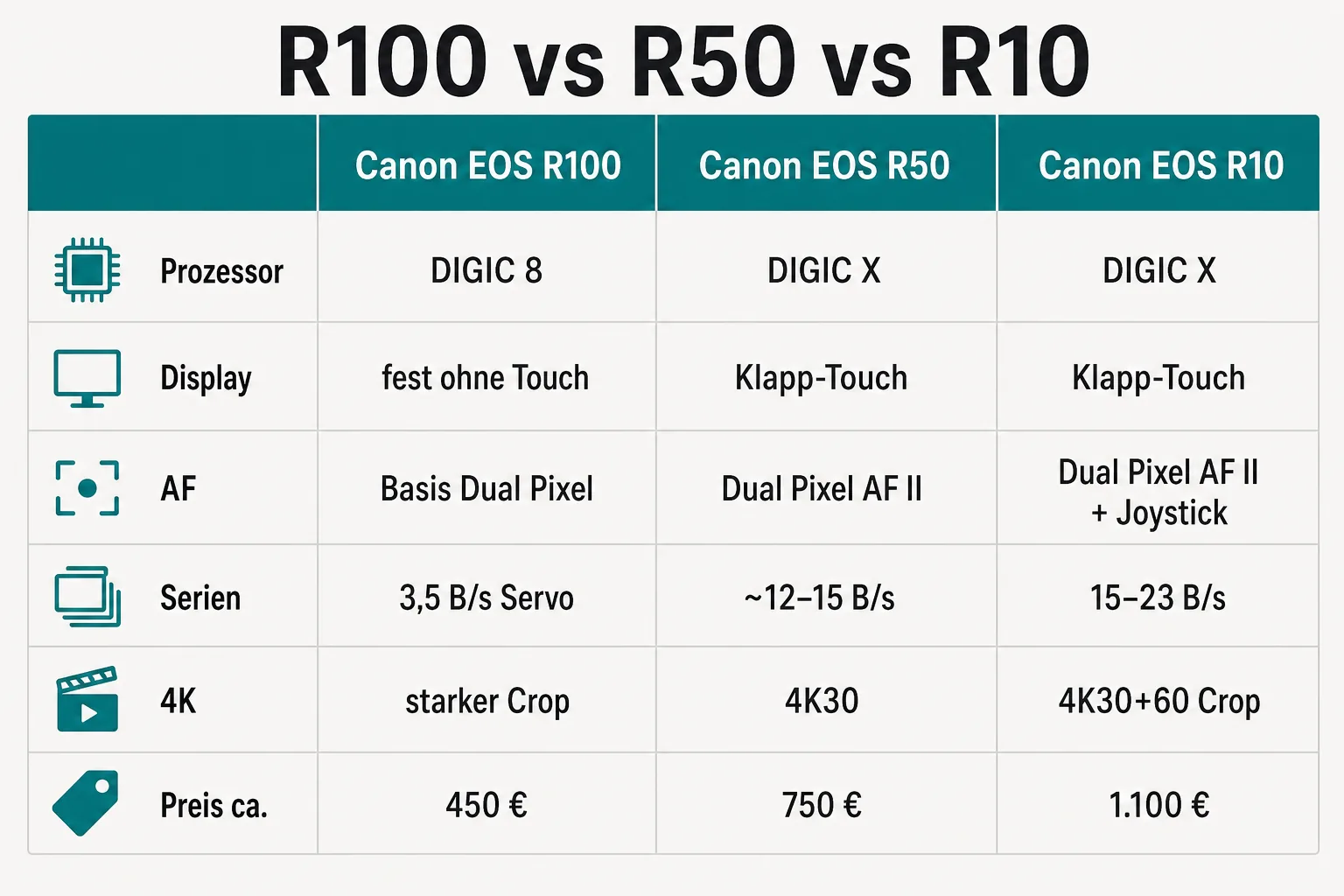
The matrix above settled the cases. Here’s the quick side glance — graphic to scan, table to look up: R100 cheapest entry, R50 upgrade, R10 for learning. No new recommendation logic, just the visual matchup.
R100 vs. R50 vs. R10 — as of August 2026
Criterion
EOS R100
EOS R50
EOS R10
Sensor
24.1 MP APS-C
24.2 MP APS-C
24.2 MP APS-C
Role 2026
Cheapest entry
Upgrade (touch/video)
Recommendation for learning
Processor
DIGIC 8
DIGIC X
DIGIC X
Display
fixed, no touch
Articulating touch
Articulating touch
Handling
stripped down
compact, no joystick
Joystick · dual dial
Video highlight
4K crop + contrast AF
4K30
4K30 OA · 4K60 crop
IBIS
No
No
No
Weight body approx.
~356 g
~375 g
~429 g
Price approx.
Kit $400–550
$600–800
Kit $1,100–1,250
As of August 2026 — check exact prices and availability at the shop
Versus the R50 the R100 only wins on price; it loses on touch, DIGIC X, AF speed and video. Versus the R10 the R100 wins massively on entry price; it clearly loses on learning handling. No option is objectively best — each fits a different use. Budget context: best camera under $1,000. Sensor: crop sensor vs. full frame.
09
Decision
The decision tree: which Canon fits you
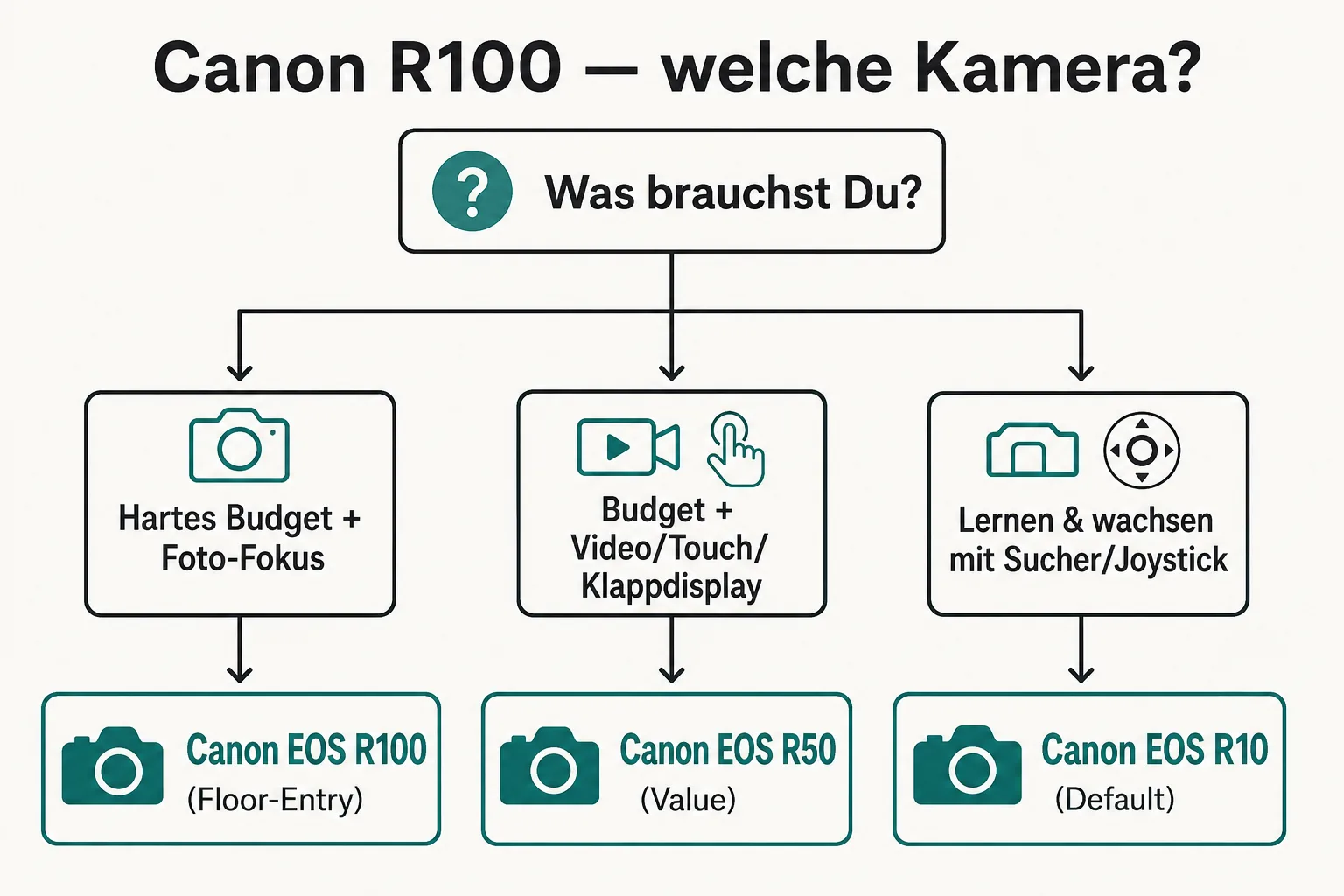
Specs enough — now the path. Walk the tree top to bottom. The first question (hard budget vs. touch/video vs. learning) decides more than any single number from the tables above.
Decision tree — from use case to the right camera, as of August 2026
Reading order on purpose: learning first (R10), then upgrade (R50), then budget entry (R100). That way nobody lands on “cheapest camera = best beginner camera.” Hard budget + photo → R100. A bit more + touch/video → R50. Learn & grow → R10 — consistent with camera for beginners.
10
Detail
Canon EOS R100 in detail: the cheapest entry with a viewfinder
After tables and tree, the balance: does what convinces about the R100 outweigh what annoys? Shortly before the verdict card — and why it stays a budget camera, not a learning camera.
The strengths day to day
Cheapest real entry into the RF / RF-S system with a viewfinder, light (~356 g), mic in, built-in flash, Creative Assist for switchers. Typically $400–550 kit: you get system and viewfinder without pro illusion. Exactly therefore budget entry — named honestly because of the cuts.
The compromises
Fixed display without touch, DIGIC 8, Dual Pixel only basic, servo ~3.5 fps, 4K with heavy crop and contrast AF, no IBIS, no joystick. Anyone who wants touch, video or learning with proper handling hits the limits fast.
On price the R100 isn’t a hidden R10 bargain — it’s the honest answer to “cheapest RF with a viewfinder.” In 2026 that means: right when the budget is hard. Not the camera for learning.
Budget
Canon
Canon EOS R100 (RF-S 18–45 kit)
Cheapest RF entry with a real viewfinder
24.1 MP APS-C, DIGIC 8, Dual Pixel AF (basic), EVF, fixed non-touch screen. 4K with heavy crop and contrast AF. Typically around $400–550 in the 18–45 kit — an RF door opener for a hard budget and photo focus, not the learning camera of choice.
Was überzeugt
+Cheapest real entry into the RF/RF-S system
+EVF included — rare at this price
+Light and compact, mic-in, built-in flash
+Creative Assist / SCN for phone switchers
Was Du wissen solltest
−Fixed screen without touch — feels dated in 2026
−DIGIC 8: no modern subject tracking like R50/R10
−Servo bursts only ~3.5 fps — weak for action/kids
−4K heavily cropped + contrast AF (no Dual Pixel in 4K)
Editor's Statement
“When the budget is hard and stills matter more than video/touch”
Many people see the Canon EOS R50 next to the R100 — fair: often around $600–800, articulating touch, DIGIC X, Dual Pixel AF II, same RF-S world. As a 2026 upgrade it fits when you want touch, video and modern tracking from the R100 — and the premium is bearable. Often the smarter dollar than “R100 and done.”
Right when APS-C and RF matter, you need selfie angle / video light and non-touch slows you down. Wrong when you consciously want to learn with a joystick and have the R10 budget — then the R50 is a good middle step, but not my learning recommendation. Straight talk: in my logic the R50 does not replace the R10 as the learning camera — it often replaces the R100 as “too stripped down.”
The R50 stays visible because the upgrade often improves everyday life more than specs on the R100 box. As a buy it sits under the upgrade condition — otherwise hard budget points to the R100, learning to the R10.
Value
Canon
Canon EOS R50 (18–45 kit)
Value — touch, flip screen and a more modern UX premium
24.2 MP APS-C, DIGIC X, Dual Pixel AF II, flip touchscreen. Typically around $600–800 in kit — the sensible premium over the R100 when video, selfie angles and modern handling matter. For learning I still recommend the R10.
Was überzeugt
+Flip touch and DIGIC X — clearly more modern than R100
+Better AF and faster bursts for everyday/family
+4K without the harsh R100 crop pain
+Compact and often the better “premium is worth it” answer
Was Du wissen solltest
−No joystick — handling behind the R10
−No 4K/60 per Canon specs
−UHS-I instead of UHS-II
−More expensive than R100 — budget has to allow it
Editor's Statement
“When you’ll pay the R100 premium for touch, flip screen and video”
Canon EOS R10: my recommendation for learning — never the R100
The Canon EOS R10 answers a related but different question: not “cheapest RF,” but “which Canon for learning and growing?”. With joystick, dual dial, Dual Pixel AF II, burst up to 15/23 fps, viewfinder and 4K30 oversampled plus 4K60 crop, typically $1,100–1,250 kit, it’s the camera I recommend beginners — consistent with camera for beginners and the Canon R10 review.
Reach for the R10 when you want to learn photography, need family/action and handling matters. Do not reach for the R100 just because it’s cheaper — and then expect R10 feeling. The R100 is budget entry; the R10 is the learning camera. Sensor and system stay APS-C RF — the use case is different. Framing: crop sensor vs. full frame.
Editor’s pick
Canon
Canon EOS R10 (RF-S 18–150 kit)
My learning pick — viewfinder, joystick and speed
24.2 MP APS-C, Dual Pixel CMOS AF II, bursts up to 15/23 fps, EVF, joystick and dual dial. 4K/30 oversampled plus 4K/60 with crop. Typically around $900–1,250 as a kit — the camera I have beginners learn and grow on, consistent with camera for beginners.
Was überzeugt
+Joystick + dual dial — a real learning and working camera
+Very strong AF and fast burst for the class
+EVF and grip: better entry than display-only feel
+RF system with adapter path to EF
Was Du wissen solltest
−No IBIS — lens IS helps, but not everywhere
−No headphone jack
−LP-E17 gets short with lots of EVF use
−Clearly more expensive than R100/R50
Editor's Statement
“When you want to learn photography and grow in the RF system”
The shopping list is short, but not optional. A few pieces decide between “system camera in the closet” and “camera you use weekly” — especially at the cheapest entry, where every extra hits the budget hard.
Spare battery LP-E17 (better two)
A second battery belongs in the kit — especially on trips and with lots of display review. Original is reliable; vetted third-party often works, with some risk on capacity and long-term stability.
Matching SD card (UHS-I often enough)
For the R100 a solid UHS-I SDXC covers practice. Capacity and speed class: best SD card for camera.
Keep the kit realistic
The RF-S 18–45 is light and cheap — tele is missing. Later portrait glass on purpose: which lens for portrait. Better one good second lens than pointless gadget.
Bags / strap
A slim shoulder or sling bag and a good strap protect and lower the barrier to taking the camera along — more important than the third accessory.
Optional: external mic
Mic in is there. For serious video it’s often more honest to look at the R50 or a vlog camera — the R100’s 4K crop remains the bigger limit.
14
Verdict
The clear buying call
Quick verdict: the R100 is 2026’s cheapest entry into the RF system with a viewfinder — typically $400–550 kit, light, honestly stripped down (no touch, DIGIC 8, ~3.5 fps servo, 4K crop). The R50 is often the smarter upgrade when touch and video matter. The R10 remains my recommendation for learning — never the R100. Cheaper does not mean better for learning.
Frequently asked questions about the Canon EOS R100
Should I buy the Canon EOS R100 in 2026?+
Only on a hard budget with a photo focus: the R100 is the cheapest RF entry with a viewfinder — but stripped down (no touch, DIGIC 8, weak servo burst, 4K with heavy crop). Anyone who can spend a bit more often does better with the R50; for learning I still recommend the R10.
R100 or R50 — which is worth it more?+
The upgrade to the R50 often pays off more than “R100 and done”: articulating touch, DIGIC X and better AF/video. The R100 stays right when the budget is hard and you mainly want photos.
Is the R100 better for learning than the R10?+
No. The R100 is the stripped-down budget camera; the R10 is the camera I recommend for learning (joystick, dual dial, Dual Pixel AF II). Cheaper does not mean better for learning.
Does the Canon EOS R100 have a viewfinder?+
Yes, an electronic OLED viewfinder (about 2.36 million dots). That’s one reason it still makes sense as an RF entry despite the cuts.
Does the R100 have a touchscreen?+
No. The 3-inch display is fixed and non-touch — for phone habits often the biggest dealbreaker versus the R50.
Can the R100 shoot good 4K?+
Only with limits: 4K 24/25p with heavy crop and contrast AF (no Dual Pixel in 4K). For video/vlog the R50 or a dedicated vlog camera is more honest.
Does the Canon EOS R100 have IBIS?+
No. Like R50 and R10: stabilization comes from the lens (IS), not the sensor.
How heavy is the Canon EOS R100?+
The body is about 356 g — very light for a system camera with a viewfinder.
Which battery does the R100 use?+
LP-E17 — same type as R50/R10. A spare battery pays off on trips.
Which SD card for the R100?+
A solid UHS-I SDXC covers practice. Details on class and capacity: best SD card for camera.
R100 or R10 — when which?+
R100 on a hard budget with a photo focus. R10 when you want to learn and grow — joystick, dual dial, Dual Pixel AF II. The R100 does not replace the R10 as a learning camera.
Is the R100 suitable for portraits?+
Yes, with a suitable lens. The body delivers sensor and basic AF; bokeh and look come mainly from the glass — see which lens for portrait.
R100 or rather a vlog camera?+
If you mainly want photos and RF entry: R100 or better R50 for video light. If you film in front of the lens: lean ZV-1 or vlog camera for YouTube — different use case.
Affiliate links marked with * — Amazon product links use partner ID martinkleinhe-20. I earn a small commission if you buy through these links; it costs you nothing extra. Assessments are based on my own practice, manufacturer specs and the consensus from reviews and user reports — no brand sponsored this article.
◆ Newsletter
Stay in the loop.
Camera and photography news, honest gear tests and new articles — in your inbox. Infrequent but relevant. No spam, unsubscribe anytime.